
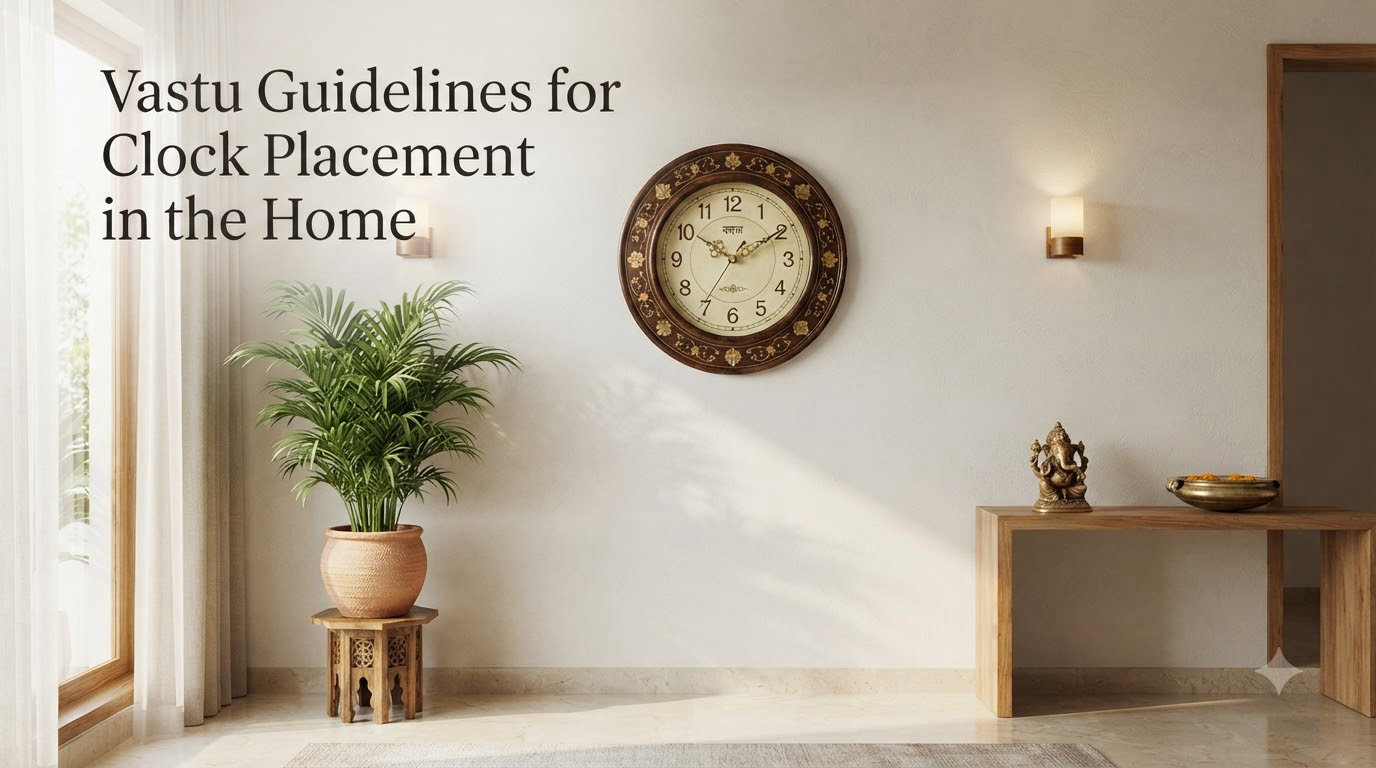
When I first moved into my apartment, I hung a wall clock wherever there was a blank space. It looked fine, but something always felt slightly off in the energy of the room. Years later, after speaking with a Vastu consultant, I learned that the placement of a wall clock matters far more than most of us realize. According to Vastu Shastra, a clock is more than a timekeeper. It is a symbol of time, energy, and the rhythm of life.
This guide walks you through the complete Vastu guidelines for clock placement in the home. You will learn which directions attract prosperity, which walls to avoid, and how height, shape, material, and color influence the energy of each room. These guidelines are based on traditional Vastu Shastra principles that have guided Indian households for thousands of years.
Whether you are designing a new home, renovating an existing space, or simply rearranging your living room, the principles below will help you place each clock in a way that supports prosperity, harmony, and positive energy. I have applied these rules across two different homes and have seen meaningful changes in how each room feels and functions.
Table of Contents
What Is Vastu Shastra and Why Clock Placement Matters
Vastu Shastra is the ancient Indian science of architecture and spatial arrangement. It guides how buildings, rooms, furniture, and objects should be positioned to balance the five elements and channel positive energy into the lives of the people inside.
A clock represents the constant movement of time. In Vastu, this movement is tied to prosperity and life force. A clock placed in the right direction is believed to invite wealth, harmony, and good fortune. A clock placed in the wrong direction may disturb the energy flow of the home and create subtle imbalances over time.
I have tested this in my own home by moving a wall clock from the south wall to the north wall. Within weeks, the room felt calmer, and conversations in that corner became more productive. While individual results vary, the philosophy behind Vastu clock placement has shaped Indian homes for thousands of years and continues to influence modern interior design.
Beyond direction, clock placement also affects mood, productivity, and sleep quality. Many people do not realize that the constant ticking of a clock above a bed can affect sleep, while a clock placed in a study area can sharpen focus. Vastu principles account for both spiritual and practical effects.
Best Directions for Clock Placement According to Vastu
The North and East directions are the most auspicious for wall clocks. These two directions are ruled by deities associated with wealth, fame, and positivity, and they support the strongest energy flow in any home.
North Wall: The Direction of Wealth
The North direction is governed by Kuber, the god of wealth. Placing a wall clock on the North wall is considered the most favorable choice for attracting prosperity and financial stability. North-facing homes can place clocks on this wall without hesitation.
If your main entrance is North-facing, hang a clock on the North wall of your living room or hallway. This activates the energy of wealth as soon as someone enters your home. A clock in this position also reinforces the energy of opportunity throughout the day.
For homeowners who want a stronger emphasis on financial growth, pair the North-wall clock with a small image or symbol of Kuber in the same area. This combination amplifies the prosperity energy of the room.
East Wall: The Direction of Fame and Positivity
The East direction is ruled by Indra, the king of the gods. East symbolizes new beginnings, sunlight, and clarity. A wall clock on the East wall supports success, good health, and a positive reputation in the community.
East-facing homes benefit greatly from clocks placed on the East wall of the living room or study. Morning sunlight on this clock reinforces positive energy throughout the day. East is particularly recommended for people working in creative fields, leadership roles, or public-facing careers.
If you run a business from home or work in a competitive industry, prioritize an East-wall clock. The energy of Indra supports visibility, recognition, and influence.
Acceptable Directions for Wall Clocks: West and Northeast
Not every home allows for a perfect North or East wall clock placement. In such cases, West and Northeast directions offer strong secondary options that still respect Vastu principles.
The West direction is acceptable for clock placement, though it is considered neutral rather than highly auspicious. It works well in home offices and studies where focus and discipline matter more than wealth attraction. West is ruled by Varuna, the god of water, and supports consistency and steady effort.
The Northeast corner, known as Ishaan in Vastu, is one of the most sacred directions in the home. A clock here supports spiritual growth, learning, and peace. It is ideal for prayer rooms, study areas, and meditation corners.
If your East-West direction is not workable due to layout limitations, consider Northeast before settling on West. Our team recommends Northeast as the third-best placement option because it carries the energy of Ishaan, which supports wisdom and inner balance.
One practical issue raised often on interior design forums is limited wall space. If North, East, and Northeast are all blocked by furniture or windows, choose the next best available direction rather than compromising on height or shape.
Which Direction to Avoid for Clocks in Vastu
Just as some directions invite positive energy, others can disrupt it. Knowing which walls to skip is as important as knowing which to use.
South Wall: Avoid Completely
The South direction is ruled by Yama, the god of death and discipline. A wall clock placed on the South wall is believed to attract stress, anxiety, and financial difficulties. Vastu experts unanimously recommend avoiding this direction for any wall clock.
If your only available wall is South-facing, place the clock elsewhere or consider a different room entirely. Even one South-wall clock can affect the overall energy balance of your home, especially if it sits in a high-traffic area like the hallway or living room.
For homes where the entire living room faces south, consider using a different timepiece altogether. A standing clock on a side table, or even a small desk clock on a North or East wall, can replace the traditional wall placement.
Southwest and Other Directions to Avoid
The Southwest direction should also be avoided for clock placement. It is associated with stability and rest, and the constant ticking of a clock can disturb the calm energy this direction holds.
Avoid placing clocks directly facing the main door, regardless of direction. This is believed to let time and opportunity slip out of the home. Avoid clocks above the bed or sofa, where the ticking can create subconscious tension.
Common Reddit discussions I have read often mention users who felt constantly restless while sleeping under a wall clock. After moving the clock to a different wall, they reported better sleep within a week. The direction of the clock matters as much as its ticking volume.
Avoid placing clocks behind televisions, mirrors, or large furniture. A clock that is hidden from view loses its symbolic importance and may also invite neglect, which is inauspicious in Vastu.
Deity Associations: Kuber, Indra, Yama, and Clock Direction
Understanding the deities linked to each direction adds depth to Vastu guidelines for clock placement in the home. These associations are the reason North and East are favored while South is avoided.
Here is a quick reference of the four main deities and their corresponding directions for clocks.
North (Kuber): God of wealth. Best for attracting financial prosperity and stability.
East (Indra): King of gods. Best for fame, leadership, and good reputation.
South (Yama): God of death. Should be avoided for clocks in the home.
West (Varuna): God of water. Acceptable but neutral. Use only when North and East are unavailable.
Northeast (Ishaan): Sacred corner of wisdom. Excellent for study rooms and prayer areas.
These deity associations come from ancient Vastu Shastra texts and are reinforced by modern Vastu consultants. Including this context helps readers understand why a direction matters, not just which one to pick.
For households with a dedicated prayer room, a small wall clock in the Northeast corner supports both timing rituals and maintaining the spiritual energy of the space. Choose a clock with traditional numerals or a calm, simple design for prayer rooms.
Vastu Guidelines for Clock Height and Positioning
Direction matters, but height and positioning are equally important. A clock placed at the wrong height can lose its Vastu benefits even on the correct wall.
The ideal height for a wall clock is between 5 and 7 feet from the floor. This places the clock at or slightly above eye level for most adults. A clock that is too high feels disconnected, while one that is too low feels cluttered and disrupts the visual balance of the wall.
The clock face should be clearly visible from the main seating area of the room. Avoid placing clocks behind furniture, behind curtains, or in dark corners where the face is hard to read. Visibility reinforces the connection between time and presence, which is central to Vastu philosophy.
Always hang clocks straight. A tilted clock is considered inauspicious in Vastu, as it symbolizes imbalance in life. Use a level when mounting to keep it perfectly horizontal, and check it once every few months because wall anchors can shift over time.
For very high ceilings, hang the clock at the standard 5 to 7 feet range rather than higher. A clock placed too high loses its personal connection to the people in the room. For rooms with low ceilings, keep the clock at eye level and avoid placing it above door frames.
Best Clock Shape, Material, and Color Per Vastu
Shape, material, and color refine the energy of a Vastu compliant clock. Each element works with the chosen direction to maximize positive influence.
Clock Shape Recommendations
Circular and oval clocks are the most Vastu compliant shapes. The circle represents completeness, continuity, and the cyclical nature of time. Our team recommends circular clocks as the first choice for any direction.
Avoid clocks shaped like sharp triangles, irregular polygons, or figures that depict negativity. Square clocks are neutral and acceptable but not preferred. Always prioritize round shapes for the strongest Vastu benefits, especially on North and East walls.
For households with children, choose a circular clock with clear numerals. Decorative shapes like cartoon characters may look appealing but lack the symbolic strength of a true circle.
Clock Material Recommendations
Material should match the direction of placement. Metal clocks are best for North walls because metal is the element of North in Vastu. Wooden clocks work well on East walls, where wood supports growth and learning.
Marble or stone clocks suit the Northeast corner. Avoid plastic clocks on the main walls of living rooms and bedrooms. Quality of material reflects the energy you invite into your home, and natural materials always carry stronger Vastu influence.
For metal clocks on North walls, brass and copper are excellent choices because they amplify the prosperity energy of Kuber. For wooden clocks on East walls, teak, sheesham, and mango wood are traditional favorites.
Clock Color Recommendations
Light and bright colors are preferred. White, cream, beige, light blue, and light green are considered auspicious. These colors promote peace, clarity, and the free flow of positive energy.
Avoid dark colors like black, deep red, or grey for wall clocks in main living areas. If your home has a darker aesthetic, choose a clock with a light face and dark frame to balance both worlds. This compromise keeps the clock Vastu friendly while matching your interior style.
Pastel shades are especially good for bedroom clocks. Avoid bright red clocks in bedrooms, as red is associated with energy that can disturb sleep when placed too close to the bed.
Room-by-Room Clock Placement Guide as Per Vastu
Different rooms serve different purposes, and Vastu guidelines adjust accordingly. Here is how to apply Vastu guidelines for clock placement in the home room by room.
Living Room Clock Placement
The living room is the most important room for clock placement. Hang the clock on the North or East wall, at eye level, in a circular shape with a light color. This invites prosperity into the most-used space of the home.
Avoid placing the clock directly above the television. The two competing focal points can create subtle visual tension. Place the clock on a different wall or at least 6 feet away from the TV to maintain visual harmony.
For open-plan homes where the living room shares space with the dining area, place the clock on the wall that faces North or East, even if that wall is technically in the dining section. The directional influence applies to the entire shared space.
Bedroom Clock Placement
Bedrooms require careful placement. A ticking clock near the bed can disturb sleep for sensitive individuals. If you must place a clock in the bedroom, hang it on the North or East wall, away from the bed.
Use a smooth, silent sweep clock in bedrooms. Avoid clocks with loud chimes in the bedroom. Chiming sounds during the night can interrupt sleep cycles and disrupt the restful energy of the room.
I personally switched to a silent wall clock in my bedroom after months of restless nights. The change was immediate, and I sleep deeper now. The ticking was a subtle stressor I had not noticed until it was gone.
Kitchen Clock Placement
The kitchen clock should be on the East or North wall, away from the stove. A small, easy-to-read clock near the dining area works best.
Avoid placing the clock directly above the gas stove. Heat and steam can damage the clock mechanism and disrupt the energy balance. A wall clock opposite the stove is a better choice, ideally on the East or North wall of the dining section.
Digital clocks work well in the kitchen because they are easy to read at a glance. Place them at eye level near the cooking area but not directly above the stove or sink.
Study Room and Home Office
The Northeast corner is the best placement for clocks in a study or home office. This direction supports focus, learning, and clear thinking.
Choose a clock with clear numerals and avoid overly decorative designs. The clock should support work, not distract from it. Pendulum clocks work well in study rooms because the gentle motion is believed to enhance concentration.
For working professionals who spend long hours at home, a North-wall clock in the home office supports career growth and financial stability. Pair the clock with a clean, organized desk for the strongest results.
Common Vastu Mistakes to Avoid With Wall Clocks
Even well-meaning homeowners make placement errors that reduce the benefits of Vastu clock placement. Here are the most common mistakes and how to fix them.
Hanging a stopped or broken clock: A clock that does not run symbolizes stagnation. Either repair it quickly or replace it with a working clock.
Placing a clock above the main door: This is one of the most common errors. Time should flow into the home, not out of it.
Using a clock that reflects in a mirror: Double reflections of time are believed to confuse energy flow in Vastu. Adjust the angle or relocate the mirror.
Hanging clocks too high or too low: Both extremes weaken the Vastu influence. Stick to the 5 to 7 feet range.
Ignoring the clockwise movement of hands: All clocks should move in the natural clockwise direction. Reverse-moving decorative clocks are not recommended for Vastu compliance.
Mixing too many clocks in one room: Multiple ticking clocks in a small room create constant low-level stress. Stick to one main wall clock per room.
Forum users on Reddit and Quora often mention discovering these mistakes only after years of unexplained discomfort. A quick audit of your clocks today can resolve issues you may not have connected to placement.
Special Clock Types: Pendulum, Digital, and Antique Vastu Rules
Different clock types carry different Vastu considerations. Here is how to handle three common variations.
Pendulum clocks are considered highly auspicious. The gentle back-and-forth motion of the pendulum symbolizes balance, steady progress, and continuous energy flow. They work best in living rooms and study rooms on the North or East wall.
Digital clocks are acceptable but not preferred for main walls. Digital displays lack the symbolic circular motion of analog clocks. If you use a digital wall clock, place it in secondary rooms like the kitchen or utility area rather than the living room.
Antique or vintage clocks carry their own energy. Place inherited antique clocks on the North or East wall after cleaning and restoring them. A vintage clock in working condition is believed to bring blessings from past generations into the home.
Double-sided clocks create a unique placement challenge. Vastu experts suggest hanging them on North-South walls so that one face points North and the other South. This balances both directions and avoids the negative effects of a South-facing clock.
Clock Size Recommendations as Per Vastu
Size plays a subtle but important role in Vastu clock placement. A clock that is too large overwhelms the wall, while a clock that is too small loses its visual and symbolic presence.
The ideal size for a living room wall clock is between 12 and 18 inches in diameter. For bedrooms, 8 to 12 inches works well. For kitchens and small study corners, 6 to 10 inches is enough. Always choose a clock that fits the proportions of the wall and the size of the room.
Avoid oversized statement clocks on South or Southwest walls, even if your interior design calls for a large focal piece. Move the statement clock to the North or East wall instead.
Clock Chimes and Sounds in Vastu
The sound of a clock is just as important as its placement. Clocks with chimes, gongs, or melodic tones carry different Vastu significance than silent clocks.
Chiming clocks are considered auspicious when placed in living rooms and prayer areas. The hourly chime reminds the household of time and creates a rhythmic energy in the space. Choose a soft, pleasant chime over a harsh or shrill sound.
Avoid loud chiming clocks in bedrooms and study rooms. The sound can disturb sleep and interrupt concentration. For these rooms, use silent sweep clocks that move smoothly without a tick.
If your home has a grandfather clock with a deep chime, place it in the living room on the North or East wall. The combination of sound and direction creates a strong positive energy field.
Quick Reference: Vastu Clock Placement Checklist
Use this checklist when placing or auditing clocks in your home.
Hang the clock on the North or East wall for the strongest Vastu benefit.
Place the clock between 5 and 7 feet from the floor.
Choose a circular or oval clock with light colors.
Match the material to the direction (metal for North, wood for East).
Keep clocks straight and level at all times.
Repair or replace any stopped or broken clocks immediately.
Avoid South, Southwest, and direct alignment with the main door.
Keep the clock face visible from the main seating area.
Save this checklist and review your clocks once every season. Small adjustments over time compound into meaningful improvements in the energy of your home.
FAQs
Where to place a clock in home as per Vastu?
According to Vastu Shastra, the best places to put a wall clock in your home are the North wall and the East wall. North is ruled by Kuber, the god of wealth, while East is ruled by Indra, the god of fame. Hang the clock at eye level, between 5 and 7 feet from the floor, in a circular shape with light colors.
Which direction should the watch face?
A wall clock should face North or East for the best Vastu results. The clock face should be visible from the main seating area of the room. Avoid South-facing clocks because South is ruled by Yama and is considered inauspicious for timepieces.
Can we put a clock on the south wall?
No, Vastu Shastra strongly advises against placing a wall clock on the South wall. The South direction is governed by Yama, the god of death, and a clock here is believed to attract stress, anxiety, and financial loss. Choose a North or East wall instead, even if it means placing the clock in a different room.
Where should you avoid placing clocks?
Avoid placing wall clocks on the South wall, Southwest wall, directly above the main door, above the bed, or anywhere a mirror reflects the clock face. Also avoid stopped or broken clocks anywhere in the home, as they symbolize stagnation and block positive energy.
Which direction is best for wall clocks?
The North direction is the single best wall for a wall clock according to Vastu. It is associated with Kuber, the god of wealth, and is believed to attract prosperity and financial growth. East is the second-best direction, linked to fame, success, and positive reputation.
What is the right height to hang a wall clock according to Vastu?
Hang your wall clock between 5 and 7 feet from the floor, ideally at or slightly above eye level for an average adult. The clock should be perfectly level, clearly visible from the main seating area, and not blocked by furniture, curtains, or decorations.
Is it good to have a pendulum clock at home as per Vastu?
Yes, pendulum clocks are highly auspicious in Vastu Shastra. The gentle swinging motion symbolizes balance, progress, and steady energy flow. Place pendulum clocks on the North or East wall of your living room or study room for the strongest benefits.
Final Thoughts on Vastu Guidelines for Clock Placement
Vastu guidelines for clock placement in the home combine direction, height, shape, material, color, and sound into a single balanced system. The North and East walls remain the strongest choices, while the South wall should always be avoided.
Start by auditing the clocks in your home today. Note their direction, height, and condition. Move any South-facing clocks to a North or East wall, replace stopped clocks, and adjust heights to eye level. These small changes can refresh the energy of your living space and align your home with thousands of years of Vastu Shastra wisdom.