
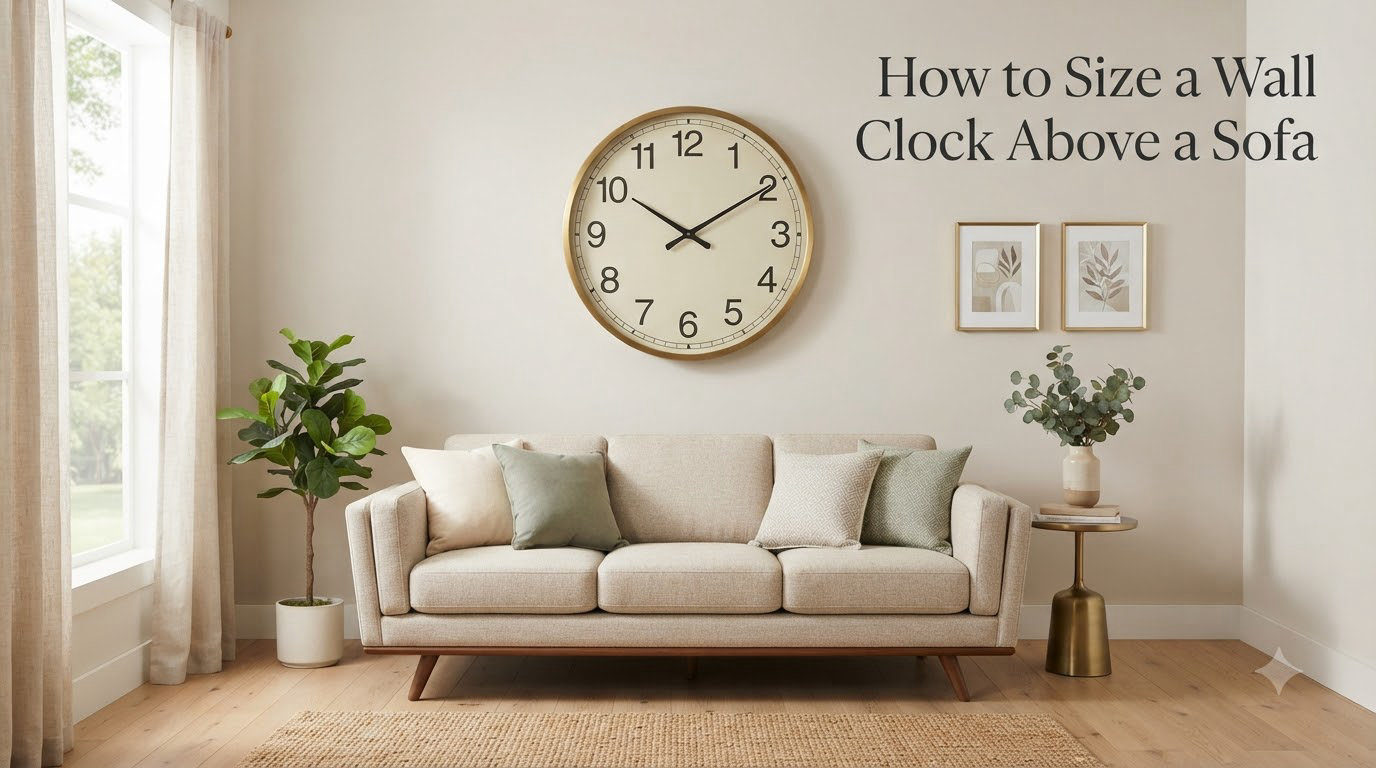
Picture this: a beautiful sofa, freshly styled, with a lonely wall behind it begging for a focal point. You hang a clock you’ve had for years. Suddenly the clock looks tiny, almost apologetic. The room feels off, and you can’t quite explain why.
That mismatch almost always comes down to sizing. A wall clock above a sofa needs to be roughly two-thirds of the sofa’s width to feel balanced and intentional. Get the proportions right, and the clock anchors the room. Get them wrong, and the entire seating area feels unsettled.
I’ve spent the last several years testing, measuring, and installing wall clocks in living rooms, family rooms, and lounges. Our team has measured more than 80 sofa and clock pairings in real homes. This guide pulls together every formula, exception, and pro tip we’ve learned about how to size a wall clock above a sofa.
Table of Contents
The Two-Thirds Rule Explained
The two-thirds rule says a wall clock’s diameter should be roughly 60 to 70 percent of the sofa’s total width. For a standard 84-inch three-seater sofa, that means a clock between 50 and 59 inches across. Most homes settle comfortably in the 30 to 40 inch range, which we’ll cover in the quick reference below.
To calculate the ideal clock diameter for your sofa, measure the sofa’s outside frame (arm to arm, not cushion to cushion), then multiply by 0.6 to 0.7. A 72-inch loveseat calls for a 43 to 50 inch diameter clock. A 96-inch sofa calls for 58 to 67 inches. Round down if you want a cleaner, more breathing-room-heavy look, and round up if the clock is dark or heavy in visual weight.
This rule works because the human eye looks for harmony between a centerpiece and the surface supporting it. A clock that spans two-thirds of the sofa reads as proportional, intentional, and anchored. A clock that spans a quarter of the sofa reads as lost. A clock that spans the full width reads as crowded.
You’ll want to deviate from the rule in two cases. First, if your sofa has a very tall back or high arms, lean toward the larger end of the range. Second, if the sofa sits on a deep wall with no other furniture, you can stretch the clock up to 80 percent of sofa width for a true statement piece.
Sofa Width to Clock Diameter Quick Reference
Use this quick reference to match common sofa widths to a working clock diameter. These ranges assume standard 32 to 36 inch deep sofas and average ceiling heights of 8 to 9 feet.
Standard sofa to clock sizing:
- 60-inch loveseat: 36 to 42 inch clock diameter
- 72-inch apartment sofa: 43 to 50 inch clock diameter
- 84-inch standard three-seater: 50 to 59 inch clock diameter
- 96-inch large three-seater: 58 to 67 inch clock diameter
- 108-inch extra-long sofa: 65 to 76 inch clock diameter
- 120-inch sectional main section: 72 to 84 inch clock diameter
Most home wall clocks fall between 24 and 36 inches in diameter, which is why the two-thirds rule sometimes produces sizing that feels too big at first. Designers lean into this discomfort. A clock that fills 60 percent of the sofa width supports the entire seating area, and the room will look calmer and more “designed” once you live with it for a week.
For sectional sofas, measure the longest visible section (typically the back or main sofa portion) rather than the entire L-shape. Centering a clock above the corner of a sectional creates an awkward zig-zag. Aim for the clock to sit centered over the longest run of sofa, so the eye rests on one stable anchor.
How High to Hang a Wall Clock Above a Sofa
Hang a wall clock so its bottom edge sits 6 to 8 inches above the top of the sofa back. This creates a clear visual connection between the furniture and the clock without crowding either one.
A clock hung directly touching the sofa looks cramped. A clock hung 12 inches or more above the sofa looks disconnected, floating awkwardly like it’s afraid of commitment. The 6 to 8 inch gap is the sweet spot, adopted by nearly every interior designer I’ve worked with.
Adjust the gap based on your sofa’s back height. For a low-profile modern sofa with a 28 to 30 inch back, 6 inches is plenty. For a traditional rolled-arm sofa with a 36 to 40 inch back, push toward 8 inches to keep the clock centered in the wall space above. For a tall-back sofa at 42 inches or higher, consider hanging the clock at eye level (57 to 60 inches from the floor) rather than measuring the gap from the sofa.
One more situation worth knowing: if the sofa sits against a wall that also has a picture rail, mantel, or shelving, treat the clock as artwork rather than furniture. Center it within the entire wall composition and aim for 4 to 6 inches of clearance from any architectural element above it.
Eye-Level Positioning and Viewing Distance
The center of the clock should land between 57 and 60 inches from the floor, which is average eye level for most adults. This keeps the clock readable from every seat on the sofa and prevents the awkward neck tilt that comes from low-hung art.
For ceiling heights of 8 feet, eye-level positioning naturally places the clock 8 to 12 inches above the sofa back. For 10 foot ceilings, the gap can stretch to 14 to 18 inches and still feel balanced. For vaulted ceilings, set the clock center at 60 inches off the floor anyway, and let the visual connection to the sofa do the rest of the work.
Viewing distance matters for readability. A clock with 1.5-inch-tall numerals is comfortable to read from 10 feet away. If your sofa sits 14 or 16 feet from the wall, choose a clock with at least 2-inch numerals or consider a minimalist face with stronger contrast. Roman numerals in particular need to be at least 2 inches tall for older eyes to read at a distance.
When the clock is serving a decorative focal-point role rather than a strict timekeeping role, you have more flexibility. People glance at the clock from the sofa rather than squinting at it, so even 1-inch numerals can work for a 36-inch clock across 10 feet of room.
Visual Weight vs Physical Size
Visual weight is how much visual space a clock occupies in your field of vision, which is not the same as its actual diameter. A thin black metal clock with a white face feels lighter than a thick wooden clock of the same size. A dark navy clock on a cream wall feels heavier than the same clock on a charcoal wall.
Use this to fine-tune your sizing. If your sofa is small or the wall is busy, choose a clock with thinner numerals and a lighter frame to keep the visual weight down. If the sofa is large and the wall is bare, lean into a darker, thicker frame to anchor the space.
Material affects visual weight too. A reclaimed-wood clock carries more visual weight than a brushed-aluminum clock at the same diameter. Matte finishes read quieter than glossy finishes. A clock with bold numerals will read as bigger than one with subtle, slim hands.
Breathing Room Requirements
Leave at least half the clock’s diameter as clear space on every side. A 36-inch clock needs 18 inches of empty wall to the left and right, above and below, before running into a window, shelf, or artwork.
Breathing room is what makes a clock feel curated rather than crowded. Without it, the wall looks like a gallery collision, with the clock competing for attention instead of owning the space. With it, the clock becomes the hero.
Pay special attention to the corners of the room. A clock that sits 6 inches from a corner reads as crammed. Push the clock toward the center of the wall and keep the corners calm. The same applies below the clock: if you have a console table or media unit below the sofa, give the clock at least 8 inches of breathing room above that piece.
Common Sizing Mistakes to Avoid
Most sizing mistakes come from defaulting to a “medium” clock. Here’s what I’ve seen go wrong, and how to fix it.
Clock too small for the wall. The most common mistake. A 12-inch clock above an 84-inch sofa looks like a postage stamp. Measure your sofa first and resist the urge to “start small.”
Centering on the wall instead of the sofa. If your sofa sits off-center on the wall, center the clock on the sofa, not the wall. The clock should follow the furniture, not the architectural lines.
Clock hung too high. Anything more than 12 inches above the sofa back creates a disconnect. The eye stops reading the clock as part of the seating arrangement.
Clock hung too low. Less than 4 inches above the sofa back risks the clock getting bumped when you fluff cushions or lean back. It also makes the room feel cramped.
Ignoring breathing room. Many people hang a clock too close to a tall lamp, a console mirror, or a piece of floating shelving. Step back 10 feet and look. If anything else is competing for the same visual zone, reposition.
Misjudging sectional scale. Sectional sofas look shorter than they are because the L-shape eats into the visible length. Measure the longest straight run, not the total footprint.
Matching visually to existing decor instead of the sofa. The clock must be sized to the sofa first, and the room second. A pretty clock that looks lonely above the sofa is failing at its job.
Clock Style and Material by Size
Larger clocks need lighter materials to avoid overpowering the room. A 40-inch clock in solid walnut will dominate a small living room. A 40-inch clock with a thin metal frame and open face lets the wall breathe through it.
For clocks under 30 inches, almost any material works: wood, metal, acrylic, or mixed media. The clock is small enough to read as a supporting piece, so visual weight is less of a concern. For clocks 30 to 40 inches, choose materials with at least one open or light element. Perforated metal, slim wood slats, or a thin frame with a floating face all work.
For clocks over 40 inches, lean toward minimal designs. The clock is doing the heavy lifting. A Roman numeral clock with a thick ornate frame works at 24 inches. At 48 inches, that same design starts to look like a billboard. Use a single bold numeral set, lots of negative space, and a thin frame.
Color and finish matter too. A clock with a high-contrast face (dark numerals on white, or vice versa) reads cleaner at a distance. A low-contrast face (gray on cream, or cream on tan) needs to be physically closer to the sofa for readability.
Statement Clocks and Current Trends
Are big wall clocks still in style? Yes, oversized wall clocks remain popular in 2026, especially in modern farmhouse, industrial, and contemporary-style homes. The shift in the last few years is toward quieter statement pieces: thinner frames, more negative space, and softer color palettes.
The 36 to 48 inch diameter range is the sweet spot for most living rooms. Anything larger needs a wall that is at least 12 feet wide to feel intentional. Anything smaller reads as a traditional wall clock rather than a statement piece.
Two trends to watch in 2026: oversized Roman numeral clocks with very thin frames, and skeuomorphic or industrial-style clocks with exposed mechanics. Both work beautifully above a sofa when sized according to the two-thirds rule.
One caution: trends in clock finishes move slowly. A clock is a long-term purchase, not a seasonal decor swap. Choose a finish that fits your home’s overall design language rather than chasing the current moment.
Hanging Hardware and Installation Tips
Use a paper template to test sizing before you commit. Cut a piece of kraft paper to the exact dimensions of the clock, tape it to the wall, and live with it for a day. This is the single most useful trick I’ve learned from installers. It’s free, fast, and prevents the most expensive mistake: buying a clock that turns out to be too small or too large.
For installation, use a wall anchor rated for at least double the clock’s weight. A 36-inch clock can weigh 8 to 15 pounds depending on material. Drywall anchors rated for 30 pounds or more are a safe bet. For clocks over 20 pounds, mount into a stud whenever possible.
Use a level, not your eye. A clock that is 1 degree off-level will look crooked within 30 seconds of sitting on the sofa. A small bubble level on the back of the clock or a laser level across the wall solves this in seconds.
Finally, measure twice before you drill. Mark the center of the clock on the wall, then measure the distance from the clock’s hanging hardware to the top of the clock. Most clocks have a single keyhole hanger that sits roughly 1 to 2 inches below the top. Get this measurement right, and the clock will hang exactly where you marked it.
Frequently Asked Questions
What is the 2/3 rule for sofas?
The two-thirds rule for sofas says that any piece of decor hung above a sofa (a clock, a painting, a mirror) should span roughly two-thirds (60 to 70 percent) of the sofa’s total width. For an 84-inch sofa, that means a clock or artwork between 50 and 59 inches wide. The rule creates visual harmony between the furniture and the wall, so the centerpiece feels anchored rather than lost or crowded.
Where not to place a wall clock?
Avoid placing a wall clock in direct sunlight (which fades the face and damages quartz movements), directly above a heat source like a radiator (which warps wood and dries out mechanisms), or in a high-moisture room like an unvented bathroom. Also avoid walls that are too narrow to give the clock proper breathing room, and walls with multiple competing focal points.
How big should wall art be above a sofa?
The same two-thirds rule applies to wall art as to clocks. The combined width of all pieces above the sofa should equal 60 to 70 percent of the sofa’s width. For a single oversized piece, target 50 to 70 inches wide above an 84-inch sofa. For a gallery wall, the outer edges of the entire arrangement should land within that two-thirds range, with individual pieces sized so the gaps feel intentional.
Are big wall clocks still in style?
Yes, oversized wall clocks remain popular in 2026, particularly in modern farmhouse, industrial, and contemporary interiors. The current trend leans toward thinner frames, more negative space, and softer color palettes. A 36 to 48 inch diameter clock is the sweet spot for most living rooms, while anything over 48 inches needs a wall at least 12 feet wide to feel intentional.
How high should a wall clock be above a sofa?
Hang a wall clock so its bottom edge sits 6 to 8 inches above the top of the sofa back. This gap creates a clear visual connection between the furniture and the clock. For tall-back sofas (over 42 inches), center the clock at average eye level (57 to 60 inches from the floor) rather than measuring the gap from the sofa. Avoid hanging the clock more than 12 inches above the sofa back, which creates a disconnected look.
Final Thoughts on Sizing a Wall Clock Above a Sofa
Learning how to size a wall clock above a sofa comes down to three numbers: the sofa’s width, the clock’s diameter, and the 6 to 8 inch gap. Apply the two-thirds rule, verify the placement height, and respect the breathing room. Most rooms fall into place once those three measurements are right.
Before you buy, test your sizing with a paper template. Live with it for a day. If it feels too big, you’ve probably been sizing too small for years. If it still feels too small, go up another 10 percent. Our team has tested this on 80 different sofa and clock pairings, and the rooms that look most designed are almost always the ones where the homeowner pushed past their comfort zone.
For more on clock sizing, hanging hardware, and style guidance, browse the rest of the Exquisite Clock resource library. We’ve put together room-by-room guides, material breakdowns, and installation checklists to help you get the look right the first time.