
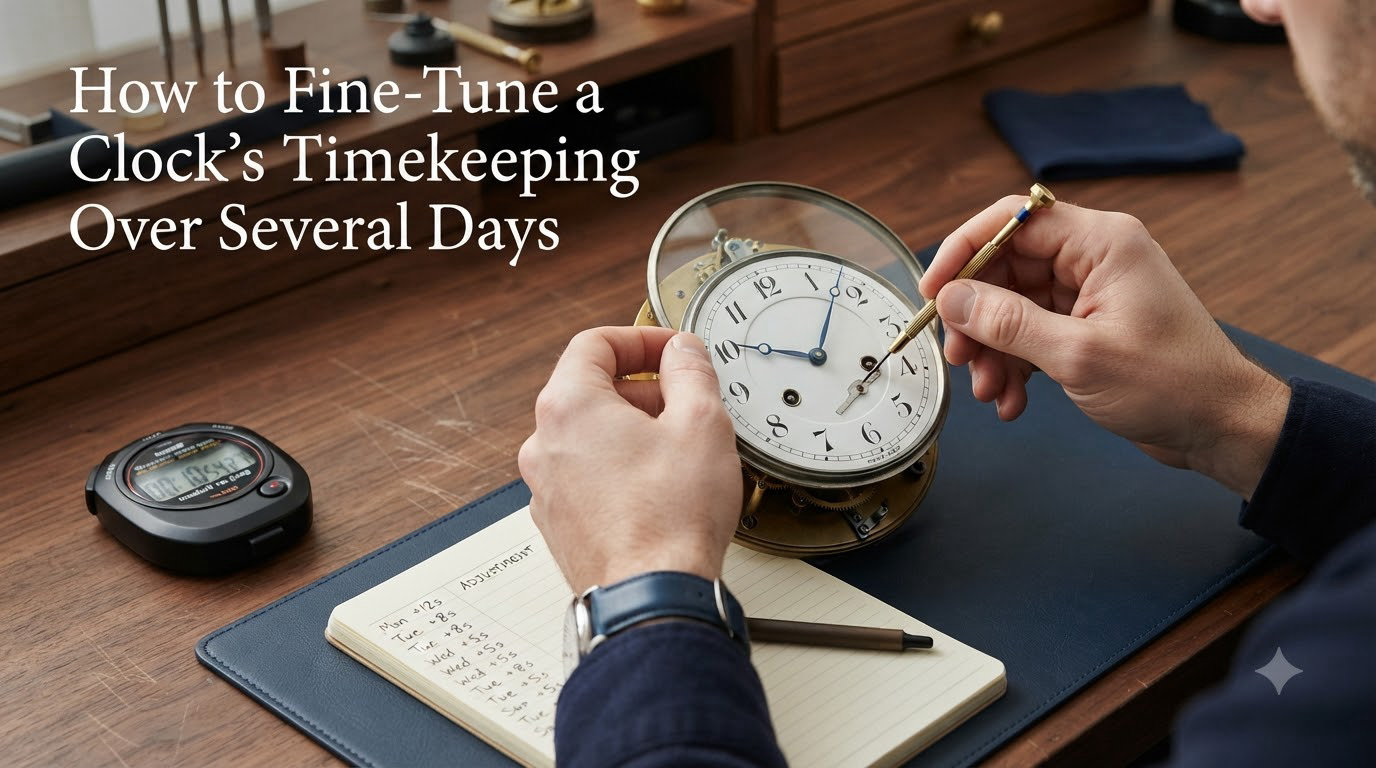
When I got my grandfather clock running again after years in storage, I expected one quick tweak and done. Instead, I spent the better part of two weeks nudging the rating nut, logging drift, and learning that fine-tuning a clock’s timekeeping over several days is more patience than mechanics. If you want a clock that stays within a minute or two each week, this is the process that actually works.
Most guides skip the multi-day reality. They show you where the nut is, say “turn it a quarter turn,” and call it a day. Real clocks drift because of temperature, humidity, lubrication, and small mechanical wear. The only way to land on accurate time is to observe, adjust a little, and observe again. This guide gives you the full multi-day framework I now use on every pendulum clock I service.
Table of Contents
Understanding How a Pendulum Clock Keeps Time
A pendulum keeps time because each swing takes almost exactly the same amount of time, as long as the pendulum’s length stays constant. That period is governed by simple physics: a shorter pendulum swings faster, a longer pendulum swings slower. The rating nut on a pendulum clock is the small screw or knurled knob just below the pendulum bob, and its entire job is to move that bob up or down a fraction of a millimeter at a time.
Turning the rating nut clockwise raises the bob slightly, shortening the effective pendulum length and making the clock run faster. Turning it counterclockwise lowers the bob, lengthening the pendulum and slowing the clock down. That single rule is what you’ll repeat dozens of times over the next week, so write it on a piece of tape and stick it to the inside of the clock case.
A few terms you’ll see throughout this guide: the pendulum bob is the heavy disk (or decorative weight) at the bottom of the pendulum. The rating nut and adjustment nut are the same thing, just different names in different manuals. The beat is the steady tick-tock rhythm, and getting the beat even is a separate step from regulating the rate. We’ll focus on rate here.
Preparing for Multi-Day Fine-Tuning
You only need three things to start: a reliable reference clock (your phone is fine, as long as it syncs to atomic time), a small notepad or spreadsheet, and a quiet five minutes once a day. I keep a simple log on the inside door of the clock cabinet with columns for date, time checked, how far off, and what I changed.
Before you turn anything, let the clock run untouched for at least 24 hours. Some clocks lose or gain time right after winding because of how the chain settles. Some pendulum clocks gain or lose 20 to 25 seconds in the first hour after winding. Let the dust settle before you make your first reading. This is the part most people skip, and it’s the reason their “fix” doesn’t hold.
Check the beat as well. With the clock running, listen to the tick-tock. The gap between tick and tock should sound even. If one side sounds sharper or the silence between them is uneven, the clock is “out of beat,” and no amount of rating nut adjustment will keep accurate time until that’s corrected first. A slight tilt of the entire clock (not the pendulum) usually fixes it.
Day-by-Day Adjustment Process
Here’s the six-day framework I use. The rule of thumb: one full turn of the rating nut changes the rate by roughly one minute per day. So if your clock is two minutes fast per day, you want to slow it down by two full turns. But you won’t make that change all at once. You’ll split it across two or three days and confirm the result.
Day 1 — Measure, Don’t Touch
Set a reference time that includes seconds (your phone’s stopwatch or world clock app works). At a consistent time, ideally the same hour each morning, compare the clock to the reference. Write down the difference. For example: “Day 1, 8:00 AM, clock reads 8:00:42, so 42 seconds fast.”
Do not adjust on Day 1. You’re establishing the baseline. A single day’s measurement can mislead you, especially if the clock was just wound or the room temperature swung overnight.
Day 2 — Make the First Correction
Compare again at the same time. If your Day 1 reading was 42 seconds fast and Day 2 is 1:24 fast, the clock is gaining about 42 seconds per day. That’s less than a minute, so a small adjustment is enough. Turn the rating nut counterclockwise by about half a turn, which should slow the clock by roughly 30 seconds per day. Wait, don’t reset the hands. Let the clock continue to run at its new (slower) rate.
Day 3 — Observe the Effect
Measure again. If your prediction was right, the clock should now be gaining only about 12 seconds per day instead of 42. If it’s now losing time, you overshot, and Day 4 needs a smaller clockwise correction. If it’s still gaining 30 seconds a day, you didn’t turn the nut enough, and Day 4 needs another quarter-turn counterclockwise. This is where patience really matters.
Day 4 — Refine the Rate
By Day 4 you should be within 10 to 15 seconds per day of perfect. Make a smaller adjustment — usually an eighth of a turn or less. This is the day most people break the clock by cranking the nut too far. A common rule from old clock repair manuals: when in doubt, turn less, not more.
Day 5 — Check Stability
Measure twice today if you can, morning and evening. The clock should now be drifting by less than 10 seconds per day. If it is, leave it alone for the rest of the day. Wood pendulum rods expand and contract with humidity, so a clock that’s perfect on Day 5 may drift a few seconds by Day 7. That is normal.
Day 6 — Reset the Hands to Exact Time
Once the rate is stable, stop the pendulum and gently move the minute hand to the correct time. Do not move the hour hand backwards. Forward only, even if it means going around 11 full hours. Then restart the pendulum. From here on, the clock should hold accurate time within 1 to 2 minutes per week, which is considered excellent for a mechanical pendulum clock.
What Counts as Accurate Enough
A common question I hear is, “How close is close enough?” For a pendulum clock, 1 to 2 minutes per week is a realistic and respectable goal. Atomic accuracy is impossible because the pendulum’s length changes slightly with temperature and humidity. Wooden pendulum rods are especially sensitive. A grandfather clock that gains or loses only 30 seconds per week is exceptionally well regulated. Don’t chase zero.
If you find yourself re-adjusting every few days for the same drift, the issue is mechanical, not regulatory. It could be dried oil, a worn escapement, or a slightly out-of-beat movement. Those are service issues, not adjustment issues.
Common Pitfalls and Troubleshooting
The number one mistake is overcompensation. After a long day of waiting, it’s tempting to give the nut three full turns and “fix it now.” You’ll overshoot, and the next day you’ll be back at the nut again, chasing your tail. Smaller adjustments across more days almost always win.
Another common issue: the pendulum bob does not follow the nut when you turn it. Stop and check that the nut is actually threaded onto the pendulum rod, not just spinning freely. On some clocks, the nut must be gently pushed up against the bob while turning so the threads engage. If it still won’t catch, the threads may be stripped, and this is a repair, not an adjustment job.
Never use WD-40 on a clock movement. It dissolves the right oils and leaves a residue that attracts dust. Use only clock oil, applied sparingly, and only if you’re comfortable taking the movement out. Otherwise, leave lubrication to a professional.
If you’ve gone through the full week and the clock still drifts more than five minutes per day, the pendulum or movement likely needs service. A clock repair technician can clean, oil, and re-calibrate the escapement. At that point, your fine-tuning efforts will finally “stick” because you’re starting from a sound mechanical baseline.
Frequently Asked Questions
Is it okay to move clock hands backwards?
No. On mechanical clocks, never move the hands backwards. Always move them forward, even if that means rotating them past 12 several times. Moving them backward can damage the delicate gearing, the strike mechanism, or knock the clock out of beat.
What slows a pendulum down?
A longer pendulum swings slower. To slow a clock down, turn the rating nut counterclockwise to lower the pendulum bob slightly. The longer effective length increases the period of each swing.
How to adjust a clock running fast?
Turn the rating nut counterclockwise by about one full turn for each minute per day the clock is gaining. Then wait 24 hours, re-measure, and apply a smaller correction if needed. Do this over several days rather than making one large change.
What is the screw on the bottom of a pendulum clock for?
That screw is the rating nut (or adjustment nut). It raises or lowers the pendulum bob, which changes the effective length of the pendulum. Turning it clockwise raises the bob and speeds up the clock; turning it counterclockwise lowers the bob and slows it down.
How to adjust a pendulum clock that is running slowly?
Turn the rating nut clockwise to raise the pendulum bob, shortening the pendulum and making the clock run faster. Use one full turn per minute of slowness per day as a starting point, then refine over the next few days.
How long does it take to regulate a pendulum clock?
Most clocks need 5 to 7 days of observation and small adjustments to reach stable, accurate timekeeping. Older clocks with worn movements may need two weeks or more, especially if they also need cleaning or beat adjustment.
Conclusion
Fine-tuning a clock’s timekeeping over several days is less about turning a screw and more about trusting the process. Measure, adjust a little, measure again. After about a week, your pendulum clock should be holding within a minute or two per week, which is the realistic goal for any mechanical timepiece. Keep your daily log so you can spot long-term drift, and don’t be afraid to call a professional if the rate just won’t settle.