
If you have ever wondered why some clocks have weights dangling on chains while others wind up with a key, you have already noticed the two great power systems of horology. The debate around mainspring vs weight-driven clocks goes back nearly six centuries, and the answer to which is better depends on what you actually want from a timepiece.
In this guide, I will walk you through how each mechanism works, where each one shines, and where each one struggles. Our team has spent the past year collecting, restoring, and timing both styles of clocks. The differences are more interesting than most people expect.
By the end, you will know exactly how a coiled spring pushes a pocket watch forward and how a falling brass weight keeps a grandfather clock ticking for a full week. You will also know which system deserves a place in your home.
Table of Contents
What Is a Mainspring and How Does It Power a Clock?
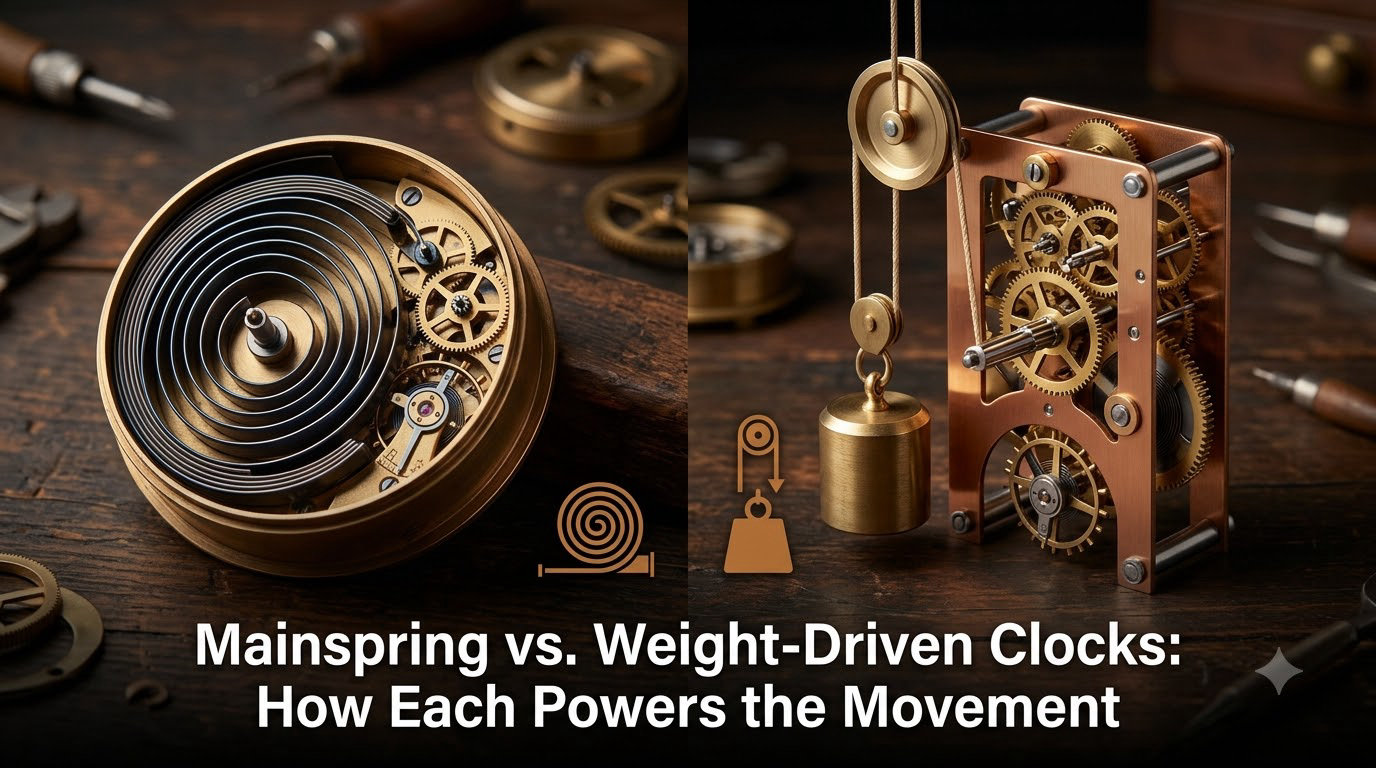
A mainspring is a coiled torsion spring that stores mechanical energy when you wind it, then releases that energy gradually to drive the gear train of a clock or watch. Think of it as a ribbon of hardened steel wrapped tightly around an arbor inside a metal drum called the mainspring barrel.
When you turn the winding key, the outer end of the spring hooks onto the barrel wall while the inner end stays fixed to the arbor. Each turn tightens the coil, building up stored torque. Once you stop winding, the spring wants to unwind.
As it unwinds, it rotates the barrel, which turns the first pinion in the gear train. From there, energy flows through the wheels and pinions, into the escapement, and finally into the pendulum or balance wheel that does the actual timekeeping.
The genius of this design is its compactness. A spring one millimeter thick and less than a meter long, coiled up, can power a watch small enough to wear on your wrist. That simply was not possible with a hanging weight before the 15th century.
Modern mainsprings are made from carefully tempered carbon steel alloys, often branded with names like SPRON or Nivarox. These materials resist metal fatigue and keep their elasticity through thousands of wind-unwind cycles.
One key concept to understand is the torque curve. A fully wound spring delivers its highest torque at the start of its run. As it unwinds, the force gradually decreases. That variable force is the single biggest difference between spring-driven and weight-driven clocks.
How Weight-Driven Clocks Use Gravity to Keep Time
Weight-driven clocks use gravitational pull from a heavy mass, usually cast iron or brass, to power the movement. The weight hangs from a cable, chain, or cord wrapped around a drum or pulley inside the clock case.
As gravity slowly pulls the weight downward, the drum turns and drives the gear train. The pendulum regulates how fast that energy is released. The escapement ticks back and forth, releasing one tooth of the escape wheel at a time.
The advantage here is profound: as long as the weight is falling, the force on the gear train stays essentially constant. Gravity does not weaken. A two-pound weight exerts the same pull at the top of its travel as at the bottom.
This is why weight-driven grandfather clocks can keep remarkable time over an entire week or even an eight-day cycle. There is no torque decay to compensate for.
The pendulum itself is the regulator, not the power source. Most people assume the pendulum drives the clock, but it only acts as a brake. The weights do the heavy lifting, literally.
You will find weight-driven systems in longcase clocks, anniversary clocks, some wall clocks, and large mantel pieces. Any clock that sits in one place and has room for hanging weights can use this technology.
What Does Each Weight Do on a Grandfather Clock?
Most three-weight grandfather clocks divide their power across three separate systems: timekeeping, striking, and chiming. Each weight runs an independent train of gears powered by its own drum.
The center weight is the timekeeping weight. It powers the gear train connected to the pendulum and the hands. If your clock has only one weight, it is almost always the center weight that runs the time.
The left weight powers the strike train. This mechanism rings the hour on a single bell or rod. At the top of the hour, the train releases a hammer that strikes once for one o’clock, twice for two o’clock, and so on up to twelve.
The right weight powers the chime train. This is the music. It plays melodies like Westminster, Whittington, or St. Michael on a sequence of rods or tubes. The chime weight is usually the heaviest of the three because the train does more work.
Two-weight grandfather clocks usually combine striking and chiming into one train, or they omit the chime entirely. Some modern cable-driven clocks use a single weight for time and a smaller secondary weight for the strike.
If a weight drops faster than usual, it usually means the train is running too freely, often due to a worn bushing. If it stops entirely, the weight has reached the bottom of its travel and the clock needs to be rewound before it can run again.
Constant Force vs Variable Force: The Core Difference
The single biggest mechanical difference between mainspring and weight-driven clocks is force consistency. Weight-driven clocks deliver essentially constant force. Mainspring clocks deliver variable force that starts high and decays as the spring unwinds.
This matters because the pendulum’s swing depends on the impulse it receives from the escapement. If the impulse changes during the run, the pendulum’s amplitude changes too, and amplitude affects timing. More swing equals slightly faster ticks in many designs.
Clockmakers have spent centuries inventing mechanisms to neutralize this problem. The three most famous are the fusee, the stackfreed, and the remontoire.
A fusee is a cone-shaped pulley that sits between the mainspring barrel and the gear train. A cord or chain wraps around the spring barrel and then unwinds upward along the cone. As the spring loses torque, the larger diameter of the cone compensates, keeping output force nearly constant.
A stackfreed is an auxiliary spring-loaded cam that presses against the mainspring barrel to apply extra force when the main spring is nearly unwound. It is a simpler but less elegant solution than the fusee.
A remontoire is a small auxiliary spring or weight that is repeatedly rewound by the main power source. The escapement is driven by the remontoire, not directly by the mainspring. This is the most accurate but also the most complex solution, used in fine observatory clocks.
The going barrel, by contrast, is the modern compromise. Most clocks today use the mainspring barrel directly, accepting a small force variation because modern pendulums and escapements tolerate it well.
Why Springs Replaced Weights in Portable Clocks
Before the mainspring was invented around the early 1400s, all mechanical clocks were weight-driven and had to stay in one place. The first known spring-driven clocks appeared in Italy, and the technology spread through Europe over the following decades.
The reason springs caught on was simple: portability. A clock that could be carried, worn, or moved with its power source intact unlocked entirely new categories of timepieces. The pocket watch, the carriage clock, the wristwatch, and the travel clock all became possible because of the mainspring.
Springs also made clocks smaller and cheaper to manufacture. A weight-driven tower clock requires a substantial case and a strong floor. A spring-driven mantel clock can sit on a shelf.
Peter Henlein of Nuremberg is often credited with making the first portable spring-driven watches around 1510. These were called drum watches because of the shape of their cases. They were not particularly accurate, but they were wearable.
The trade-off was loss of constant force. Pocket watches and wristwatches accept this trade because portability is worth more than perfect isochronism to most users. Modern watchmaking has largely compensated through improved materials and balance wheel design.
Today, weight-driven clocks remain popular for stationary longcase clocks where constant force and decorative hanging weights both add value. Spring-driven mechanisms dominate everywhere else.
Accuracy Comparison: Which Type Keeps Better Time?
In theory, weight-driven clocks are more accurate than spring-driven clocks because of constant force. In practice, the difference is small for most home and office use.
A well-made weight-driven grandfather clock typically gains or loses only a few seconds per week. A good spring-driven wall clock might lose a minute per week. The difference comes down to amplitude variation in the pendulum swing.
Spring-driven clocks tend to run faster when freshly wound and slower as the spring unwinds. This is most noticeable in clocks that run only one day on a single winding. Eight-day spring-driven clocks show much less variation because the torque curve flattens over a longer run.
For consumers, both technologies are easily accurate enough for daily life. The accuracy of a $200 quartz movement is far better than either, but mechanical clocks offer craftsmanship, character, and the joy of a physical mechanism that mechanical engineering enthusiasts find irreplaceable.
Premium spring-driven watches with tourbillons and remontoires can match or exceed the accuracy of weight-driven pendulum clocks. The question of which is more accurate really comes down to the specific design and quality of construction, not the power source alone.
Winding Requirements: Weight-Driven vs Key-Wound Clocks
Weight-driven clocks wind themselves as long as you pull up the weights once a week or once a month, depending on the design. You do not wind a weight-driven clock. You simply lift the weights back to the top of their travel.
Most grandfather clocks are eight-day designs, meaning they run for seven to eight days on a full wind. Some anniversary clocks and small mantel pieces are 31-day clocks, requiring winding only once per month.
Spring-driven clocks require turning a key to wind the spring. Wall clocks and mantel clocks usually have a single hole in the dial. Grandfather clocks with spring movements have a separate winding arbor, often accessed by opening the front door.
Chain-driven weight clocks use a double-loop chain that wraps around a sprocket in the movement. As the weight descends, it pulls the chain down. When you wind the clock, you pull the chain back up while a ratchet lets the click slip over the teeth.
Cable-driven clocks use a braided cable wrapped around a drum. The cable is more elegant but can fray over decades and usually needs replacement every 50 years or so. Chain-driven clocks are more durable and easier to service.
Self-winding or automatic clocks use a weighted rotor that winds the mainspring as you move. These exist mostly in wristwatches today, though automatic mantel clocks were popular in the mid-20th century.
The Overwinding Myth and How to Safely Release a Stuck Spring
You cannot actually overwind a clock spring. The spring is contained inside a barrel, and the barrel has walls strong enough to hold many times the tension a human can apply with a key. When people say they overwound a clock, they almost always mean the spring broke or the mainspring slipped its hook.
The real problem is usually a dirty, dry, or worn movement that cannot deliver power to the escapement. The spring has plenty of energy stored, but the gear train cannot transmit it. The user interprets this as overwound because the clock stops soon after winding.
To safely release a stuck mainspring, the safest approach is to remove the movement and let a watchmaker or clock repairer disassemble the barrel. Trying to release tension by turning the key backward can strip the winding square or damage the click mechanism.
If you must work on it yourself, here are the steps our team uses:
- Remove the clock from the wall or case to access the movement.
- Open the back plate to expose the mainspring barrel.
- Insert a soft brass wedge into the barrel to block rotation.
- Slowly allow the click to release one tooth at a time.
- Wear safety glasses and gloves, because a broken spring can release sharp fragments.
Warning: if the spring is already broken, fragments may have escaped into the movement. Disassemble fully and inspect every part. A broken mainspring usually requires replacement, not repair.
For weight-driven clocks, there is no equivalent danger. You cannot over-pull a weight. The worst you can do is forget to wind it and let it run down, which simply stops the clock.
Choosing the Right Mechanism for Your Home or Collection
Choose a weight-driven clock if you want the most accurate mechanical timekeeping available and you have the floor space for a tall case. A grandfather clock or grandmother clock with a quality movement will outlive most owners and become a family heirloom.
Choose a spring-driven clock if you want portability, smaller footprint, or lower cost. Wall clocks, mantel clocks, and cuckoo clocks are almost always spring-driven for these reasons.
Choose a weight-driven clock if you enjoy the visual ritual of seeing the weights descend each day. Many owners find the slow drop meditative and use it as a kind of mechanical meditation.
Choose a spring-driven clock if you travel or want to take the clock with you when you move. A spring-driven mantel clock is far easier to relocate than a 90-kilogram grandfather clock.
For collectors, the question is which movements you can service. Springs eventually need replacement, and so do cables and chains. If you are willing to send movements to a specialist every 25 to 50 years, both styles are reasonable long-term investments.
Whatever you choose, keep the clock out of direct sunlight, away from heating vents, and on a stable surface. Mechanical clocks are sensitive to temperature swings and vibration.
Frequently Asked Questions About Mainspring vs Weight-Driven Clocks
How do you release an overwound clock spring?
The safest method is to remove the movement and have a watchmaker disassemble the mainspring barrel to release tension safely. Trying to back-wind the key can strip the winding square or damage the click. Wear safety glasses and gloves because broken spring fragments can fly off at high speed.
Which clock movement is best?
Weight-driven pendulum clocks offer the best accuracy for stationary home use because gravitational force stays constant during the run. Spring-driven movements offer the best portability for travel, mantel, wall, and wearable timepieces. There is no single best choice for every situation.
Why did people use springs to power the clocks?
Springs replaced hanging weights in the early 15th century because springs made clocks portable. A coiled spring can power a pocket watch, while a weight must hang from a fixed point. Spring power also reduced the size and cost of clock cases, opening the market to ordinary households.
What does each weight do on a grandfather clock?
On a three-weight grandfather clock, the center weight powers the timekeeping gear train that drives the hands. The left weight powers the striking train that rings the hour. The right weight powers the chime train that plays melodies like Westminster on the rods or tubes.
Are weight-driven clocks more accurate than spring-driven?
Yes, weight-driven clocks are generally more accurate because gravitational force does not decay during the run. Spring-driven clocks lose torque as the spring unwinds, which slightly changes pendulum amplitude. The difference is usually only a few seconds per week in a well-made clock.
How long does a mainspring last?
A quality modern mainspring lasts 15 to 30 years in a regularly wound clock before metal fatigue becomes a concern. Antique mainsprings may need replacement sooner. Signs of a tired mainspring include shorter running times between windings and erratic timekeeping.
Final Thoughts on Mainspring vs Weight-Driven Clocks
The mainspring vs weight-driven clocks question is really a question about priorities. If accuracy, longevity, and visual presence matter most, a weight-driven longcase clock is hard to beat. If portability, smaller scale, and variety matter most, spring-driven clocks offer more flexibility.
Both mechanisms trace back to the same simple insight: a clock needs stored energy, a regulator, and a controlled release. Gravity and torsion springs are simply two different ways to solve the same problem.
Our team’s recommendation for 2026 is to choose the mechanism that fits your space and your habits. Either way, you will own a piece of engineering that has worked reliably for hundreds of years and will keep working long after we are gone.
Take good care of whichever style you choose, and it will mark time for generations.