
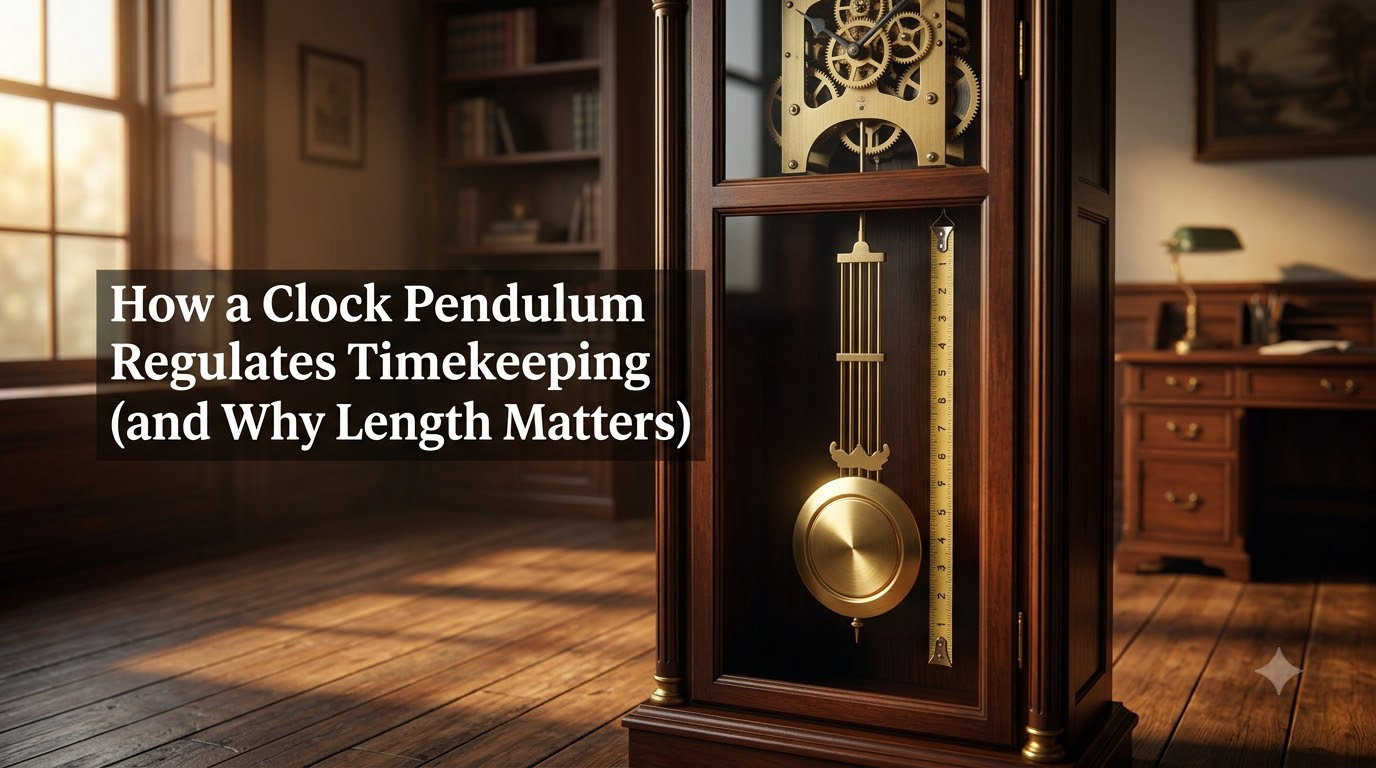
A pendulum regulates timekeeping by swinging at a fixed frequency determined almost entirely by its length. Longer pendulums swing more slowly, and shorter pendulums swing faster. This relationship, governed by the formula T = 2 times pi times the square root of length divided by gravity, means that a clock pendulum regulates timekeeping with remarkable consistency regardless of the bob’s weight.
I have spent years repairing and restoring mechanical clocks, and the pendulum remains one of the most elegant applications of physics in everyday objects. When you understand why length controls the swing rate, everything about clock adjustment suddenly makes sense. The tick of a grandfather clock, the steady rhythm of a Vienna regulator, the gentle motion of a mantel clock — all trace back to this single principle.
In this guide, I will walk you through exactly how a clock pendulum regulates timekeeping, the physics behind why length matters, and practical ways to adjust your own clock for better accuracy. We will cover the energy cycle that keeps the pendulum moving, the escapement mechanism that connects the pendulum to the gear train, and the environmental factors that can throw off even a well-made clock.
The story begins with Galileo Galilei, who around 1602 noticed that swinging chandeliers in the Pisa cathedral kept remarkably steady time. Christiaan Huygens turned that observation into the first practical pendulum clock in 1656, improving timekeeping accuracy from about 15 minutes per day to under 15 seconds per day. That single innovation changed navigation, astronomy, and science itself.
Table of Contents
What Is a Pendulum and How Does It Work?
A pendulum is a weight, called the bob, suspended from a fixed pivot point so it can swing freely back and forth. In a clock, the pendulum hangs from a thin suspension spring attached to a solid support bracket. The rod connecting the bob to the suspension can be made of wood, metal, or even a combination of materials designed to resist temperature changes.
Gravity is the force that makes the pendulum work. When you pull the bob to one side and release it, gravity pulls it back toward its lowest point — the resting position. But the momentum the bob gains carries it past center and up the other side. Gravity slows it, stops it briefly, and pulls it back again. This back-and-forth motion repeats with the same timing on every swing.
This motion involves a constant exchange of energy. At the top of each swing, the bob has maximum potential energy because gravity is pulling it downward. At the bottom of the swing, that potential energy has converted into maximum kinetic energy — the energy of motion. The bob rushes through the lowest point and climbs the other side, converting kinetic energy back into potential energy. The cycle repeats.
In a perfect frictionless world, the pendulum would swing forever. Real pendulums lose a tiny bit of energy on each swing to air resistance and friction at the pivot. That is where the clock’s power source — a wound mainspring or descending weight — comes in. Through the escapement mechanism, the clock gives the pendulum a small push on every swing to replace the lost energy and keep it going.
What makes the pendulum so valuable for timekeeping is its isochronism — the tendency to swing at the same rate regardless of the size of the swing. Whether the pendulum swings wide or barely moves, each complete oscillation takes the same amount of time. This property is what allows a pendulum to serve as a reliable timing reference.
How a Clock Pendulum Regulates Timekeeping
The clock pendulum regulates timekeeping by acting as the master timekeeper for the entire mechanism. Every other part of the clock — the hour hand, minute hand, strike train — derives its motion from the steady beat of the pendulum. The pendulum swings, and the clock counts those swings to advance the hands at the correct rate.
Here is how the process works in practice. The pendulum swings left and right, and at the center of each swing it passes a small lever called the crutch or fork. This fork connects to the anchor, a component shaped like a crescent moon with two small pallets at its tips. The anchor interacts with the escape wheel, a gear with specially shaped teeth.
As the pendulum swings one direction, one pallet of the anchor releases a tooth of the escape wheel. The escape wheel rotates forward by one tooth, and the other pallet catches the next tooth to stop the wheel. On the return swing, the process reverses. Each swing releases exactly one tooth, and each tooth represents a precise increment of rotation that gets transmitted through the gear train to the hands.
This is the famous tick-tock sound. Each tick or tock is the sound of a pallet catching an escape wheel tooth. Two sounds per full oscillation — one on each half-swing — give the clock its characteristic rhythm. A typical grandfather clock beats once per second, meaning the pendulum completes one full oscillation every two seconds (one second each direction).
The critical insight is that the escape wheel cannot advance faster or slower than the pendulum allows. The pendulum acts as a gatekeeper. No matter how much force the mainspring or driving weight delivers, the escape wheel can only move when the pendulum releases it. This is why the pendulum regulates the clock — it sets the pace that everything else must follow.
The escapement also serves a second function. Each time a tooth escapes, the shaped tooth gives the anchor pallet a tiny push. This impulse travels back through the crutch to the pendulum, replacing the small amount of energy lost to friction on that swing. This continuous energy replenishment is what keeps the pendulum moving indefinitely. The clock feeds energy in tiny, precisely timed doses rather than one continuous push, which would change the swing rate.
For this reason, a pendulum clock can run for days or weeks on a single winding. The energy consumption is minimal because only enough power is needed to overcome friction losses on each swing — not to drive the pendulum itself. The pendulum’s natural frequency does the heavy lifting.
The Physics: Why Length Determines Period
The period of a pendulum — the time it takes to complete one full back-and-forth oscillation — is determined by a deceptively simple formula: T = 2 times pi times the square root of the effective length divided by gravitational acceleration. In compact notation, T = 2 pi sqrt(L/g). This formula is the single most important concept for understanding how a clock pendulum regulates timekeeping.
Let me unpack what each part of that formula means. T is the period, measured in seconds. Pi is the mathematical constant approximately equal to 3.14159. L is the effective length of the pendulum, measured from the pivot point to the center of mass of the bob, in meters. G is the acceleration due to gravity, approximately 9.81 meters per second squared at the Earth’s surface.
Notice what is not in the formula: mass. The weight of the bob does not appear anywhere. This is why doubling or tripling the bob weight does not change the swing rate. Galileo himself recognized this, though he never built a working pendulum clock. The mass cancels out because a heavier bob feels more gravitational force but also has more inertia resisting that force — the two effects balance perfectly.
The square root relationship is the key to understanding the behavior. Because length sits inside the square root, doubling the length does not double the period. Instead, it increases the period by a factor of the square root of 2, which is about 1.414. A pendulum four times as long swings twice as slowly. A pendulum nine times as long swings three times as slowly.
Here is a worked example that brings this to life. For a pendulum to complete one full oscillation in exactly 2 seconds — which gives a one-second beat in each direction — it needs an effective length of about 99.4 centimeters, or roughly 39.1 inches. This is the length used in most full-size grandfather clocks. A shorter pendulum of about 24.8 centimeters (9.8 inches) completes one oscillation in 1 second, beating twice per second. You will find this shorter length in many wall clocks and smaller regulators.
The physical reason length controls the period comes down to how gravity and geometry interact. A longer pendulum bob has to travel a larger arc to reach the same angular displacement. More distance means more time to get there, even though gravity provides the same acceleration. The restoring force — the component of gravity pulling the bob back toward center — acts at a shallower angle on a longer pendulum, producing a weaker restoring effect per unit of displacement. Weaker restoring force means slower acceleration, which means a longer period.
Think of it like a playground swing. A long swing with chains set wide apart moves slowly and grandly. A short toddler swing whips back and forth quickly. The same principle applies. The pendulum’s effective length sets the speed of the swing through this geometric relationship, and nothing about the weight changes it.
This formula also explains why clocks behave differently at different locations. Gravity (g) varies slightly across the Earth’s surface due to latitude, altitude, and local geology. A clock adjusted to keep perfect time at sea level in London will run slightly fast if moved to a mountaintop, where gravity is marginally weaker. Horologists account for this by adjusting the pendulum length after relocating a precision clock.
Why Length Matters More Than Weight
This is one of the most common points of confusion I encounter. People assume that a heavier pendulum bob must make the clock run faster, or that adding weight would slow it down. Neither is true. Weight has almost no direct effect on the period of oscillation, as the formula T = 2 pi sqrt(L/g) makes clear — mass does not appear in it at all.
What weight does affect is stability and energy efficiency. A heavier bob carries more momentum, which helps it push through small irregularities in the escapement and air resistance variations. This makes the clock more consistent in practice, even though the theoretical period is unchanged. A heavier bob also resists disturbances from vibrations, drafts, and minor mechanical friction changes better than a light one.
The bob weight also influences how efficiently the clock transfers energy to the pendulum. A bob that is too light relative to the driving force may get pushed too hard on each impulse, causing the swing amplitude to increase to the point where isochronism breaks down. A bob that is too heavy may not receive enough impulse to maintain its swing, causing the clock to stop. Clockmakers balance these factors during design.
There is a subtlety worth noting. The effective length of a pendulum is measured to the center of mass, not to the bottom of the bob. A large, heavy bob with its mass concentrated low has a different effective length than a small bob at the same attachment point. When people change the bob on a clock and notice a timing change, it is usually because the new bob shifted the center of mass, not because the weight itself changed the period. The length — specifically the effective length to the center of mass — is always the controlling variable.
In my own repair work, I have replaced lightweight bobs with heavier ones dozens of times. The clock’s rate barely shifts, confirming the physics. But when I move the bob up or down the rod by even a fraction of an inch, the timing changes immediately. That is length at work.
The Escapement Mechanism: The Pendulum’s Partner
The pendulum cannot regulate a clock on its own. It needs the escapement mechanism — the bridge between the pendulum’s steady oscillation and the gear train that drives the hands. Without the escapement, the pendulum would swing briefly and stop, and the clock’s gears would spin freely with no timing control.
The escapement does two jobs simultaneously. First, it allows the gear train to advance only in small, pendulum-controlled increments. Second, it transfers a small amount of energy to the pendulum on each swing to keep it moving. These two functions are inseparably linked in the design.
The most common type in older clocks is the anchor escapement, invented by Robert Hooke and refined by William Clement in the late 1600s. The anchor is a curved arm with two pallets that alternately catch and release the escape wheel teeth. It earned its name because the shape resembles a ship’s anchor. Each release lets one tooth pass, producing the tick or tock sound and advancing the gear train by a precise amount.
A more advanced version is the deadbeat escapement, invented by George Graham in 1715. In a deadbeat escapement, the pallet faces are curved so that the escape wheel teeth slide along them with no recoil — no backward jump after each release. This eliminates a small source of error present in anchor escapements and significantly improves accuracy. You will find deadbeat escapements in high-quality Vienna regulators and precision observatory clocks.
The impulse that the escapement delivers to the pendulum is timed to occur near the center of the swing, when the pendulum is moving fastest. This is the optimal moment because adding energy at maximum velocity has the least effect on the period. Pushing at any other point in the arc would introduce timing errors. This careful timing is one reason well-designed escapements contribute so little disturbance to the pendulum’s natural frequency.
The escapement is where art meets engineering in clockmaking. A properly adjusted escapement delivers just enough impulse to keep the pendulum running, no more and no less. Too much impulse wastes power and can increase the swing amplitude beyond the isochronous range. Too little, and the clock stops. Getting this balance right is the heart of clock regulation.
Adjusting Your Clock: The Rating Nut
If your pendulum clock is running fast or slow, the rating nut is your primary tool for correction. The rating nut is a small threaded nut located at the bottom of the pendulum rod, just beneath the bob. Turning this nut raises or lowers the bob along the rod, changing the effective length and therefore the period.
Here is the basic rule: turning the rating nut to the right (clockwise) raises the bob, shortening the effective length and making the pendulum swing faster. The clock runs faster. Turning the nut to the left (counterclockwise) lowers the bob, lengthening the effective length and making the pendulum swing slower. The clock slows down.
I recommend a systematic approach to adjustment. Let the clock run for a full 24 hours and compare it against a reliable reference like a phone or atomic clock. Note how many seconds or minutes the clock gains or loses in that period. Then make a small adjustment — typically a quarter turn of the rating nut for a full-size grandfather clock, less for a smaller clock.
After each adjustment, wait at least 24 hours before checking again. The pendulum needs time to settle into its new rate. Making multiple adjustments too quickly makes it impossible to tell which change produced which result. Patience is essential. When I regulate a client’s clock, I often make adjustments over the course of a week, letting the clock run a full day between each change.
A useful guideline for grandfather clocks: one full turn of the rating nut typically changes the rate by about 30 seconds per day, though this varies by clock. For smaller clocks with shorter pendulums, the effect per turn is smaller. If your clock gains 2 minutes per day, start with about a quarter-turn counterclockwise and observe.
Some modern and high-end clocks use alternative regulation methods. A few feature a small adjustment screw accessible through the dial, so you can regulate the clock without stopping the pendulum. Others use a nut with a micrometer scale for precise adjustments. Regardless of the mechanism, the principle is always the same: change the effective length to change the rate.
Factors That Affect Pendulum Accuracy
Even with a perfectly adjusted rating nut, several factors can pull a pendulum clock off its intended rate. Understanding these variables helps you diagnose problems and appreciate the engineering that goes into precision timekeeping.
Temperature is the biggest enemy of pendulum accuracy. Metal pendulum rods expand when warm and contract when cold. A longer rod means a slower clock, so a warm room makes the clock run slow. For a steel rod about 1 meter long, a temperature increase of 10 degrees Fahrenheit changes the rate by roughly 2 seconds per day. Over a full year of seasonal temperature swings, the accumulated error can be significant.
Clockmakers developed clever solutions. John Harrison invented the gridiron pendulum in 1726, using alternating rods of steel and brass with different expansion rates. The differential expansion cancels out, keeping the effective length nearly constant across temperatures. Another approach uses a jar of mercury as the bob — mercury expands upward as it warms, raising the center of mass to compensate for the rod’s downward expansion. Modern precision clocks often use invar, a nickel-iron alloy with an exceptionally low expansion coefficient.
Air pressure and humidity also play minor roles. Dense air increases resistance slightly, and humidity changes can affect wooden pendulum rods. These effects are small compared to temperature but measurable in precision instruments.
Gravity variations matter too. As I mentioned earlier, gravity is slightly weaker at higher altitudes and near the equator. A clock perfectly regulated at sea level will lose about 16 seconds per day for every 10,000 feet of elevation gain. This is why observatory clocks were sometimes adjusted after installation to match their specific location.
Finally, mechanical condition affects accuracy. A worn pivot hole, a dirty escape wheel, or a weak mainspring can all introduce irregularities. Regular cleaning and oiling every 3 to 5 years keeps the mechanism running at its designed rate. I have seen clocks lose several minutes per day simply because the pivots were dry and creating excess friction.
FAQs
Why does length affect a pendulum?
Length affects a pendulum because the period of oscillation is proportional to the square root of the effective length. A longer pendulum must travel a larger arc to reach the same angle, and the restoring force from gravity acts at a shallower angle, producing weaker acceleration. The formula T = 2 pi sqrt(L/g) captures this relationship: change the length and the period changes predictably. Longer means slower; shorter means faster.
What is a pendulum and how did it improve timekeeping in clocks?
A pendulum is a weight suspended from a fixed point that swings back and forth under gravity. Christiaan Huygens built the first practical pendulum clock in 1656 based on Galileo’s earlier observations. The pendulum improved timekeeping accuracy from about 15 minutes per day to under 15 seconds per day because its swing rate depends almost entirely on length, making it far more consistent than earlier verge-and-foliot mechanisms.
Does the length of a clock pendulum affect its period?
Yes, the length of a clock pendulum directly determines its period. The relationship is T = 2 pi sqrt(L/g), where T is the period, L is the effective length, and g is gravitational acceleration. A pendulum that is four times longer swings twice as slowly. This is why adjusting the rating nut to change the bob position directly speeds up or slows down the clock.
Why is a pendulum used to measure time?
A pendulum is used to measure time because it is a natural harmonic oscillator with a highly consistent period. Its swing rate depends almost entirely on its length, not on the weight of the bob or the size of the swing. Combined with an escapement mechanism that counts each oscillation and transfers energy to keep it moving, the pendulum provides a reliable, adjustable timing reference for mechanical clocks.
How much should I turn the rating nut to adjust my clock?
For a full-size grandfather clock, one full turn of the rating nut typically changes the rate by about 30 seconds per day. Turn clockwise to raise the bob and speed up the clock, or counterclockwise to lower the bob and slow it down. Make small adjustments of a quarter turn at a time, then wait 24 hours to observe the effect before adjusting again.
Does temperature really affect a pendulum clock?
Yes, temperature noticeably affects pendulum clocks. A steel pendulum rod about 1 meter long changes the clock’s rate by roughly 2 seconds per day for every 10 degrees Fahrenheit of temperature change. Warm temperatures expand the rod, making it longer and slowing the clock. High-quality clocks use compensating designs like gridiron pendulums or invar rods to minimize this effect.
Putting It All Together: The Pendulum’s Elegant Simplicity
Understanding how a clock pendulum regulates timekeeping comes down to one central idea: the period of a pendulum depends on its effective length and the local gravitational acceleration, and almost nothing else. The formula T = 2 pi sqrt(L/g) distills centuries of observation and engineering into a single relationship that anyone can use.
This is why length matters more than weight. It is why a tiny turn of the rating nut can correct a clock that runs minutes off per day. It is why precision clockmakers go to extraordinary lengths to compensate for temperature and gravity variations. And it is why the pendulum clock, invented in 1656, remained the most accurate timekeeping technology available for nearly 300 years until the invention of the quartz crystal oscillator.
The pendulum demonstrates how a simple physical principle — a weight swinging under gravity — can produce extraordinary precision when combined with clever engineering. The escapement counts the swings and replenishes the energy. The gear train translates those counted swings into the movement of hands across a dial. The suspension spring provides a nearly frictionless pivot. Every component serves the pendulum’s natural rhythm.
If you own a pendulum clock, I encourage you to listen to its beat with fresh appreciation. Each tick represents a measured release of energy, governed by the same physics that Galileo observed in a swinging chandelier. Try adjusting the rating nut using the steps above, and you will experience directly how length controls time. The relationship is real, predictable, and remarkably satisfying to work with.
For those who want to go deeper, explore the history of precision horology, the design differences between anchor and deadbeat escapements, or the story of how pendulum clocks made accurate sea navigation possible. The world of mechanical timekeeping has depths worth exploring, and it all starts with understanding why a pendulum’s length is the key to everything.