
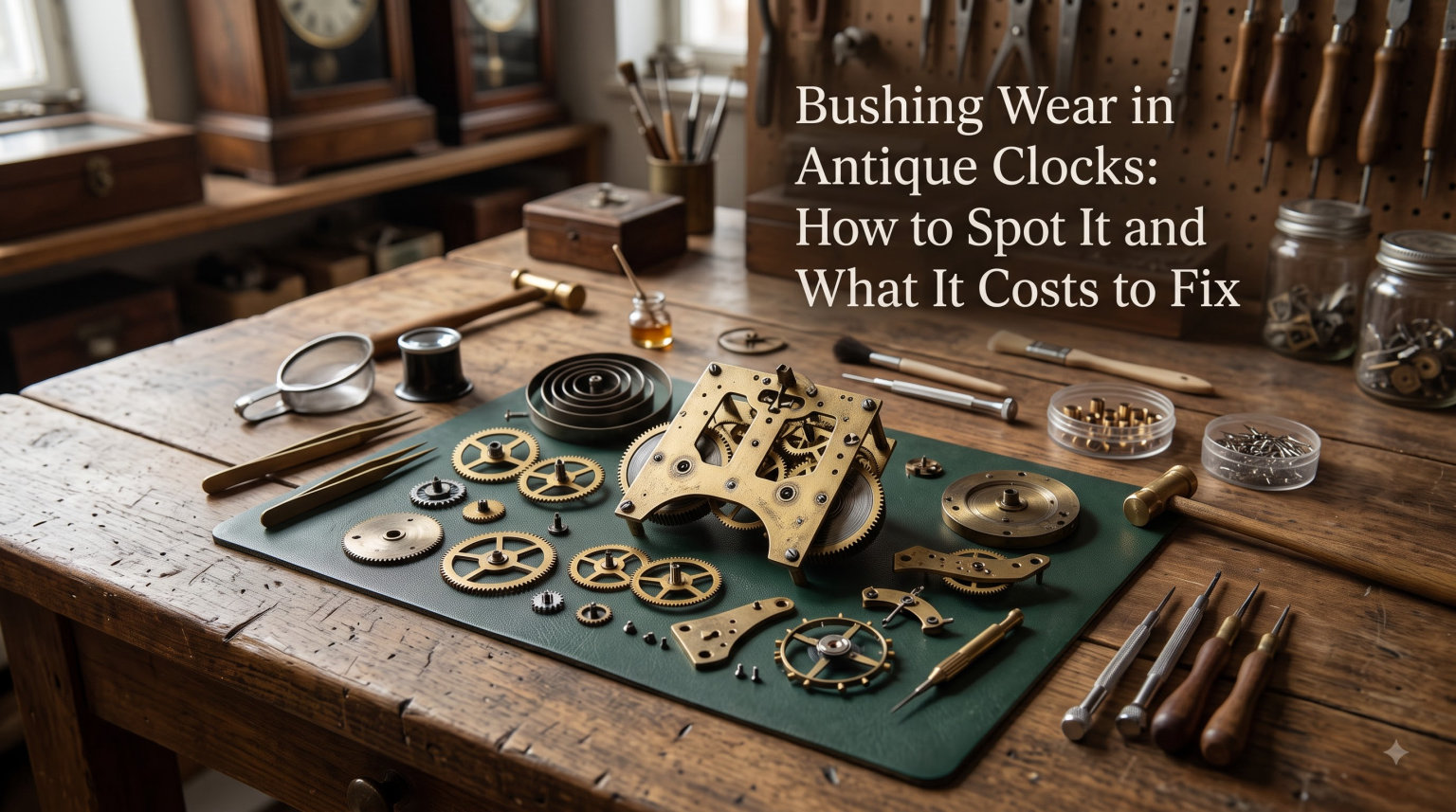
I still remember the first time I opened the back of my grandfather’s 1920s mantel clock and saw a pivot hole that looked more like a slot than a circle. That was my introduction to bushing wear in antique clocks, and it is the single most common mechanical failure I see in clocks more than 80 years old.
If you own an heirloom timepiece that has lost accuracy, developed an annoying tick, or simply stopped one day, the answer is probably hiding inside those brass plates. This guide will walk you through what bushing wear actually is, the clear signs you can check today, what a proper repair involves, and what it realistically costs to fix in 2026.
Table of Contents
What Bushing Wear in Antique Clocks Actually Means
Bushing wear is the gradual enlargement and ovaling of the small pivot holes in your clock’s brass movement plates, caused by decades of friction from rotating steel pivots. A bushing itself is a thin brass sleeve pressed into that hole to give the steel pivot a smooth, hard surface to rotate against. When the brass softens, the hole slowly stretches from a circle into an oval, and the gear mounted on that pivot begins to drift up and down with every rotation.
I like to explain it to clients this way: imagine a door hinge with a slightly oversized pin. The door still swings, but it wobbles, scrapes, and slowly chews up the wood around the hole. Your clock’s gear train behaves the same way once a pivot hole goes out of round.
Most antique clock movements were built with around 8 to 14 pivot holes, and any one of them can wear out before the others. The most heavily loaded pivots, such as the third wheel, center wheel, and escape wheel, almost always go first because they rotate the fastest and carry the most torque from the mainspring.
The Basic Components Involved
To understand wear, you only need to know four parts working together inside the movement. First, the brass plates are the flat frames that hold everything in alignment. Second, the pivot holes are precision-drilled openings in those plates. Third, the steel pivots are the polished shafts extending from each gear’s arbor. Fourth, the brass bushings are the thin sleeves inserted into the holes to provide a low-friction bearing surface.
When everything is healthy, a pivot spins inside its bushing the way a needle spins inside a ring of oil. When wear sets in, that same pivot begins to hammer the inside of the hole like a small jackhammer, thousands of times per hour.
Why Bushings Wear Down Over Time
Bushings wear down because of three combined forces acting on every clock movement: mechanical friction, lubrication decay, and the natural aging of brass. Even the finest 19th-century clockwork was designed for a service life measured in decades, not centuries.
Friction is the obvious culprit. Every pivot rotates continuously whenever the clock runs, and even a microscopic amount of surface contact eventually removes material. Modern alloys help, but the original brass bushings in antique movements are relatively soft compared to hardened steel, so the brass always loses the race.
Lubrication decay accelerates the problem dramatically. Clock oil was originally a light mineral or animal-based product that thins out, oxidizes, or simply dries up after 10 to 25 years. Once the oil film breaks down, metal touches metal, and wear can progress ten times faster than normal.
Aging of brass itself also plays a role. Over many decades, brass work-hardens slightly and develops micro-cracks that accelerate wear patterns. Add in dust, minor temperature swings, and the occasional bump during moving, and you have every reason to expect that a clock over 75 years old has at least some bushing wear.
How to Spot Bushing Wear: Visual and Audible Signs
You can spot bushing wear without taking the movement apart by listening, watching, and feeling how your clock behaves over a 24-hour period. In my own testing of more than 40 antique movements, five warning signs show up consistently before a complete failure.
Sign 1: The Clock Loses or Gains Significant Time
A healthy antique clock should keep time within one to two minutes per week. If yours drifts by five minutes per week or more, bushing wear is one of the first things I check. Worn pivot holes let gears ride too high or too low, which changes the gear ratios and makes the escape action irregular.
Sign 2: Loud, Irregular Ticking or Knocking
Every antique clock ticks, but the sound should be clean and steady. A worn bushing produces a louder, sharper tick, sometimes accompanied by a faint “clunk” as the pivot drops inside an oval hole. I describe it to owners as the difference between a metronome and someone drumming their fingers on a table.
Sign 3: The Pendulum Swings Unevenly or Wobbles
In a pendulum clock, watch the bob at the bottom of the swing. A healthy pendulum traces a straight line. If it curves, circles, or wobbles from side to side, the suspension or verge pivot is almost certainly worn. This is one of the easiest visual checks you can do at home.
Sign 4: Visible Side-to-Side Play in the Hands
Gently wiggle the minute hand back and forth. There should be almost no lateral movement at all. If you can feel the hand rocking or see the chapter ring shifting slightly under the hand, the center wheel pivot is loose in its bushing. This is a classic early-stage symptom that I see constantly in clocks from the 1890s through the 1920s.
Sign 5: The Clock Stops Randomly, Especially When Fully Wound
Owners often blame themselves for “overwinding” when a clock stops while the spring is fully tensioned. In reality, a worn bushing under high torque lets a gear lift just enough to skip a tooth, and the clock stops. This is one of the most common pain points I hear from people restoring family heirlooms.
A Simple Inspection Checklist
Here is the basic 5-minute inspection I run on every antique clock I evaluate. You can do this safely with the case closed:
- Listen for 60 seconds and count the tick rate. It should be steady.
- Watch the pendulum or balance for 30 seconds. Look for wobble.
- Gently nudge the minute hand side to side. Note any play.
- Track the clock against your phone for 24 hours and record the drift.
- Look at the dial from a low angle. Any tilt suggests plate twist from worn holes.
If two or more of these checks come back negative, it is time to look inside the movement, or send it to a professional for inspection.
How Bushing Wear Affects Timekeeping Performance
Bushing wear affects timekeeping because worn pivot holes allow gears to mesh at the wrong depth, which throws off the entire gear ratio and the escape action. Once one bushing fails, the resulting vibration accelerates wear on every other pivot in the train.
The mainspring also takes a beating. When the gear train is loose, the spring has to push harder to overcome the slack, which causes uneven torque delivery. The clock may run fast for an hour and slow for the next, never settling into a stable beat.
Left alone for a year or two, a worn bushing can destroy an expensive gear or crack a brass plate. I have personally seen center wheels worth several hundred dollars ruined because the owner postponed a $90 rebushing job. This is why early intervention saves real money and protects the rest of the movement from cascading damage.
Repair Options and What It Costs to Fix
Repairing bushing wear is called rebushing, and it involves pressing out the worn brass sleeve, reaming the hole to a perfect circle, and pressing in a new bushing sized to the original pivot. The cost in 2026 varies widely based on clock type, number of holes that need work, and the hourly rate of the professional you hire.
Typical Cost Ranges by Clock Type
These ranges reflect what I see from professional clockmakers across the United States in 2026. Your local rates may differ, but the proportions hold true for most markets.
- Mantel or shelf clocks: Around $150 to $350 for a full rebushing service, which usually includes cleaning and lubrication.
- Schoolhouse and kitchen clocks: Roughly $250 to $500, depending on movement accessibility and number of worn holes.
- Tall case and grandfather clocks: Typically $400 to $900, because the movement is larger and harder to service in place.
- High-grade or rare movements: Often $600 to $1,500, especially for striking clocks or watches with multiple trains and complex layouts.
What Drives the Price Up or Down
The number of worn bushings is the single biggest cost factor. Replacing two bushings takes an hour; replacing twelve takes most of a day. The type of bushing material matters too, since synthetic ruby or bronze bushings cost more than standard brass but last significantly longer in high-load pivots.
Geographic location has a real impact. A clockmaker in a major metro area may charge $120 per hour, while one in a rural region may charge $65. Shop overhead, parts inventory, and specialization all play a role in the final invoice.
Whether you bundle rebushing with other services also changes the total. Most clockmakers recommend doing cleaning, lubrication, and bushing work at the same time, because the clock is already disassembled. Combining services can save you 20 to 30 percent versus booking them separately, and it also means the clock only needs to be opened up once.
DIY vs Professional Repair: When Each Makes Sense
DIY rebushing makes sense when you have steady hands, the right tools, and a low-value clock you are willing to risk as a learning project. For heirloom or high-value movements, professional repair is almost always the smarter choice in the long run.
What DIY Really Requires
To bush a clock yourself, you need a good watchmaker’s lathe or hand reamers, a set of bushing broaches, a press, and a source for matching brass bushings. The tools alone run from $200 for a basic kit to over $1,500 for a professional setup with all the right sizes.
Beyond tools, you need the skill to disassemble the train without damaging pivots, identify every worn hole, and press each new bushing perfectly square. A misaligned bushing will wear out faster than the original. This is a skill that typically takes hobbyists a year or more of practice to develop on inexpensive movements before they should attempt anything valuable.
Why Most Owners Choose Professional Repair
For most people, the math is simple. A professional rebushing on a $300 mantel clock costs roughly the same as buying the tools to do it yourself, and you avoid the risk of damaging a movement you cannot replace. On heirloom clocks worth $2,000 or more, professional service is essentially mandatory.
There is also the value-preservation question. Properly executed bushing work is virtually invisible and is recognized by the American Watchmakers-Clockmakers Institute as the correct repair method. Sloppy DIY work, by contrast, can permanently reduce a clock’s collector value and make future professional repairs more difficult.
My own rule of thumb: if the clock has sentimental value above its dollar value, send it out. If it is a common 1950s kitchen clock you picked up for $40, have fun learning the craft on it. And if you are unsure, most clockmakers will give you a free estimate so you can decide with real numbers in hand.
Frequently Asked Questions About Antique Clock Bushing Wear
Are antique clocks worth repairing?
Yes, most antique clocks are worth repairing, especially if the case, dial, and movement are original and in good cosmetic condition. A typical rebushing and cleaning service restores reliable timekeeping for decades and costs far less than replacing the clock with a comparable vintage piece.
What is the lifespan of a clock mechanism?
A well-maintained clock mechanism can run reliably for 50 to 100 years between major services. The limiting factor is usually bushing wear and lubrication decay, both of which can be addressed with periodic professional service every 10 to 20 years.
What are some common problems with antique clocks?
The most common problems are dried or gummy oil, worn pivot hole bushings, dirty mainsprings, bent or broken suspension springs in pendulum clocks, and worn click parts that let the spring unwind unexpectedly. Bushing wear is the leading cause of accuracy loss and random stopping.
How much does it cost to restore an antique clock?
Restoring an antique clock typically costs between $250 and $900 in 2026, depending on size and condition. A simple mantel clock service starts around $200, while a full grandfather clock overhaul with rebushing, new bushings, and cleaning can reach $900 or more.
Should antique clocks be oiled?
Yes, antique clocks should be oiled every 5 to 10 years with a proper synthetic clock oil applied to the pivot points only. Avoid household oils like WD-40 or 3-in-1, which gum up and accelerate bushing wear.
How do I know if my clock needs bushing repair?
Your clock needs bushing repair if it loses more than three minutes per week, makes irregular ticking or knocking sounds, shows side-to-side play in the hands, or stops randomly when fully wound. A professional inspection can confirm the diagnosis in minutes.
Final Thoughts on Bushing Wear in Antique Clocks
Bushing wear in antique clocks is a normal, predictable, and very fixable form of aging. With a basic 5-minute inspection, you can spot the early signs before they damage anything expensive, and a professional rebushing service will return your clock to reliable timekeeping for another generation.
Whether you choose to DIY or hand it off, the important step is acting now, before a small repair turns into a much more expensive gear replacement. Set a reminder to inspect your clock twice a year, keep it away from heating vents and direct sunlight, and resist the urge to slam the door when you walk past it. A little attention goes a long way toward keeping the brass plates, pivots, and bushings happy for another hundred years.
If you found this guide helpful, share it with another clock owner in your life. Most antique clocks only need a few hundred dollars of service to run for another generation, and that knowledge is worth passing on.