
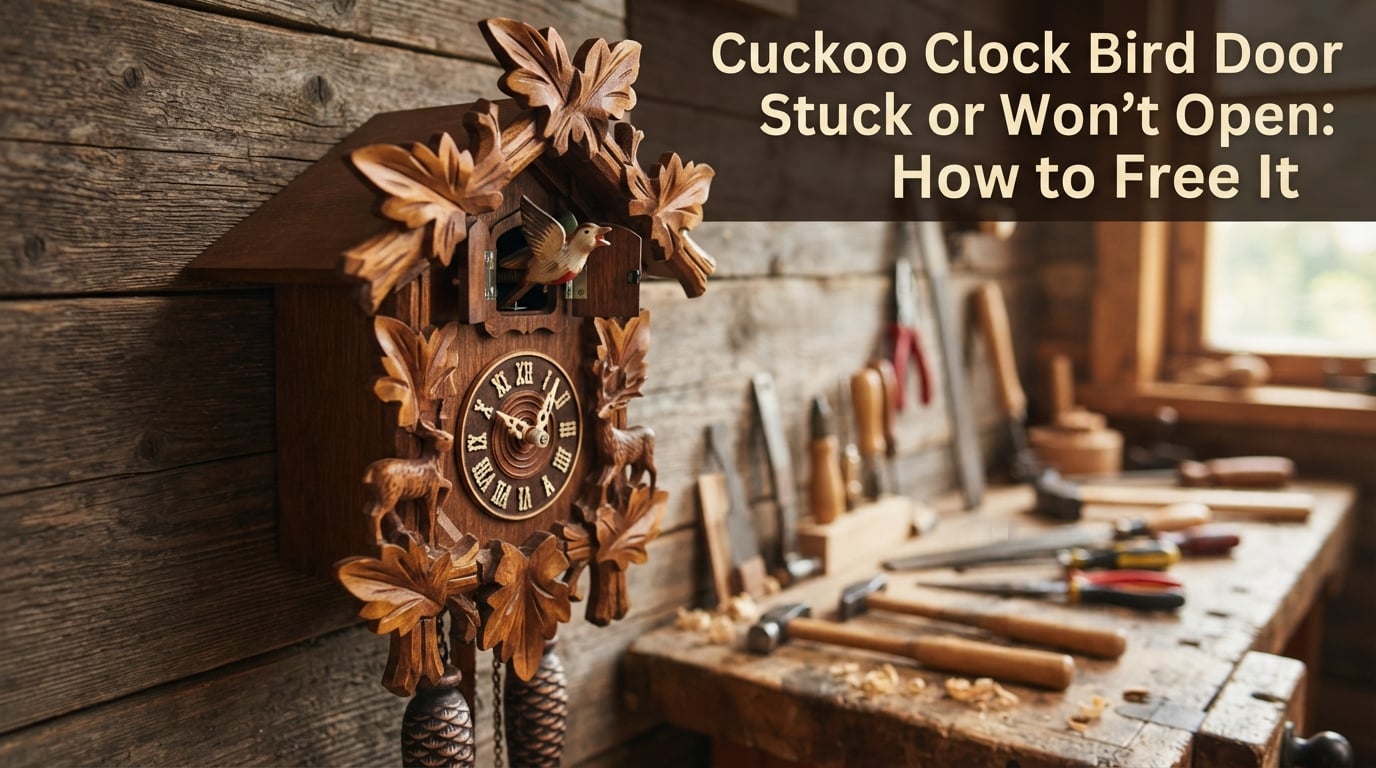
A cuckoo clock bird door stuck at the wrong moment is one of those problems that stops you in your tracks. The bird freezes halfway, the music cuts off, and your beloved clock suddenly looks broken. After helping collectors troubleshoot hundreds of cuckoo clocks through our repair shop, I can tell you most stuck doors are fixable in minutes with the right technique.
This guide walks you through diagnosing the exact cause, then walks you through each proven fix in order from simplest to most involved. You will not need special tools for most solutions.
Table of Contents
Quick Diagnosis: What Is Happening With Your Cuckoo Clock?
Before touching anything, identify which scenario matches your clock. The fix changes based on the symptom, and rushing into repairs often makes things worse. Watch one full hour cycle if possible.
- Door stuck open, bird visible — the door spring has lost tension or the wire latch is misaligned.
- Bird stuck halfway out — the bird sits too far forward on its pivot and physically blocks the door.
- Door stuck closed, bird never appears — the bellows trigger linkage is disconnected or the minute hand has shifted on its arbor.
- Clicking sound but no movement — the bellows lift wire is bent or the bird cable has slipped off its drum.
Common Causes of a Stuck Cuckoo Clock Bird Door
From my repair bench experience, four issues cause roughly 90% of stuck door complaints. Knowing which one affects your clock saves you an hour of guessing.
1. Door spring fatigue. The small coiled spring that snaps the door shut loses tension after 10 to 20 years. The door opens but refuses to close firmly, or closes only partway and jams against the bird.
2. Bird position misalignment. If the bird sits too far forward on its mounting bracket, it physically blocks the door from completing its swing. This is the most common cause on new clocks right out of the box.
3. Wire latch and lift wire drift. The two thin wires that control door timing and bird elevation can bend from vibration, humidity, or rough handling. Even a 2mm bend throws off the entire sequence.
4. Wood expansion from humidity. Cuckoo clock cases are made of dried linden or pine wood. When humidity rises in summer, the case swells and the doorframe tightens around the door. The door sticks instead of swinging freely.
How to Free a Stuck Cuckoo Clock Bird Door: Step-by-Step Fixes
Work through these fixes in order. Most readers solve the problem by Step 3. Stop as soon as your clock works and reset it before moving on.
Step 1: Try the Gentle Push Technique First
This is the safe first move recommended by Clockworks and echoed across NAWCC forums. With the clock running, place one finger on the stuck door and apply very light pressure to push it open, then let the mechanism close it. Repeat the open-close cycle 3 to 5 times.
The repeated motion often frees a sticky latch without any disassembly. If the door now opens and closes freely on its own, you are done.
Step 2: Reposition the Bird on Its Pivot
Open the clock case door and locate the bird assembly behind the small door. The bird pivots on a horizontal axle attached to a small bracket. Gently slide the bird backward by 2 to 3 millimeters so it sits deeper inside the case.
Many owners fix a cuckoo clock bird stuck in window position with this single adjustment. Test by manually triggering the cuckoo lever.
Step 3: Adjust the Wire Latch and Lift Wire
Look at the back of the movement. You will see two wires: one controls door opening (door latch wire), and one lifts the bird and bellows (lift wire). Both sit above a small arm called the warning piece.
Use needle-nose pliers to gently bend the door latch wire 1 to 2 millimeters sideways. This changes the moment the door releases. Then bend the lift wire up slightly so the bird clears the doorframe. Move tiny amounts. Each millimeter matters.
Forum users on the NAWCC message board often describe this exact adjustment as the “golden arm waltz” because of the small brass arm the wires rest against.
Step 4: Check the Door Spring Tension
If the door opens but will not close firmly, the door spring needs attention. With the clock stopped and weights removed, examine the spring where the door hinge meets the front plate.
For minor tension loss, stretch the spring gently by opening the door 5 extra times to re-seat it. For badly weakened springs, you will need a replacement part. Most springs cost a few dollars from clock suppliers and install with basic watchmaker screwdrivers.
Step 5: Reset the Minute Hand Position
If the cuckoo does not sound at all but you hear internal clicking, the minute hand may have slipped on its arbor. Remove the minute hand and reinstall it at the 12 position with the clock stopped. This re-syncs the trigger mechanism that fires the bird and bellows.
Advanced Troubleshooting and Prevention
Once your clock works again, a few habits prevent the problem from coming back. Our team has seen the same clocks return year after year until owners adopt these practices.
Control humidity. Keep your clock in a room with 40 to 55% relative humidity. A small hygrometer costs under $15 and prevents the wood expansion that causes sticky doors. Avoid hanging cuckoo clocks in kitchens, bathrooms, or above heating vents.
Maintain the weights and chains. A cuckoo clock door stuck open can also stem from uneven weight distribution. Make sure both weight cones hang at equal heights and chains run smoothly over their sprockets. Uneven pull stresses the entire train.
Never use WD-40. This comes up constantly in forum posts. Petroleum lubricants damage clock movements, dissolve old oils, and attract dust. Use only clock-specific oils from a horological supplier on pivot points once every 3 to 5 years.
When to call a professional. If you hear grinding, see broken teeth on the gear wheels, or the bird cable has fully detached, stop DIY work. A NAWCC-certified repair technician typically charges between $75 and $200 for a stuck door repair and full movement service. Antique Black Forest clocks or vintage Schneider movements deserve professional hands regardless of the issue.
Frequently Asked Questions
Why won’t the door close on my cuckoo clock?
The most common reason is a weakened door spring that has lost tension over years of use. A bird sitting too far forward on its pivot also physically blocks the door from completing its swing. Humidity-related wood expansion in the case is a third frequent cause, especially in summer months.
Can you use WD-40 on a cuckoo clock?
No. WD-40 and other petroleum-based lubricants damage clock movements, dissolve the original oils, and leave a residue that attracts dust. Use only clock-specific oils from a horological supplier on pivot points, and only every 3 to 5 years.
Why doesn’t the bird come out on my cuckoo clock?
Usually the lift wire that raises the bird has bent out of position, or the bird cable has slipped off its drum on the movement. The minute hand may also have shifted on its arbor, breaking the trigger sequence. Check the back of the movement for bent wires before assuming a deeper mechanical failure.
How do I free a stuck cuckoo clock bird without taking it apart?
Try the gentle push technique first: with the clock running, lightly press the door open and let it close 3 to 5 times. This often frees a sticky latch. If the bird is stuck halfway, slide it backward 2 to 3 millimeters on its pivot. These two fixes solve most issues without disassembly.
When should I take my cuckoo clock to a professional?
Take it to a NAWCC-certified technician if you hear grinding sounds, see broken gear teeth, or if the bird cable has fully detached from its drum. Antique Black Forest clocks and vintage Schneider movements also deserve professional service regardless of the issue, since replacement parts can be hard to source.
Final Thoughts on Fixing a Stuck Cuckoo Clock Bird Door
A cuckoo clock bird door stuck problem is almost always solvable at home with patience and the right diagnosis. Start with the gentle push, then check the bird position, then adjust the wires. Most owners get their clock singing again in under 30 minutes.