
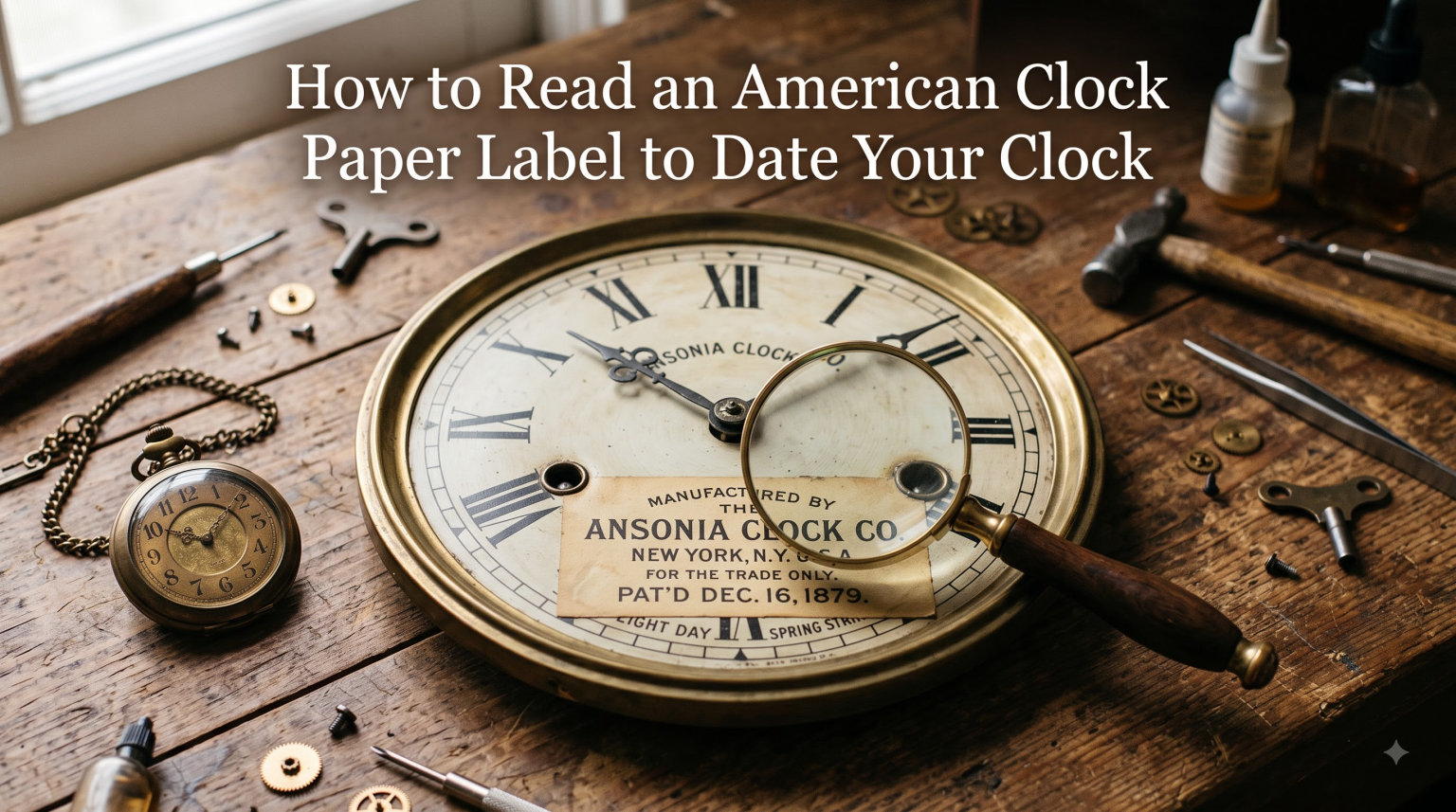
That yellowed square of paper glued inside your antique clock case might be the single most important clue to its identity. For American clocks made between roughly 1820 and 1930, the paper label glued inside the case was essentially the manufacturer’s signature, warranty card, and instruction manual rolled into one. If you can read it correctly, you can usually figure out who made the clock, roughly when it was made, and sometimes even the specific model.
Learning how to read an American clock paper label to date your clock is a skill that every antique clock owner and collector can develop with a bit of patience. The process comes down to four steps: finding the label, reading the maker information, using the printer details to narrow down a date range, and cross-referencing what the label says with the movement inside the case. I will walk you through each step in detail, including how to handle faded labels, how to tell a retailer name from a manufacturer name, and how to use free databases like the NAWCC Labels and Printers Project.
This guide focuses specifically on American clocks, where paper labels are most common and most informative. European clocks tend to use engraved nameplates, stamped movement marks, or dial signatures instead. If you have an American shelf clock, mantel clock, wall clock, or banjo clock from the 1800s or early 1900s, the paper label is your starting point for identification and dating.
Table of Contents
What Is an American Clock Paper Label?
An American clock paper label is a printed paper sheet that clock manufacturers glued inside the wooden case of their clocks during the 1800s and early 1900s. These labels typically contained the maker’s name, city and state of manufacture, the clock model or style name, patent information, and setup or winding instructions for the customer. They were printed by commercial printing companies and applied at the factory before the clock was shipped.
Unlike engraved brass plates or stamped marks on the movement, paper labels could include a large amount of text at very low cost. This made them ideal for American manufacturers who were mass-producing affordable clocks in places like Connecticut and Massachusetts. Companies like Seth Thomas, Waterbury, E.N. Welch, Ansonia, and New Haven Clock Company all used paper labels extensively.
The labels were usually glued to the inside backboard of the clock case, where they would be visible when you opened the door or removed the movement. Over the decades, many labels have become faded, torn, mouse-damaged, or partially detached. Even a fragment of a label, though, can hold enough information to identify the maker and narrow the manufacturing date.
Step 1: Locate the Paper Label Inside the Clock Case
Paper labels on American clocks are almost always hidden inside the case, not on the exterior. You need to open the clock and look in several specific locations to find one. Here are the four most common spots where manufacturers placed their labels.
On the Inside Backboard
The most common location is the inside of the backboard, which is the wooden panel forming the rear wall of the clock case. To check this spot, you typically need to remove the clock from the wall or turn it around, then open the back door or panel. The label is often centered on the backboard directly behind where the pendulum hangs.
Behind or Below the Pendulum
On many shelf and mantel clocks, the label sits on the backboard directly behind the pendulum bob. You may need to carefully stop the pendulum and move it aside to see the label clearly. In some cases the label is positioned just below the pendulum’s lowest swing point.
Be gentle when moving the pendulum. The suspension spring that holds it is delicate and can snap if bent. If the pendulum feels stuck, do not force it.
Inside the Base or Bottom Panel
Some manufacturers glued labels to the inside of the case base or on the underside of the bottom shelf. You might need to look up from underneath the clock or remove a bottom panel to find these. This location is less common but does appear on certain Seth Thomas and Waterbury models.
On the Inside of the Trunk Door or Side Panel
On some wall clocks, particularly schoolhouse and banjo styles, the label appears on the inside of the access door or on a side panel visible when the door is open. Always check the door itself, not just the backboard, because a label may be hiding right there on the inner surface.
If you have checked all four locations and found no label, your clock may have lost it over time. This is common. In that situation, you will need to rely on movement marks, case style, and dial signatures for identification instead.
Step 2: Read the Maker Name and Company Information
The maker name is usually the largest and most prominent text on a clock paper label. It appears at the top, often in decorative typography with the company’s city and state directly below it. Your first task is to transcribe this information carefully, because even partial names can be searched against historical databases.
When reading the maker section of a label, look for these specific elements in order of importance: the company name, the city and state, any model or style name, patent dates or patent numbers, and winding or setup instructions. Each of these tells you something different about the clock.
Company Name and Location
The company name identifies the manufacturer. Common American clock makers you will encounter include Seth Thomas Clock Company (Plymouth Hollow, later Thomaston, Connecticut), Waterbury Clock Company (Waterbury, Connecticut), E.N. Welch Manufacturing Company (Forestville, Connecticut), Ansonia Clock Company (Ansonia, Connecticut, later Brooklyn, New York), and New Haven Clock Company (New Haven, Connecticut). The city name is useful because some companies changed locations over time, which itself is a dating clue.
For example, Seth Thomas clocks labeled “Plymouth Hollow, Connecticut” predate those labeled “Thomaston, Connecticut,” because the town was renamed in 1866 after Thomas’s death. That single detail on the label narrows the manufacturing date to before or after 1866.
Model or Style Information
Some labels include a model name, style number, or trade name for the specific clock design. This information is valuable because manufacturers often produced a model for only a limited number of years. If you can match a model name to a catalog listing, you can date the clock with considerable precision.
Not every label includes model information. Many simpler shelf clocks have generic labels with only the company name and instructions. In those cases, you will need to rely on the other dating methods described in the next steps.
Patent Dates on the Label
Many labels include patent dates, which give you an earliest possible manufacturing date. If a label references “Patented March 1, 1864,” for instance, the clock must have been made in 1864 or later. Patent dates are a floor, not an exact date, but they are extremely useful for narrowing the range.
Manufacturer Versus Retailer Names
One of the most common sources of confusion is that a label may show a retailer’s name rather than the actual manufacturer. Department stores, jewelry shops, and mail-order companies like Sears sometimes sold clocks under their own names, even though the clocks were made by a major manufacturer. A label reading “Sold by Jones and Company” or bearing a jeweler’s name does not necessarily tell you who built the movement.
If the label mentions a business that is clearly a retailer rather than a known clock manufacturer, you will need to look at the movement for additional clues. The movement plates, the winding arbor layout, and the strike configuration can often point you toward the real manufacturer even when the label does not.
Step 3: Use the Printer Information to Date the Clock
One of the most powerful and underused dating methods involves the printing company named on the label itself. Many American clock labels include the printer’s name and address in small text, usually at the bottom edge of the label. By cross-referencing this printer information against historical records, you can often narrow the manufacturing date to within a few years.
This method works because printing companies operated from specific addresses for limited periods. If a printer was located at a particular street address only between 1880 and 1885, then any clock label bearing that address must date from that same window. The NAWCC (National Association of Watch and Clock Collectors) maintains a free database called the Labels and Printers Project specifically for this purpose.
How to Find the Printer Information
Look at the very bottom of the label, often in tiny text along the edge. You are looking for phrases like ” Printed by [name]” or a printer name and street address printed in small type. The text can be quite small, so use a magnifying glass or take a high-resolution photo and zoom in.
Not every label includes printer information. Smaller manufacturers and later labels sometimes omit it. But when it is present, it is one of the most reliable dating tools available for American clocks.
Using the NAWCC Labels and Printers Project
The Labels and Printers Project, hosted by the NAWCC at lpp.nawcc.org, is a searchable database of clock label printers and their known operating periods. You can search by printer name, address, or city to find the date range during which that printer was active at that location. The database is built from contributions by collectors and researchers who have verified label dates through catalogs, advertisements, and other historical documents.
To use the database effectively, follow these steps. First, transcribe the printer name and full address exactly as they appear on the label. Second, search the database for that printer name. Third, compare the address on your label to the addresses and date ranges in the database. Fourth, note the overlap between your label’s printer address and the known operating period.
The result gives you a manufacturing date range that is often more precise than what the maker name alone can provide. For example, you might determine that your Seth Thomas clock was made between 1881 and 1886 based on the printer address, even if the model name on the label does not appear in surviving catalogs.
Why Printer Dating Works Better Than You Might Expect
Printing companies in the 1800s served local markets. A clock factory in Connecticut would typically use a printer in the same region. When that printer moved to a new address, the clock company’s new labels would reflect the new address. Because printers moved, merged, or went out of business on a fairly regular basis, their address changes create natural dating milestones that are often documented in city directories and business records.
This is why a label fragment with no maker name visible can still be dated if the printer information is legible. I have seen collectors date unidentified clocks purely from the printer address on a torn label corner.
Step 4: Correlate the Label with the Movement Serial Number
The paper label is just one piece of the identification puzzle. To confirm your dating and identification, you should cross-reference what the label tells you with the physical movement inside the clock. The movement is the mechanical works that drive the timekeeping, and it often carries its own identifying marks.
Finding Marks on the Movement Plates
Remove the movement from the case if you are comfortable doing so, or use a flashlight and mirror to inspect it in place. Look at the front and back movement plates for stamped names, serial numbers, patent dates, or maker symbols. Seth Thomas stamped many of their movements with a date code or a company name. Waterbury and New Haven also used movement stamps that can confirm the manufacturer.
Serial numbers on the movement, when matched against surviving factory records, can sometimes pinpoint the exact year of manufacture. Not all companies left serial number records that survive today, but for Seth Thomas and a few others, dedicated researchers have compiled useful dating charts.
Matching Movement Type to Label Era
Even without a serial number, the movement type itself provides dating clues. Eight-day weight-driven movements with wooden gear trains were common in the 1820s and 1830s. Thirty-hour spring-driven movements became dominant by the 1840s. By the 1880s and 1890s, many American shelf clocks used eight-day spring-driven movements with the familiar two-winding-hole dial layout.
If your label suggests an 1870s date based on the printer information but the movement is clearly a wooden-works weight-driven type from the 1830s, something does not match. Either the label is a reproduction, or the movement was replaced at some point. This kind of mismatch is exactly why you should always check both sources rather than relying on the label alone.
Patent Marks on the Movement
Movements sometimes carry patent dates stamped into the brass plates. These work the same way as patent dates on labels: they establish the earliest possible manufacture date. Cross-referencing movement patent dates with label patent dates can strengthen your dating confidence or reveal inconsistencies.
Common American Clock Makers and Their Labels
Familiarizing yourself with the major American clock manufacturers and their typical label formats makes identification much faster. Here are the companies you are most likely to encounter and what to look for on their labels.
Seth Thomas Clock Company
Seth Thomas is probably the most recognized name in American clockmaking. The company operated from 1813 until well into the 20th century. Early labels read “Seth Thomas, Plymouth Hollow, Connecticut.” After 1866, when Plymouth Hollow was renamed Thomaston, the labels changed accordingly. Later labels from the 1880s onward read “Seth Thomas Clock Company, Thomaston, Conn., U.S.A.” The city name change is one of the simplest dating tools for Seth Thomas clocks.
Waterbury Clock Company
Waterbury Clock Company operated in Waterbury, Connecticut, from 1857 to 1944. Their labels typically read “Waterbury Clock Company, Waterbury, Conn.” The company produced a wide range of shelf clocks, wall clocks, and later, inexpensive watches. Waterbury labels often include detailed winding instructions and the company’s winding key icon.
E.N. Welch Manufacturing Company
E.N. Welch operated in Forestville, Connecticut, from 1864 until it became the Sessions Clock Company in 1903. Labels from the Welch era read “E.N. Welch Mfg. Co., Forestville, Conn.” If you find a Welch label, your clock dates between roughly 1864 and 1902. After 1903, the same factory produced clocks under the Sessions name, and the labels changed accordingly.
Ansonia Clock Company
Ansonia Clock Company started in Ansonia, Connecticut, in 1851 and moved its main operations to Brooklyn, New York, in 1879. This move is reflected on their labels. Early labels say “Ansonia, Connecticut” and later labels say “Brooklyn, New York.” This location change gives you a clean pre-1879 versus post-1879 dating split. Ansonia was known for ornate figurine clocks and iron-case clocks in addition to standard shelf models.
New Haven Clock Company
New Haven Clock Company operated in New Haven, Connecticut, from 1853 until 1960. Their labels typically read “New Haven Clock Company, New Haven, Conn.” The company absorbed the operations of Jerome Manufacturing Company and produced an enormous volume of affordable shelf clocks. New Haven labels are among the most commonly found on American antique clocks today.
Label Condition: Reading Faded and Damaged Labels
One of the biggest frustrations clock owners face is trying to read a label that has faded, torn, or been partially eaten by insects or mice. Forum posts on r/Antiques, r/clocks, and the NAWCC message board are full of people asking for help with barely legible labels. Fortunately, several techniques can help you extract more information than you might think possible.
Start with angled lighting. Hold a flashlight at a low angle across the label surface, almost parallel to the paper. This raking light creates shadows in the depressed printed areas and can reveal text that is invisible under direct overhead lighting. Move the light around the entire label to catch different angles.
If angled light does not work, try UV light. A longwave ultraviolet flashlight, the kind used for detecting pet stains or counterfeit currency, can sometimes make faded printer’s ink fluoresce against the paper background. This works especially well with older oil-based inks. Do not use shortwave UV, which can damage old paper.
Photograph the label at high resolution with your phone or a digital camera. Open the image on a computer and adjust the contrast, brightness, and sharpness. Boosting contrast and inverting the colors sometimes reveals text that your eye could not pick up from the original. Several clock collectors on the NAWCC forums have identified maker names from contrast-enhanced photos of labels that looked completely blank in person.
Transcribe every word you can read, even fragments. A partial city name, a few letters of a printer name, or a partial patent date can all be searched against databases. Do not assume a label is unreadable until you have tried all of these methods.
Red Flags: When a Label Might Not Be Original
Not every paper label inside an antique clock is original. Reproduction labels exist, and some sellers apply them to clocks to increase perceived value. Knowing how to spot a reproduction protects you from making identification mistakes based on false information.
Original labels from the 1800s and early 1900s were printed on rag paper, which has a distinctive texture and does not yellow uniformly the way modern wood-pulp paper does. The ink on original labels often has a slightly raised texture you can feel with your fingertip. Reproductions tend to be printed on modern paper with flat inkjet or laser toner that sits on the surface.
Watch for glue patterns as well. Original labels were applied with animal-hide glue or flour paste, which leaves a brownish, uneven residue. If the label is attached with perfectly even, white adhesive, it is almost certainly a modern replacement.
Another red flag is a label that contradicts the movement. If the label says “Seth Thomas, Thomaston, Conn.” but the movement has no Seth Thomas stamps and uses a movement style associated with a different manufacturer, the label may have been added later. Always compare label information against movement evidence before accepting the label at face value.
Be cautious with retailer labels as well. A label bearing a jewelry store or department store name tells you who sold the clock, not who manufactured it. This is a common point of confusion for new collectors, and it is why movement inspection is such an important companion step to label reading.
Reference Resources and Next Steps for Clock Identification
Once you have read your label and gathered movement information, the next step is to verify your findings against established reference resources. Several free and paid tools can help you confirm maker identification, narrow date ranges, and connect with experienced collectors who can help.
The NAWCC Labels and Printers Project
The Labels and Printers Project at lpp.nawcc.org is the single most valuable free resource for dating American clock labels. Use it to search the printer name and address from your label and find the corresponding date range. The database is continually growing as collectors contribute new verified entries. Even if your first search returns no results, check back periodically or contribute your own findings to help others.
NAWCC Message Boards and Community Help
The NAWCC maintains active message boards at mb.nawcc.org where members post photos of clocks and labels for community identification help. Collectors with decades of experience regularly help identify makers, models, and date ranges from partial labels. A clear, well-lit photo of your label and movement, along with the label text you have transcribed, will get you the best responses. Membership is required to post, but browsing the archives is free.
Reddit Communities: r/Antiques and r/clocks
Reddit’s r/Antiques and r/clocks communities are accessible without membership and have active members who enjoy helping identify antique clocks. Post clear photos of the label, the full clock, and the movement with your best transcription of any legible text. Be upfront about what you have already tried, and respond to follow-up questions promptly.
Reference Books and Catalog Reprints
Several reference books compile information on American clock makers and their products. Tran Duy Ly’s series of clock identification books, published by Arlington Book Company, reprints original manufacturer catalogs with model names, dates, and illustrations. These books are the gold standard for model identification and can help you match your clock’s case style to a specific catalog year. They are available through the NAWCC library, horological booksellers, and sometimes local libraries.
Professional Appraisers
If you need a formal identification or valuation for insurance, estate, or sale purposes, consult a professional appraiser who specializes in horology. Look for appraisers affiliated with the NAWCC or with the Appraisers Association of America. A qualified appraiser can examine your label, movement, and case together and provide documentation of the clock’s maker, date, and value.
Building Your Identification Toolkit
As you gain experience, assemble a set of tools that will make label reading easier. A good magnifying glass or jeweler’s loupe, a raking-angle flashlight, a longwave UV light, and a smartphone with a high-resolution camera cover most situations. Keep notes on every clock you examine, including label transcriptions, printer information, and movement marks. Over time, your personal reference file becomes as valuable as any published database.
FAQs
How do you identify clock maker marks?
Clock maker marks appear in three main places: on the paper label inside the case, stamped into the brass movement plates, and engraved or printed on the dial face. Start by locating the paper label on the inside backboard, then check the movement for stamped names or serial numbers. Cross-referencing all three sources gives the most reliable identification.
How do you identify an antique American clock?
To identify an antique American clock, look for a paper label glued inside the case on the backboard, behind the pendulum, inside the base, or on the access door. Read the maker name, city and state, and any model or patent information. Then inspect the movement for stamped marks and serial numbers, and compare the case style to known manufacturer catalogs.
How to date a vintage clock?
Date a vintage clock by combining four methods: read patent dates on the label for an earliest possible year, use the printer name and address from the label against the NAWCC Labels and Printers Project database, check the city name on the label for known company location changes, and match the movement serial number or type to factory records. Using multiple methods together narrows the date range more precisely than any single method alone.
How can you tell the age of a clock?
You can estimate a clock’s age by examining the paper label for maker location changes, patent dates, and printer address information. Then cross-check the movement type, since wooden-works movements indicate the 1820s to 1830s, while spring-driven movements became standard by the 1840s. Case construction materials and glass type also provide era clues that help confirm the date range suggested by the label.
Putting It All Together
Reading an American clock paper label to date your clock comes down to a repeatable four-step process. First, locate the label inside the case on the backboard, behind the pendulum, in the base, or on the door. Second, read and transcribe the maker name, city and state, model information, and patent dates. Third, use the printer name and address at the bottom of the label to search the NAWCC Labels and Printers Project for a manufacturing date range. Fourth, confirm your findings by checking the movement for stamped marks and serial numbers.
Every clock tells its own story through its label, and learning to read that story is one of the most rewarding skills in antique collecting. The more labels you examine, the faster identification becomes. Start with the free resources from the NAWCC, share your findings with collector communities, and keep careful notes. Before long, you will be the person helping others learn how to read an American clock paper label to date their own clocks.