
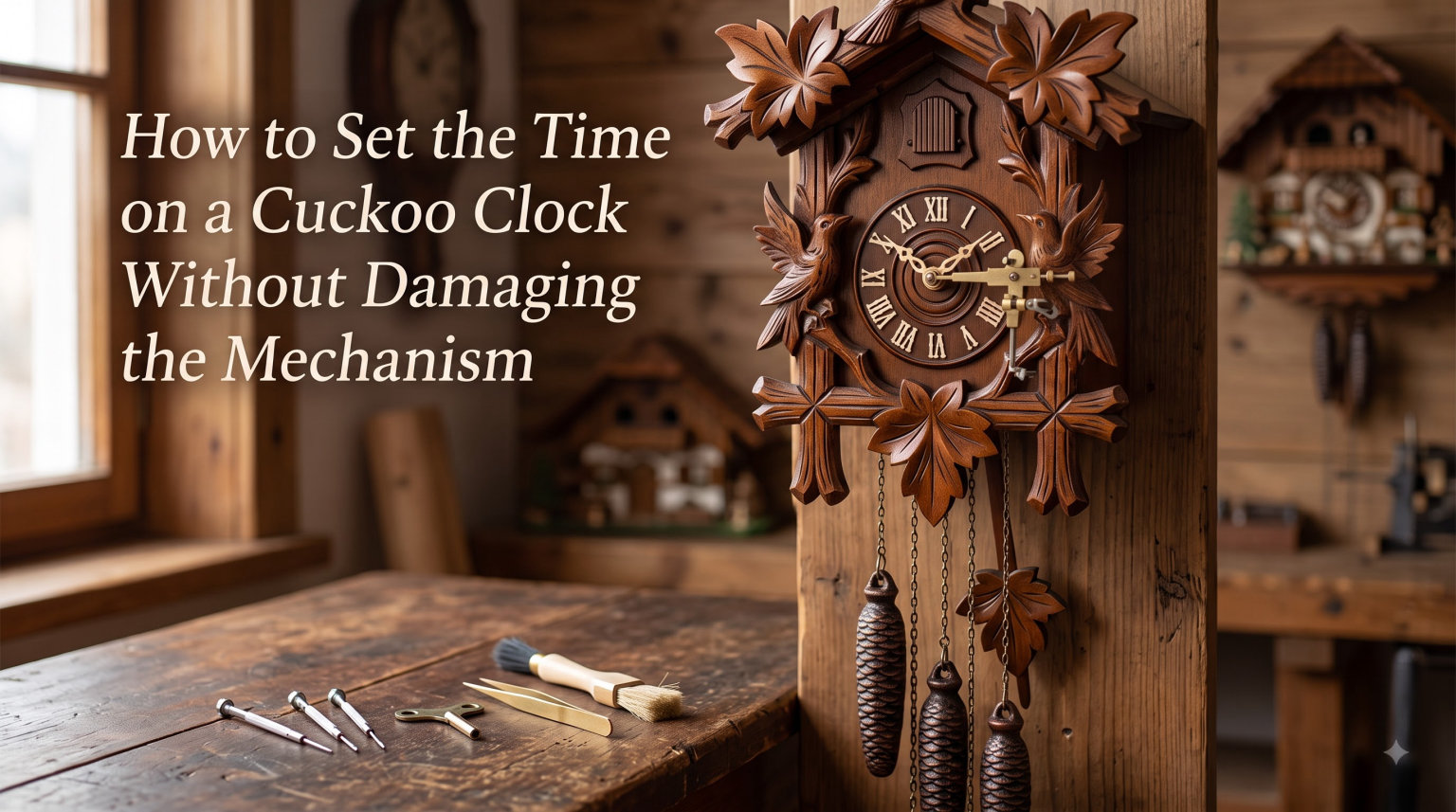
If you just hung a cuckoo clock on your wall or inherited a family heirloom, the first question on your mind is probably about setting it correctly. Learning how to set the time on a cuckoo clock without damaging the mechanism comes down to one rule: always move only the minute hand forward (clockwise), and pause at each hour and half-hour mark to let the cuckoo call complete before continuing.
Many first-time owners feel nervous about touching the hands, and that caution is well-founded. A cuckoo clock mechanism is a delicate arrangement of gears, bellows, and a striking mechanism that can bend or misalign if handled the wrong way. Moving the hands backward is the most common mistake, and it can cause damage that requires professional repair.
In this guide, I will walk you through the complete process step by step. You will learn the correct way to move the hands, how to synchronize the cuckoo call with the displayed hour, how to regulate the pendulum for accurate timekeeping, and what to do when things go wrong. Whether you own a modern German cuckoo clock or a vintage heirloom, these instructions will help you handle your timepiece with confidence.
Table of Contents
Understanding Your Cuckoo Clock Mechanism
Before you touch any part of the clock, it helps to understand what is happening inside. A traditional mechanical cuckoo clock is a weight-driven timepiece, meaning gravity pulls on the weights to power the movement. The pendulum swings back and forth to regulate the speed of the gears, keeping time steady.
Here are the key parts you need to know:
- Minute hand: The longer hand that points to the minutes. This is the only hand you should ever touch when setting the time.
- Hour hand: The shorter hand that points to the hour. On most cuckoo clocks, this is a friction-fit hand that you should not move directly.
- Pendulum: The swinging rod and bob (the round weight at the bottom) that regulates the clock’s speed.
- Weights: The pinecone-shaped weights that hang from chains and provide the driving force. A clock may have two or three weights depending on whether it has a music box.
- Bellows: The air chambers inside the clock that push air through tuned pipes to create the cuckoo sound.
- Striking mechanism: The system of gears and levers that triggers the cuckoo bird and the call at the correct hour.
The reason this mechanism is so delicate is that all these parts work in precise synchronization. The striking mechanism is connected to the gear train through a rack-and-snail system that counts the hours. When you move the minute hand, the clock’s internal levers engage this system automatically. If you force the hands backward or skip past a striking point, those levers can bend or the gears can clash.
Understanding this interconnection is the foundation for everything that follows. Treat the hands gently, let the clock do its striking naturally, and the mechanism will serve you for decades.
How to Set the Time on a Cuckoo Clock Without Damaging the Mechanism
Now for the main event. Learning how to set the time on a cuckoo clock without damaging the mechanism requires patience more than anything else. The process is simple, but you must not rush through the striking points.
The Golden Rule
Always move the minute hand forward (clockwise), and never move the hour hand directly. The minute hand drives the striking mechanism, so moving it forward lets the clock strike naturally at the correct intervals. Moving it backward forces the internal levers in the wrong direction, which can bend or break them.
Step-by-Step Time Setting Procedure
Follow these steps carefully:
Step 1: Stop the pendulum. Gently hold the pendulum bob to stop its swing. This prevents the clock from ticking while you are adjusting the hands, which avoids conflicting movements inside the mechanism.
Step 2: Identify the current time on the clock. Look at where the minute and hour hands are pointing. Note whether you are before or after a striking point (the 12 o’clock position for the hour and the 6 o’clock position for the half-hour on most clocks).
Step 3: Move the minute hand forward slowly. Using your thumb and index finger, gently push the minute hand clockwise. Move it one minute at a time or in small increments. Never force it past resistance.
Step 4: Pause at the half-hour mark. When the minute hand reaches the 6 o’clock position, the clock will trigger its half-hour strike. Stop moving the hand immediately and let the cuckoo call complete fully. On a one-day movement, this is usually a single cuckoo. On an eight-day movement with music, it may play a tune.
Step 5: Pause at the full hour. When the minute hand reaches the 12 o’clock position, the clock will trigger the full hour strike. The cuckoo will call the correct number of times for that hour. Wait until the bird has finished its full sequence and returned inside before you continue moving the hand.
Step 6: Continue moving forward until you reach the correct time. Repeat the pausing process at every striking point along the way. If the clock is several hours behind, this will take a few minutes. Patience here protects your investment.
Step 7: Restart the pendulum. Once the hands show the correct time, give the pendulum a gentle push to start it swinging. Make sure it has an even swing in both directions.
Step 8: Verify the cuckoo count matches the hour. Wait for the next hour strike and count the cuckoo calls. If the clock strikes three times but the hour hand points to 4, the call is out of sync (see the troubleshooting section below for how to fix this).
What If the Clock Is Several Hours Behind?
If your cuckoo clock has stopped for days or weeks, you will need to advance it through multiple striking cycles. This is normal and safe as long as you pause at each hour and half-hour. Some clockmakers recommend an alternative approach: if the clock is more than a few hours behind, simply set it to the next hour by moving forward and pausing, then let it run naturally from there.
Synchronizing the Cuckoo Call
If the cuckoo call does not match the hour shown on the dial, you need to resynchronize it. The most reliable method is to move the minute hand forward to the nearest full hour and let the cuckoo strike. Count the number of calls. Then gently slip the hour hand (which is friction-fit on most clocks) to point at the number that matches the cuckoo count. This brings the display back in sync with the striking mechanism.
Never force the hour hand. It should slide with light finger pressure on most German cuckoo clocks. If it resists, do not push harder, as you could damage the center shaft.
Critical Warning: Never Move the Hands Backward
This is the single most important thing to remember about cuckoo clock maintenance. Never turn the minute hand counterclockwise (backward). I cannot stress this enough, because it is the number one cause of cuckoo clock damage reported by owners and repair shops.
When you move the minute hand backward, you reverse the direction of the gear train that controls the striking mechanism. The rack and snail components are designed to engage in one direction only. Forcing them backward can bend the gathering pallet, misalign the rack, or cause the striking levers to jam.
Here is what can happen if you move the hands backward:
- The gears clash and teeth bend or break, requiring expensive repairs.
- The cuckoo bird mechanism jams, causing the bird to get stuck in the doorway.
- The striking mechanism falls out of sync, striking the wrong number of times.
- The bellows can be forced out of alignment, distorting the cuckoo sound.
If the clock is ahead of the correct time, the safe solution is to stop the pendulum and wait until real time catches up to the clock’s displayed time. Then restart the pendulum. It may mean waiting a few hours, but it costs nothing and causes zero damage.
One exception exists: some clockmakers and experienced horologists accept moving the minute hand backward on certain clock movements, but only between striking points and only for small adjustments. Unless you know your specific movement type, do not risk it. The forward-only method is universally safe.
Pendulum Regulation: Making Your Clock Run Faster or Slower
After you set the time, your cuckoo clock may run slightly fast or slow. This is completely normal. Mechanical clocks require fine-tuning through pendulum adjustment, and it often takes several days of observation to get it dialed in.
The Rule: Pendulum Up Means Faster, Down Means Slower
The pendulum bob controls the speed of the clock through a simple principle of physics. A shorter pendulum swings faster, and a longer pendulum swings slower. To adjust the speed:
- To make the clock run faster: Turn the rating nut (the small nut beneath the pendulum bob) clockwise to raise the bob up the pendulum rod.
- To make the clock run slower: Turn the rating nut counterclockwise to lower the bob down the pendulum rod.
Each full turn of the rating nut changes the clock speed by a small amount. Make one adjustment, then observe the clock for a full 24 hours before making another change. This gives you accurate data on whether the adjustment worked.
How Much Should You Adjust?
A good starting point is a half-turn of the rating nut for every minute the clock is off per day. If your clock gains two minutes in 24 hours, lower the bob by one full turn and check again the next day. Small, incremental changes are far more effective than large ones.
Temperature and humidity also affect pendulum clocks. Wooden pendulum rods expand in humid or warm conditions, which can slow the clock slightly. Do not be alarmed by minor seasonal variations. Focus on getting the average rate correct over a week.
How to Start the Pendulum
When you restart the pendulum after setting the time, give it a gentle push to one side. Listen to the ticking. An evenly spaced tick-tock sound means the clock is in beat and properly leveled. If the ticking sounds uneven, like tick—tock-tick—tock, the clock is out of beat and you need to adjust its level on the wall.
Winding Your Cuckoo Clock: One-Day vs Eight-Day Movements
Winding is closely related to time setting because a fully wound clock keeps more accurate time. A clock that is about to run out of power may slow down or stop before the next winding is due.
One-Day Movement
A one-day cuckoo clock needs to be wound every 24 hours. You pull the chain (or the ring at the end of the chain) downward to raise the weight back up. Pull until the weight reaches the underside of the clock case. Do this for all weights. Most owners wind their clocks at the same time each day to build a routine.
Eight-Day Movement
An eight-day cuckoo clock only needs winding once per week. The weights are heavier and the chain has a longer travel distance. Pull each chain until the weight sits just below the clock body. Wind all weights at the same time, typically on the same day each week.
The Weight and Chain System Explained
On a clock with two weights, one drives the timekeeping movement and the other drives the cuckoo striking mechanism. On a clock with three weights, the third weight powers the music box that plays after the cuckoo call. Always let weights descend naturally as the clock runs. Never hold them up or interfere with the chains during operation.
When winding, pull the chain straight down with steady, even pressure. Jerking the chain or pulling too fast can tangle it or dislodge it from the sprocket inside the clock.
Quartz vs Mechanical Cuckoo Clocks: Setting Differences
Not all cuckoo clocks are mechanical. Quartz (battery-operated) cuckoo clocks work completely differently, and the time-setting process is much simpler. If you own a quartz cuckoo clock, here is what you need to know.
On a quartz cuckoo clock, you simply turn the small knob or dial on the back of the movement to set the time. You can move it forward or backward without any risk of damage, because there is no mechanical striking mechanism connected to the hands. The electronic movement controls everything independently.
Quartz clocks do not have a functional pendulum for timekeeping. The pendulum on a quartz clock is purely decorative, powered by a small battery-operated motor. You do not need to regulate speed or adjust the bob. The timekeeping accuracy depends entirely on the quartz crystal and battery quality.
The cuckoo call on a quartz clock is produced electronically through a speaker. It is triggered by the movement at the correct times automatically. If the call seems wrong, check the battery first and replace it if needed. Low battery power is the most common cause of quartz cuckoo clock problems.
One thing to note: some quartz cuckoo clocks have a night shut-off switch that silences the call during set hours. This is a convenience feature you can toggle on or off as you prefer.
Setting Time on Antique and Heirloom Cuckoo Clocks
If you have inherited an antique cuckoo clock, extra care is essential. These timepieces often have fragile mechanisms with decades of wear, and parts may be irreplaceable. Many owners of family heirloom clocks report feeling anxious about handling them, which is a healthy instinct.
For antique clocks, follow the same forward-only rule but be even more gentle. Move the minute hand with barely any pressure. If you feel resistance that does not resolve at a striking point, stop immediately. Forcing an antique movement can cause damage that is difficult and expensive to repair.
Antique clocks may have additional considerations:
- Wooden gears in very old clocks can be brittle and prone to cracking under stress.
- Older leather bellows may have deteriorated, producing weak or distorted cuckoo sounds.
- Friction-fit hour hands on vintage clocks may be loose and shift position easily, requiring frequent resynchronization.
- Rusted or tarnished chain links may catch or bind during winding.
If your antique clock has not run in years, do not attempt to start it without having it inspected by a qualified horologist. Old lubricants can harden into abrasive paste that damages gears when the clock runs. A professional cleaning and oiling can restore the mechanism safely.
For clocks with significant sentimental or monetary value, the cost of professional service is always less than the cost of replacing a damaged heirloom.
Troubleshooting Common Cuckoo Clock Problems
Even with careful handling, cuckoo clocks can develop issues. Here are the most common problems and how to address them.
The Pendulum Stops Swinging
This is the most frequent complaint. In nearly all cases, the clock is not level on the wall. Check with a small level tool and adjust the mounting until the clock sits perfectly vertical. An out-of-level clock produces uneven ticking (out of beat), which drains energy from the pendulum until it stops.
Other causes include the clock being mounted on an unstable wall that vibrates, the weights being tangled with each other, or the pendulum rod touching the clock body during its swing. Check that the pendulum hangs freely with clearance on all sides.
The Cuckoo Call Is Out of Sync
If the clock cuckoos the wrong number of times for the displayed hour, the striking mechanism and the hands have lost synchronization. Move the minute hand forward to the next full hour, let the cuckoo strike, and count the calls. Then slip the friction-fit hour hand to match the number of cuckoos. This realigns the display with the strike count.
The Clock Runs Fast or Slow
As discussed in the pendulum regulation section, adjust the rating nut to raise or lower the pendulum bob. Raise the bob to speed up the clock and lower it to slow it down. Make small adjustments and observe over 24 hours.
The Cuckoo Bird Gets Stuck
If the bird does not return inside after its call, the door spring may be weak or the bird’s wire linkage may be bent. On some clocks, you can gently push the bird back inside by hand. Do not force it. If the problem recurs, the linkage needs adjustment or the spring needs replacement, which is a job for a clock repair professional.
The Weights Do Not Descend
If a weight chain seems stuck, check for tangles or knots in the chain. Make sure the chain is properly seated on the sprocket inside the clock. Never pull the weight down forcefully, as this can strip the sprocket teeth. If the chain has come off the sprocket, the clock case may need to be opened to reseat it.
The Clock Stops After Being Moved
If the clock stopped after you adjusted the time, the most likely cause is that you moved past a striking point without pausing. The mechanism may have jammed partway through a strike. Gently move the minute hand forward to the next striking point and let it complete. If the clock still will not run, the striking mechanism may need to be reset by a professional.
How to Stop a Cuckoo Clock for Extended Periods
Sometimes you need to stop your cuckoo clock for a vacation, a move, or seasonal storage. Doing this correctly prevents damage to the mechanism.
To stop the clock, simply hold the pendulum gently until it stops swinging. Leave the weights in place if you are only stopping for a few days. For longer storage periods of weeks or months, remove the weights and pendulum to relieve stress on the chains and movement.
When you remove the weights, note which chain each one belongs to if your clock has different weight sizes. Store them wrapped in soft cloth to prevent scratching. Leave the chains hanging inside the clock case or secure them so they do not fall off the sprockets.
To restart after storage, reattach the pendulum and weights, set the time using the forward-only method described above, and give the pendulum a gentle push. Let the clock run for 24 hours and check the timekeeping accuracy before making any pendulum adjustments.
Frequently Asked Questions
What is the proper way to set the time on a cuckoo clock?
The proper way is to move only the minute hand forward (clockwise) in small increments. Stop at each hour and half-hour mark and let the cuckoo call complete fully before continuing. Never move the hour hand directly, and never turn the minute hand backward.
Is it okay to move clock hands backwards?
No. Moving cuckoo clock hands backward can bend the striking levers, jam the cuckoo bird mechanism, and misalign the gear train. Always move forward only. If your clock is ahead of the correct time, stop the pendulum and wait for real time to catch up.
Do I move the cuckoo pendulum up or down to make it faster?
Move the pendulum bob up to make the clock run faster and down to make it run slower. Turn the rating nut beneath the bob clockwise to raise it (faster) or counterclockwise to lower it (slower). Make small adjustments and observe for 24 hours before changing again.
What are the common problems with cuckoo clocks?
The most common problems are the pendulum stopping (usually from the clock not being level), the cuckoo call being out of sync with the hour display, the clock running fast or slow (pendulum needs regulation), the bird getting stuck in the doorway, and weights not descending due to chain tangles. Most of these can be fixed with basic adjustments described in the troubleshooting section above.
How do I synchronize the cuckoo call with the correct hour?
Move the minute hand forward to the next full hour and let the cuckoo strike. Count the calls, then gently slip the friction-fit hour hand to point at the number matching the cuckoo count. This realigns the display with the striking mechanism. Never force the hour hand.
How do you set a battery-operated quartz cuckoo clock?
Turn the small setting knob on the back of the quartz movement to set the time. You can move it in either direction without risk of damage since there is no mechanical striking mechanism connected to the hands. Quartz clocks do not need pendulum regulation. If the cuckoo call malfunctions, check and replace the battery first.
Conclusion
Knowing how to set the time on a cuckoo clock without damaging the mechanism comes down to a few core principles: move the minute hand forward only, pause at every striking point, and never force anything. These simple habits protect the delicate gears, bellows, and striking levers that make your clock sing.
Remember the key rules: the minute hand moves clockwise only, the hour hand is friction-fit and should be slipped gently if needed, and the pendulum bob goes up for faster and down for slower. Take your time, observe the results over 24 hours, and make incremental adjustments rather than large ones.
If you encounter persistent problems like the pendulum stopping or the cuckoo call being out of sync, check the clock’s level first. Most issues trace back to positioning or minor synchronization problems that you can fix yourself. For antique or heirloom clocks with significant wear, do not hesitate to consult a professional horologist.
Your cuckoo clock is built to last for generations when treated with care. By following the steps in this guide, you can confidently set the time, regulate the speed, and keep your timepiece running accurately and sounding beautiful for years to come.