
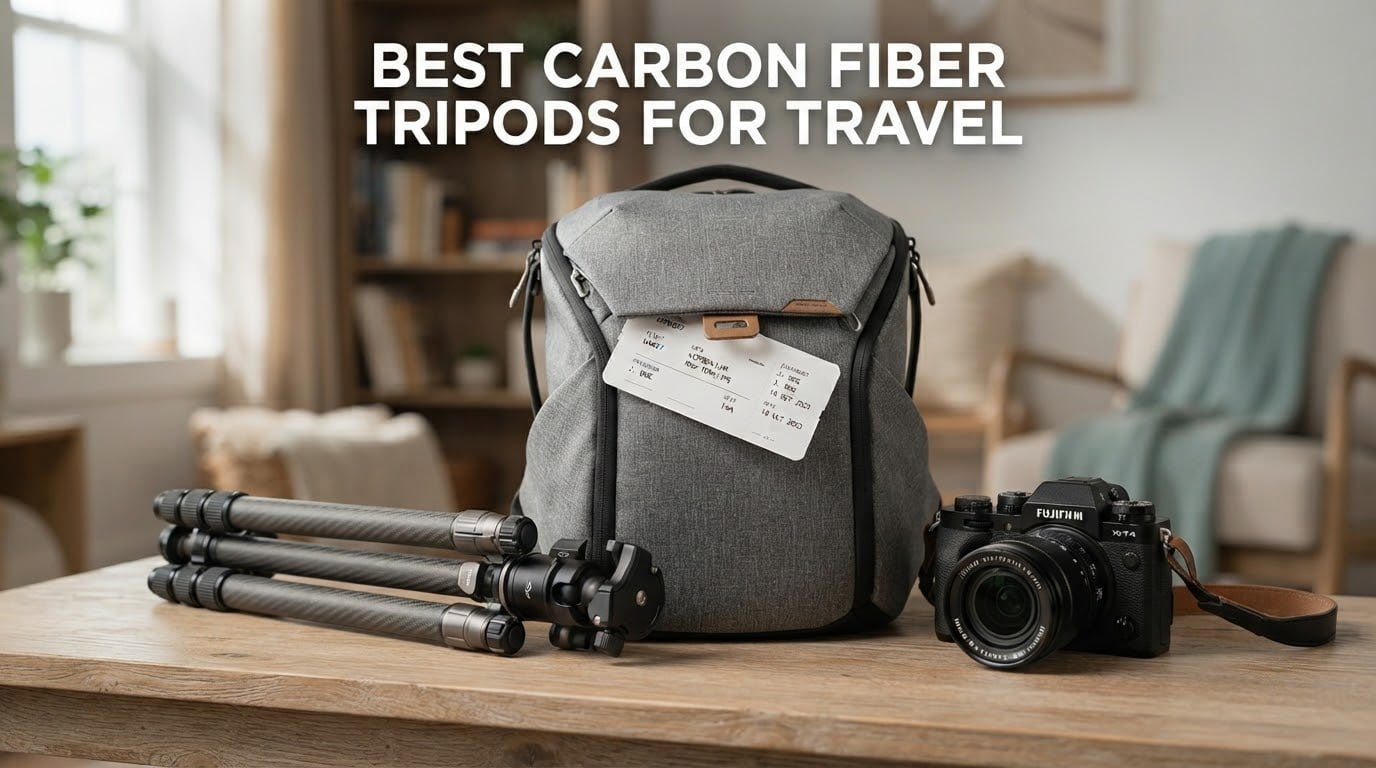
The Peak Design Travel Tripod Carbon Fiber is the best carbon fiber tripod for travel because it folds to 15.4 inches, weighs 2.8 lb, and still holds a 20 lb load, which is the rare combination of packed size, weight and rating that a carry-on demands.
Weight: 2.8 lb / 1.29 kg
Maximum height: 60 inches, minimum 5.5 inches
Folded length: 15.4 inches, roughly the diameter of a water bottle
Load capacity: 20 lb / 9.1 kg
Leg sections: 5, with lever-quick-release deployment
That headline pick is one of twelve carbon fiber travel tripods we compared for this guide, and the whole list stays inside one material on purpose. Almost every competing roundup mixes aluminum, plastic and gimbal options into a carbon fiber query, which tells you less than it should. If you want to know what the material actually buys you, compare these twelve against each other first, then read our carbon fiber versus aluminum section and the section count rule before you commit.
Weight is the number travelers fight hardest. A full-size aluminum travel tripod in the same class usually runs 3.5 to 5 lb, so carbon fiber cuts roughly a quarter to a third of what you carry before you add a body and a lens. The second number is folded length, because a tripod that is 19 inches long is a problem in a daypack even when it is light. Our winners and runners-up both fold under 16.5 inches, which is the range where a tripod fits beside a jacket rather than in the overhead bin.
The third factor is load capacity, and this is where spec sheets get generous. We use a simple rule throughout this guide: your camera plus lens plus plate should sit at half the rated load or lower if you plan to shoot at full height in wind. A model rated for 22 lb is not the same as a model that stays rigid at 22 lb, and the manufacturer data on these twelve makes that distinction unusually clear.
If you are still narrowing, three questions usually settle it: what camera and lens, what budget range, and what maximum height you need for very low ground-level framings. If you are still assembling the rest of your kit, our backpack picks for travel and luggage guide cover the bags these tripods ride in.
Table of Contents
Top 3 Picks for the Best Carbon Fiber Tripods for Travel (October 2026)

The Peak Design takes the top slot because it is the only one of the twelve that deploys in seconds without touching a leg lock. Every other carbon travel tripod we tested needs you to work twist locks or flip buckles on each leg, and that is exactly the moment a tripod gets abandoned at the end of a long travel day.
The NEEWER TP17B takes the value slot on the strength of 3143 reviews and a 13.2 lb rating at a weight most photographers would call heavy. If you shoot a mirrorless body with a kit zoom and you want a spare tripod that converts to a monopod, this is the one most people should buy.
The GEEKOTO CT25Pro earns the payload slot with a 26.5 lb rating, which is the highest in this group. It is also the heaviest and the longest when folded, so it fits a photographer carrying one long telephoto lens rather than a general traveler.
All 12 Carbon Fiber Tripods Compared in 2026
| Product | Specifications | Action |
|---|---|---|
| Peak Design Travel Tripod Carbon |
|
Check Latest Price |
 NEEWER Basics TP17B NEEWER Basics TP17B |
|
Check Latest Price |
 GEEKOTO CT25Pro GEEKOTO CT25Pro |
|
Check Latest Price |
 K&F Concept C225C0 K&F Concept C225C0 |
|
Check Latest Price |
 NEEWER LITETRIP LT32 NEEWER LITETRIP LT32 |
|
Check Latest Price |
 Manfrotto Befree Advanced Twist Manfrotto Befree Advanced Twist |
|
Check Latest Price |
 Benro Slim TSL08CN00 Benro Slim TSL08CN00 |
|
Check Latest Price |
 SIRUI AM-223 with SL-100 column SIRUI AM-223 with SL-100 column |
|
Check Latest Price |
 SIRUI Traveler 5CX SIRUI Traveler 5CX |
|
Check Latest Price |
 SIRUI Traveler 5C SIRUI Traveler 5C |
|
Check Latest Price |
 AOKA CMP163CL AOKA CMP163CL |
|
Check Latest Price |
 SmallRig 5025 SmallRig 5025 |
|
Check Latest Price |
A few things stand out in the data. Five tripods here fold under 14 inches: the SIRUI AM-223 at 8.5 inches without its column, the SmallRig 5025 at 11.4 inches, the SIRUI Traveler 5CX at 12.4 inches, the SIRUI Traveler 5C at 13 inches, and the K&F Concept at 13.7 inches. Five carry a load rating of 20 lb or more. And the lightest option, the AOKA at 1.1 lb, is also the lowest rated at 6.6 lb, which is the central trade-off in this category.
1. Peak Design Travel Tripod Carbon Fiber – Best Overall for Travel
Peak Design Travel Tripod, Carbon Fiber, Compact Design, Quick Setup and Takedown, Pro-Level Stability, Ergonomic Ball Head, Compact and Portable Travel Tripod for Camera and Phone, 20 lb Capacity
2.8 lb weight
15.4 inch folded length
20 lb load capacity
60 inch max height
Pros
- Deploys in seconds with a lever system
- Folds to water-bottle diameter
- Holds a full-frame DSLR with a telephoto
- Phone mount built into the center column
Cons
- Ball head geometry is awkward in portrait orientation
- Premium cost for a travel tripod
- Leg clips can pinch fingers
Five leg sections, a 15.4 inch folded length and a 2.8 lb weight make this the model I keep reaching for when a trip involves flights and more than one sunrise shoot. The lever system is the difference. Instead of unscrewing three twist locks, you swing three clips and the legs are locked, which matters when your hands are cold and the light is going.
Owners on photography forums consistently describe the same thing: this folds down small enough to ride in a backpack side pocket and has survived trips through Japan and Europe without a case failure. The included padded sleeve is light and has clip points for strapping it outside a pack.
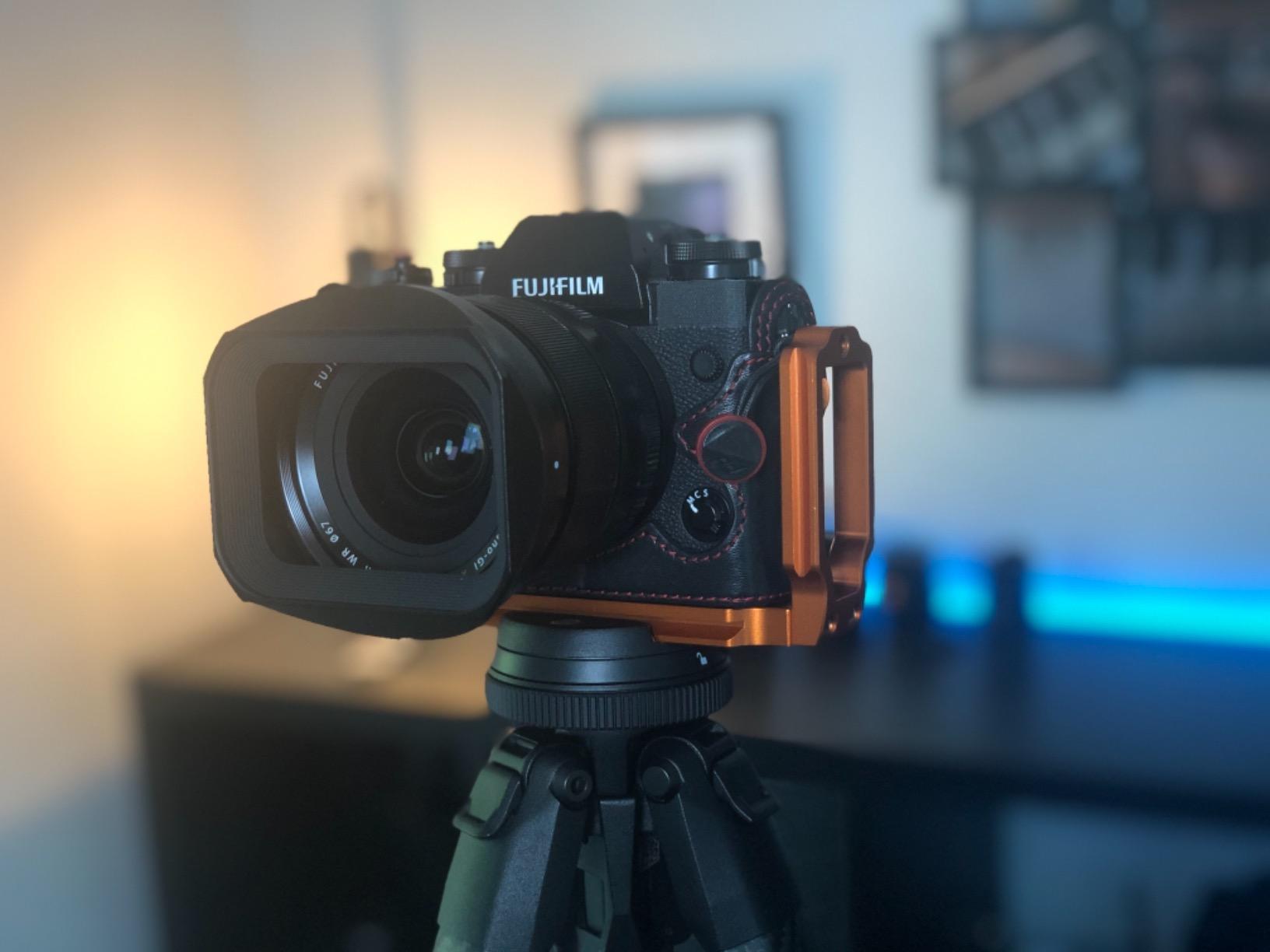
The mechanics are worth understanding. Carbon fiber legs give the tube enough stiffness to stay rigid at a diameter where aluminum would need to be thicker and heavier, and the reverse-folding hinge at the top of each leg wraps the tubes around the center column so the packed bundle has no dead space. The result is a 3.11 inch wide packed profile.
Two details get missed in the spec sheet. The center column carries a built-in mobile device mount that pops out, and the included hex key stows inside one of the legs, so you are not hunting for a tool when a latch binds in the field.
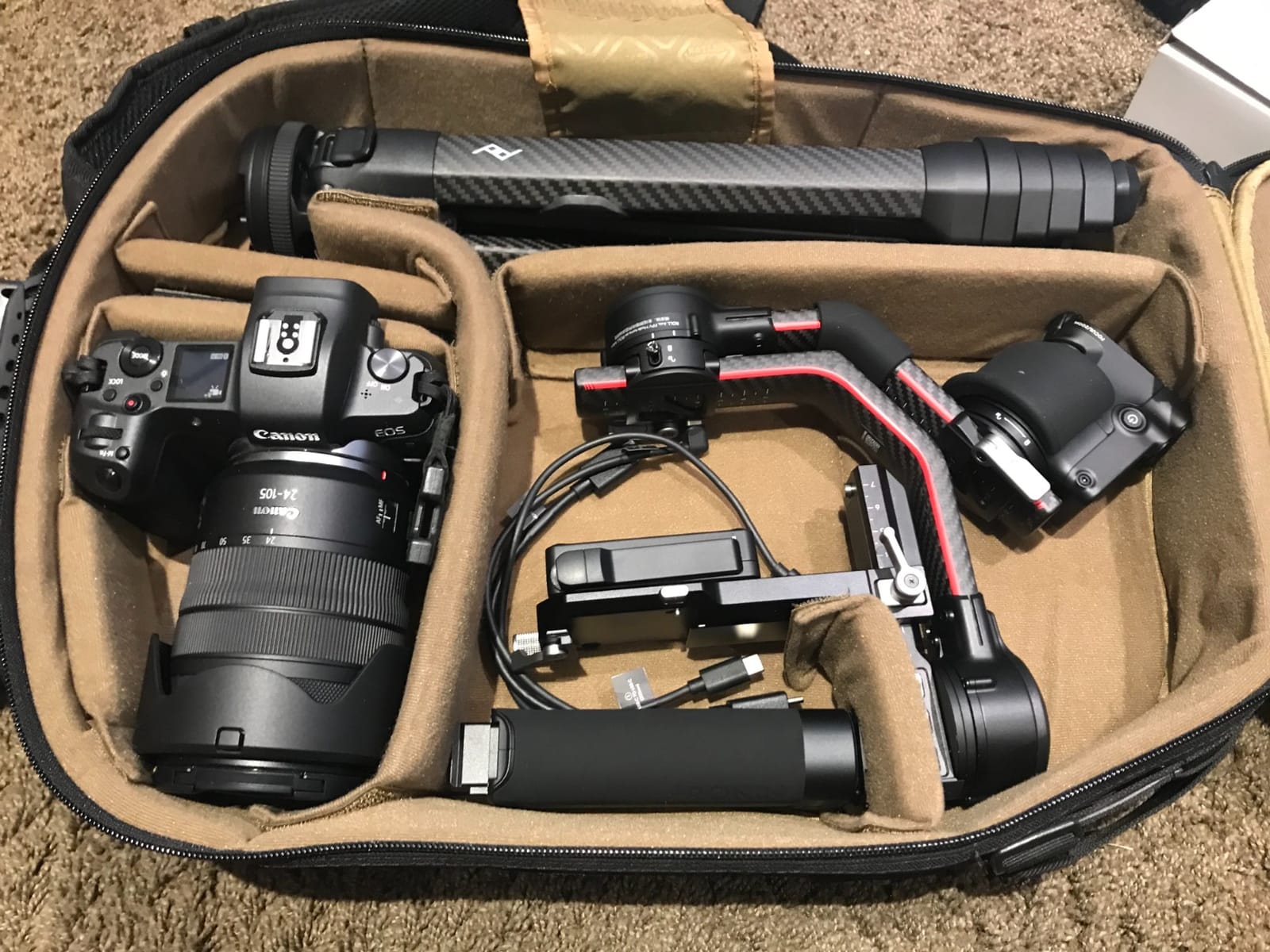
What to check before you buy the Peak Design
Make sure your usual orientation is landscape. Several owners report that the ball head’s limited mobility makes rotating a camera to vertical awkward, and that is the single most common complaint in reviews of this tripod. If you shoot a lot of portraits or vertical video, test this in a shop or buy from a seller with easy returns.
Third-party heads need the separate Universal Head Adapter, which is an extra purchase. If you already own a quality ball head, budget for the adapter or confirm that the included head is what you will use.
Where the Peak Design falls short
It is not the most rigid tripod at its rated load, and owners with heavy wildlife telephoto lenses report that it is the wrong tool for that job. The reviews are honest about this: the strength of the design is speed of deployment and packed size, not stiffness under a 200 mm lens at full height.
Users also report that the leg clips can pinch fingers if closed quickly, and that the small hex key holder can eject the tool. Both are minor, but both happen at the exact moment you are rushing.
2. NEEWER Basics Carbon Fiber Travel Tripod Monopod TP17B – Best Value
NEEWER Basics Carbon Fiber Travel Tripod Monopod, 64″ Compact, TP17B
3.2 lb weight
16.3 inch folded length
13.2 lb load capacity
64 inch max height
Pros
- Thousands of reviews backing the build
- Twist locks deploy smoothly
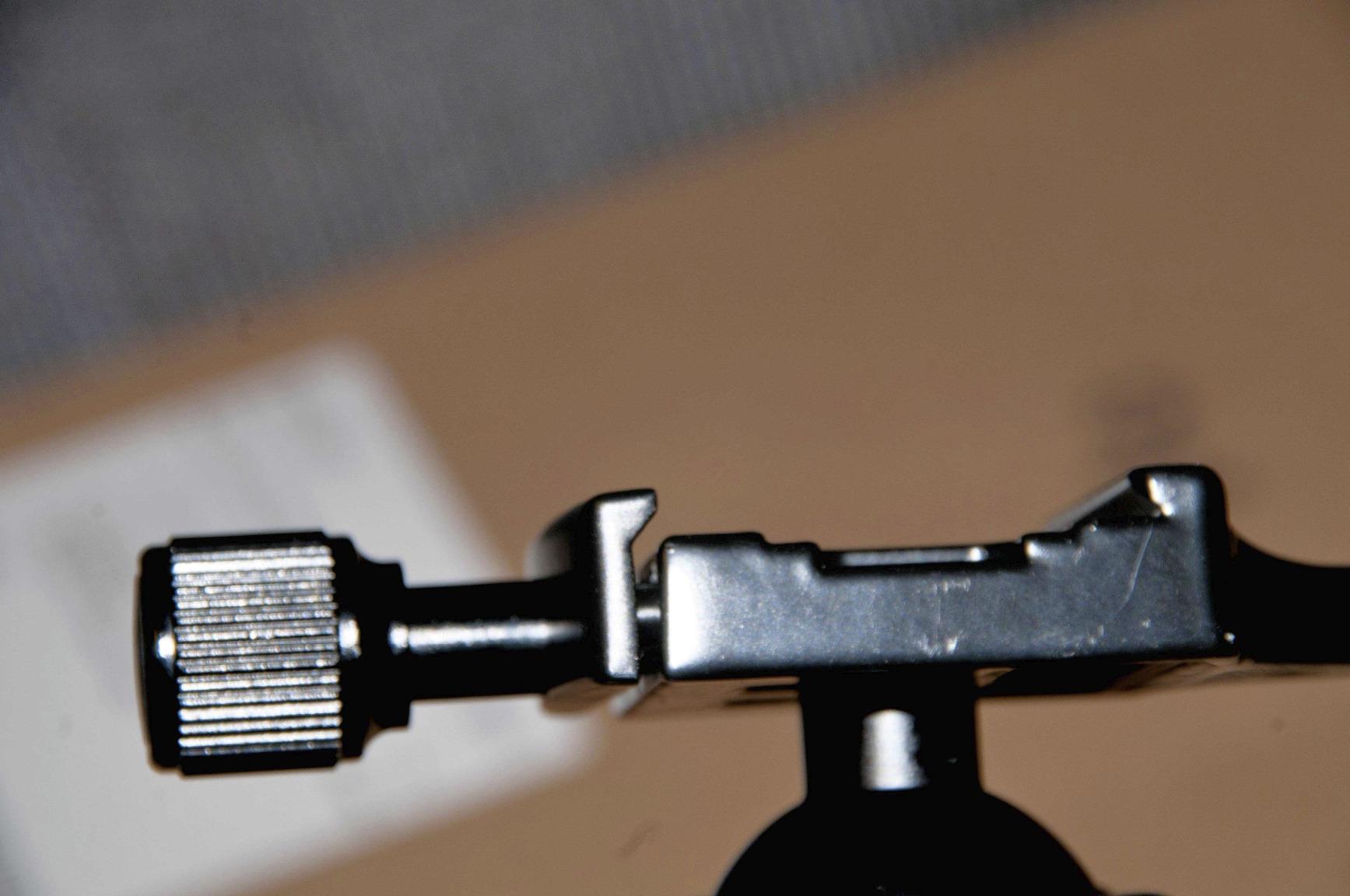
- Includes an Arca-type quick release plate
- Converts to a monopod in seconds
Cons
- Ball head friction is close to on or off
- Thin sections shake at full extension
- Heavier than its class suggests
With 3143 reviews averaging 4.6 stars, the NEEWER Basics TP17B has more owner history behind it than any other tripod on this list, and that matters more than any spec line. Buyers regularly describe it as delivering most of the stability of a professional carbon tripod for a fraction of the cost, and the review volume is why we rate it as the safest of the twelve to buy.
The height range is genuinely useful: 21.3 to 47.2 inches on the legs, with a two-section center column that extends to 63.8 inches or inverts for macro work. Three selectable leg angles let you work uneven ground without centering the column and losing height.
Removing one leg and reattaching the center column turns it into a monopod, which is the feature that saves you space on crowded trips. You lose one tripod leg, and you get a walking stick for narrow trails. The included 1/4 inch Arca-type quick release plate and a bubble level on the head are more than most budget tripods ship with.
It holds a DSLR plus a long zoom without flexing according to owners, and the twist locks are reported to deploy and collapse smoothly. The padded carry bag with a strap is well made for the class.
What to check before you buy the TP17B
Measure your full kit, not just your camera. The 13.2 lb rating covers a body, a lens and a plate, and it is a head-and-legs limit rather than a promise. If your body plus lens exceeds 8 lb, the margin is thin at full height.
Check the ball head behavior with your own hands if you can. Owners report the friction control is closer to on or off than continuously adjustable, so a heavy video camera can wander slightly as you pan. That is fine for stills and awkward for long pans.
Where the TP17B falls short
It is 3.2 lb, which is not ultralight, and the included head is part of that weight. If your priority is the lightest possible tripod rather than the most reviewed one, look at the AOKA or the K&F Concept instead.
Legs are thin and can shake noticeably at full extension, and the foot design is basic with exposed threads that can gum up with grit. The documentation in the box is minimal, so plan ten minutes with the parts laid out before your first trip.
3. GEEKOTO Carbon Fiber Camera Tripod CT25Pro – Best for Heavy Payloads
GEEKOTO Carbon Fiber Camera Tripod with 1/4″ Quick Release Plate,Foldable
3.4 lb weight
26.5 lb load capacity
20.8 inch folded length
65 inch max height
Pros
- Highest load rating in this group
- Quick release plate swaps cameras in seconds
- Converts to a monopod in about a minute
Cons
- Slow springless twist locks
- Heaviest option here
- Thin top sections transmit vibration
A 26.5 lb rating on a 3.4 lb tripod is the number that makes this model worth a look for anyone carrying a long telephoto. It is the highest capacity of any carbon fiber travel tripod in this roundup, and it reaches 65 inches, so you can shoot over crowds and terrain that a 52 inch tripod cannot clear.
Owners treat it as a budget first travel tripod. The quick release plate swaps cameras in about two seconds, the center column reverses for low and macro angles, and the three-angle leg system with a safety lock handles uneven ground. The center column hook accepts sandbags, which is the cheapest stability upgrade available.
It folds to 20.8 x 5.3 x 4.9 inches, which makes it the longest packed tripod in this roundup, ahead of the Benro Slim at 20.1 inches. That packed size is the trade you make for the extra payload and reach, and it pays off only if you are carrying one long lens rather than swapping bodies all week.
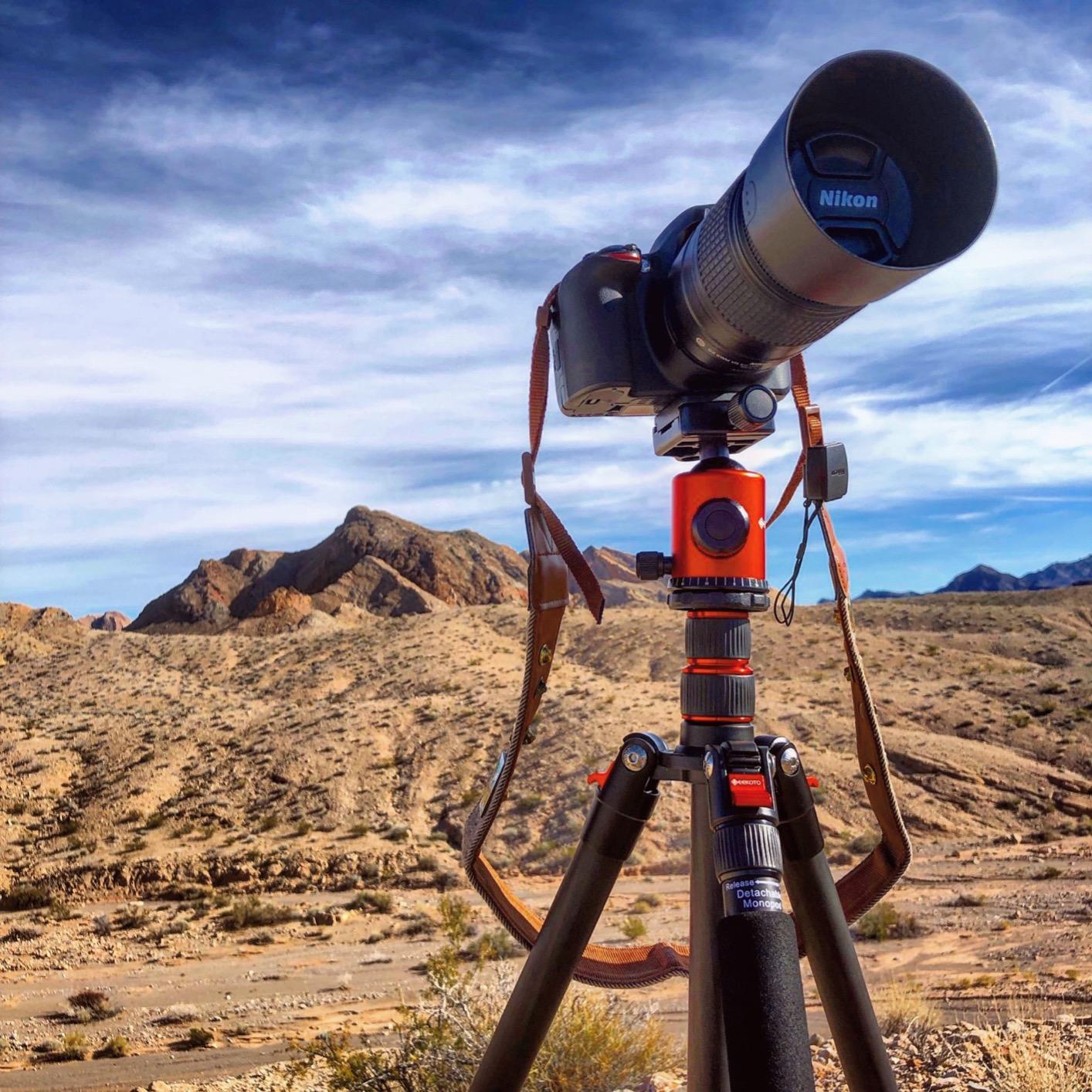
At this rating, the diameter of the tubes matters more than the material. Thick carbon tubes carry a heavy load without the flex that thinner ultralight tubes show, and the 360 degree rotating, 90 degree tilting ball head has a damping adjustment knob for smoother framing.
What to check before you buy the CT25Pro
Setup speed. The twist locks have no spring assistance, so you work each one in sequence while the tripod is half open. Owners who value fast deployment above all else find this slow, and it is the most common complaint in reviews.
Bag space. At 20.8 inches folded and 3.4 lb, this one needs a suitcase rather than a side pocket. Measure your daypack before you commit.
Where the CT25Pro falls short
Ball head friction adjustment is limited, and the head is the first thing many owners consider replacing. The top leg sections can still transmit vibration at maximum height even with a 26.5 lb rating, because rated capacity and rigidity are different measurements.
It is also heavier than many carbon tripods in its class, which partly undercuts the reason to choose carbon in the first place. If your kit is under 10 lb, the lightness of the K&F Concept is a better fit.
4. K&F Concept C225C0 with Detachable Monopod – Best for Ultralight Packing
K&F Concept 60″ Carbon Fiber Camera Tripod, Detachable Monopod for SLR DSLR
2.2 lb weight
13.7 inch folded length
8 kg load capacity
60 inch max height
Pros
- Only 2.2 lb with a 60 inch reach
- 13.7 inch fold clears cabin length limits
- Detachable monopod column
- Inverts for low and macro work
Cons
- Resin Arca clamp on the included head
- Minimum height of about 13 inch
- Occasional defective leg-angle latches
At 2.2 lb and 13.7 inches folded, the K&F Concept C225C0 packs smaller than almost anything in this roundup while still reaching 60 inches. That combination is the reason it ranks this high. It is one of the few carbon fiber travel tripods where packed size, not weight, is the standout number.
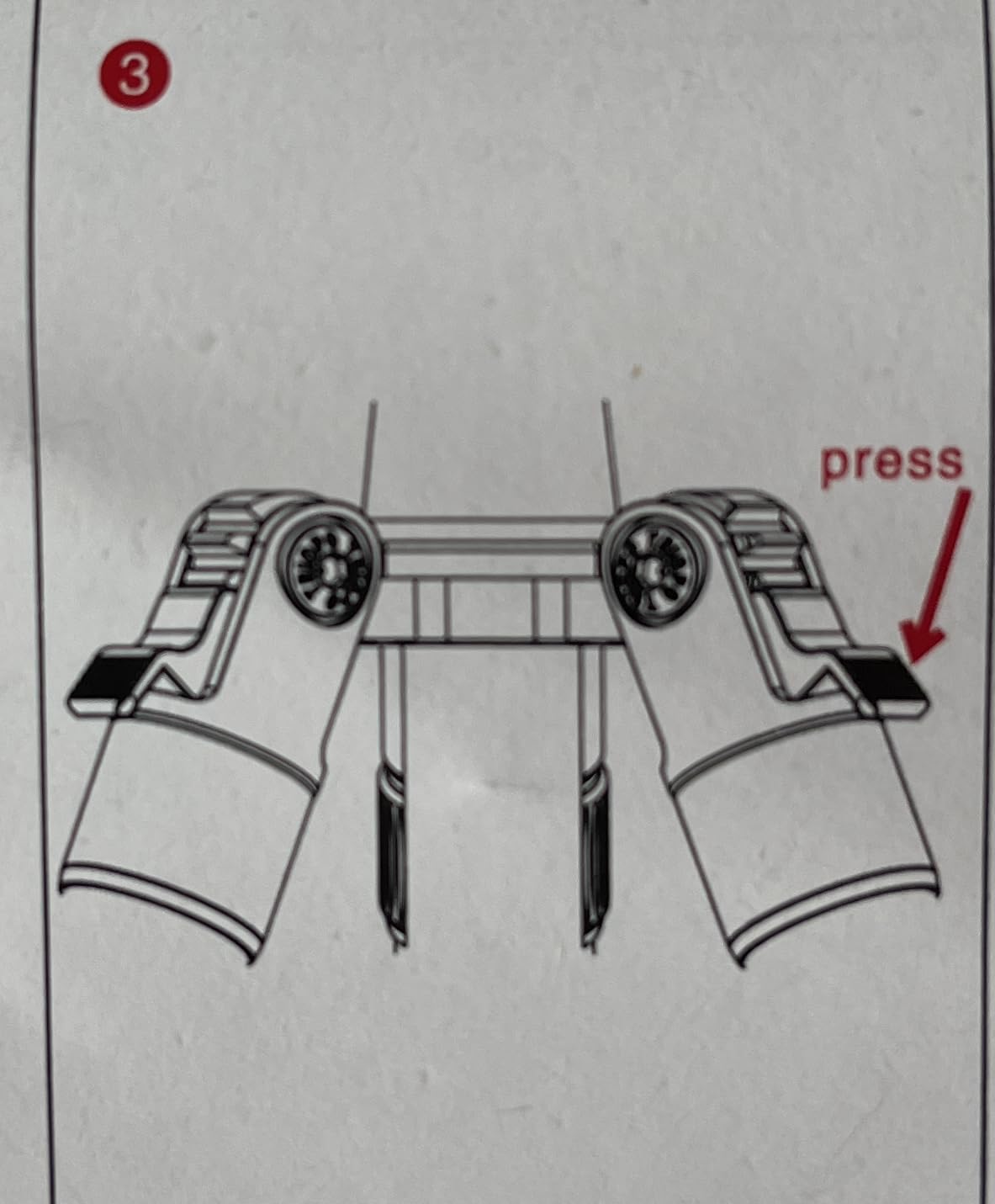
The 180 degree reflex fold pulls the legs back around the center column, and the manufacturer states that the folded length fits within typical airline cabin baggage length limits. Five leg sections with metal knob locks span 18 to 60 inches, so the tube count is high but the folded result stays short.
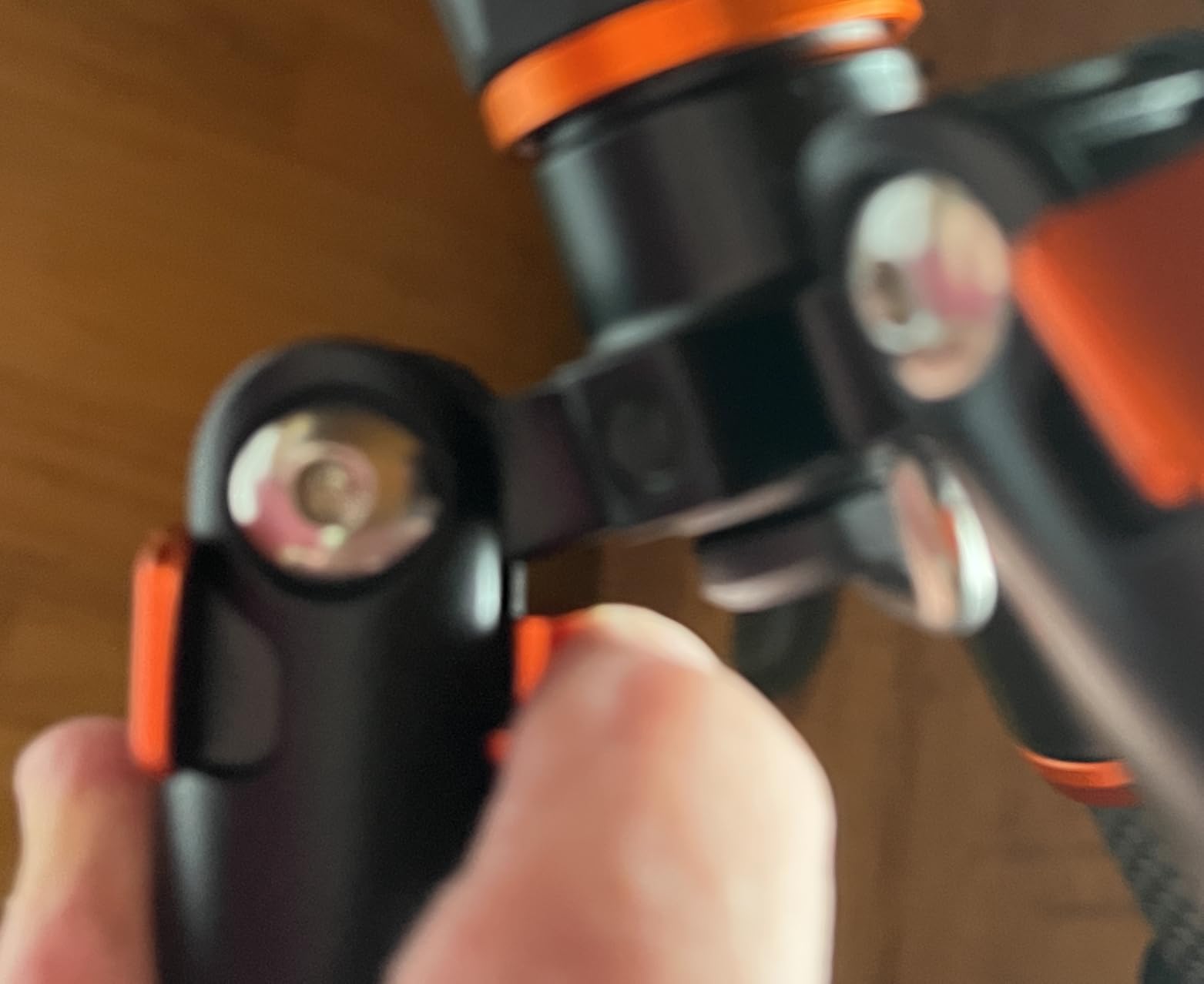
The center column detaches to form a monopod from 14.6 to 62 inches, which is unusual at this weight and lets you track a subject across a scene without carrying a second support. The quick-release column also inverts for macro and low-angle work without tools.
Detailed reviewers in the 914-review pool note that build quality rivals larger Gitzo and Manfrotto models, and that the included 25 mm ball head carries a 360 degree horizontal scale plus broad Arca-Swiss compatibility. Customer service is reported as responsive when a unit arrives with defective leg latches.
What to check before you buy the K&F Concept
The minimum working height of about 13 inches is the real limitation. If you shoot low ground-level scenes, close macro of plants, or stars without an extension post, the inverted center column gets you part of the way but not to ground level.
Weight your kit against the 8 kg rating. That covers a mirrorless body and a zoom comfortably, and a body with a telephoto with little margin left. Buyers with heavier kits report wobble at full extension.
Where the K&F Concept falls short
The included ball head uses a plastic resin bridge in the Arca clamp rather than solid metal, and the raised clamp screw limits how far a long Arca plate can slide in. If you already own a proper head, this kit is a monopod column with legs.
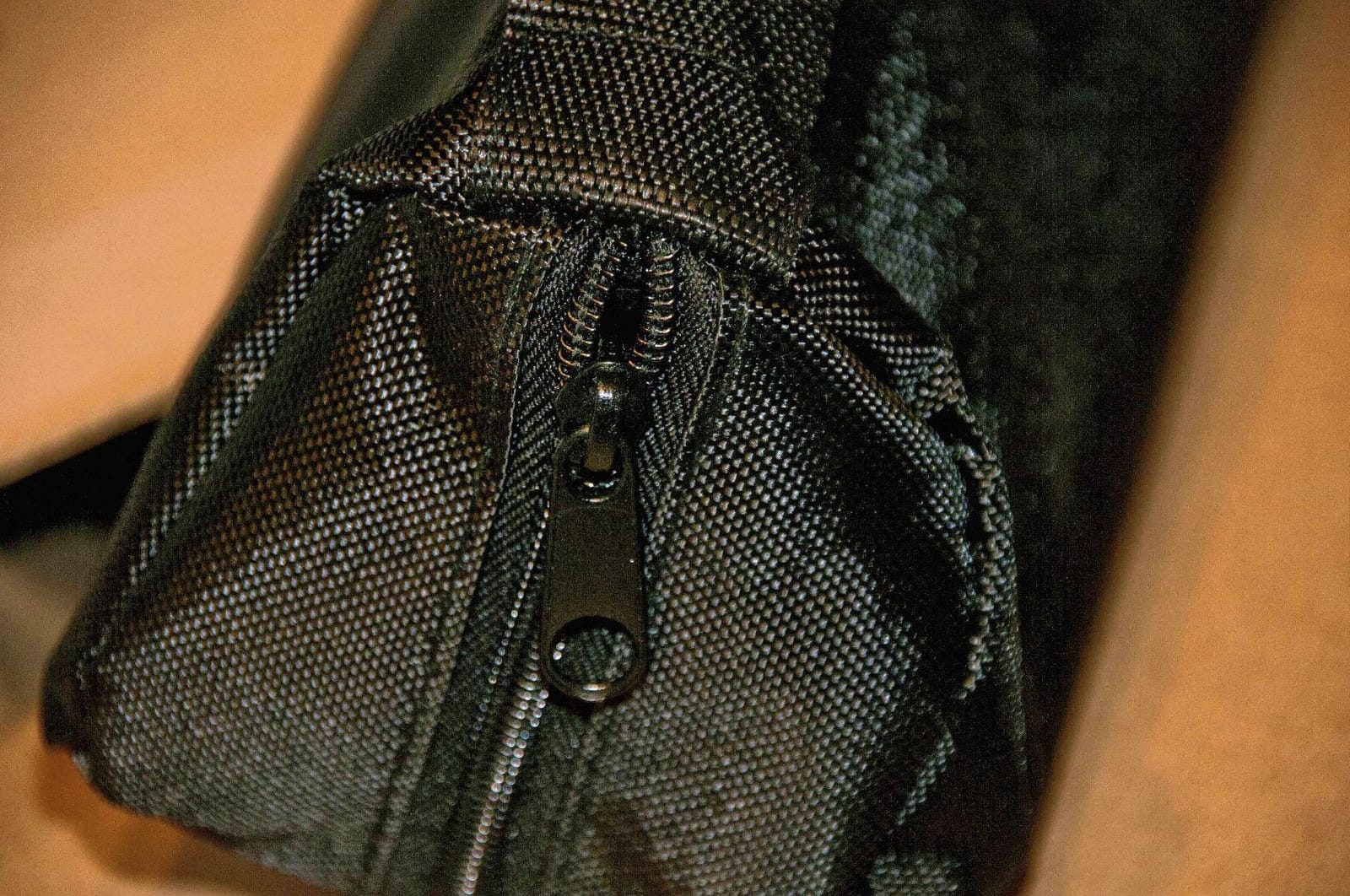
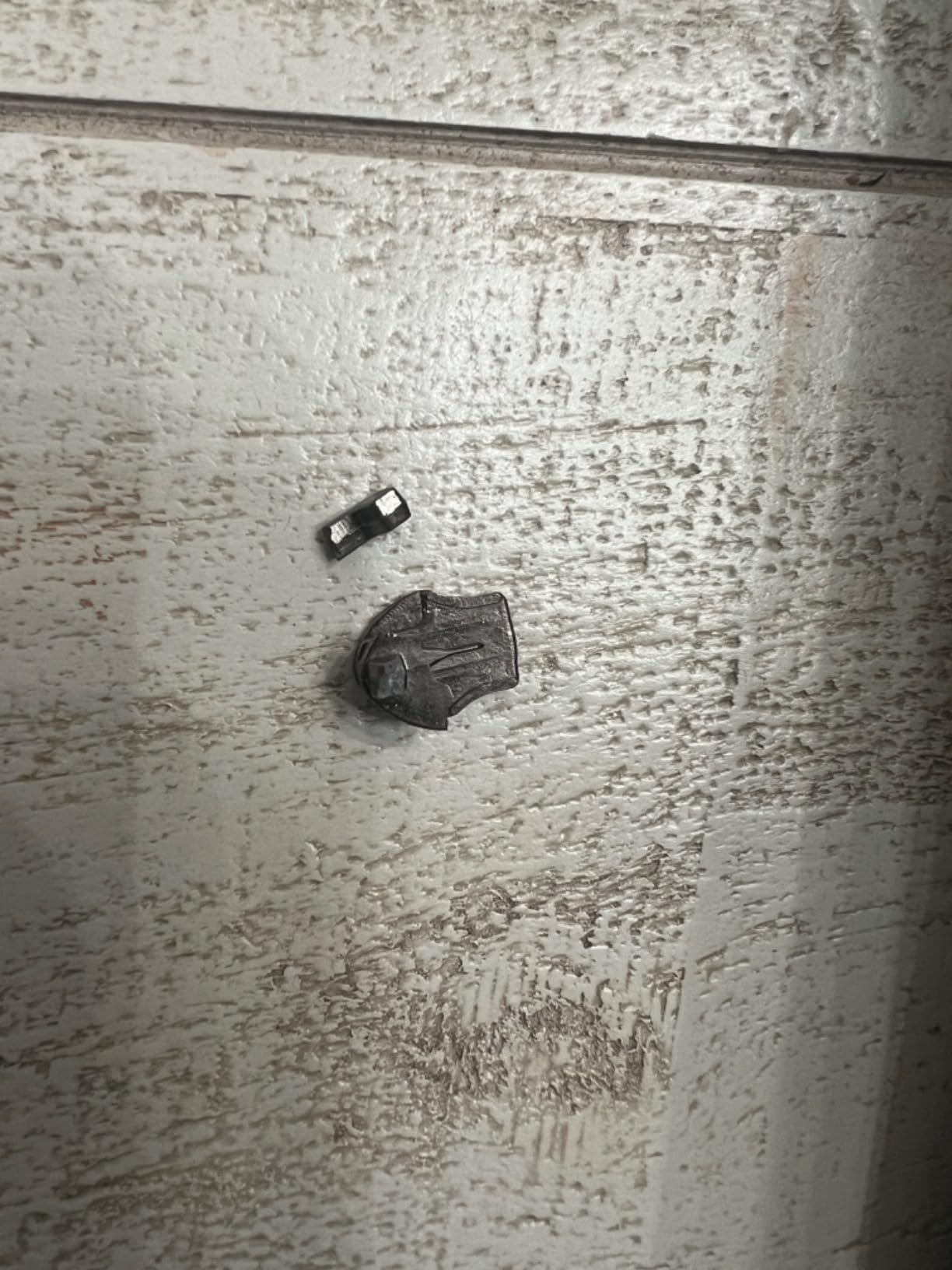
Reviews also cover leg-angle latches that arrive jamming or failing to hold position, along with a carry bag whose inexpensive zipper can give out early.
5. NEEWER LITETRIP LT32 – Best for Modular Heads and Accessories
NEEWER LITETRIP LT32 62″ Travel Tripod Carbon Fiber with +/-5° Leveling
2.6 lb weight
17 inch folded length
22 lb leg capacity
26 mm carbon tubes
Pros
- Genuinely rigid at full extension
- Spring-loaded flip buckles deploy fast
- Accepts Arca and Peak Design plates
- Includes spikes and accessory threads
Cons
- Stock ball head is limited for video
- No independent pan control
- Carry case fits only the bare tripod
The LT32 is the one full-size tripod in this roundup built around 1 inch, 26 mm carbon tubes at a 2.6 lb weight, and that pairing is why reviewers compare it favorably to the Peak Design on stiffness. Where thinner ultralight legs flex, owners report this one stays rock solid fully extended, including with long lenses.
The locking system is the other story. Spring-loaded metal flip buckles deploy faster and lock more securely than the twist locks most rivals use, and they are easier to confirm closed in dim light or with gloves. Legs adjust from 16 to 62 inches across four sections with 22, 55 and 70 degree angles.
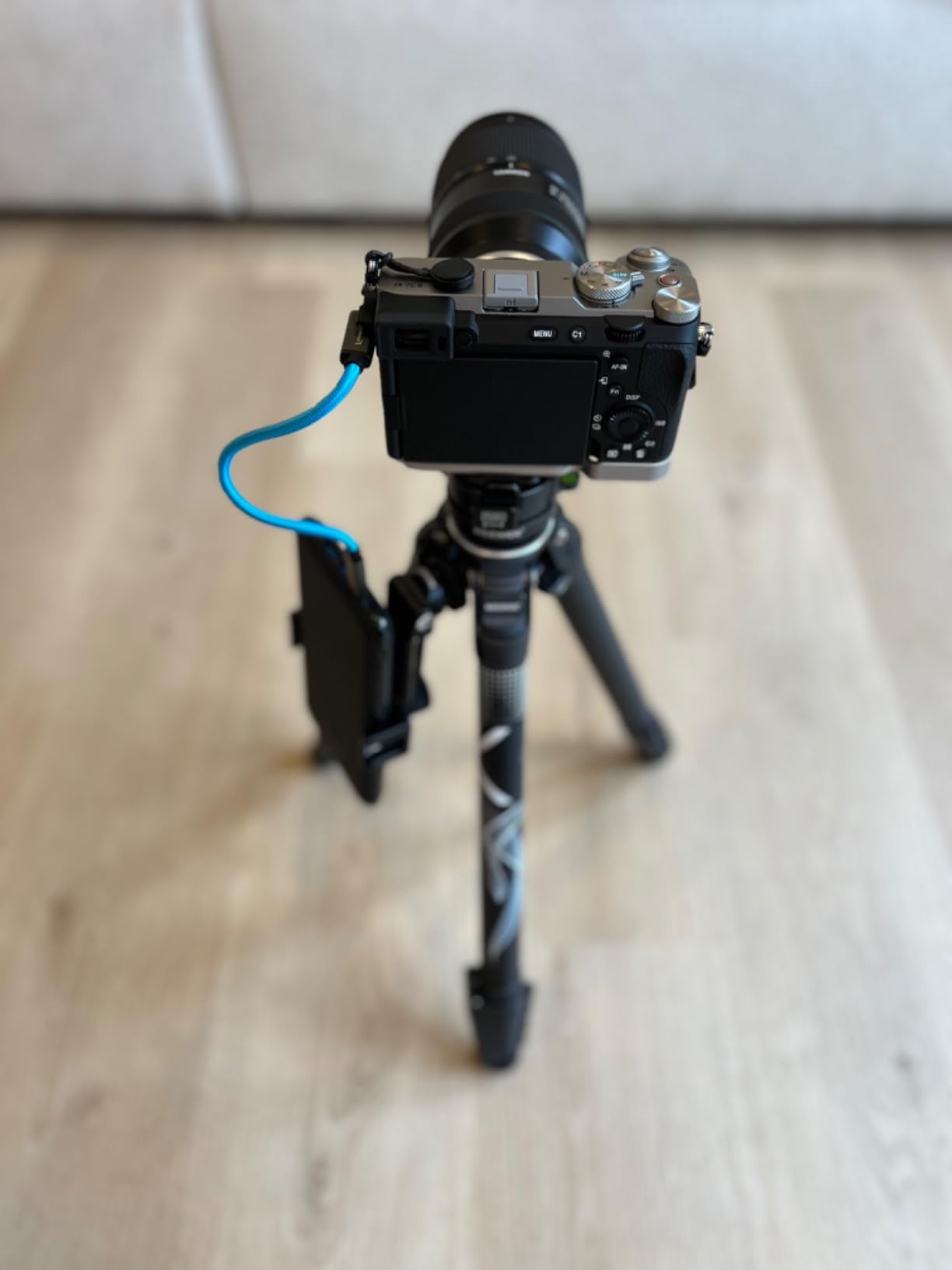
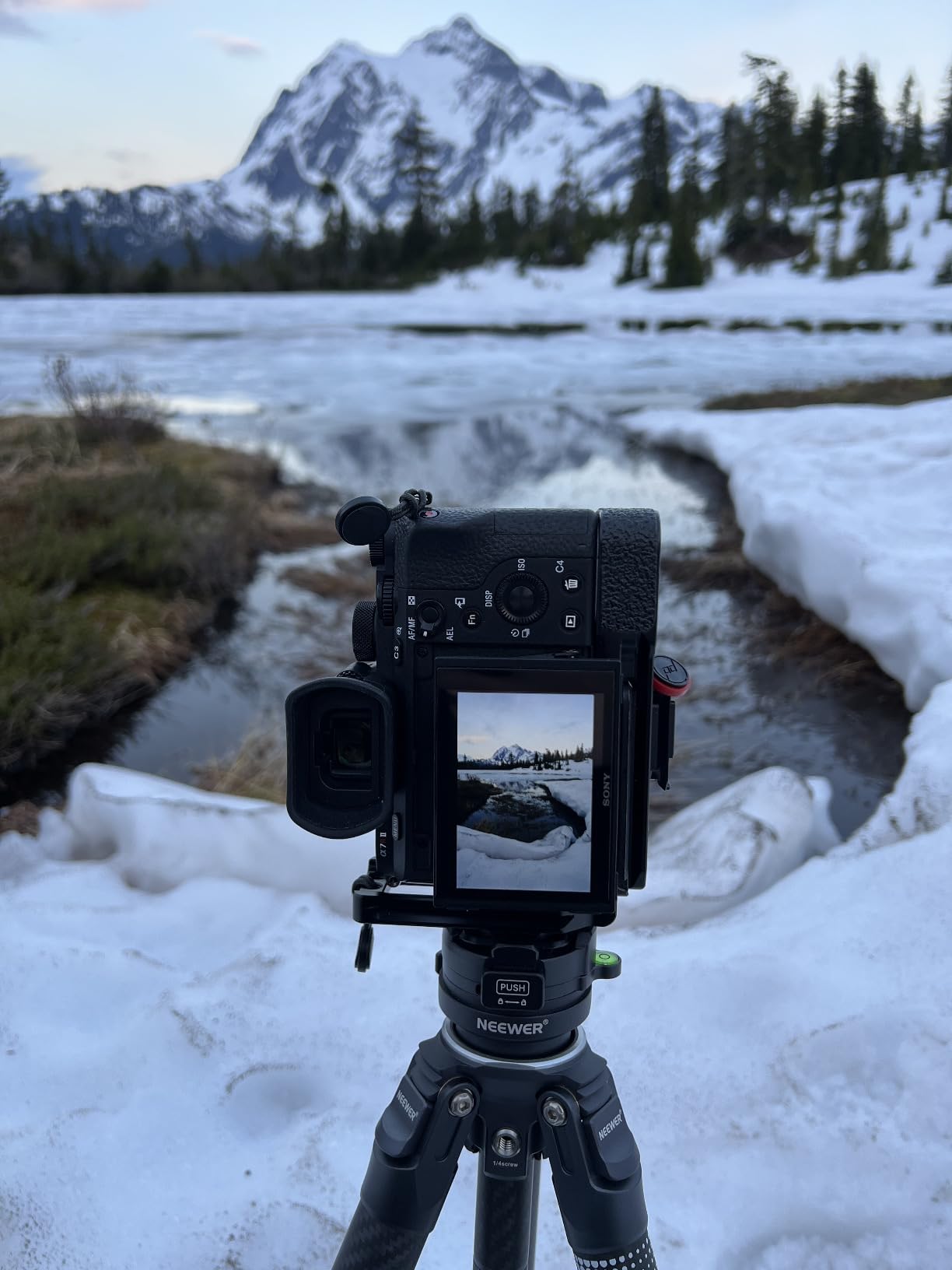
Modularity is the point. The center column is detachable, the ball head base detaches with plus or minus 15 degree quick leveling and dual U slots for 90 degree tilt, and the Arca-type quick release plate has a side push button with a safety lock. The same plate also accepts Peak Design plates, which solves the ecosystem problem for people who own both.
Two 1/4 inch threads on the spider accept magic arms and accessories, and removable non-slip foot pads take spikes for sand, rock and mud. Reversing the center column reaches 7.5 inches for macro, one of the lowest working heights on this list.
What to check before you buy the LT32
Plan to replace the head. Multiple owners treat the kit as legs and buy a separate fluid video head or a better ball head. The included head works for stills, but it has no independent pan control, which is awkward when you rotate the camera to vertical.
Note the split rating: 22 lb on the legs, 10 lb with the ball head fitted. The head is the limiting component, so your real ceiling for a heavy kit is 10 lb.
Where the LT32 falls short
The thinnest leg sections still show slight spring when fully extended with long lenses, and the quick release plate can feel to hold lightly without added friction tape. The included carry case fits only the bare tripod, not a mounted camera.
It is also the longest folded length of the mid-size options here at 17 inches, so it takes more space in a daypack than the Peak Design or the SIRUI models.
6. Manfrotto Befree Advanced Twist – Best for Build Quality and Service
Manfrotto Befree Advanced Twist Camera Tripod Kit, Travel Tripod Kit with Fluid Head and Twist Closure, Portable and Compact, Carbon Camera Tripod for DSLR, Reflex, Mirrorless, Camera Accessories
2.8 lb weight
16.14 inch folded length
17.6 lb load capacity
59 inch max height
Pros
- Refined build quality from an established maker
- Twist locks release across all legs at once
- 494 ball head has three control knobs
- Reversible center column
Cons
- 494 head does not accept Arca-Swiss L-brackets
- Feet can pull out and not refit
- Friction knob is hard to tune
Manfrotto builds for people who keep gear for a decade, and this kit shows it. The carbon fiber build is rated to 17.6 lb and reviewers report it comfortably carrying medium format bodies and pro DSLR setups such as a Canon R5 with a 24-105, at just under 3 lb.
The side pull selector releases all four legs at once with both hands, which is faster than working each leg separately. The 494 center ball head has three independent control knobs, so you can loosen only the axis you are turning, and the center column reverses for low work.

Owners note it fits inside an 18L hiking pack without becoming a burden, and that the 16 inch minimum height with a reversible column covers both standing and low framings. The 360 degree panoramic rotation and three spider lock positions handle uneven terrain.
With 154 reviews, this is the smallest sample in the group, and the ratings reflect a tripod that is well made but has a specific weak point rather than a broad problem.
What to check before you buy the Befree Advanced
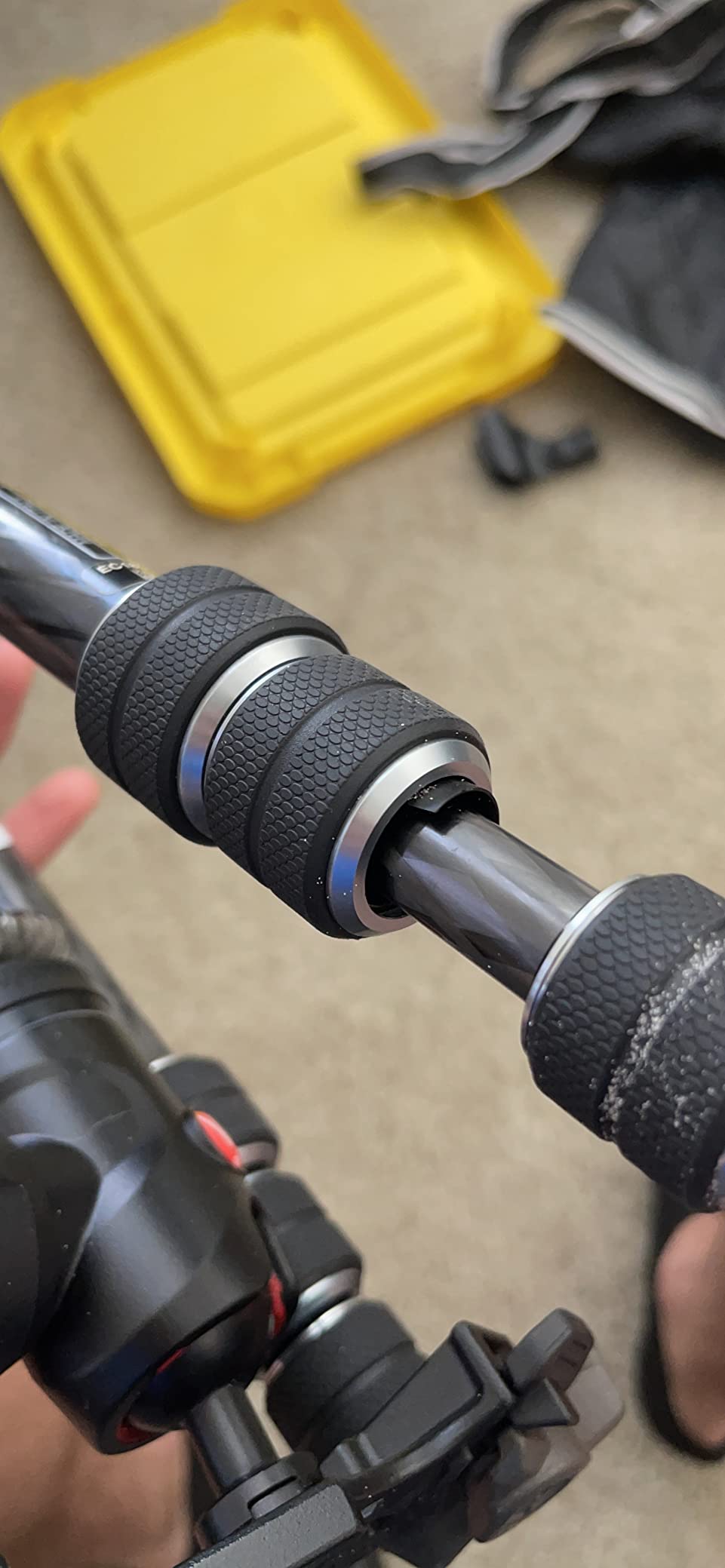
Plate standard. The included 494 head accepts Manfrotto RC2 plates, not Arca-Swiss plates, so an L-bracket from another brand will not drop in and you will rotate 90 degrees for vertical shots. This is the most repeated criticism in the reviews.
Long-term owners report the head friction knob degrades with use and is hard to hold at a consistent setting. If precise control matters to you, budget for a head upgrade.
Where the Befree Advanced falls short
A minority of reviews report broken or seized legs and cameras jamming in the head, and the rubber feet can pull out of the leg stem and cannot be refitted. The adjustment mechanism also takes practice to learn.
It is not the lightest option at this folded length, and the plate limitation means it costs you flexibility with other gear in a way the Arca-compatible models do not.
7. Benro Slim Carbon Fiber Travel Kit – Best Warranty Backup
Benro Slim Tripod Kit with Ball Head, Carbon Fiber, 4 Sections, Twist Lock Legs, 57.6″ Maximum Height, 8.78 lb. Load Capacity- Black (TSL08CN00)
3 lb weight
20.1 inch folded length
8.8 lb load capacity
5 year warranty
Pros
- Only 3.2 inch wide when folded
- Three leg angle positions
- Removable N00 head with Arca-style plate
- Warranty extends to 5 years with registration
Cons
- 8.8 lb rating limits it to mirrorless kits
- Folds longer than most at 20.1 inch
- N00 ball head is modest
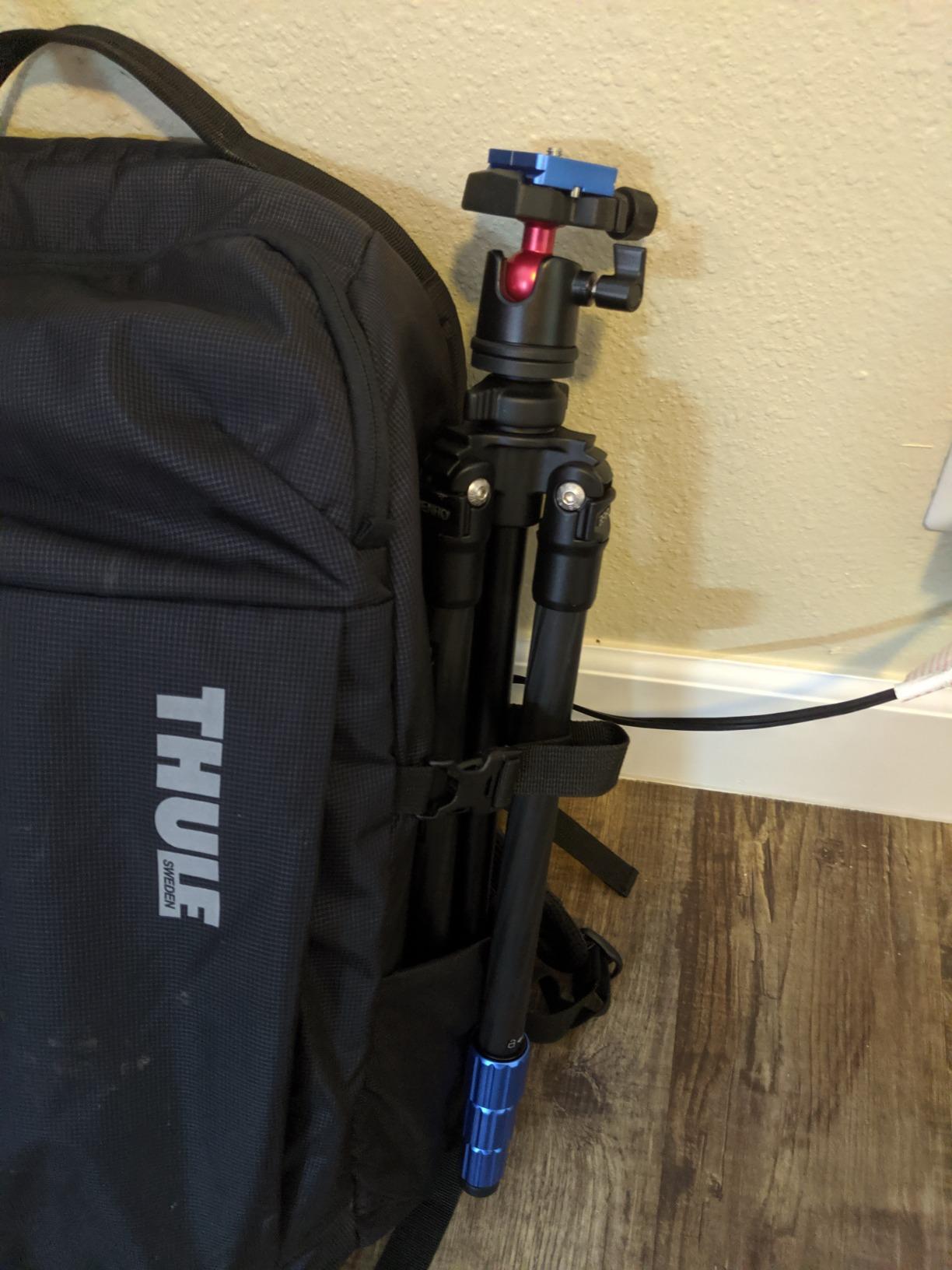
The Benro Slim is the narrowest of the full-size tripods in this roundup, folding to only 3.2 inches wide, and that packed diameter is what makes it interesting. Length is not its strength at 20.1 inches, but width is the measurement that decides whether a tripod slides into a narrow daypack or sits on top of everything else.
It includes a removable N00 ball head with an Arca-Swiss style quick release plate, so the plate works with common third-party accessories, and the magnesium alloy shoulder gives it a solid feel above its class. Owners report the twist locks stay secure and repeatably tighten over time.
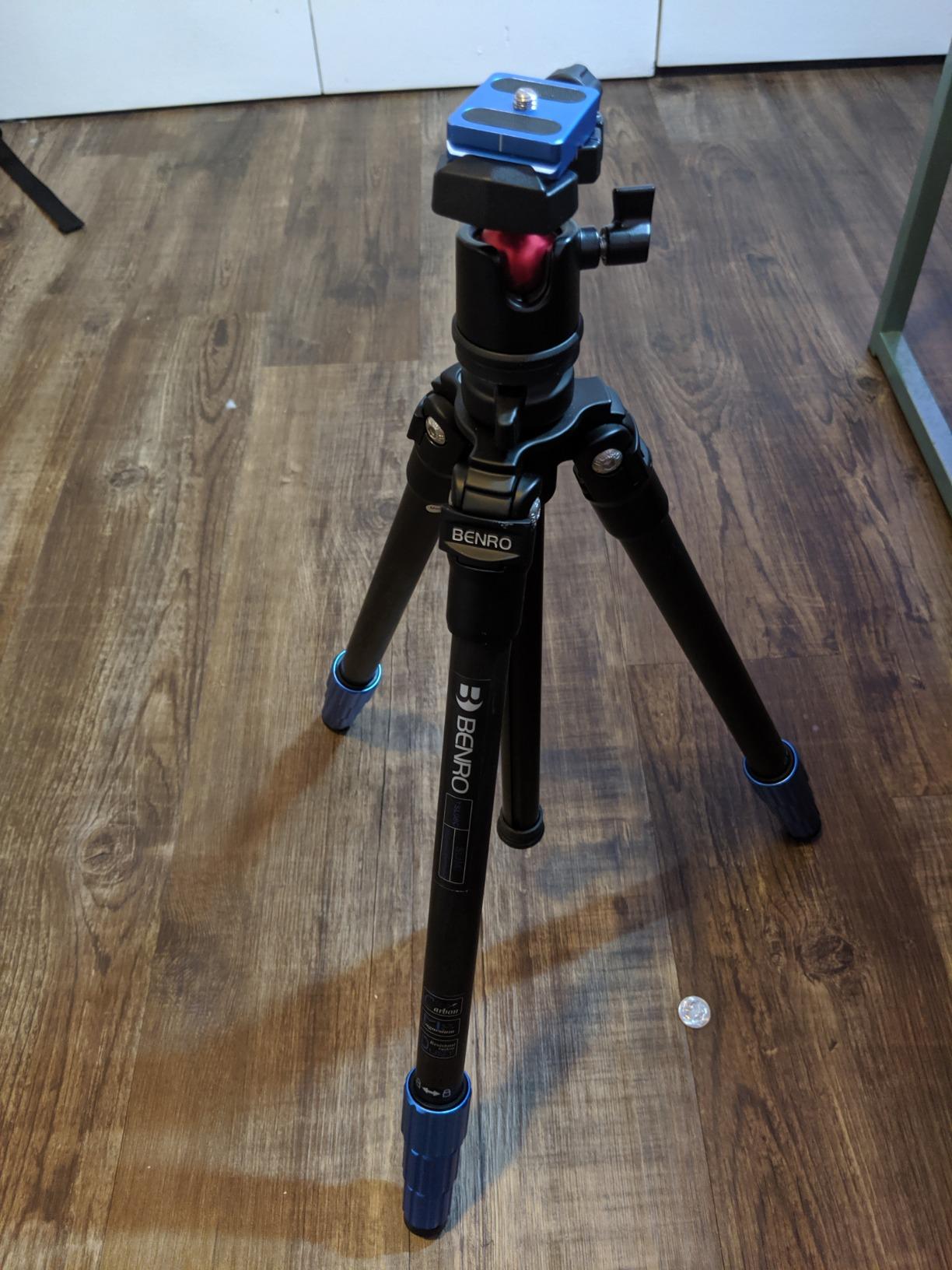
The carbon legs use twist-lock sections with three leg angle positions, and the center column reverses for versatility. Height runs from 15.74 inches to 57.59 inches, which is a shorter reach than most here but a low minimum that helps with close work.
The warranty is the differentiator. A three-year limited warranty extends to five years with online registration, which is longer than the one-year and two-year terms attached to several competitors in this group and the only multi-year registration offer among the budget options.
What to check before you buy the Benro Slim
The 8.8 lb rating. That is a mirrorless body plus a compact zoom, not a body plus a telephoto. If your kit is heavier, the rating is not a formality, it is the ceiling.
Length, not width. At 20.1 inches folded, this is one of the two longest options here. The narrow profile helps in a tight pack, but the length still decides whether it goes in your daypack or your suitcase.
Where the Benro Slim falls short
The N00 ball head is modest and many users upgrade it, and the ball can loosen enough to need a retightening during a session. It is not as light as dedicated ultralight carbon travel tripods despite the carbon legs.
Owners also note that the low rating and the modest head together push serious users toward a different tripod. It is a good kit for the weight it is designed to carry, and a poor substitute for a heavier one.
8. SIRUI AM-223 with SL-100 Center Column – Best for Tabletop and Table-Level Work
SIRUI Lightweight Carbon Fiber Mini Travel Tripod with Two-Section Center Column, Max Height 26″, Supports 22lbs (AM-223+SL-100)
1.46 lb total weight
8.5 inch folded without column
22 lb load capacity
26 inch max height
Pros
- Highest rated in the set at 4.7 stars
- Folds to 8.5 inches without the column
- 22 lb rating far beyond its weight
- 1/4 inch accessory port for lights and microphones
Cons
- Not a full-size travel tripod
- Best for mirrorless and compact cameras
- Small platform for large setups
This is the highest rated product in our set at 4.7 stars across 292 reviews, and it earns that rating by doing one thing extremely well. At 1.46 lb including the column, and 8.5 inches folded without the column, it is small enough for a jacket pocket and rated to 22 lb on 22 mm carbon tubes.
The detachable two-section carbon center column adds 12.2 inches when you need height and comes off in seconds when you do not. Working height runs from 2.3 inches to 26 inches, and the semi-automatic leg angle system offers 22, 55 and 85 degree positions.
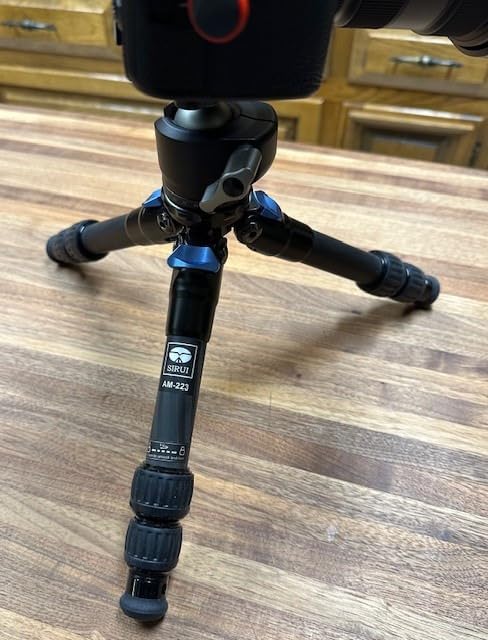
The 1/4 inch accessory port is the sleeper feature. It lets lights, microphones and other gear mount directly without a separate bracket, and one reviewer used the tripod as a walking aid on rough ground. Convertible 1/4 and 3/8 inch screws are fitted on both the tripod and the column.
Owners consistently frame this as a backup or table-level companion rather than a main travel tripod, and that framing is accurate. It is a second tripod, not the only one.

What to check before you buy the SIRUI AM-223
Height. At 26 inches maximum, this cannot replace a full-size tripod. It is right for table shots, low light, product work, group shots seated, and as a second support for a second camera.
Load expectations. The 22 lb rating is real for the legs, but a small platform is a compromise for very large or heavy setups. Mirrorless bodies, compact cameras and phones are the intended range.
Where the AM-223 falls short
It is not a travel tripod in the sense this guide means. You cannot shoot a wide vista from standing height with it, and you cannot comfortably carry a telephoto on it.
The accessory port and the included Allen key are fiddly in the field according to users, and the foot screws may come loose with the legs when you unscrew them for packing. Small details, but they happen every time you set up.
9. SIRUI Traveler 5CX – Best for Compact Packing with Real Height
SIRUI Lightweight Carbon Fiber Travel Tripod, 52″ Compact Camera Tripod with 360°Ball Head Kit, Detachable Center Column, Max Load 13.23lbs/6kg, Traveler 5CX
2.03 lb weight
12.4 inch folded length
13.23 lb load capacity
6 year warranty
Pros
- Shortest full-size fold in the set at 12.4 inch
- Works down to 3.5 inch for astro angles
- Detachable column doubles as a selfie pole
- Six year warranty
Cons
- Legs flex near full extension with heavy loads
- Column cannot be inverted
- Not for demanding long exposures
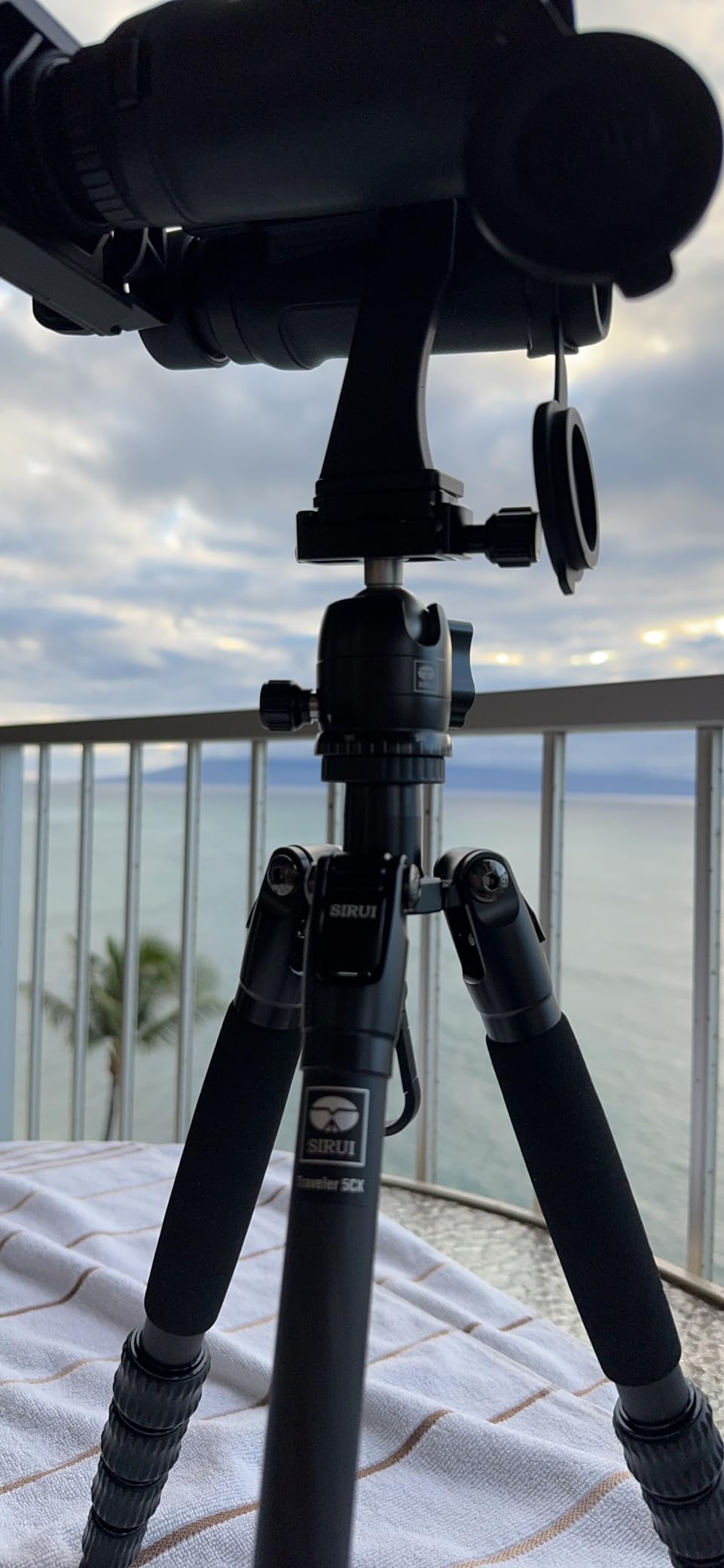
At 12.4 inches folded and 2.03 lb, the SIRUI Traveler 5CX is the shortest full-size fold in this roundup, and the 51.97 inch maximum height means you are not sacrificing reach to get it. The five carbon leg sections plus a removable column get you down to 3.54 inches, which covers genuine ground-level and night sky framings.
Owners describe the twist locks as never drifting out of adjustment over repeated use, and the detachable center column doubling as a vlogging or selfie pole is reported as more useful than expected. The 360 degree detachable panoramic ball head has separate pan control and a top level.
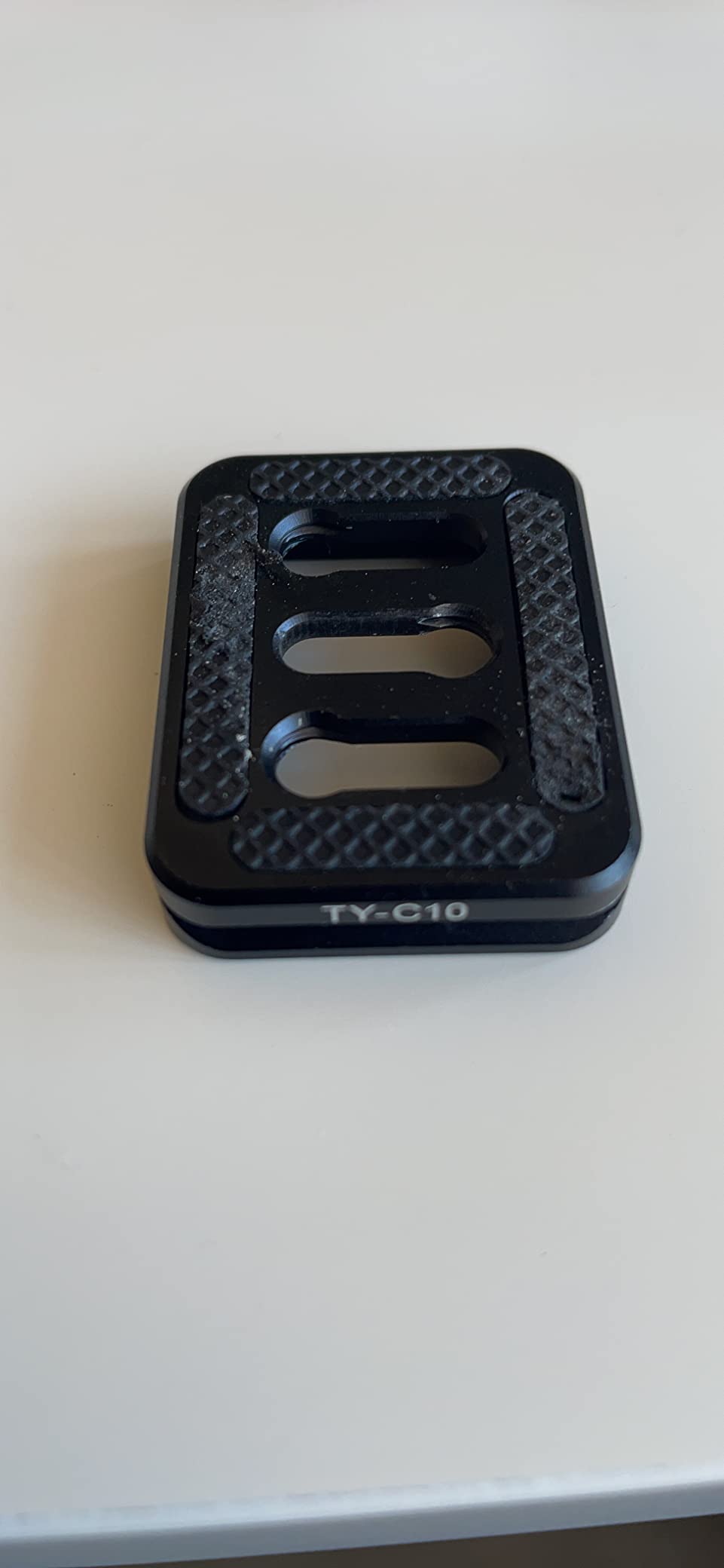
The load rating is 13.23 lb, and SIRUI publishes an honest field recommendation alongside it: roughly half the rated load at full 52 inch height. Manufacturers that publish a lower real-world number rather than a maximum test figure earn trust, and this is one of them.
Three leg angle positions, a drawstring storage pouch and an Arca-compatible quick release plate round out a package that most reviewers call strong value relative to other feature-rich carbon travel tripods.
What to check before you buy the Traveler 5CX
Full height with a heavy body. The legs flex when pushed to maximum extension with heavy payloads, and the honest 50 percent guidance at full height is worth reading as a limit rather than a formality. If you shoot long exposures at 50 inches with a telephoto, this is the wrong tool.
Macro. The column is removable only and cannot be used inverted, so low and inverted framings are limited to the leg angle positions.
Where the Traveler 5CX falls short
It is not stable enough for demanding long-exposure astrophotography, and reviewers who want Gitzo-class stability say plainly that this is not that. Some users also report plastic threading parts with a limited lifespan.
The included drawstring pouch is minimal. For a tripod this small, a proper case is worth adding to the cost.
10. SIRUI Traveler 5C – Best for Light Mirrorless Kits
Sirui Compact Traveler 5C Tripod 54.3 inches Lightweight Carbon Fiber Travel Tripod for Camera with 360° Panorama Ball Head for Arca Swiss Quick Release Plate, Max Load 8.8lbs
1.87 lb weight
13 inch folded length
8.8 lb load capacity
6 year warranty
Pros
- Light at 0.85 kg with a 13 inch fold
- Twist locks held tight over extended use
- Ball head mounts on a standard thread
- 6 year warranty included
Cons
- Advertised inverting column does not invert
- 8.8 lb rating is restrictive
- Thin legs shake at full extension
The Traveler 5C sits in the lightest weight class here at 1.87 lb, and with 562 reviews it is also the most heavily reviewed tripod in that class, which makes its 4.2 star rating a reliable signal rather than a small sample. We include it because the failures are specific enough to shop around.
What works is the weight and the fold. At 0.85 kg and 13 inches folded it fits dedicated tripod straps on a hiking bag, the twist locks held tight through extended use with no developing looseness, and the rubber feet grip rather than behaving like hard plastic. The ball head mounts on a standard thread, so it can be swapped for an upgrade.
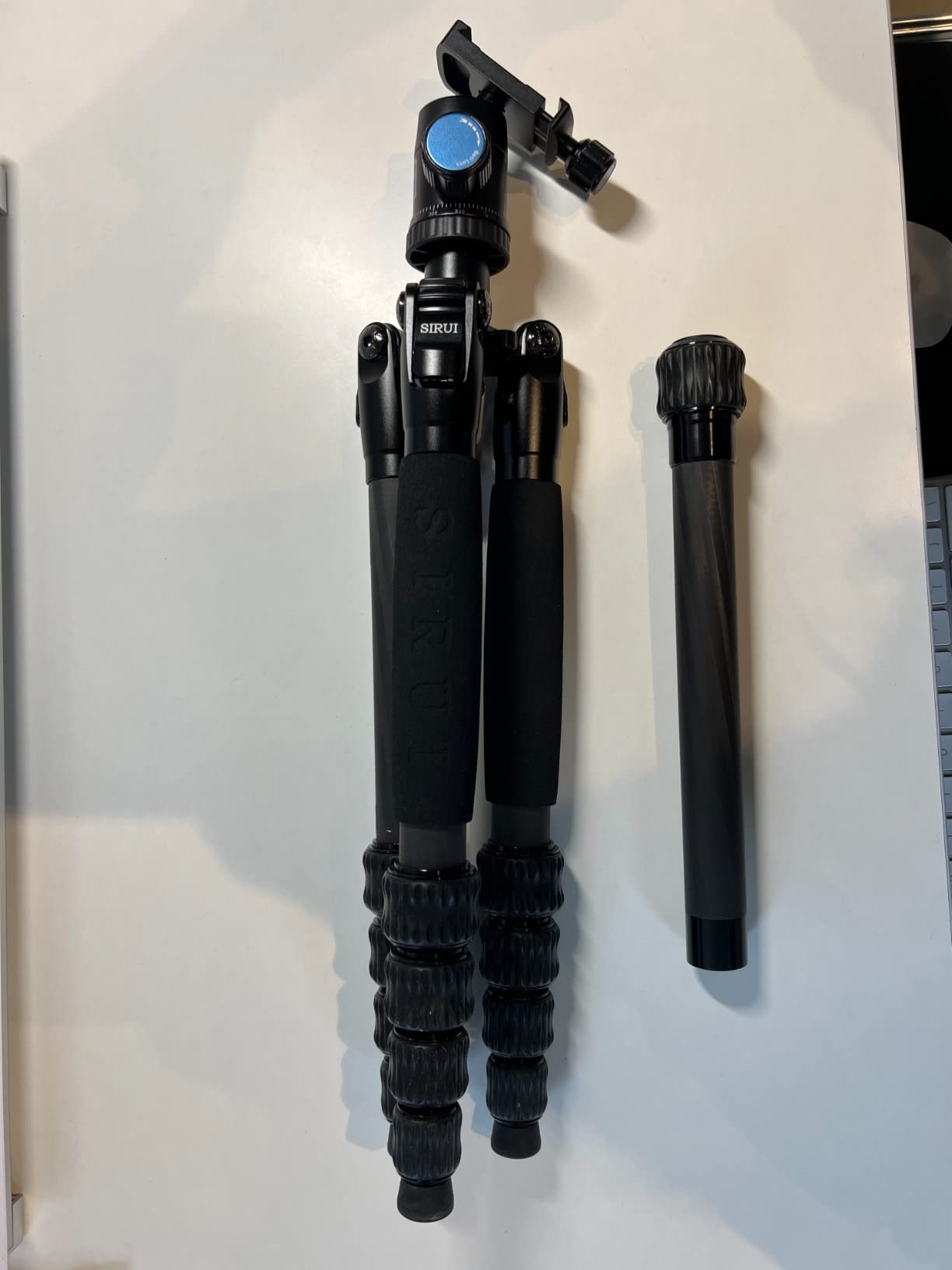
Owners also report it rigid enough for a Canon 1DX with a 35-250 mm when the camera is mounted at the lens rather than on the body, which is a legitimate technique for protecting capacity. The carry bag and an accessory pouch with hex keys and a carabiner are included, along with a six year warranty.
Three-position leg angle adjustment, a center column hook for hanging weight and legs that invert 180 degrees for compact storage complete the feature list. The aluminum ball head has two independent control knobs with 360 degree pan and vertical tilt.
What to check before you buy the Traveler 5C
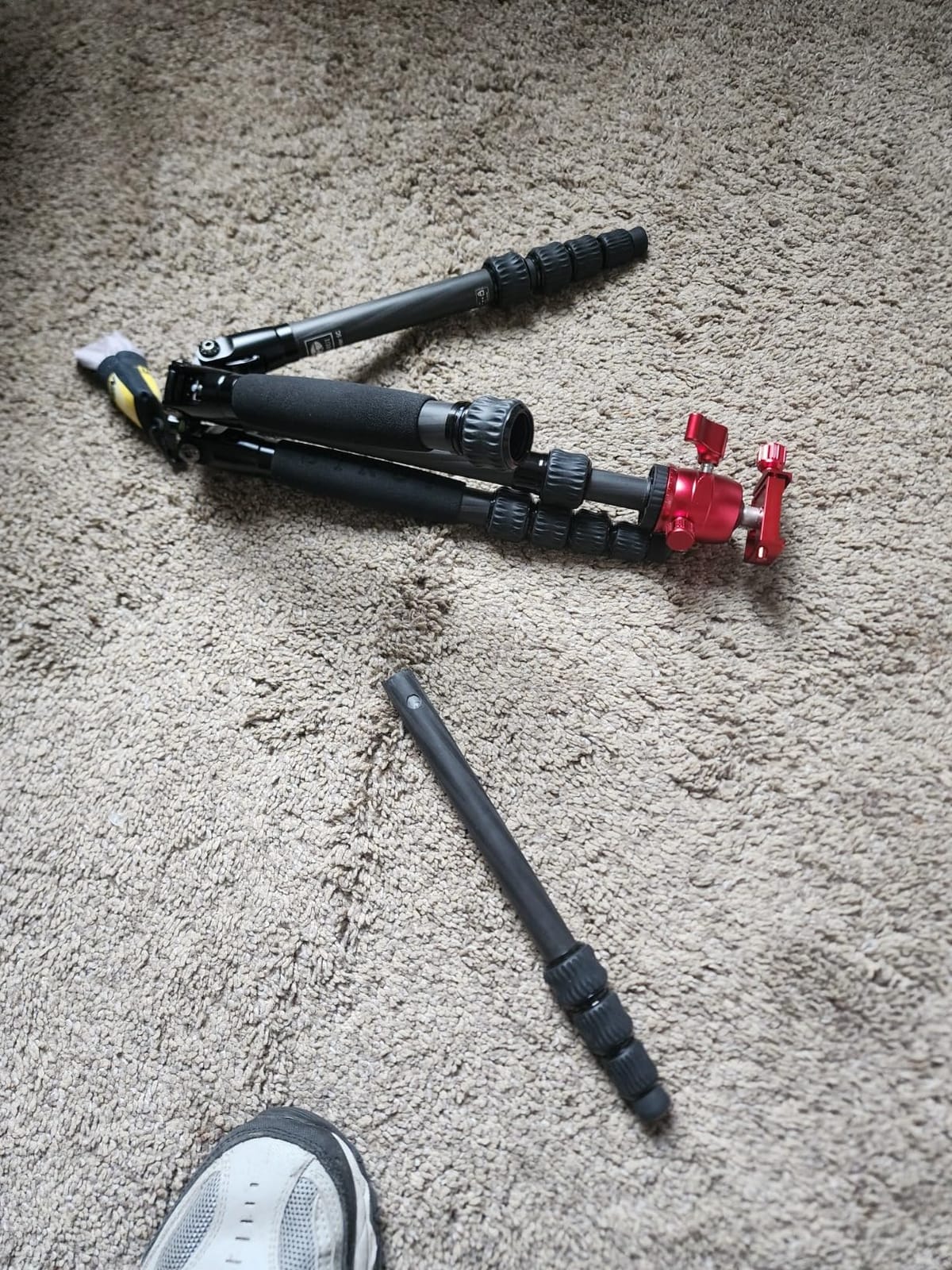
The inverting center column. The listing advertises inversion and reviewers report that it does not actually invert, and that flipping the legs instead does not lock securely. If inverted macro is part of how you shoot, do not buy this on that basis.
Plate security. Some users report the Arca clamp geometry letting certain third-party quick release plates slip, which is a camera drop risk. Test your own plate, and stick to the included one if you cannot.
Where the Traveler 5C falls short
The 8.8 lb rating limits it to mirrorless bodies and lighter DSLR kits, and thin legs transmit shake at full extension, making it weak for low light and long exposures. The weight saving against an aluminum travel tripod is also modest in practice.
The head-to-leg retaining screw can loosen with use. If you work on a deadline, check it at setup rather than at the shot.
11. AOKA Carbon Fiber Mini Travel Tripod CMP163CL – Best for Hiking and Backpacking
AOKA Carbon Fiber Mini Travel Tripod with 360° Ball Head
1.1 lb weight
14.6 inch folded length
6.6 lb load capacity
2 inch slim diameter
Pros
- Lightest full-featured option at 1.1 lb
- Slim 2 inch packed diameter
- Extension rod raises it to about 54 inch
- Accepts Peak Design and Arca plates
Cons
- Extension pole flexes and vibrations damp slowly
- Slow twist-lock deployment
- Extra screw needed to close the legs
Reviewers treat the AOKA as hiking gear rather than photography gear, and that is the most useful way to think about it. At 1.14 lb for the tripod and about 590 g with the extension rod, it is well over a pound lighter than the full-size carbon travel tripods in this group, and it goes places larger tripods never will.
It folds to 14.6 inches with a slim 2 inch diameter and needs no center pole, so the packed profile is genuinely slender. Three-section carbon legs give a base height of about 28 inches, and the two-section extension rod raises that to roughly 54 inches for standing shots.
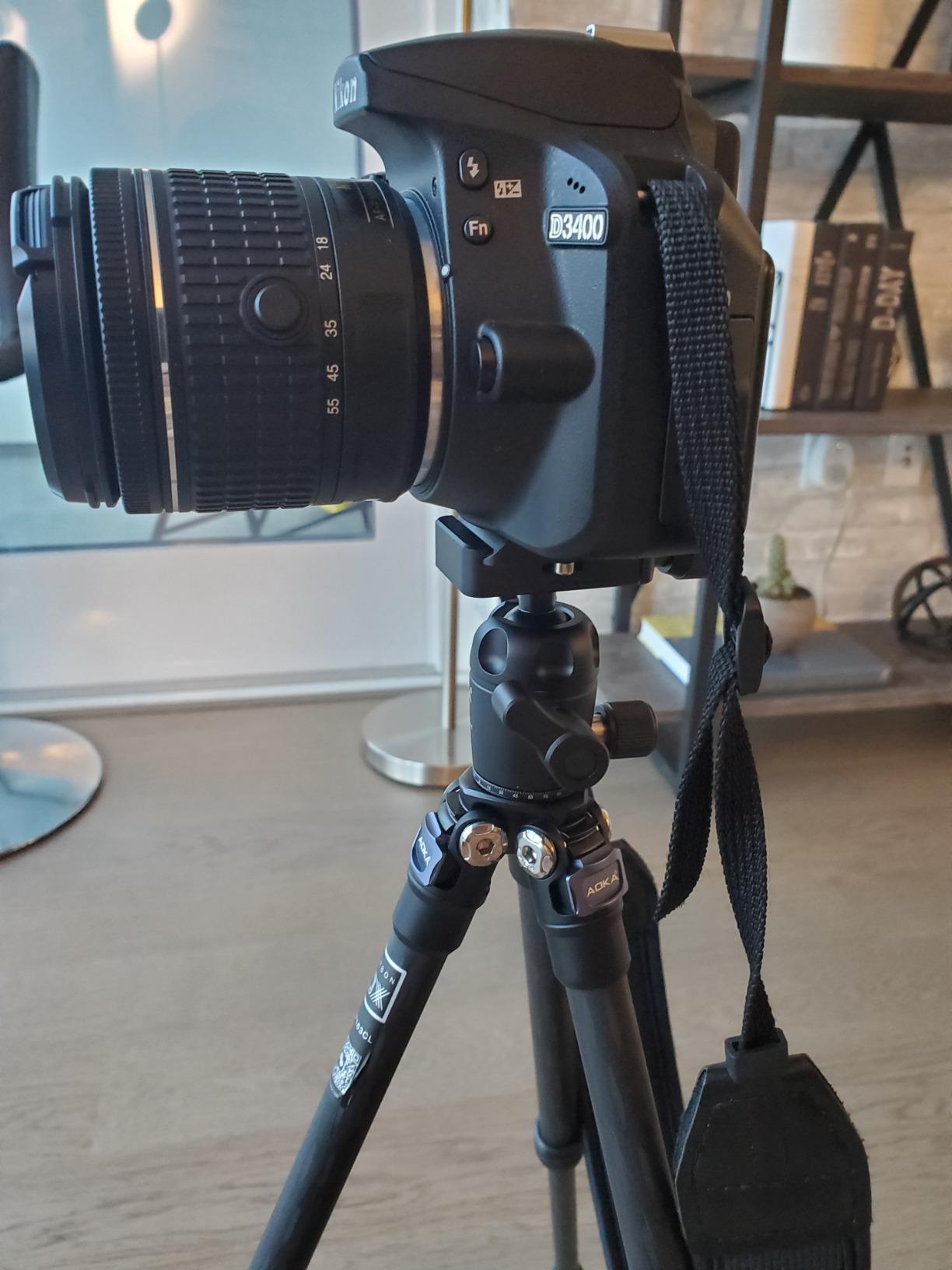
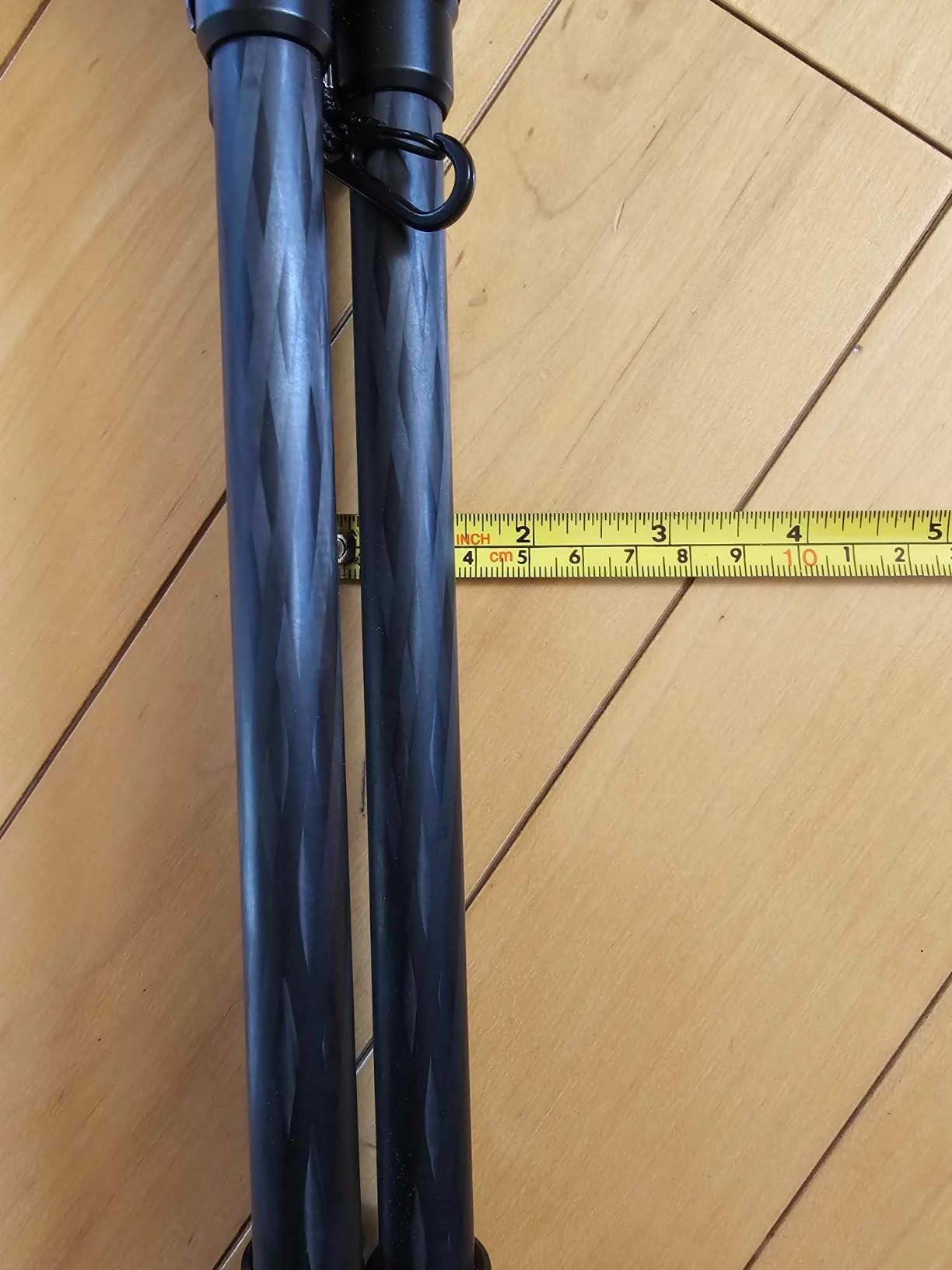
Detailed users measure the geometry and describe it honestly. With the thinnest section retracted it is rock solid for star and long exposures, while the center extension pole is the weak point, and that is where most of the reported flex comes from. The 6.6 lb rating means about 2 kg is the practical ceiling.
The KB20 panoramic ball head has lever locking that needs only about 90 degrees to switch between free and locked, and the clamp accepts Peak Design capture plates as well as Arca-style plates. A phone clamp, stabilizer screw, two Allen wrenches and a tripod bag are included.
What to check before you buy the AOKA
Deployment time. You unscrew the center pole and then work all three twist locks on each leg, which owners describe as slow. Levers would be quicker, and this tripod is not fast.
The stabilizer screw has to be loosened before the legs will fully close. Forgets that on day one, and you are unpacking it in a hotel room.
Where the AOKA falls short
Stability is the weakest aspect. The center extension pole flexes and vibrations damp slowly, and it is not stable for longer exposures when fully extended, especially in wind. Treat the extension rod as a convenience for framing, not as a support for long exposures.
It is not intended for large telephoto lenses, the ball head controls are bunched and awkward with gloves, and a number of owners report a broken or poorly designed level bubble.
12. SmallRig Carbon Fiber Tabletop Tripod Kit 5025 – Best for Video and Rigging
SmallRig Carbon Fiber Tabletop Tripod Kit – 5025
845 g weight
11.4 inch stored length
22 lb tripod capacity
Fluid pan head
Pros
- Thick 1 inch carbon tubes for a tabletop kit
- 22 lb tripod rating above most table options
- Fluid head with fixed damping for smooth pans
- 3/8 inch base thread doubles as a head
Cons
- Video head rated only 6.6 lb
- 17 inch maximum height
- Fixed damping cannot be adjusted
The SmallRig 5025 is the odd one out here, and it earns its place as a support rather than a primary travel tripod. It stores at 290 mm, or 11.4 inches, and stands to 432 mm, or 17 inches, which covers tabletop, low-angle and short standing work on a rock or a wall.
What makes it interesting is the tube diameter and the rating. It uses thickened 1 inch, 25.5 mm carbon tubes with a 10 kg tripod load capacity, which is far above most tabletop options and explains why owners use it with larger bodies and cages than the size suggests.
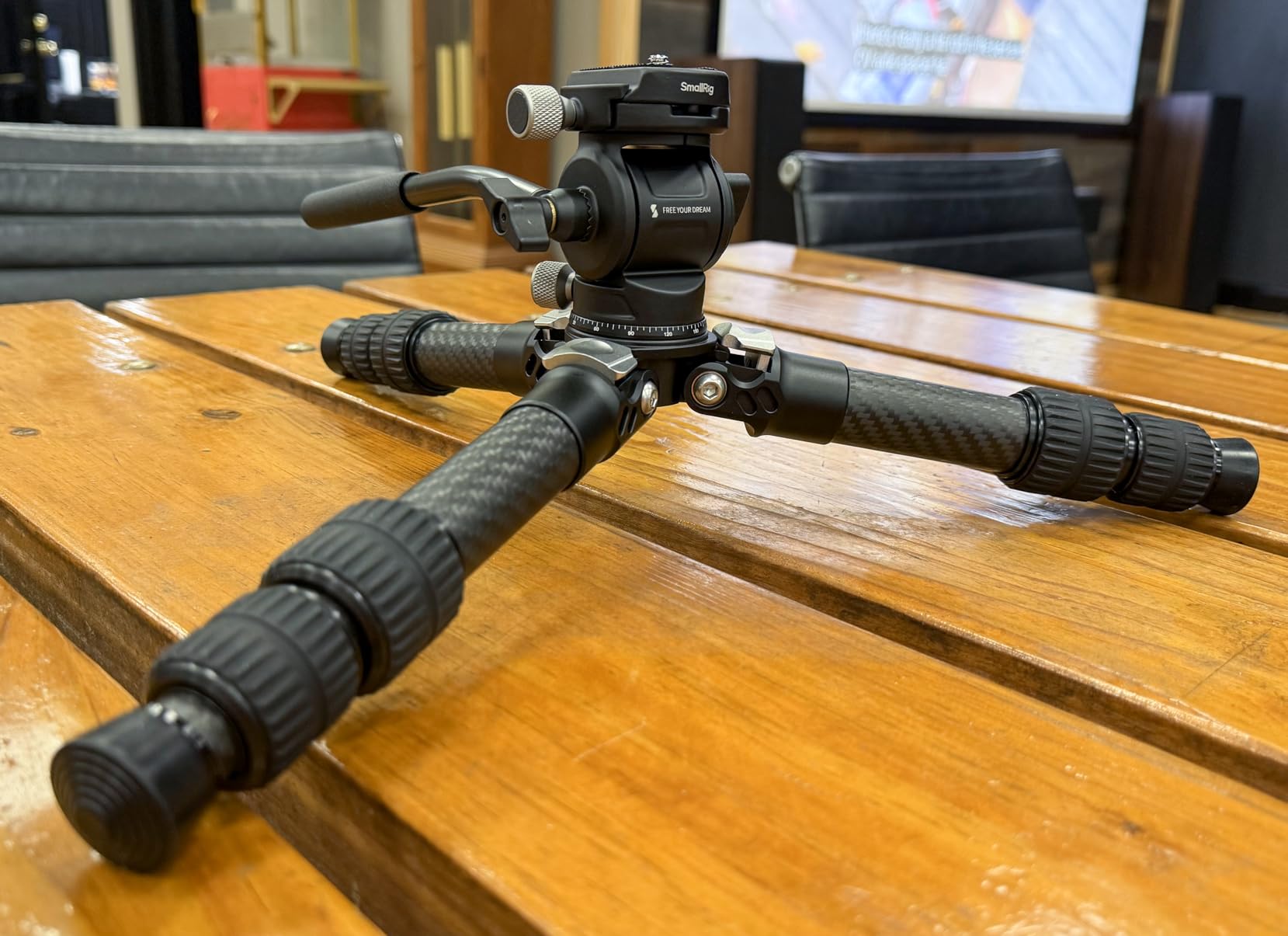
The fluid pan head has fixed damping with plus 90 and minus 70 degree tilt and 360 degree swivel, driven by a handle. For short video moves on a table or a trail wall, that gives you smoother motion than a friction ball head provides, and the 83 percent five-star share reflects that.
The 3/8 inch threaded base socket means it can also mount on a monopod or a larger tripod, or accept a ball head. The 1/4 inch-20 quick release plate takes cameras and cages, and the foot spikes attach to 3/8-16UNC holes and are replaceable for outdoor surfaces.
What to check before you buy the SmallRig 5025
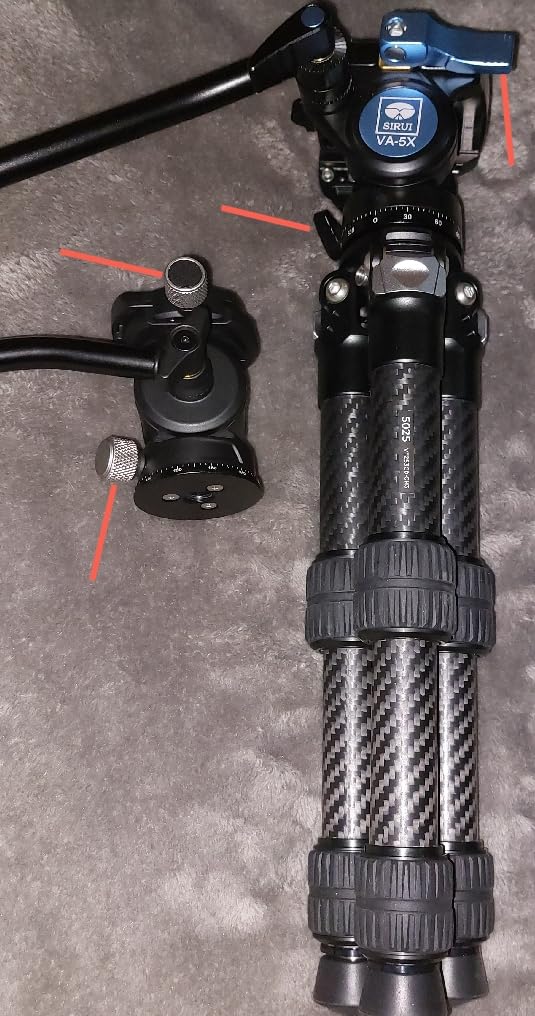
The head rating is 3 kg, or 6.6 lb, even though the tripod itself rates 22 lb. The head is the real constraint, and it is easy to misread the 22 lb number as a camera capacity.
Height. At 17 inches maximum it suits tabletop and low-angle work, not standing shooting, and the small footprint makes it easier to tip on uneven ground.
Where the SmallRig 5025 falls short
The fluid damping is fixed and cannot be adjusted, so you cannot slow the pan for a slow move or speed it up for a whip pan. The 2 year warranty is shorter than the SIRUI and Benro terms in this group.
It is a companion, not a replacement. If you need one tripod to do everything on a trip, this is the wrong shape entirely.
Carbon Fiber vs Aluminum: Is the Premium Real?
Yes, the premium is real but it is not uniform, and the honest answer depends on which spec matters to you. Carbon fiber’s advantage is a better strength-to-weight ratio, which lets manufacturers use thinner tubes that absorb vibration better than aluminum at the same weight. It is not stronger than aluminum in every sense, and it is not stiffer per unit of thickness in a way that makes thin ultralight legs immune to flex.
Here is what the data in this roundup actually shows. The lightest carbon fiber travel tripod here weighs 1.1 lb. A comparable full-size aluminum travel tripod in the same class typically runs 3.5 to 5 lb. That is a difference of two to four pounds, which is the entire argument for the material if you carry your kit on your body.
The second difference is damping. Carbon fiber tubes settle rather than ring, and that matters for long exposures where a ringing aluminum leg shows up as a soft frame. The effect is real but it is a refinement, not a rescue, and it does not substitute for rigidity at full extension.
Where carbon fiber loses is repairability. Aluminum dents, bends and can be straightened, while a cracked carbon tube usually means a cracked tripod. The two materials also sit at very different points in this category, from entry models built around resin clamps to pro kits sold with multi-year warranty terms.
Our rule: if you fly, hike, or walk more than a mile with your kit, carbon fiber pays for itself in what you stop leaving behind. If you shoot from a car or a fixed spot, a light aluminum tripod is harder to argue against. Forum discussion reaches the same conclusion from the other direction, with owners of long telephoto kits still choosing carbon travel tripods because the weight difference compounds across every trip.
Wind, Vibration and the Section Count Rule
Thin carbon legs vibrate, and no spec sheet will tell you so. The most repeated complaint in photography forum threads about ultralight carbon is legs that move visibly in wind, and the models in this roundup that draw it are the ones with the most sections and the thinnest top tube. A rigid body does not fix this, and neither does a heavier head.
Five section legs are the reason a tripod folds short, and they are also the reason it flexes. Every extra telescoping section adds a joint, and every joint is a place where stiffness drops. The SIRUI Traveler 5CX and 5C use five sections to reach 12.4 and 13 inch folded lengths, and both have owners reporting flex at maximum extension.
Four section legs trade a few inches of packed length for noticeably better rigidity. The NEEWER LT32 uses four sections of 1 inch, 26 mm carbon and owners report it stays solid fully extended where lighter models flex. The Manfrotto Befree Advanced and the Benro Slim also use four.
Three section legs go further still. The GEEKOTO CT25Pro, the SIRUI AM-223, the AOKA and the SmallRig 5025 all use three, and they are the models that pair the highest load ratings with the least top-section flex.
Three practices reduce vibration regardless of model. Keep the heaviest leg pointed downhill, which puts the least load on the cantilevered leg. Hang a bag on the center column hook when the wind picks up, and the GEEKOTO, NEEWER, SIRUI and Peak Design all include one. Shoot long exposures at a lower leg height than you think you need, because flex grows with extension.
How to Choose a Carbon Fiber Travel Tripod
Start with weight, because it is the only spec you feel every day. Under 2 lb covers most mirrorless travel kits. Between 2 and 3 lb covers a pro body with a zoom. Above 3 lb, ask yourself whether you are buying payload capacity or simply not shopping hard enough.
Second, measure folded length against your actual bag, not the abstract idea of a daypack. Under 14 inches fits side pockets and laptop sleeves comfortably. Between 14 and 17 inches fits most carry-on backpacks with a little planning. Over 18 inches means you are looking at a suitcase or an overhead bin, which is where the GEEKOTO CT25Pro at 20.8 inches and the Benro Slim at 20.1 inches sit.
Third, size load capacity against your kit, not against your camera. Add body, lens, plate, and any accessory in the tray, then double it for margin if you shoot at full height. The SIRUI Traveler 5CX is the clearest example of why: it rates 13.23 lb and the manufacturer recommends roughly half that at full 52 inch height.
Fourth, check maximum and minimum height together. Maximum height decides whether you can clear a crowd or a bank. Minimum height decides whether you can get the camera near the ground, and several models here reach very low: the Peak Design to 5.5 inches, the SIRUI 5CX to 3.54 inches, the NEEWER LT32 to 7.5 inches.
Fifth, decide on the head before you buy the tripod. A ball head handles stills in any orientation. A fluid head with a handle gives smoother pans for video but usually has a lower rating, as the SmallRig 5025 shows at 6.6 lb against a 22 lb leg rating. Check whether the head is removable, because that determines whether you can upgrade later.
Sixth, look at the plate standard. Arca-Swiss compatibility means your existing L-brackets, grips and cages can move between tripods. The NEEWER LT32 accepts both Arca and Peak Design plates, which is the most flexible combination among these twelve, while the Manfrotto 494 head accepts only Manfrotto RC2 plates.
Seventh, count sections and locks. Twist locks are thinner and faster to work one-handed; flip locks are easier to confirm closed in poor light. Spring-loaded flip buckles, as on the NEEWER LT32, are the fastest of both. And fewer sections means more rigidity, as covered above.
Finally, read the warranty and the review count together. A multi-year warranty like the Benro five-year registration or the SIRUI six years is a real signal about parts availability and service. So is review volume: the NEEWER TP17B at 3143 reviews and the SIRUI 5C at 562 reviews tell you more about long-term reliability than a 140-review listing does. This is also the honest answer to whether brands like K&F Concept, SIRUI and NEEWER are legitimate. They are established manufacturers with published weights, capacities, part numbers and warranty terms, and their review volumes reflect real long-term ownership rather than a single launch window.
If you are building out the rest of your travel kit, our travel wallet picks and jewelry organizers for travel cover the small items that share the same bag space.
Frequently Asked Questions
Are carbon fiber tripods worth it?
Yes, if you carry your kit rather than driving to the shoot. Carbon fiber cuts roughly a quarter to a third of the weight of a comparable aluminum travel tripod, and the tubes damp vibration rather than ring, which helps long exposures. In our comparison the lightest option weighed 1.1 lb against a typical aluminum class of 3.5 to 5 lb. The premium is harder to justify if you shoot from a fixed location.
Which is the best carbon fiber travel tripod?
The Peak Design Travel Tripod Carbon Fiber is our best overall pick because it folds to 15.4 inches, weighs 2.8 lb and holds 20 lb, and it deploys with lever clips in seconds instead of working three leg locks. If you want the most reviewed and lowest-risk buy, the NEEWER Basics TP17B has 3143 reviews at 4.6 stars and converts to a monopod.
Is the Peak Design Travel Tripod a good tripod?
It is an excellent travel tripod and a mediocre studio one. Owners praise the fast lever deployment, the 15.4 inch folded size and the 20 lb rating, and the same owners report that the ball head geometry is awkward in portrait orientation and that it is not the most rigid tripod at full load. It suits a mirrorless or light DSLR kit far better than a heavy telephoto setup.
Are Ku0026amp;F Concept tripods any good, and is the company legitimate?
Ku0026amp;F Concept is an established manufacturer publishing weights, capacities, part numbers and dimensions for its tripods rather than anonymous listings. The C225C0 weighs 2.2 lb, folds to 13.7 inches and rates 8 kg, and 914 reviews average 4.4 stars. Recurring negatives are the resin Arca clamp on the included head, a 13 inch minimum height, occasional defective leg latches and a cheap carry bag.
How much weight can a travel tripod hold?
It depends on the model and on the height you shoot at. Ratings in this roundup run from 6.6 lb to 26.5 lb, and rated capacity is a maximum rather than a working figure. As a rule, keep your body plus lens plus plate at half the rated load or lower when shooting at full height, because flex and vibration rise with extension.
Can a carbon fiber tripod go in carry-on luggage?
Yes, if the folded length clears your airline limit. Most models here fold between 8.5 and 20.1 inches, and the Ku0026amp;F Concept at 13.7 inches and the SIRUI Traveler 5CX at 12.4 inches are the safest choices for cabin bags. Check the packed diameter as well, since the Benro Slim is the narrowest at 3.2 inches while others are closer to 5 inches.
Is a Sirui tripod a good tripod?
It depends on which model, and the differences are large. The AM-223 with its detachable column is the highest rated item in our set at 4.7 stars and folds to 8.5 inches, while the Traveler 5CX is rated 4.6 and the Traveler 5C is rated 4.2. The 5C’s most reported problem is an advertised inverting center column that does not actually invert.
Conclusion: Our Best Carbon Fiber Tripods for Travel
The Peak Design Travel Tripod Carbon Fiber wins our best carbon fiber tripods for travel ranking on packed size and speed. It folds to 15.4 inches, weighs 2.8 lb, holds 20 lb, and deploys with three lever clips rather than a dozen twist locks, which is the difference between a tripod you carry and a tripod you leave behind.
For most people, the NEEWER Basics TP17B is the smarter purchase. It weighs 3.2 lb, folds to 16.3 inches, converts to a monopod and has 3143 reviews at 4.6 stars behind it. The K&F Concept C225C0 takes the ultralight slot at 2.2 lb and 13.7 inches folded, and the GEEKOTO CT25Pro takes the heavy payload slot with a 26.5 lb rating.
Whichever you choose, measure your folded length against your real bag and keep your kit under half the rated load when shooting at full height.
We may earn a commission from purchases made through our links, at no extra cost to you.