
The first pair of ski boots you buy will shape how your whole first season feels. Get them wrong and every chairlift ride turns into a small negotiation with cramped toes, and you end up blaming yourself instead of the learning curve. Get them right and you can focus on the thing you came for, which is turning.
That is what this roundup is for. We went through ten beginner-focused alpine ski boots, checked the published specifications for each one, and read the owner reviews to separate the marketing language from what skiers actually report after a season on snow. Every boot below lists its flex rating or skill level, its last width, its closure system, and the fit complaints that show up repeatedly.
If you have never skied before, you also want to know how the boot fits with the rest of your setup, and our picks for the best skis for beginners are a sensible next read. The boots do the precision work, but softer skis make the first ten days a great deal less punishing.
Table of Contents
What to Look for in Beginner Ski Boots?
Three specifications decide almost everything: the flex rating, the last width, and the sizing. If you understand those three, you can walk into any shop and filter the wall of plastic boxes down to a realistic shortlist.
Flex rating measures how stiff the shell is. Beginners want the low end of the range, roughly 60 to 80 for adults and lower for children, because a softer boot bends forward with less leg strength. That means you can control your turns without exhausting yourself by lunchtime. The widely repeated beginner rule of thumb is a soft flex between 70 and 80 for adults, and anything at 100 or above is built for someone who already knows how to drive an edge.
Last width is measured in millimetres across the ball of the foot. A 98mm last is narrow and suits slim feet, 100mm is the standard average, and 102mm to 104mm is high volume territory made for wide feet and high insteps. Skiers with wide feet should read 102mm or more as the floor rather than the ceiling. Several boots in this roundup use a 104mm last specifically to take pressure off the forefoot.
Sizing means a boot that is snug, not loose. Your toes should lightly graze the front of the boot when you are standing, and pull back a few millimetres when you bend into a skiing position. That two-state test matters more than any number on the box. Boots can be ground wider and heat-expanded, but they can never be shrunk, so a boot that is too large creates more problems than one that is slightly snug.
The rest of this guide expands on each of those points, including how to translate flex rating into a body weight and how to test a boot in a shop in under ten minutes.
Top 3 Beginner Ski Boots for 2026

Rossignol Evo 70
- 104mm relaxed last
- Custom fit liner
- Sensor Matrix shell
- GRIPWALK compatible


Nordica The Cruise
- 104mm comfort last
- Soft flap instep
- Instep Volume Control
- Infrared liner
Best Ski Boots for Beginners in 2026: Quick Overview
All ten boots below appear in the table with their published specifications. Ratings and review counts are copied directly from the retailer listings so you can see how much owner feedback sits behind each one.
| Product | Specifications | Action |
|---|---|---|
| Rossignol Evo 70 Ski Boots |
|
Check Latest Price |
| Head Edge LYT RX HV Ski Boots |
|
Check Latest Price |
| Nordica The Cruise Ski Boots |
|
Check Latest Price |
 Rossignol Kelia 50 Ski Boots Rossignol Kelia 50 Ski Boots |
|
Check Latest Price |
 Nordica Cruise S W Ski Boots Nordica Cruise S W Ski Boots |
|
Check Latest Price |
 K2 BFC 80 Ski Boots K2 BFC 80 Ski Boots |
|
Check Latest Price |
 Rossignol Pure Comfort 60 Ski Boots Rossignol Pure Comfort 60 Ski Boots |
|
Check Latest Price |
 Atomic Hawx Magna 75 Ski Boots Atomic Hawx Magna 75 Ski Boots |
|
Check Latest Price |
 Nordica Cruise 65 W Ski Boots Nordica Cruise 65 W Ski Boots |
|
Check Latest Price |
 Head Edge 65 W HV Ski Boots Head Edge 65 W HV Ski Boots |
|
Check Latest Price |
1. Rossignol Evo 70 Ski Boots – Best All-Round First Pair
Rossignol EVO 70 HV+ – Ski Boots for Men and Women – Black
104mm relaxed last
Custom fit liner
Sensor Matrix shell
GRIPWALK compatible
Pros
- 104mm relaxed last with wider forefoot and toe box
- Custom fit liner with adjustable zones and heel support
- Soft padding through the ankle and instep
- Easy opening boot overlap for smooth entry and exit
Cons
- GRIPWALK soles sold separately for walking grip
- Some shell lengths offered only in limited variants
- A few 1-star reports about relaxed-last fit expectations
This was the boot we kept coming back to. The Rossignol Evo 70 pairs a 104mm last with a custom fit liner that has softer padding through the ankle and instep, which is close to the ideal specification for a new skier with nothing to prove. The last is a 104mm last, the widest specification in this group, and the padding sits exactly where beginners build pressure.
Owners consistently describe immediate comfort and a forgiving fit, and the 4.8 average across 73 reviews is the highest in this roundup with 87% of ratings at five stars. The Sensor Matrix shell design cuts weight compared with older constructions while still delivering direct power transfer to the ski, so the boot does not feel like a brick once you start linking turns.
The easy opening boot overlap is a small feature with a large effect. Nothing demoralises a first-timer faster than wrestling with a shell at the bottom of a magic carpet, and this overlap is designed to open smoothly for both entry and exit.
Fit and Sizing Notes
Rossignol lists this as a relaxed fit, and review language backs that up. Some buyers note that sizing runs narrow at particular listed sizes, so treat the street shoe size as a starting point and confirm with the shell length rather than the label. The liner is heat-moldable, so a bootfitter can take the guesswork out of the first week.
Best For and Less Ideal For
This suits an adult beginner with a wider foot, a mid-to-heavy lower leg, or anyone who plans to spend real time walking around the resort between runs. Walkability needs the separately sold grip soles, so it is less attractive if walking comfort matters more to you than on-snow comfort.
2. Head Edge LYT RX HV Ski Boots – Most Forgiving High Volume Shell
Head Edge LYT RX HV Alpine Ski Boots, Anthracite/Black, 25.5
High Volume fit
Extra forefoot and instep room
Polyurethane shell
1 year warranty
Pros
- High Volume fit adds room through forefoot and instep
- Built to accommodate wider feet and relaxed fits
- Polyurethane shell and outer material
- One-year limited manufacturer warranty
Cons
- Listed as intermediate level rather than a dedicated beginner flex
- Only three shell sizes offered among the listed variants
- Limited published review detail beyond fit width
The Head Edge LYT RX HV is built around one idea: extra room. Its High Volume construction adds space through the forefoot and instep, which is the profile most often recommended for skiers who spend their first season being told they have wide feet. It is a polyurethane shell, the same material most performance shells use, so it can be adjusted by a bootfitter if needed.
Across 71 reviews it holds a 4.7 average with 85% of ratings at five stars. The consistent theme is that skiers feel room to move without feeling loose, which is the balancing act a high volume last has to get right.
One caveat deserves attention. Head lists this model at an intermediate skill level rather than a dedicated beginner flex, and some buyers note it feels firmer than a true beginner boot. That is a fair trade for a very wide fit, but if you want maximum forgiveness, a softer model suits you better.
Fit and Sizing Notes
The available variants cover a narrower spread of shell lengths than some rivals, so check that your size sits inside the listed range before committing. Because the volume is the selling point, avoid sizing up on top of it. A High Volume boot already gives you the room that a larger size would otherwise provide.
Best For and Less Ideal For
Pick this if you have genuinely wide feet or a high instep and you would rather buy one boot that fits than compromise on width. It is less ideal for a very light or small-footed skier who will drown inside the extra volume, or for anyone who wants the softest possible flex in their first season.
3. Nordica The Cruise Ski Boots – Widest Last With Easy Entry
Nordica The Cruise Men’s Comfort Fit All Mountain Alpine Ski Boots (Black/White/Red, 31.5)
104mm comfort last
Dual soft flap instep
Instep Volume Control
Infrared liner
Pros
- Dual soft flap opens the throat wide for step-in and step-out
- 104mm extra-wide comfort last suits large feet and wide calves
- Instep Volume Control adjusts boot board height by plus or minus 4mm
- Infrared liner customization relieves pressure points
Cons
- Soft flex feels firmer than the beginner label implies
- One report cites buckles that did not hold up over time
- Listed weight of 8 pounds is heavy for a pair
Nordica The Cruise is the boot we would hand to a skier with two specific problems: a big foot and a high instep. The 104mm last has a streamlined anatomical shape, and the dual soft flap integrated into the throat opens the shell unusually wide so you can step in rather than squeeze in.
The instep volume control is the feature that separates it from the pack. It raises or lowers the boot board by plus or minus 4mm, which lets a fitter adapt the boot to an instep that most stock setups would pinch. Combined with infrared liner customisation at the pressure points, this is a boot that can genuinely be adapted rather than simply tolerated.
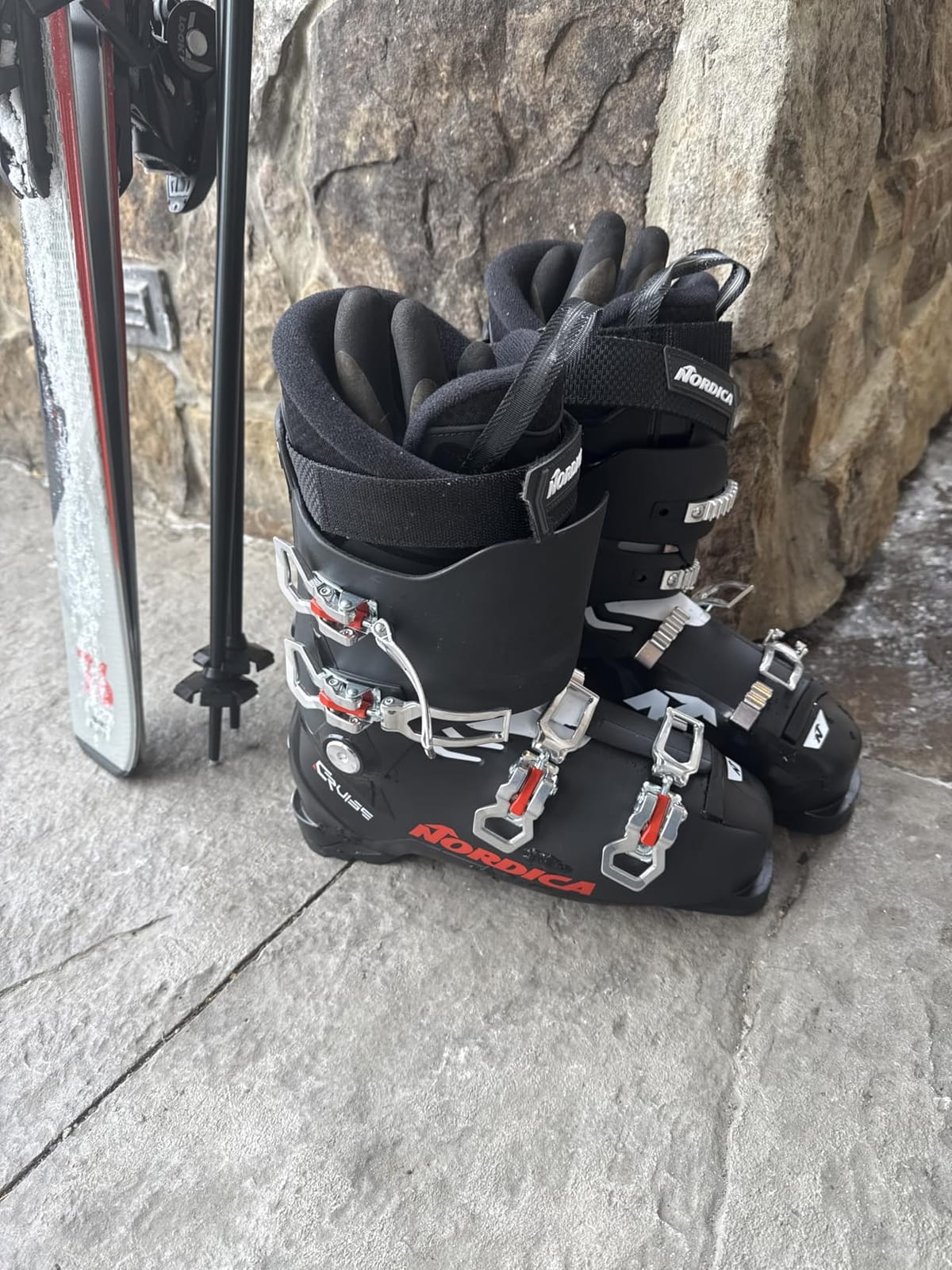
With 76 reviews at a 4.4 average, the feedback is warm but not flawless. Owners like the combination of comfort and enough flex to steer, and the liner is reported to feel like a slipper after break-in while still transferring control. A minority note the boot feels firmer than the beginner label suggests, and one reviewer reported buckling durability problems.
Fit and Sizing Notes
Fit is not universal here. One buyer found the boot uncomfortable and switched brands, which is a reminder that a 104mm last helps most feet but not all of them. Use the instep volume control as an adjustment tool rather than assuming it fixes a wrong shell length.
Best For and Less Ideal For
This is a strong match for wide feet, wide calves, and anyone who wants step-in comfort more than they want a specific performance feel. It is less ideal for a skier who needs the very softest flex for maximum forgiveness, and the listed 8 pound weight tells you it will not be the lightest boot on a long walking day.
4. Rossignol Kelia 50 Ski Boots – Soft Flex For Women
Rossignol Kelia 50 – Downhill Ski Boots for Women – Black/White
Women's 104mm relaxed last
Tulip-shaped cuff
Heat-moldable liner
Three-buckle shell
Pros
- Comfort for wide calves and shorter lower legs
- Tulip-shaped cuff relieves shin and calf pressure
- Heat-moldable liner conforms closely to the foot
- Forgiving flex suits beginners and intermediates
Cons
- Low flex index limits it for more aggressive skiing
- GRIPWALK soles sold separately for walkability
- Heavier build at 8.2 pounds for a pair
The Kelia 50 is the women’s version of Rossignol’s relaxed-fit approach, and the distinguishing detail is the tulip-shaped cuff. Rather than a straight cuff that presses into the calf, the tulip profile flares slightly, which reviewers repeatedly credit for relieving pressure on shins and calves through a full day.
The three-buckle shell has soft plastic around the instep, so the boot opens easily even in cold conditions when stiff plastic becomes stubborn. The liner is heat-moldable and the shell uses the Sensor Matrix design for reduced weight. At 47 reviews and a 4.6 average, comfort is the standout across nearly every written review, and several owners mention success after heat molding the liners.
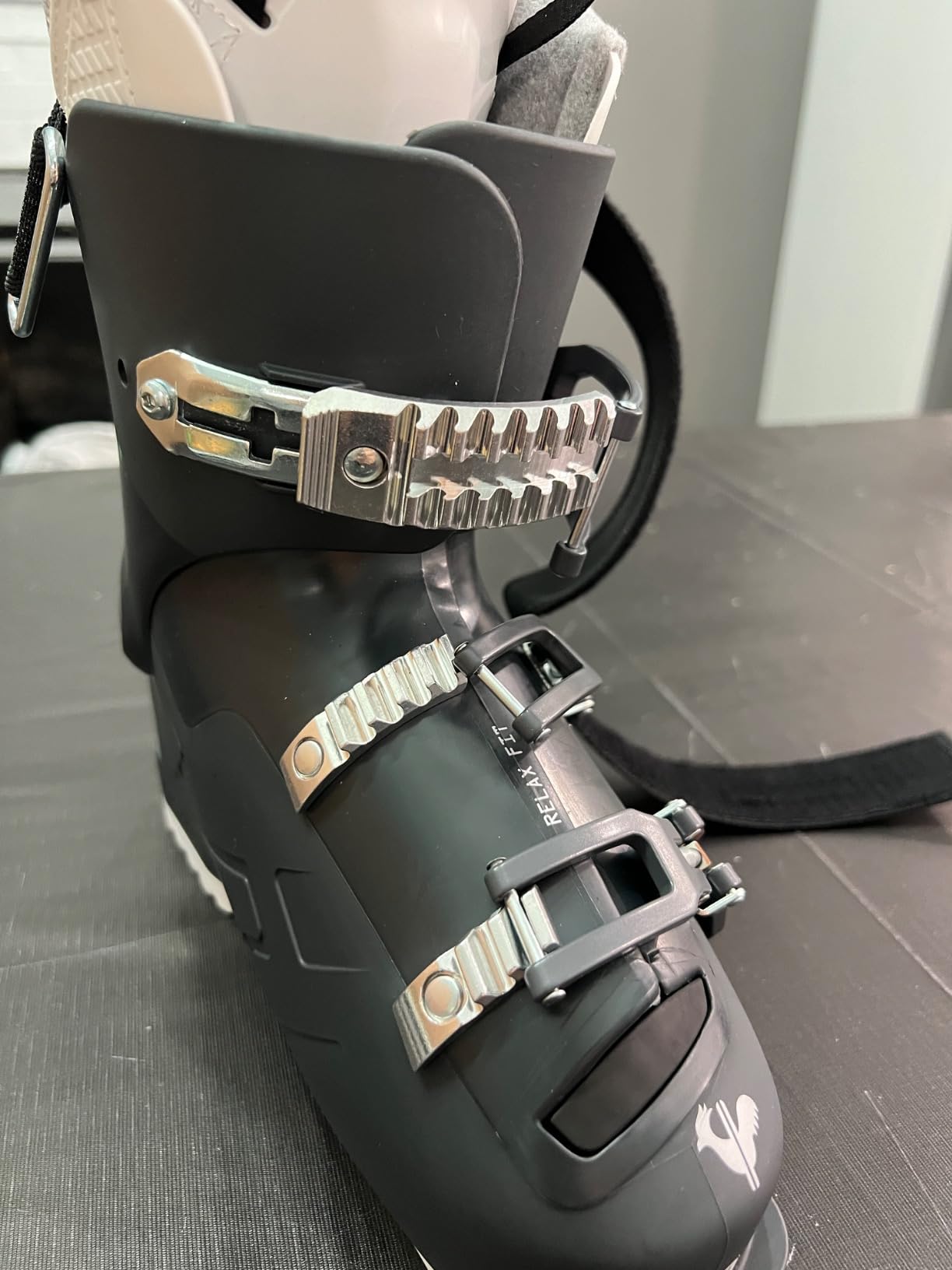
The 50 flex index is genuinely soft, which is exactly what a first-season skier wants and exactly what limits the boot later on. If you are already an aggressive skier looking for edge control, this is not the shell you want.
Fit and Sizing Notes
The relaxed 104mm last suits a normal to wide foot, and the flexible cuff reduces the calf pressure that drives a lot of first-season complaints. The composite material shell is less heat-moldable than polyurethane, so most adjustment here happens through the liner rather than the shell.
Best For and Less Ideal For
Women with wide calves or shorter lower legs get the most out of this boot, as do anyone who finds a straight cuff punishing. It is a poor match for a skier who already turns confidently and wants a stiffer boot, and the separate grip soles are an extra step if you plan to walk the base area.
5. Nordica Cruise S W Ski Boots – Softest Shell For New Skiers
NORDICA Women’s The Cruise S W Ski Boots – Adult Winter Sports Downhill Alpine Ski Boots for Beginner and Intermediate Skiers, Black/Light Blue/White, 22.5
104mm forgiving last
Soft shell construction
Dual Soft Flap Instep
Heat-moldable liner
Pros
- Soft shell and forgiving 104mm last built for new skiers
- Dual Soft Flap Instep gives unusually easy entry and exit
- Heat-moldable liner and customizable shell for a personalised fit
- Two-year manufacturer warranty
Cons
- Very soft flex gives less support once you want steeper terrain
- Listed item weight of 15 pounds appears inaccurate
- Small pool of owner photos for visual fit reference
If your priority is the softest possible starting point, this is it. The Cruise S W is built around a soft shell construction and the manufacturer positions it for beginner and intermediate skiers rather than for progression. The streamlined anatomical shape on a 104mm last keeps it from feeling shapeless.
At 38 reviews and a 4.5 average, satisfaction centres on comfort and easy entry. The Dual Soft Flap Instep opens the throat wide, and the heat-moldable liner lets a fitter shape the boot to your foot in a single session. The two-year warranty is also a genuine plus for a first purchase.
The tradeoff is obvious and worth stating plainly. A very soft flex that feels wonderful in week one becomes a liability on steeper terrain, when a beginner needs the boot to hold an edge rather than fold. Buy this if your season is groomers and lessons.
Fit and Sizing Notes
The 104mm last is forgiving across the forefoot, and the shell is described as customizable, so there is room to adapt the internal fit. Check the listed size range carefully, because the available variants start at a 22.5 shell and not every half size is offered.
Best For and Less Ideal For
This suits a first-season adult or an older teen learning on gentle terrain, particularly anyone who wants the least intimidating boot on the wall. It is not the right boot for someone who will be on steeps or in variable snow within a month, and the listed weight figure is not something you should plan a walking day around.
6. K2 BFC 80 Ski Boots – Hands-Free Entry And Full Heat Molding
K2 BFC 80 Men’s Ski Boots (Grey, 26.5)
Hands-free entry
Heat-moldable shell and cuff
Cushfit liner
GripWalk soles
Pros
- Dual material overlap allows hands-free entry and exit
- Shell and cuff are both heat-moldable for a true custom fit
- Cushfit liner has extra foam in key areas
- GripWalk sole-binding system improves walking comfort
Cons
- Small review base of 14 ratings
- 80 flex is firmer than most true beginner boots
- Rating spread includes an 11 percent two-star share
The K2 BFC 80 uses a dual material overlap that gives you a wide opening for entry and a clean release on exit, so you can get in and out without using your hands. That is the single most useful feature for anyone who wants to move quickly at a chairlift.
Both the shell and the cuff are heat-moldable, so a bootfitter can shape two separate areas to your foot rather than working with a fixed shell. The Cushfit liner adds foam in key areas for out-of-the-box comfort, and GripWalk soles are included for better walking comfort on flat approaches. Protective pads for the wrist, elbow, and knee come in the box, which is unusual and sensible for a beginner.
At 80 flex this is the firmest shell in the roundup, and with only 14 reviews the feedback base is thin. The rating spread is wider than the softer beginner boots here, including a notable share of two-star ratings that points to a fit that is not uniformly forgiving. If you are a lighter skier, that is a real risk.
Fit and Sizing Notes
The heat-moldable shell and cuff make this the most adjustable option in the group, which is valuable if your foot shape is unusual. Pair that with a fitter visit rather than an online guess, because the moulding process is where the benefit is realised.
Best For and Less Ideal For
It works well for a beginner who is confident and wants a boot that will not fall apart as they progress, and for anyone who values getting on and off quickly. It is a poor first purchase for a small or light skier who needs maximum forgiveness, and the thin review history means you are relying more on the design than on owner evidence.
7. Rossignol Pure Comfort 60 Ski Boots – Fleece Lined Winter Pick
Rossignol Pure Comfort 60 – Ski Boots for Women – Relaxed Fit Ski Boots – Black
Women's 104mm relaxed last
Polar fleece lining
Sensor Matrix shell
Custom liner
Pros
- Women's-specific relaxed 104mm last suits wider feet
- Polar fleece lining stays warm when wet and dries quickly
- Soft instep plastic allows smooth entry and exit
- Six half sizes available from 22.5 through 27.5
Cons
- Very small review base of 5 ratings
- Polypropylene shell is less heat-moldable than polyurethane
- 36 percent of ratings sit at three stars
The Pure Comfort 60 is built around warmth, and the polar fleece lining is the reason. Fleece retains its insulation when it gets wet and dries quickly, which is a genuine advantage on cold, damp days when a foam liner can feel flat by lunch.
The rest follows the Rossignol relaxed-fit formula that works well for beginners: a 104mm last, a Sensor Matrix shell for reduced weight, a custom liner for internal adjustment, and soft plastic around the instep so the overlap opens smoothly. Six half sizes from 22.5 through 27.5 give a decent fitting range.
Weigh the evidence carefully here. With only 5 reviews there is very little owner history to lean on, and 36% of those ratings sit at three stars, which points to inconsistent comfort across fits. The polypropylene shell is also less heat-moldable than a polyurethane shell, so most adjustment happens in the liner.
Fit and Sizing Notes
Its relaxed 104mm last is well suited to a wider foot or a recreational skier who prioritises comfort. Make sure your half size sits inside the available range, and confirm the fit in person if at all possible given how little feedback this model has.
Best For and Less Ideal For
This is the one to look at if you ski in cold conditions or if your previous boots left you shivering. It is a weaker bet for anyone who wants a shell a fitter can mould aggressively, and the small review pool means you should treat the comfort claims as promising rather than proven.
8. Atomic Hawx Magna 75 Ski Boots – Lightest Per-Boot Weight
Atomic HAWX Magna 75 Women’s Alpine Ski Boots, Black/Gold, W25/25.5 MY25
Beginner skill level
PP shell construction
1644 g per boot
Medium width
Pros
- Explicitly labelled as a beginner-level boot
- Lightest per-boot weight in this roundup at 1644 g
- Adjustable fit that owners rate highly
- European reviewers praise carrying comfort over full days
Cons
- Break-in period causes noticeable pressure at first
- Forward flex range cannot be fully adjusted
- Lowest average rating in the group at 4.0
The Hawx Magna 75 carries an explicit beginner skill level from the manufacturer, and it is also the lightest boot in the roundup on a per-boot basis, at 1,644 grams at size 24-24.5. Weight matters more than most specs suggest for a first-timer, because a lighter boot is simply less tiring over a full day of falls and lifts.
At 27 reviews the average rating is 4.0, the lowest in this roundup, so read the feedback closely. Owners are largely positive on comfort, value, and adjustability, and several describe the boots as excellent once the break-in is complete. European reviews in particular mention carrying comfort through a full mountain day.
The criticisms are consistent enough to plan around. A noticeable pressure period during break-in is common, and the forward flex range cannot be fully adjusted even after fine-tuning the fit, which matters if you fall outside the intended shape.
Fit and Sizing Notes
The shell is a polypropylene construction in a medium width, which makes it a sensible choice for an average-width foot rather than a wide one. The break-in pressure is the thing to plan for, so give yourself a first-day wear at home before a full day on the mountain.
Best For and Less Ideal For
It suits a skier who wants the lightest boot possible and does not have unusually wide feet. It is less suitable for anyone who needs a roomy last, and if your priority is a walkable boot for a base-area-heavy resort, lighter shells usually mean giving something up on that front.
9. Nordica Cruise 65 W Ski Boots – Instep Volume Control For All-Mountain Days
Nordica Cruise 65 W Women’s Comfort Fit All Mountain Alpine Ski Boot (Black/White/Green, 24.5)
104mm comfort last
Dual soft flap instep
Instep Volume Control
Soft-shell build
Pros
- 104mm comfort last with dual soft flap for very easy entry
- Instep Volume Control adjusts boot board height by plus or minus 4mm
- Reviewers report comfort across multi-day trips
- Soft-shell construction suits all-mountain use
Cons
- Very small review base of 7 ratings
- 17 percent of ratings sit at three stars
- One reviewer had not used the boots before reviewing
The Cruise 65 W shares the Cruise family platform: a 104mm comfort last, the dual soft flap that opens the throat wide, and instep volume control that moves the boot board by plus or minus 4mm. That combination makes it the most directly adjustable boot in the roundup if your instep is the problem rather than your forefoot.
With 7 reviews at a 4.5 average, the written feedback is strongly positive on comfort, with owners describing multi-day trips where the fit held up and reporting that they preferred owning the boots to renting. The soft-shell construction suits a mix of on-piste and touring use.
The evidence base is thin, though, and 17% of ratings sit at three stars. One reviewer had not actually skied in the boots before posting, which is a reminder to weight review counts as much as averages when you are choosing between models.
Fit and Sizing Notes
The instep adjustment is the reason to choose this over a standard soft boot, and it is worth having a fitter use it rather than relying on the stock setting. The 104mm last handles forefoot width, so a slim-footed skier may find it loose across the ball of the foot.
Best For and Less Ideal For
It fits skiers with a high instep who also spend several days a week on the mountain, where a fit that stays comfortable over multiple days matters. It is a weak recommendation for anyone who wants the softest possible flex, and the small review count means you should plan a proper fitting rather than a blind purchase.
10. Head Edge 65 W HV Ski Boots – Upright Soft Flex With Published Geometry
Head Edge 65 W HV Women’s Alpine Ski Boots (White, 25.5)
65 flex
102mm last
5 degree ramp angle
12.5 degree forward lean
Pros
- 65 flex is a soft and forgiving choice for beginners
- 5 degree ramp angle supports an upright easy-turn stance
- 102mm last with High Volume fit
- Buckle closure allows on-slope adjustment
Cons
- Smallest review base with only 4 ratings
- Snug fit type may feel narrow for wide feet
- 27 percent of ratings sit at three stars
What sets the Edge 65 W HV apart is that Head publishes the geometry instead of leaving you to guess. The flex is 65, the last is 102mm, the ramp angle is 5 degrees, and the forward lean is 12.5 degrees. Those numbers tell you immediately that this is an upright, easy-to-turn boot rather than an aggressive one.
A low ramp angle with moderate forward lean means you will stand taller and turn more easily than you would in a stiffer shell, which is exactly what a new skier wants while they are learning to link turns. The buckle closure allows on-slope adjustment, and the High Volume fit adds room through the forefoot. Twelve colour and size variants run from 22.5 to 27.5.
Only 4 reviews exist, so treat this as a specification-led pick. There is also a caution: the listing describes the fit type as snug, so skiers with genuinely wide feet should be cautious despite the 102mm High Volume designation. 27% of the ratings sit at three stars.
Fit and Sizing Notes
Because the geometry is published, you can sanity-check the fit against other boots you have tried. A 65 flex at 102mm sits in the soft and roomy corner of the beginner market, which suits a lighter skier who is worried about buying something too stiff.
Best For and Less Ideal For
This suits a skier who wants an upright stance and the softest published flex in the roundup. It is a poor choice if you have wide feet and the listing’s snug fit type is accurate, and the four-review base means you should expect to do your own fit research rather than rely on crowd feedback.
How to Choose Beginner Ski Boots?
Start with your weight, because flex rating is meaningless without it. A softer skier needs a softer boot, and overbuying flex out of anxiety is the most common expensive mistake in this category. The widely used starting point for adults sits between 70 and 80, with lighter skiers dropping toward 60 and heavier skiers able to handle closer to 80 without struggling.
Then check your foot width against the last. Skiers with wide feet should treat 102mm as the minimum and feel comfortable in 104mm, while slim feet often do better in a 98mm or 100mm last. High volume and high instep are related but not identical, which is why instep volume control matters: it changes the height of the boot board rather than the width of the last.
Closure system is the third decision. Traditional buckles give you precise, incremental adjustment and are easy to tune on the hill. Overlap and soft-flap designs prioritise fast entry and exit, which is the feature beginners rate highest once they are on snow. Cable closures are worth considering if effortless on and off is your top priority, though they offer less fine adjustment than buckles.
Finally, plan on a fitting rather than an online guess. The most-upvoted pattern in ski forums is consistent: getting fitted by a professional bootfitter is the single highest-impact step a beginner can take. A fitter will heat-mould the liner, adjust the boot board, add a footbed if you need one, and tell you plainly when a boot is wrong for your foot.
Rental Boots vs. Buying Your First Pair
Rental boots are genuinely useful for a first trip. They cost nothing up front and they let you test whether you enjoy skiing before you commit. The problem is that rental fleets are built to fit the widest range of skiers possible, so they are rarely comfortable for anyone, and they are frequently the reason beginners believe that all ski boots hurt.
That expectation is the real cost. A first-timer who spends three days in painful rental boots then tries on a properly fitted pair often assumes something is wrong because the sensation is so different. Learn where your toes sit in a boot while you are still renting, and you will take that knowledge to your fitting.
Buying makes more sense once you know you are returning for a second season, or if you already know your size and flex and you value the fit enough to pay for it. One trip is genuinely enough to decide, as long as that trip was spent on good rental boots or on a lesson.
Breaking In New Ski Boots and Fixing Pain Points
Some discomfort in the first few hours is normal. Boots are being shaped to your foot, the liner is settling, and your foot is unused to the position. What is not normal is sharp pain, numbness, or a hot spot that gets worse through the day.
Cramped toes are the most reported complaint of all, and the usual fix is thinner ski socks before you blame the boot. If the toes still pinch after a sock change, the shell is too small or the last is too narrow, and that is a fit problem rather than a break-in problem.
Top-of-foot pain is usually instep volume, not size. Try the lower buckles one notch looser before you conclude the boot is wrong, and ask about instep volume control or a liner with more instep padding.
Arch pain is most often the footbed rather than the shell. A custom footbed is the standard fix here and it usually costs less than replacing the boots.
Shin bang happens when the cuff and liner do not line up with your shin. Loosening the power strap slightly and having a fitter align the cuff usually resolves it in one visit.
Give new boots a first wear at home with ski socks on before you spend a full day in them. It takes twenty minutes and it is the cheapest insurance in this entire guide.
What Is Ski Boot Syndrome?
Ski boot syndrome is nerve damage caused by prolonged compression of a nerve inside a ski boot, usually across the top of the foot or across the toes. The symptoms are burning, tingling, numbness, or shooting pain that continues after you take the boots off, rather than resolving within minutes.
It happens when a boot is too tight for too long, and it is why the advice to never size up is more than a comfort preference. It can also follow from a footbed that sits too high or from a liner that has not been moulded properly. If the tingling persists, stop skiing in that boot and see a professional rather than pushing through another season.
First-Time Skier Gear Checklist Beyond Boots
Boots are the fit-critical purchase, but four other items matter on day one. A properly fitted helmet is the one piece of gear worth spending real money on, and our guide to the best ski helmets covers fit and sizing the same way this one does.
Beyond that you need waterproof gloves, one base layer, one mid-layer, ski socks, and goggles with a lens tint suited to the conditions. Most first-season beginners can rent skis and poles with confidence, since those items fit less precisely and change less often.
Take our picks for the best skis for beginners alongside the boot decision. Softer skis and a forgiving boot together are the combination that keeps people skiing past the first weekend.
Frequently Asked Questions
What are the easiest ski boots to get on?
The easiest boots to get on are the ones with a wide throat opening and a soft or overlapping instep. In this roundup, the K2 BFC 80 offers hands-free entry through a dual material overlap, while the Nordica The Cruise, Nordica Cruise 65 W, and Nordica Cruise S W use a dual soft flap instep that opens the shell exceptionally wide. The Rossignol Kelia 50 and Pure Comfort 60 add soft plastic around the instep so the overlap opens smoothly even in cold weather.
What is ski boot syndrome?
Ski boot syndrome is nerve damage caused by prolonged compression of a nerve inside a ski boot, most often across the top of the foot or across the toes. Symptoms include burning, tingling, numbness, or shooting pain that continues after the boots are removed rather than clearing within minutes. It usually results from a boot that is too tight worn for too long, which is why sizing up is discouraged, and it requires stopping use of that boot and getting a professional fitting.
What should a first-time skier wear?
A first-time skier should wear alpine ski boots with a soft flex between 60 and 80 for adults, a last of 102mm or 104mm if your feet are wide, and thin ski socks rather than thick ones. Layer a moisture-wicking base layer, a mid-layer, and waterproof gloves and jacket on the body, and choose a properly fitted helmet. Boots and socks matter most for comfort, since bulky socks are a common cause of cramped toes.
How tight should ski boots be?
Ski boots should be snug, not loose. Your toes should lightly graze the front of the boot when you are standing upright and should pull back a few millimetres when you bend forward into a skiing stance. In that flexed position you should feel pressure across the instep, shin, and heel but should never feel a pinching pain on the top of the foot or in the toes.
What flex number do I need as a beginner?
Most adult beginners do well in a flex rating between 70 and 80. Lighter skiers should drop toward 60 or 65, which is why the Head Edge 65 W HV is a reasonable pick for a small skier. Flex ratings of 100 and above are built for advanced skiers who already know how to control an edge, and a boot that is too stiff will exhaust your legs before the end of the first morning.
What ski boots are best for high volume feet?
High volume feet should look for a 102mm or wider last. In this roundup the Rossignol Evo 70, Rossignol Kelia 50, Rossignol Pure Comfort 60, and all three Nordica Cruise models use a 104mm last, while the Head Edge LYT RX HV is built around a High Volume construction and the Head Edge 65 W HV uses a 102mm last. High insteps are a separate issue, and the Nordica models add instep volume control that adjusts the boot board by plus or minus 4mm.
Final Verdict: Which Beginner Ski Boot Is Right For You
For most first-season adults, the Rossignol Evo 70 is the safest starting point in this roundup of the best ski boots for beginners. It combines a 104mm last with a custom fit liner, the highest average rating among the boots here, and a genuinely easy opening shell.
If you have wide feet and want a boot built around volume from the ground up, take the Head Edge LYT RX HV. If you have a high instep as well, the Nordica The Cruise gives you instep volume control that the Rossignol does not offer. For the softest possible start on gentle terrain, the Nordica Cruise S W is the one. For cold conditions, the fleece-lined Rossignol Pure Comfort 60 makes more sense than any other option here.
Whatever you choose, get fitted by someone who does this every day, wear thin socks, and do not size up. A boot that is a fraction too snug can be moulded and adjusted on the hill. A boot that is too large cannot be fixed at all.