

Two rackets, one starting clamp, and a machine that has to fit on a workbench you also use for laundry. That is the real decision most people face when they start shopping for the best tennis stringing machines for home use, and it is why so many of them never buy one at all. The spec sheets all look similar. Where they differ is in pull type, mounting points, bench footprint, and how much of your patience they consume per job.
We spent weeks working through the current crop of machines that actually ship to home stringers, comparing pull systems, mount systems, tension ranges, and the small details that decide whether a job takes ten minutes or forty. The short version: a drop weight machine is the most forgiving place to start, a crank machine is what you want once you are stringing more than a couple of rackets a month, and the constant pull electronic end of the market is largely out of reach for a domestic garage.
This roundup covers six machines, from a steel drop weight workhorse to vertical crank models with a 102 lb pull. We also cover what nobody else covers: the accessories that are not in the box, the accessories that are not in the box for most premium machines either, and the honest math on when a home stringer actually pays for itself. If you are still setting up your workshop, our home workbench guide covers the bench-side fundamentals that pair well with a machine this size.
Table of Contents
Top 3 Best Tennis Stringing Machines for Home Use (October 2026)

Klippermate Tennis Stringing Machine
- Drop weight tension
- Alloy steel build
- Unlimited lifetime warranty
- Tool kit and string included

GLOPTIX GT-210 Vertical Stringer
- Linear pull 9-102 lbs
- 6-point frame support
- Vertical stand-up format
- KG and LB scales

GLOPTIX GT-160 Desktop Stringer
- Linear pull 9-102 lbs
- Spring crank lock
- 6-point frame system
- Compact desktop form
The Klippermate takes the top slot on evidence rather than on spec alone. It is the only machine in this roundup with a large body of independent owner feedback behind it, and that feedback keeps landing on the same two points: repeatable tension and build quality that survives decades of use.
The GLOPTIX GT-210 and GT-160 are the same basic machine in two formats, and both crank to 102 lbs. If you already know how to string and want the job done quickly, either one is a step up from a drop weight. The GT-210 stands up vertically and saves bench length; the GT-160 is a desktop unit that is simpler to mount.
All 6 Tennis Stringing Machines Compared in 2026
| Product | Specifications | Action |
|---|---|---|
| Klippermate Tennis Stringing Machine |
|
Check Latest Price |
| GLOPTIX GT-210 Vertical Stringing Machine |
|
Check Latest Price |
| GLOPTIX GT-160 Desktop Stringing Machine |
|
Check Latest Price |
 iDili DIY Racket Frame Threading Machine iDili DIY Racket Frame Threading Machine |
|
Check Latest Price |
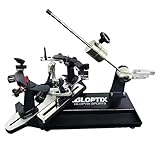 GLOPTIX GT-120 Drop Weight Machine GLOPTIX GT-120 Drop Weight Machine |
|
Check Latest Price |
 GAMMA Momentum 2 Drop Weight Stringer GAMMA Momentum 2 Drop Weight Stringer |
|
Check Latest Price |
Two things stand out when you lay the six out next to each other. First, this is a drop weight and crank market, not an electronic one, so the tension-control question is really a question of consistency rather than of exact poundage. Second, the review counts vary enormously, and that tells you something useful: the Klippermate is a proven design, while several of the others are newer units with very few owners reporting back.
1. Klippermate Tennis Stringing Machine: The Proven Drop Weight Choice
Klippermate® Tennis Racquet / Racket Stringer
Drop weight tension
Alloy steel build
25 lb weight
20 x 12 inch footprint
Pros
- Repeatable drop weight tension
- All steel construction resists flexing
- Clamps grip frames firmly
- Tool kit plus string and grip package included
- Unlimited lifetime warranty
Cons
- Slower than crank machines
- No lever adjustment after clamping
- Steep learning curve for first timers
With 198 reviews on record, the Klippermate is the most thoroughly documented machine we looked at, and the owner feedback is unusually consistent. The recurring praise is not about features, because it does not have many. It is about the tension holding steady from one job to the next, and about the clamps, which owners consistently rate above the clamps that come with machines costing considerably more.
Construction is the other theme. The frame is alloy steel rather than fiberglass or aluminum, at 25 pounds and a 20 by 12 inch footprint. That weight is a feature in a garage and a nuisance if you planned to carry the machine to a club once a month. It is also why the machine still feels solid when you are pulling stiff polyester at the top of the scale.
The one detail worth knowing before you order: the lever arm cannot be adjusted once the string is clamped. You set the weight bar, judge the level by eye, and commit. There is no bubble level on the scale, so the tolerance is narrow. On your first few jobs, work at moderate tension and get a feel for the arm before you trust it near 50 lb.
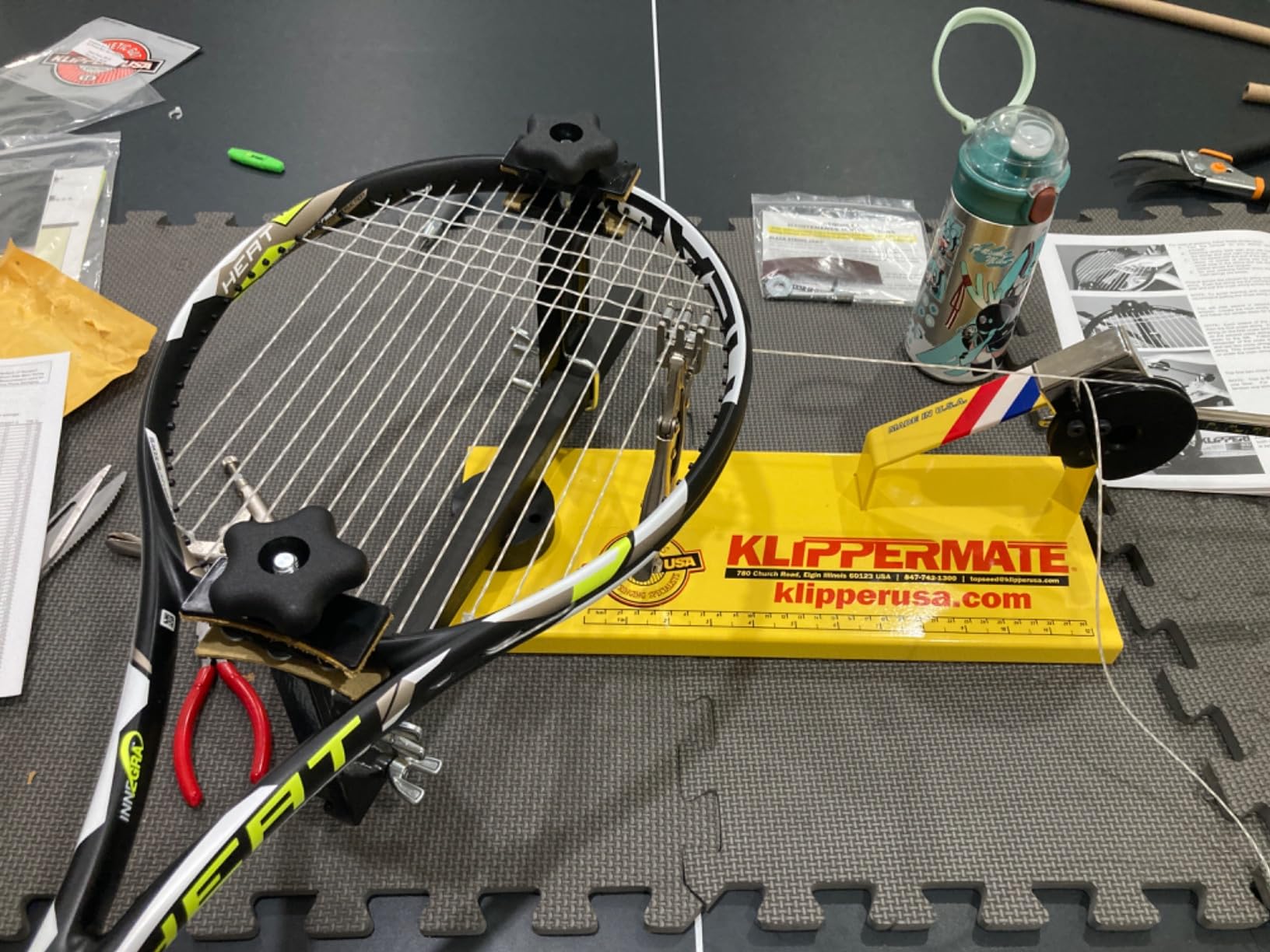
Longevity is where this machine separates itself. One owner in a long-running r/10s thread described stringing with a Klipper drop weight for 28 years and was counting down to retirement. That is not a spec sheet claim, it is a service life report, and it lines up with what the lifetime warranty implies about how the manufacturer expects the machine to be treated. The warranty itself is unlimited and lifetime, backed by phone-based technical support, and spare part availability is listed at 100 years.
On speed, it is the slowest machine here. A drop weight arm takes time to settle, and you cannot rush the level check. If you are stringing two rackets a month for yourself and your partner, that is a non-issue. If you are running a small club league, it adds up quickly.
What the Klippermate does better than the rest
Two things, and both are hard for a competitor to copy. The first is documented long-term service: when owners report that the same machine held calibration for decades, that changes the calculation entirely compared with a unit with five reviews. The second is the package. It ships with a complete tool kit plus a free string and grip package, and the instructions are described in reviews as the most complete of any stringer, which matters enormously if this is your first machine.
There is no assembly required either, which means you can go from box to first string job in an afternoon. For a beginner, that removes the single most common reason a new stringer gets abandoned in a garage corner.
Where the Klippermate falls short
It cannot be upgraded. There is no path from this drop weight to fixed clamps, and no retrofit to constant pull, so if your stringing habits grow toward stiff polys at high tension, you will eventually outgrow it rather than grow into it. A Wise tensioner is a known add-on route for drop weight machines, but the Klippermate’s arm and clamp layout are fixed enough that buyers should verify fit before counting on it.
The vice-grip string clamps can also leave cosmetic dents or ghosting marks on string surfaces, which is a fair complaint if you care about how a fresh job looks. It does not affect play, but string snappers notice it.
2. GLOPTIX GT-210 Vertical Stringing Machine: Widest Tension Range
GLOPTIX GT-210 Tennis Racket Stringing Machine Manual Vertical Progression Racket String Tools, with Tools and Accessories
Linear pull 9-102 lbs
6-point frame system
61.7 lb package weight
2 year warranty
Pros
- Cranks to 102 lbs of linear pull
- Vertical format saves bench space
- 6-point support with K-shaped grippers
- Speed-wrench lever clamps
- Clear KG and LB scales
Cons
- Heavy and awkward to move
- Limited setup documentation
- Tension head needs calibrating
- Only 9 reviews
The GT-210 is the machine to consider if your rackets are stiff graphite frames that you want strung high, or if you also string badminton or squash frames that pull far harder than a tennis racket. A 9 to 102 lb linear pull covers essentially any job a home user will encounter, which is more range than anything else in this roundup.
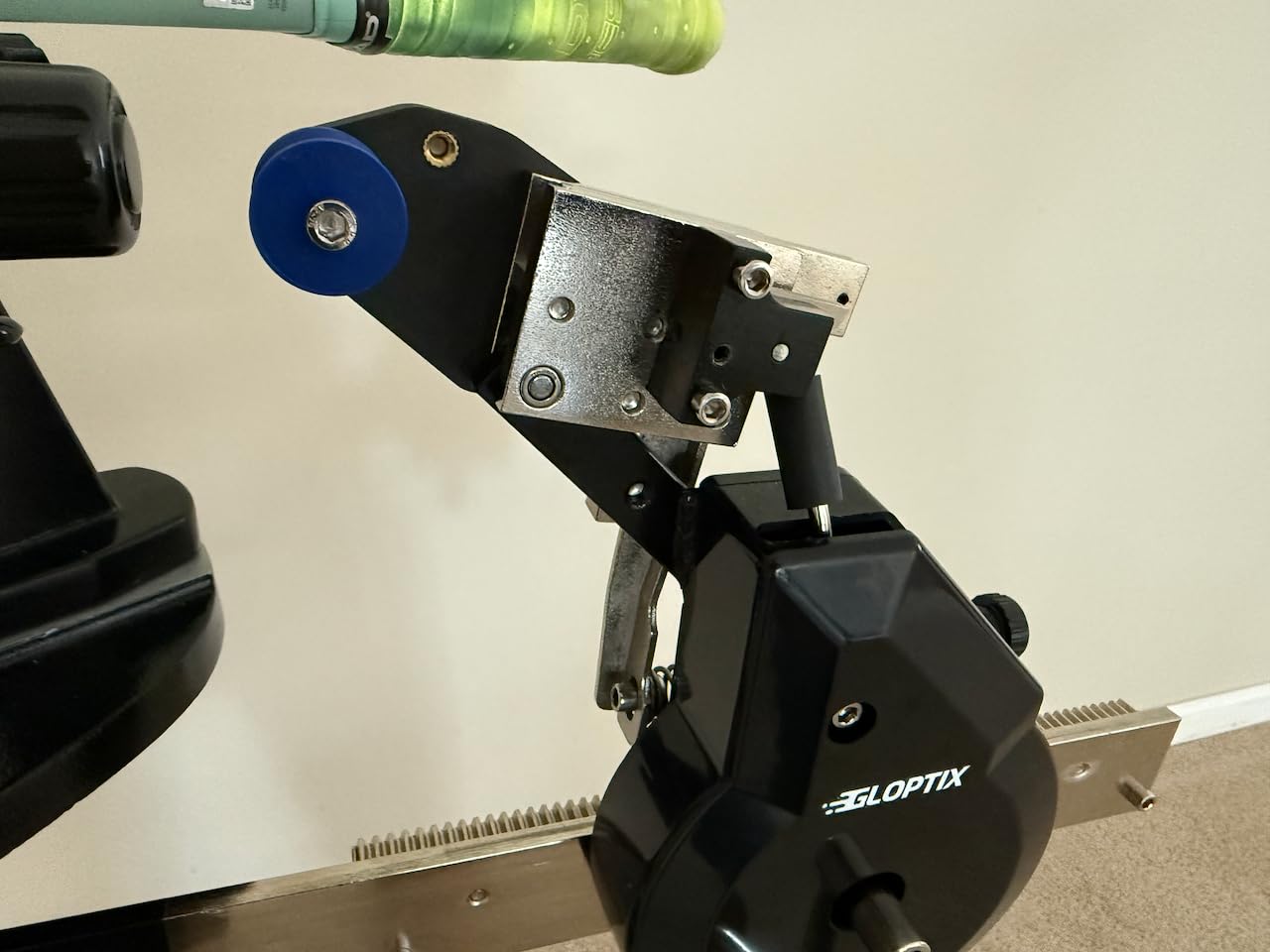
The vertical standing format is the practical win in a domestic space. A desktop stringer needs a wide, deep bench to sit on; the GT-210 stands on the floor and takes up a narrow footprint of wall instead. The 360 degree steel swivel base lets you rotate the rack rather than crawling around it, which genuinely speeds up threading.
The mounting is where this machine earns its keep at high tension. It uses a 6-point frame shooting system with K-shaped grippers and added high-pound protectors, so the hoop is supported at six points while you pull. That is the setup regular users recommend to anyone worried about deforming an expensive frame, and it is a real step up from a two-point mount.
Why the vertical format matters at home
Space is the deciding factor in most home setups, and floor space is cheaper than bench space. The GT-210’s package weight is 61.7 pounds, which sounds heavy until you understand it as a floor-standing unit you leave in place. If you do need to move it, that weight is a genuine two-person job.
The dual KG and LB scale markings are clear and easy to distinguish, which is a small quality of life detail that matters when you are setting tension by eye on a crank pull. The lever speed-wrench system clamps the string without the bounce or loosening that plagues some crank machines, and the spring-loaded lockout tensioner resets quickly between strings.
What to know before you buy
Documentation is the weak point. There are few public setup resources and limited written instructions, and the tension head typically needs calibrating out of the box. Buyers who put in that setup time rate the machine highly; buyers who expect a Klippermate-style unboxing experience tend to be disappointed. Budget an afternoon for setup and calibration before your first job.
With 9 reviews on record, long-term reliability is not well documented. The build specification is credible, and the two-year manufacturer warranty is real, but this is not a machine with a decade of field data behind it.
3. GLOPTIX GT-160 Desktop Stringing Machine: Fastest Job Time
GLOPTIX GT-160 Tennis Racket Stringing Machine Manual Desktop Progression Racket String Tools, with Tools and Accessories
Linear pull 9-102 lbs
6-point frame system
57.3 lb package weight
Desktop format
Pros
- Roughly halves drop weight stringing time
- Spring crank locks tension reliably
- 6-point frame system protects the hoop
- Clear KG and LB scales
- Simple desktop mounting
Cons
- No setup or calibration instructions
- Tension head needs calibrating first
- Very small review base
- Minimal brand video content
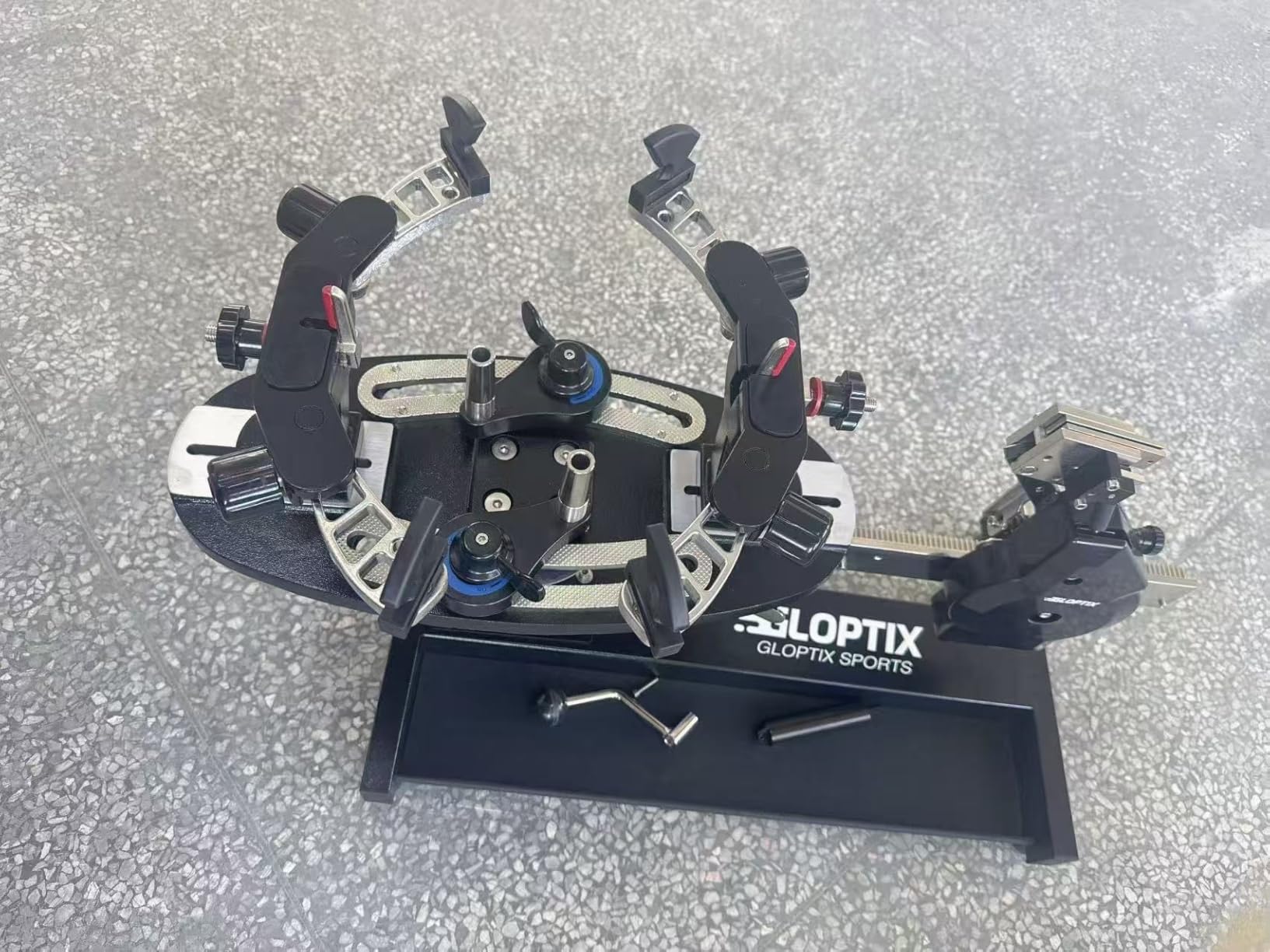
The GT-160 is the GT-210’s sibling in desktop form, and it shares the same 9 to 102 lb linear pull range, the same 6-point frame shooting system with K-shaped grippers, and the same 360 degree steel swivel base. What changes is the chassis: a tabletop body at 57.3 pounds rather than a vertical stand.
Owners consistently report one thing above all else, which is that this machine roughly halves the time a job takes compared with a drop weight setup. That is the whole argument for a crank machine. A spring-loaded manual crank lockout tensioner draws the string to your target and holds it, and because there is no weight bar to settle, you get straight to the clamps. The spring mechanism also resets quickly, so consecutive strings feel consistent.
Desktop mounting is simpler than it looks in a spec list. You set the machine on the bench, mount the racket, and turn the crank. There is no height or tilt adjustment to dial in, which some people will call a limitation and most home users will call a relief.

Where the crank system pays for itself
If you are stringing more than a couple of rackets a month, time is the metric that matters. At four rackets a month, the difference between a ten-minute arm settle and a locked-in crank pull adds up to a meaningful chunk of an evening. At one racket a month, it is irrelevant, and a drop weight machine is the more sensible purchase.
The 6-point mounting with high-pound protectors is the other reason to look here rather than at a cheap crank. It keeps the hoop from deforming while you are pulling, which matters most on stiff graphite frames strung above 45 lb.
The setup gap is the deciding factor
This machine has no unboxing, setup, or tension calibration instructions, and the tension head needs calibrating before first use. The brand’s video channel has minimal and only partly relevant content, so you are largely working from the manual and your own judgement. That is exactly the situation the Klippermate is built to eliminate.
There are only 5 reviews on record, so long-term durability is largely unproven. Owners who did the calibration work report the machine is quick and the seller responsive on problems. If you are comfortable with that tradeoff, the GT-160 is a strong pick for an experienced stringer. If you are not, pay the premium for a machine that explains itself.
4. iDili DIY Racket Frame Threading Machine: The Cheapest Way In
DIY Racket Frame Threading Machine Badminton Racket Stringing Machine Wire Stretcher Aluminum Alloy 20-32LB (A)
20-32 lb tension range
6-point fixed head
Aluminum alloy body
Listed for badminton and tennis
Pros
- Compact and portable
- Aluminum alloy resists deformation
- Fixed 6-point head with high-pound protector
- Lowest entry cost in the roundup
Cons
- Tension scale under-reports by about 10 percent
- Clamp buttons extremely stiff
- Jaw geometry struggles near the frame edge
- Some owners could not finish a job
We include this one because it is the honest floor of the market, and because a lot of first-time buyers find it first. It is a small manual frame threading machine built from aluminum alloy and phenolic resin, listed for both badminton and tennis, and it is the least expensive way to find out whether stringing is something you want to do.
On paper the design is sensible. It has a fixed 6-point head and a high-pound protector, and the manufacturer reports testing the pull to 70 lb without frame deformation using tennis string. For a badminton frame, where the pull requirement is lower and the frame is smaller, that is a reasonable machine.
For a tennis racket, the picture is less favourable, and the reviews are blunt about why. The tension scale under-reports by roughly 10 percent, so the number on the dial is lower than the force actually applied. That is not a cosmetic issue when you are stringing a stiff frame and assuming you are at 50 lb.
When this machine is the right call
It suits badminton more than tennis, full stop. The 20 to 32 lb tension range is closer to badminton requirements, the compact build is genuinely portable, and the fixed 6-point head keeps the smaller frame from distorting. College and high school badminton players stringing their own frames are the stated use case, and it is a fair one.
For a pure tennis beginner on a very tight budget who is stringing a cheap beginner racket, it will physically complete the job. That is a real but narrow benefit.
Where it falls apart
The flying clamps are the problem. Owners report that the clamp buttons are extremely hard to press, that the supplied clamps differ from the ones shown in demo videos, and that the jaw bevel is almost flat, so the clamps will not grip reliably where string spacing narrows near the frame edge. Those are not preferences, they are mechanical faults that show up on every job.
Some owners report being unable to complete a stringing job with it at all, and the 3.4 rating across 5 reviews is the lowest average in this roundup. Buy it to practise threading on a cheap frame, not to produce rackets you intend to play with.
5. GLOPTIX GT-120 Drop Weight Machine: Compact With Real Range
GLOPTIX GT-120 Drop Weight Stringing Machine Manual Desktop Tennis Racket Stringing Machine, with Tools and Accessories
Drop weight 15-80 lbs
6-point frame system
48.5 lb package weight
Desktop format
Pros
- Usable 15-80 lb tension range
- 360 degree rotating rack plate
- K-shaped grippers and 6-point support
- Compact desktop footprint
Cons
- Only 2 reviews on record
- Slower than crank machines
- Tension read by eye rather than a calibrated lock
The GT-120 is the most affordable of the three GLOPTIX machines in this roundup and the one that makes the most sense for a first drop weight purchase. It covers 15 to 80 lb on a drop weight system, which spans essentially every tension a recreational player will want, and it does so in a desktop footprint.
The 360 degree rotating rack plate is the feature that stands out in use. You can spin the rack to reach the string path rather than leaning around the frame, which removes the most awkward part of the mounting step. Combined with the 6-point frame shooting system and K-shaped grippers, the racket stays protected while you pull.
It is also the most compact of the three GLOPTIX units at 48.5 pounds, though that is still a substantial bench object rather than a shelf item. The material is aluminum rather than steel, so it is lighter than a Klippermate but also less rigid.
Why the rotating rack changes the workflow
Every machine in this roundup mounts a racket, but not every machine lets you move the racket. The rotating plate means the frame comes to you, which is exactly what you want in a dim garage with a headlamp on. For a first stringer, that removes more friction than any other single feature here.
The tension range is the other argument. A drop weight machine that only manages 30 lb is fine for a beginner frame and useless for a stiff one. Covering to 80 lb means you can move between a soft multifilament at 45 lb and a stiff polyester at 65 lb without changing machines.
Read the rating carefully
It carries a perfect 5.0 rating, and that number is based on 2 reviews. Treat it as a thin signal rather than a track record. There is very little independent owner feedback to judge this machine by, and it is a newer design in a brand with a short history.
As a drop weight, it is inherently slower than the crank machines, and like all drop weights the tension is set by judging the weight bar by eye rather than reading a calibrated lock. If you already know you want a crank, this is the wrong machine. If you want a forgiving first setup with room to grow, it is worth a look.
6. GAMMA Momentum 2 Drop Weight Stringer: Most Beginner Friendly Design
GAMMA Momentum 2 Drop Weight Stringing Machine – Professional-Grade Tennis Racquet Stringer with Advanced Features for Precision and Durability, Easy-to-Use and Ideal for Home or Club Use
Drop weight tension
2-point mount
Die-cast aluminum base
5 year limited warranty
Pros
- Wayfinding decals guide the stringing sequence
- Composite floating clamps are gentle on string
- Die-cast aluminum base is compact and stable
- Three string sets and full tool set included
Cons
- Only one review on record
- 2-point mount rather than 6-point
- Slower per racquet than crank machines
The Momentum 2 is the newest machine here, first listed in May 2026, and it is the only one designed explicitly with a first-time stringer in mind. The wayfinding system is the headline: red-marked touchpoints and placed decals indicate where the string goes in the gripper, where tension is applied, and where the weight sits. That is a printed answer to the question that stalls most beginners, which is not what the machine does badly but what the correct sequence even is.
The clamps are the technical improvement worth noting. Composite floating clamps grip the string firmly while spreading contact, which reduces tension loss and avoids marking the string. On older metal clamp designs the jaws concentrate force on a small area, and the string pays for it. Here, that trade-off has been engineered out.
It is also well bundled: three sets of string plus a straight awl, a pathfinder awl, a string cutter, pliers, and hex wrenches. The die-cast aluminum base gives a stable, low-profile footprint at 24.72 by 13.31 by 8.27 inches, and a matte black tool tray with a protective pad keeps everything within reach.
Who will like the Momentum 2 most
Someone who wants the ergonomics of a modern machine without the commitment of a crank system. The wayfinding decals make the first job dramatically less intimidating, the bundled tool set removes an extra purchase, and the floating clamps mean a mis-threading mistake does not ruin the string.
GAMMA is also one of the names regular stringers consistently treat as a default recommendation alongside Tourna, and a 5 year limited warranty is a longer commitment than most competitors in this roundup offer.
Two things to weigh first
It uses a 2-point mounting system. For most home rackets that is fine, and the floating clamps hold well, but if you own a stiff graphite frame you play hard and care about, the 6-point systems on the GLOPTIX machines above are the safer choice. Forum advice on protecting expensive frames consistently points toward six-point mounting and fixed clamps as the minimum.
And the single review should be read for what it is. One owner called it easy to use and praised the brand, which is encouraging but not evidence. The Momentum 2 is a very new model with a very short track record, so we would treat it as a well-designed bet rather than a proven one.
How to Choose a Tennis Stringing Machine for Home Use?
The single most useful question is not which brand. It is how many jobs you will realistically do in a month, because that determines which pull system you need and everything else follows from it. Here is how the three pull types differ, in plain terms.
Drop weight is a weight bar that swings down a graduated arm and pulls the string to a set position. It is mechanically simple, has almost nothing to break, and is very forgiving to learn on. The tradeoff is time and precision: you wait for the arm to settle and you judge the level by eye, so repeatability is good but not laboratory exact.
Constant pull machines use a motor to maintain tension as the string stretches, which is what you want for stiff polyester strings at high tension. They are electronically complex, cost far more, and are generally shop equipment. The exception worth knowing: a drop weight machine can sometimes be retrofitted with a Wise tensioner to get closer to constant pull behaviour at a fraction of the cost. Verify fit with the machine’s mounting layout before buying one.
Linear pull is a crank. You wind a handle to draw the string to the target, the mechanism locks, and the job moves on quickly. Crank machines are the standard upgrade once you are past the learning stage, and the two GLOPTIX units here crank to 102 lb.
The second question is mounting points, and the answer for home use is six if you can get it. A 2-point mount grips the frame at two points and lets the rest of the hoop flex, which is fine for soft frames and a gamble on stiff ones. A 6-point mount supports the frame at six locations, which measurably reduces the risk of deforming an expensive racket. Both GLOPTIX crank machines and the GT-120 use 6-point systems; the Klippermate and the Momentum 2 use narrower mounts.
Third, the domestic constraints nobody mentions. Noise is rarely a problem for any machine in this roundup, but footprint is: a 25 pound steel drop weight takes 20 by 12 inches of bench, and the GT-210 takes floor space and 61.7 pounds. Assembly matters too. The Klippermate requires none; both GLOPTIX crank machines need a tension head calibrated before first use. If you travel to a club to string, weight is the number that decides for you.
Then there are the accessories, and this is where home stringers get surprised. A starting clamp is the one item everybody names, and even well-equipped premium machines are widely reported to ship without one. A stringing block, grommet strips, an awl, and a decent string cutter round out a workable kit. Budget for the starting clamp regardless of which machine you choose.
On strings, beginners do best with a soft multifilament or a synthetic gut at 48 to 52 lb. Stiff polyester at 50 lb is unforgiving on both the string bed and the arm, and a drop weight machine’s accuracy is least welcome exactly where it is needed least. If you are stringing for someone with tennis elbow, softer is lower tension and lower impact, not a machine upgrade.
On the money side, the arithmetic is simple. Shops charge a labour fee per racket on top of string, and a home machine removes that fee from every job. At a typical shop rate, a machine in the few-hundred range breaks even within roughly a year of ordinary stringing. If you string once or twice a year, it never breaks even, and no machine will change that.
So who should not buy one? If you restring once or twice a year, keep paying the shop, because the machine will age instead of earning. If you are still deciding whether you like stringing, practise on a cheap manual frame such as the iDili before spending on anything serious. And if you only want to build tennis elbow, string softer rather than stringing yourself.
Used machines are where many home stringers actually buy, and the inspection list is short: check that the clamps open and close cleanly, that the tension arm or crank holds calibration, that the base is not bent, and that all the parts are present, because machines are frequently sold without the stand or the starting clamp. Ask for a photo of the tension head under load before you pay.
If you are setting up a home workspace alongside other bench equipment, our guides to organising a garage workspace and small home equipment picks cover the surrounding setup.
Frequently Asked Questions
What stringing machine should I buy?
Buy a drop weight machine if you are stringing one to three rackets a month and are still learning, and a crank machine if you are past that point. A 6-point mount is worth paying for if you own stiff graphite frames. Among the six we reviewed, the Klippermate is the safest first purchase and the GLOPTIX GT-160 is the fastest per job.
How much does a tennis stringing machine typically cost?
Home-use machines fall into three bands. Budget drop weight machines start at the low end, mid-range machines add 6-point mounting and taller tension ranges, and premium constant pull electronics sit well above anything a typical garage stringer needs. Our roundup covers the budget and mid bands only, because the electronic tier is shop equipment.
Is Klippermate worth it?
For a home user, yes. It is the only machine in our roundup with a large body of independent owner feedback, and owners consistently report repeatable tension and builds that last for decades, including one r/10s user who stringed with a Klipper drop weight for 28 years. The trade-off is speed, since a drop weight arm is slower than a crank.
Are drop weight stringing machines accurate?
Reasonably, yes, within limits. A drop weight machine holds tension consistently from job to job, which is what matters for a home stringer, but it cannot adjust the lever after the string is clamped and the scale has no bubble level, so you set tension by eye. It is accurate enough for most recreational stringing and for string types up to stiff multifilaments.
What is the best tennis stringing machine for beginners?
The GAMMA Momentum 2 is the most beginner friendly design we found, with red-marked touchpoints and wayfinding decals that show the correct stringing sequence, composite floating clamps that are gentle on string, and a bundled tool set plus three strings. The Klippermate is the alternative choice for a first machine, and it wins on documentation and included accessories rather than on guidance.
How long does it take to learn to string a tennis racket?
Expect the first job to take 40 to 60 minutes on a drop weight machine, mostly because you are checking the manual and second-guessing the sequence. By the fourth or fifth racket most stringers are down to 20 to 30 minutes, and switching to a crank machine typically cuts a further 30 to 40 percent from that time.
Best Tennis Stringing Machines for Home Use: Final Verdict
The Klippermate is our pick for the best tennis stringing machines for home use overall, because it is the only machine here with decades of independent owner feedback behind it, and that feedback keeps pointing to the same strengths: repeatable tension, steel construction, and clamps that outperform the field. It ships with a tool kit and string, needs no assembly, and carries an unlimited lifetime warranty.
If you already know how to string and want each job done faster, the GLOPTIX GT-160 is the pick for the desktop and the GT-210 for a floor-standing footprint, both cranking to 102 lb on 6-point mounts. For a first machine with a gentler learning curve, the GAMMA Momentum 2’s wayfinding decals and floating clamps make the first job the least intimidating of the group.
Whichever you choose, add a starting clamp to the basket. It is the accessory most often missing and the one every stringer names. Check the current details before you order, and string something.