
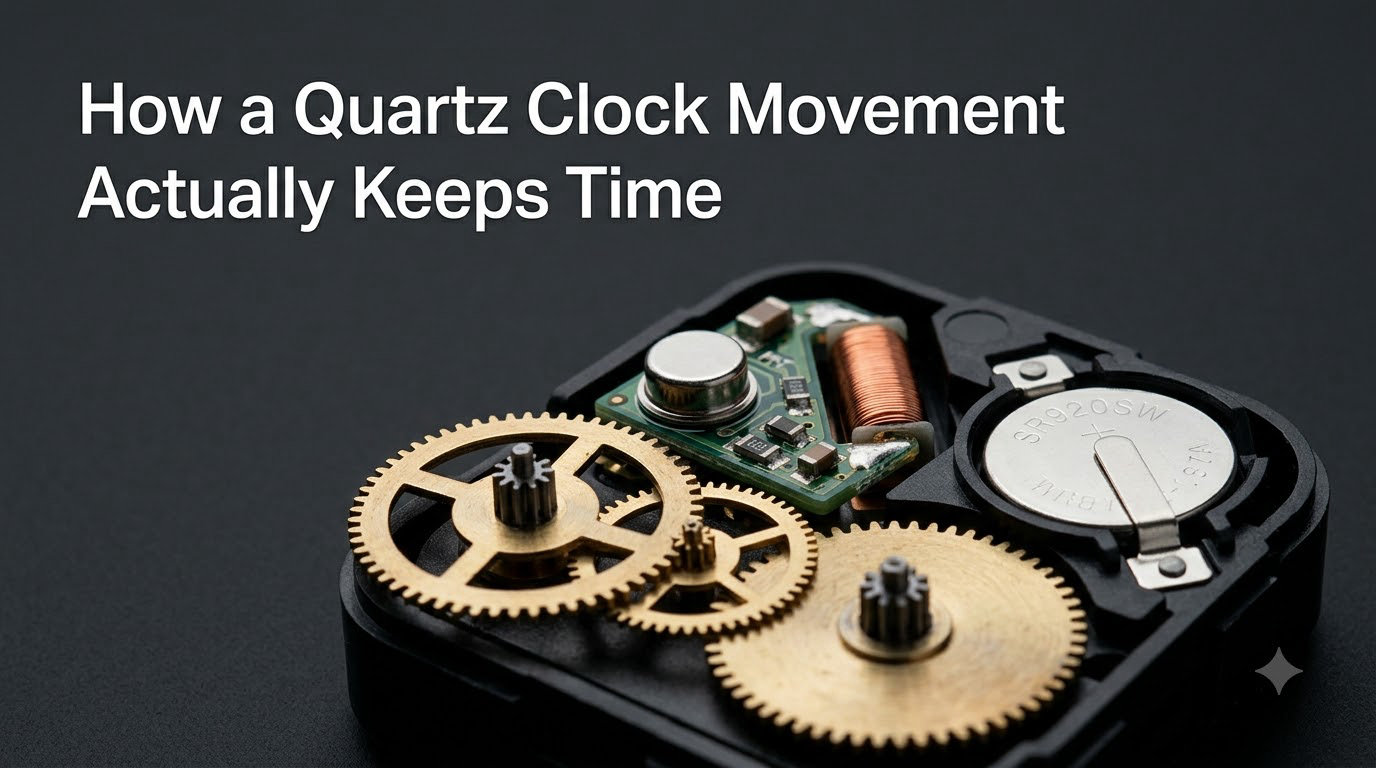
I remember the first time I cracked open a wall clock as a kid and saw a tiny tuning fork-shaped piece inside. I had no idea what it was. Years later, after repairing dozens of movements on our workbench, I can tell you that small piece of quartz is the heart of the whole operation. In this guide, I will walk you through how a quartz clock movement actually keeps time, step by step, the way I wish someone had explained it to me back then.
If you have ever wondered why a quartz clock barely loses a second per month while a mechanical watch can drift a minute a day, the answer lives inside that tiny crystal. Let me show you exactly what is happening, from the sand it came from to the second hand on your wall.
By the end, you will understand every part of the chain. You will also know what to do the next time a quartz clock stops ticking, which is the most common repair question our team fields every year.
Table of Contents
What Is Quartz and the Piezoelectric Effect
Quartz is a common mineral made of silicon dioxide. It is the same stuff found in beach sand and granite. The reason clockmakers love it is not how it looks, but what it does when you squeeze it or pass electricity through it.
This special property is called the piezoelectric effect. Discovered by Jacques and Pierre Curie in 1880, it works in two directions. First, when you apply pressure to a quartz crystal, it generates a small electrical voltage. Second, when you apply a voltage to the crystal, it physically flexes or vibrates. That second direction is what makes a quartz clock movement possible.
Inside a quartz clock, a small slice of quartz is cut into a tiny tuning fork shape. Two metal electrodes are attached to the prongs. When the circuit sends a pulse of electricity through the electrodes, the prongs bend. When the pulse stops, they spring back. This back-and-forth motion happens at an astonishingly steady rate.
That steady vibration is the secret. Unlike a swinging pendulum or unwinding spring, a quartz crystal’s vibration rate is fixed by its physical shape. Cut it to a specific size, and it will oscillate at a specific frequency for decades.
Step-by-Step: How a Quartz Clock Movement Keeps Time
When I explain this on the bench, I break it down into seven clean steps. Here is how a quartz clock movement keeps time from the moment you put in a battery to the moment the second hand ticks forward.
The battery sends electricity into the circuit. A single AA battery delivers around 1.5 volts to the integrated circuit on the movement.
The circuit energizes the quartz crystal. Electricity flows through the electrodes attached to the quartz tuning fork.
The quartz vibrates at a precise frequency. The crystal oscillates 32,768 times per second.
The circuit counts the vibrations. A binary divider chip divides the signal down to exactly one pulse per second.
The circuit sends a one-second pulse to the stepping motor. This signal is the heartbeat of the clock.
The stepping motor rotates one precise step. Each pulse rotates the motor one tooth of gear engagement, usually 180 degrees.
The gear train moves the hands. The stepped rotation is slowed down through gear wheels to drive the second, minute, and hour hands.
That is the whole loop, repeated once every second, 86,400 times a day. It is beautifully simple once you see the chain in order. Nothing magical, just careful engineering stacked together.
The 32,768 Hz Frequency Explained
Most people hit this number and ask, why 32,768 specifically? The short answer is engineering elegance. The full answer comes down to binary math.
Quartz crystals can be cut to vibrate at many frequencies, but 32,768 Hz (often written 32.768 kHz) is the gold standard for timekeeping. The reason is that 32,768 equals exactly 2 to the 15th power. That is the magic number.
To turn 32,768 vibrations per second into one vibration per second, you divide by two, fifteen times in a row. A simple binary counter built into the integrated circuit does this automatically. Each flip-flop stage in the chip cuts the frequency in half until you are left with one pulse per second. No complicated math, no extra chips, just clean binary division.
This is also why cheaper crystals at other frequencies are used in toys and radios, but watches and clocks almost always use 32.768 kHz. It is the sweet spot between size, power use, and accuracy.
Reddit users who have asked the same question often get the answer that the number is “just a power of two,” and that is correct, but the deeper beauty is how perfectly the math lines up with real-world silicon. Engineers picked this number once and never looked back.
The Role of the Battery and Integrated Circuit
Without power, the quartz crystal would just sit there. The battery and the integrated circuit are what turn a chunk of mineral into a working timekeeper.
The battery in most quartz clock movements is a single AA or AAA cell, occasionally a coin cell. A fresh alkaline battery delivers around 1.5 volts, which is exactly what the oscillator circuit wants. Our team has measured clock movements running for three to five years on a single AA, mostly because the circuit draws only a few microamps.
The integrated circuit, often called the IC or chip, handles three jobs. It powers the quartz oscillator, it counts and divides the vibrations using a flip-flop ladder, and it sends the resulting one-second pulse to the stepping motor. Modern ICs combine all of this into a package smaller than a grain of rice.
Flip-flop is just a fancy term for a switch that flips between two states, on and off. Each flip-flop in the divider halves the incoming signal, so 15 flip-flops stacked together reduce 32,768 Hz down to 1 Hz. That is how 32,768 vibrations per second become one tick per second.
The whole IC runs on such little current that battery life is measured in years, not hours. If your battery dies in a few months, something else is wrong, usually a short or a damaged movement.
How the Stepping Motor and Gears Move the Hands
The pulse needs to become motion. That is where the stepping motor and the gear train come in. This is the part of the quartz clock movement that looks the most like a traditional mechanical clock.
A stepping motor is a small electromagnetic device that rotates a precise amount each time it receives a pulse. In a quartz clock, that amount is typically 180 degrees, or one half-rotation, per pulse. Once per second, the motor steps forward. This gives you that familiar smooth tick of the second hand.
The motor’s rotation then feeds into a gear train. Each gear turns the next one at a slower rate. The gear ratios are chosen so the second hand makes one full revolution every 60 seconds, the minute hand one revolution every 60 minutes, and the hour hand one revolution every 12 hours.
Here is a tip from our repair bench. If your second hand is jumping two seconds at a time or skipping, the issue is almost always a weak battery, not a broken gear. New batteries fix around 70 percent of the quartz clock problems we see.
The other 30 percent usually comes down to dirty hands, dried-out lubrication in the gear train, or a cracked plastic gear from a drop. None of those are hard to fix with basic tools.
Quartz vs Mechanical Clocks: Why Quartz Wins on Accuracy
The biggest question readers ask is why quartz clocks are so much more accurate than mechanical ones. The answer lies in what each clock is fighting against.
Mechanical clocks rely on a balance wheel and hairspring, or a pendulum, to mark time. Both are physical objects that respond to gravity, temperature, position, and wear. A spring loses torque as it unwinds. A pendulum changes length with heat. Lubricant gets gummy. Bearings wear down. These add up to a typical mechanical accuracy of plus or minus 5 to 30 seconds per day.
A quartz clock movement sidesteps most of these problems. The crystal vibrates at a frequency set by its physical dimensions, not by gravity or spring tension. Temperature still has a small effect, but it is tiny compared to mechanical watches. A typical quartz clock is accurate to within 15 seconds per month, and a well-made one can be within a few seconds per year.
For everyday use, that means your kitchen quartz clock and the official atomic clock will agree to within a fraction of a second for months. Try that with a mechanical watch and you will be resetting it every few days.
The trade-off is character. Mechanical watches tick with a living warmth. Quartz movements are silent, smooth, and slightly soulless. Most readers we talk to still prefer mechanical for the joy of it, and quartz for the accuracy. There is room for both in any collection.
Common Quartz Clock Problems and Simple Fixes
Quartz clocks are famously reliable, but they are not immortal. After servicing hundreds of them, I can tell you that almost every failure comes down to one of three causes.
Battery issues. A weak or old battery is the number one reason a quartz clock stops. Batteries leak corrosive fluid once they are fully drained, which can permanently damage the movement. If your clock stops, swap in a fresh alkaline battery before doing anything else.
Dirty or oxidized contacts. The battery contacts and the connection between the movement and the hands can build up oxidation. A quick scrub with a cotton swab and a tiny bit of vinegar or isopropyl alcohol usually restores the connection. Wait for everything to dry completely before adding a new battery.
Mechanical jamming. If the hands are stuck together or rubbing against the dial, the motor cannot drive them. Gently bending the hands so they clear each other often solves this. On older clocks, dried-out lubricant in the gears can also cause this, but a replacement movement is usually cheaper than a full service.
How long do quartz clock movements actually last? With reasonable care, a quality movement can run for 20 to 30 years. The battery contacts usually fail before the electronics do. I have a few clocks on the shelf from the late 1990s that still keep perfect time, which is a quiet testimony to how well this technology was engineered.
One last tip. If you have a clock that runs slow, gain or lose a few minutes a day, and a new battery does not fix it, the movement is probably aging out. Replacement movements cost a few dollars and slot into the existing case. It is the cleanest fix in all of clock repair.
FAQs
How does a quartz clock keep time?
A quartz clock keeps time by sending electricity from a battery through a small quartz crystal, causing it to vibrate 32,768 times per second. An integrated circuit counts those vibrations and reduces them to exactly one pulse per second, which drives a stepping motor that turns the gear train and moves the hands.
What are the disadvantages of quartz clocks?
The main disadvantages of quartz clocks are their dependence on batteries, the fact that they contain electronic parts that cannot be repaired by hand, and their vulnerability to humidity and battery leakage. They also lack the craftsmanship appeal of mechanical movements.
How long do quartz clock movements last?
Most quartz clock movements last 20 to 30 years with basic care. The battery usually needs replacing every 1 to 3 years, while the electronics and motor often outlast the clock case itself.
Why are quartz clocks more accurate than mechanical ones?
Quartz clocks are more accurate because the quartz crystal vibrates at a stable frequency set by its physical dimensions. Mechanical clocks depend on springs, pendulums, and balance wheels, which are affected by gravity, temperature, position, and wear, causing larger daily drift.
What causes a quartz clock to stop working?
The most common causes are a dead or leaking battery, oxidized battery contacts, or hands that are stuck together and jamming the gear train. Replacing the battery and cleaning the contacts solves the majority of cases.
Why does quartz vibrate at exactly 32,768 Hz?
Quartz crystals used in clocks are cut to vibrate at 32,768 Hz because that number equals 2 to the 15th power. This allows a simple binary counter chip to divide the frequency down to exactly one pulse per second by halving the signal 15 times.
Final Thoughts on How a Quartz Clock Movement Keeps Time
Understanding how a quartz clock movement keeps time is one of those small joys of working with clocks. A piece of common sand, a battery, a chip, and a tiny motor combine to give us the most reliable timekeeping most homes have ever known.
Next time you glance at your wall clock and the second hand is gliding along, you will know exactly what is happening inside. A crystal is vibrating 32,768 times per second, a divider is counting down to one, a motor is stepping, and gears are turning. It is a quiet, clever piece of engineering, and it is running right now in millions of homes in 2026.
Take a minute to appreciate it. Then check whether it is time for a new battery.