
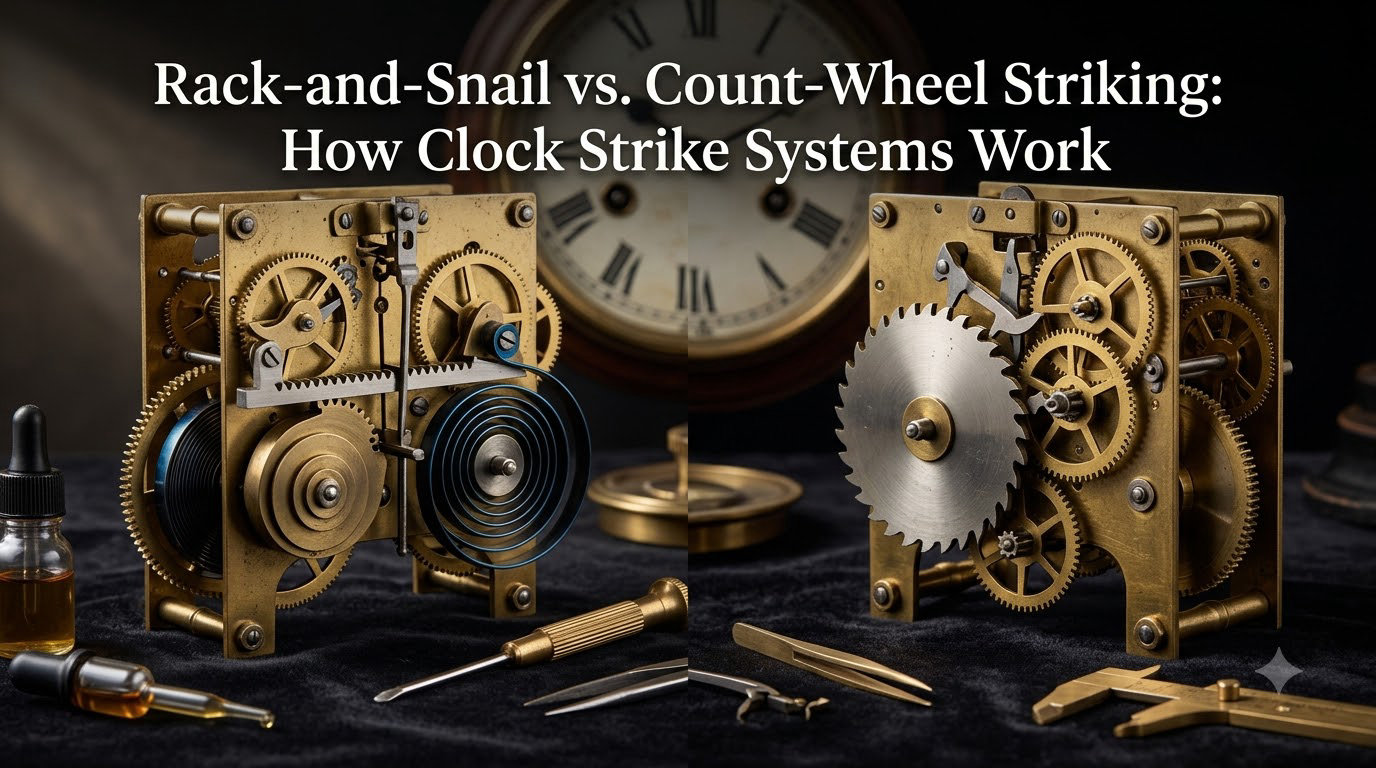
Every mechanical striking clock you’ve ever heard chime on the hour uses one of two clever systems to know when to stop ringing: a count wheel or a rack-and-snail assembly. Both have been keeping clocks honest for centuries, but they take very different paths to arrive at the same ding-dong result.
I’ve spent the last decade restoring antique longcase and mantel clocks at our workshop, and the rack-and-snail vs count-wheel striking debate comes up almost weekly with new collectors. Some swear by the elegant self-correcting nature of rack striking, while others prize the rugged simplicity of count wheel mechanisms from the 1700s.
In this guide, I’ll walk you through exactly how both strike systems work, where they came from, and how to identify which one is hiding inside your grandfather clock. You’ll also learn why one became dominant and what to do when your clock starts striking the wrong hour.
Whether you’re a collector dating an unmarked movement, a restorer deciding what to keep, or simply a curious owner wanting to understand the heartbeat inside your clock, this comparison covers the mechanics, history, and practical handling of both systems. The differences may look subtle on paper, but they shape how every clock sounds and behaves.
Table of Contents
What Is a Striking Clock and Why Does the Mechanism Matter
A striking clock is a mechanical timepiece that audibly announces the hours by sounding a bell, gong, or coiled wire chime. It runs two separate gear trains inside the case: one keeps time (the going train), and the other produces strikes (the strike train).
When the hour hand reaches 12, a release lever lets the strike train run freely, and a hammer pounds the bell until some mechanism tells it to stop. That “tell it when to stop” part is the soul of the whole design, and it’s where rack-and-snail vs count-wheel striking comes into play.
Understanding which system your clock uses matters more than you’d think. The mechanism type affects how you set the time, how you silence the strike, and how the clock behaves when the power runs down. Our team has seen far more damage from improper handling than from actual mechanism failure, and almost all of that damage traces back to owners not knowing what they’re working with.
It also helps you date an unmarked clock. Count wheel striking dominated English clockmaking before Thomas Tompion refined rack-and-snail around 1680. After that, rack-and-snail gradually took over, and today almost every new striking clock uses it.
There’s also a practical collector’s angle. Knowing the strike system lets you estimate value, predict maintenance needs, and avoid costly mistakes when buying or restoring. A count wheel clock from 1720 with original parts carries more weight than one with replacement components. A rack-and-snail clock from 1760 with a worn gathering pallet is a routine service job. Knowing which system you’re looking at tells you which of those situations applies.
Count Wheel Striking Explained: How the Oldest System Works
Count wheel striking is the senior member of the two systems, with roots stretching back to the earliest weight-driven tower clocks of medieval Europe. It earned its place because the design is brutally simple: a spinning wheel with notches cut into its edge.
The count wheel itself looks like a gear with irregularly shaped teeth. Most of the teeth are long and shallow, but a few are cut deeper than the rest. A spring-loaded lever, called the count lever or count wheel lever, rests its tip inside these notches and bobs up and down as the wheel rotates.
When the strike train is released at the hour, the count wheel starts spinning. Each shallow notch lets the lever drop just far enough to allow one strike of the hammer. When the lever finally hits a deep notch, it falls far enough to engage a stop pin that locks the train and ends the striking sequence.
Here’s the part that trips people up: the position of those deep notches represents a specific hour. The wheel has to be in the right rotational position to strike the correct number of times. If the train runs down or someone manually advances the hands without striking, the count wheel loses track of where it is.
This is the count wheel’s biggest weakness. The strike train and going train are not synchronized, so any disruption leaves the clock striking the wrong hour until you manually re-sync it. Restoration specialists actually value this “feature” because count wheel clocks tend to have very few parts and survive centuries of use.
The deep notches typically occupy positions for hours 1 through 12, though some older English clocks had slightly different layouts. The number of shallow notches between deep notches dictates how many strikes occur at each hour. At 3 o’clock, for example, three shallow notches precede the deep notch for the fourth position.
One detail worth knowing: the count wheel rotates once per strike sequence. This means a clock striking 12 times will have the count wheel rotating through one full revolution at noon and midnight. Watching this happen on an open movement is one of the small pleasures of mechanical horology.
Key Components of a Count Wheel System
Five parts make up a working count wheel strike assembly. The count wheel carries the deep and shallow notches around its circumference. The count lever rides in those notches and acts as the gatekeeper for each strike. The stop pin catches the lever when it falls into a deep notch and locks the train.
The warning lever (or warning piece) provides a brief interval between the hour and the first strike, giving the clock time to settle. Finally, the gathering pallet coordinates the release of the strike train at the right moment. Each piece does one job, and that clarity is part of why count wheels survived for 400 years.
The warning run deserves special attention. This is the brief pause between the hour hand reaching 12 and the first strike of the hammer. The warning lever lifts slightly and holds the strike train back for one pendulum swing, then releases it. Without this delay, the hammer would strike immediately at the hour, which sounds rushed and mechanical. The warning run gives the strike a confident, deliberate tone.
Rack and Snail Striking Explained: How the Self-Correcting System Works
Rack-and-snail striking is the elegant solution to the count wheel’s biggest problem. Instead of relying on the strike train’s position to remember the hour, it uses the time train itself to set the count. This is what makes it self-correcting.
The rack is a straight piece of metal with teeth cut along one edge, looking like a saw blade. It hangs vertically next to the hour wheel and can pivot at its top. The snail is a stepped cam attached to the hour hand arbor, with twelve levels cut into it (one for each hour).
At the top of every hour, the rack’s tail piece drops onto the appropriate step of the snail. The number of teeth sticking up above the rack tail determines how many strikes will sound. As the strike train runs, a gathering pallet lifts the rack one tooth at a time until the rack tail returns to the snail and the sequence stops.
This is the genius of rack-and-snail striking. Because the snail is physically connected to the hour hand, the count is always tied to the actual displayed time. Even if the strike train runs down completely, restarting the pendulum will produce the correct number of strikes on the next hour.
The catch is what collectors call the “12-1 wall.” If you try to set the hands backwards past 12, the rack can jam against the snail in a way that’s hard to undo. Always move the hands forward, slowly, when setting a rack-and-snail clock.
The warning lever on a rack-and-snail clock works slightly differently than on a count wheel. It lifts the rack away from the snail just before each strike, allowing the rack tail to drop back onto the snail after the final tooth has been counted. This creates the same deliberate pause between the hour and the first strike that gives a striking clock its characteristic tone.
The gathering pallet in a rack-and-snail clock has two jobs instead of one. It has to lift the rack one tooth per strike AND it has to coordinate with the warning lever. Most rack-and-snail clocks built after 1750 have a gathering pallet mounted on a separate arbor from the count lever, which allows finer adjustment and reduces wear.
Key Components of a Rack and Snail System
The rack-and-snail assembly is more complex than a count wheel, which is why it took longer to perfect. The snail cam rides on the hour arbor and has twelve terraced steps that set the strike count.
The rack itself has teeth on one edge and a downward-pointing tail at the bottom. The gathering pallet lifts the rack one tooth per strike until the count is complete. The warning piece and strike release lever coordinate the moment of release, and a maintaining power system keeps the snail in position when winding.
One extra detail worth mentioning: most rack-and-snail clocks built after 1700 include maintaining power through a spring-loaded click that keeps the train engaged during winding. Without it, the snail could shift slightly mid-wind and throw off the count.
High-quality English longcase clocks from makers like Tompion, Graham, and Quare often had rack-and-snail movements with beautifully cut brass snails and engraved racks. These parts were sometimes finished with decorative patterns that you can still see on unrestored examples. The same care went into the gathering pallet, which was hardened and polished to reduce wear on the rack teeth.
Count Wheel vs Rack and Snail: A Head-to-Head Comparison
Both systems accomplish the same goal, but they get there differently. Here’s a quick breakdown based on what our team sees in the workshop and what experienced collectors discuss on the NAWCC forums.
Count wheel advantages include simpler construction with fewer parts, easier to repair for beginners, and proven longevity with many 18th-century examples still running. The disadvantages are striking out of sync after power loss, requiring manual re-sync when disturbed, and no self-correction if the train runs down.
Rack-and-snail advantages include self-correcting strike count, fewer synchronization headaches for owners, and dominance in modern clockmaking. The disadvantages are more complex mechanism requiring skilled repair, danger of jamming at the 12-1 wall if set backwards, and harder to manufacture which made early examples expensive.
If you want a clock you can wind, set, and forget, rack-and-snail wins every time. If you appreciate historical authenticity and don’t mind occasional re-syncing, count wheel clocks reward patient owners with mechanical purity.
From a collector’s perspective, the system type also affects restoration costs. Count wheel movements are usually cheaper to service because parts are simpler and tolerances are more forgiving. Rack-and-snail movements require more careful adjustment, and replacement parts like gathering pallets often need to be custom-fabricated for antique clocks.
For everyday use in a home setting, rack-and-snail is the practical choice. Modern reproduction longcase and mantel clocks overwhelmingly use rack-and-snail because owners don’t want to deal with synchronization after power outages or winding. The self-correcting feature is the single biggest reason rack-and-snail won the long historical contest between the two systems.
Historical Evolution: From Medieval Bells to Thomas Tompion
Striking clocks appeared in European tower clocks as early as the 14th century, with the first reliable weight-driven mechanisms appearing in England around 1285. These massive iron-frame clocks all used variations of the count wheel because no one had invented anything better.
The count wheel remained unchallenged for nearly 400 years. Then in the late 1600s, English clockmakers began experimenting with ways to make striking more reliable. Edward Barlow is often credited with inventing rack striking around 1675, though Thomas Tompion’s earliest surviving examples from around 1680 are the ones historians usually point to.
Tompion’s innovation caught on slowly. Throughout the early 1700s, count wheel and rack-and-snail mechanisms coexisted in English workshops. By 1750, rack-and-snail had become the dominant choice for high-quality longcase clocks, though count wheel persisted in cheaper mantel clocks well into the 19th century.
American clockmakers generally followed English trends, with one twist: shelf clocks and banjo clocks from the early 1800s often used simplified count wheel designs because they were cheaper to produce. German Black Forest clocks developed their own rack variations that influenced cuckoo clock design, which is why cuckoo clocks strike with two different notes.
French clockmakers took yet another path. They favored complicated repeating mechanisms that could strike the last hour, quarter, or minute on demand when a cord was pulled. These repeating clocks often used rack-and-snail-style systems adapted for the repeating function. The famous Lepaute and Berthoud movements from the 18th century included some of the most refined rack-and-snail work ever produced.
By the Victorian era, rack-and-snail had become standard in quality clocks throughout Europe and America. Industrial production methods made the parts easier to manufacture, and the self-correcting feature proved valuable in domestic settings where clocks might be moved or left unwound. Today, the only place you regularly see count wheel striking is in restored antique clocks from before 1750 or in reproduction tower clocks that mimic historical designs.
Regional and National Variations in Strike System Usage
British clockmaking led the world in striking mechanism development from the 1600s through the 1800s, and most surviving examples follow English patterns. London workshops set the standard, with provincial makers in places like Liverpool, Bristol, and Edinburgh producing high-quality work in the same traditions.
American clockmakers diverged from English practice in two ways. First, they developed cheaper count wheel movements for mass-produced shelf clocks sold through catalogs and general stores. Second, they created simplified rack-and-snail designs for higher-end mantel clocks influenced by German and Austrian immigrants who brought Black Forest traditions.
German Black Forest clockmakers developed their own version of rack-and-snail optimized for cuckoo clocks. The two-note strike on different bellows requires precise count control, which rack-and-snail provides naturally. These 19th-century German movements are still being made today and remain surprisingly affordable.
French repeating clocks developed separately from English striking clocks. The repeating function allows the owner to pull a cord and have the clock strike the current hour and quarter on demand, useful in the days before electric lighting. These clocks use a modified rack-and-snail system that can be triggered manually rather than automatically at the hour.
How to Identify Which System Your Clock Uses (And How to Handle It)
Open the clock door and look at the mechanism just behind the dial. If you see a wheel with irregular notches on its edge and a lever bouncing in those notches, you’re looking at a count wheel. If you see a stepped spiral cam (the snail) connected to the hour hand and a toothed bar (the rack) hanging next to it, you’re looking at rack-and-snail.
For closed cases, listen to the striking sequence. Count wheel clocks often have a slightly different strike rhythm because the count lever has to reset between strikes. Rack-and-snail strikes sound smoother and more even.
To estimate age, count wheel mechanisms generally suggest pre-1750 English clocks or 19th-century American shelf clocks. Rack-and-snail can mean anything from 1690 to today, but the style of movement, dial, and case will narrow it down further.
When setting the time, follow this rule: always move the hands forward, slowly, and never through the 12-to-1 zone if you have a rack-and-snail clock. Stop and wait for the strike to complete before advancing further. This prevents the 12-1 wall jam that has wrecked more rack-and-snail movements than I can count.
If you’re still not sure which system you have, the dial work offers clues. Count wheel clocks often have simpler dial layouts because the count wheel itself doesn’t need complex mounting. Rack-and-snail clocks frequently have more elaborate chapter rings because the snail needs to be positioned precisely relative to the rack tail.
Troubleshooting Common Strike Problems on Both Systems
Why does my clock strike the wrong number of times? This is the most common question I get, and the answer depends on which system you have. Count wheel clocks usually strike wrong because the count wheel position doesn’t match the current hour, often after the train ran down. Solution: advance the time forward to the next hour and let it strike, then set it correctly.
Rack-and-snail clocks usually strike wrong for three reasons. The rack tail is bent or worn and not sitting properly on the snail step. The gathering pallet has a worn tooth and isn’t lifting the rack cleanly. Or the snail itself is loose on the hour arbor and rotating independently.
If the strike runs continuously without stopping, the stop pin on a count wheel is likely worn or missing. On a rack-and-snail, the gathering pallet spring has probably failed or the rack teeth are damaged.
For silencing the strike at night, gently insert a piece of soft foam or cork between the hammer and the bell. Never wedge the hammer against the bell, as this can bend the hammer shaft or damage the strike train. Modern clock silencers that attach with a magnet work well and remove easily.
If the strike sounds weak or muffled, check the hammer alignment with the bell. The hammer should strike about one-third of the way down the bell for the best tone. Adjust by bending the hammer arm slightly while the strike train is locked.
When the warning run disappears or becomes erratic, the warning lever spring has probably weakened. This spring keeps the lever in contact with the count wheel or rack during the brief pause before striking. Replacement springs are available from clock parts suppliers, but proper installation requires removing the movement from the case.
If the clock strikes on the half-hour when it shouldn’t, the rack is probably not fully seated on the snail. This happens when the rack tail has worn past its adjustment range or when the gathering pallet is lifting too aggressively. A clockmaker can adjust the pallet depth or replace the rack tail to restore proper behavior.
Frequently Asked Questions About Clock Strike Systems
How does a striking clock work?
A striking clock runs two gear trains inside one case. The going train drives the timekeeping, and the strike train drives the hammer that hits the bell. When the hour arrives, a release mechanism lets the strike train run while either a count wheel or rack-and-snail assembly counts out the correct number of strikes.
What is the count wheel striking mechanism?
Count wheel striking uses a notched wheel with shallow slots that allow one strike each, plus a few deep slots that engage a stop pin to end the sequence. The strike train spins the wheel, and a lever rides in the notches to control each hammer blow. It’s one of the oldest and most reliable strike systems in mechanical clocks.
How does a rack and snail mechanism work?
Rack and snail striking uses a stepped cam (the snail) attached to the hour hand and a toothed bar (the rack) hanging next to it. At the hour, the rack tail drops onto the correct step of the snail, leaving a specific number of teeth exposed. Each strike lifts the rack one tooth until the sequence ends and the count is automatically correct.
Why did count wheels become obsolete?
Count wheels became obsolete because they need the strike train and time train to stay synchronized. If power is lost or someone moves the hands without striking, the count gets out of sync with the displayed time. Rack and snail solves this by tying the count directly to the hour hand position, making it self-correcting.
Why does my clock strike the wrong number?
Count wheel clocks usually strike wrong after the train runs down because the count wheel position no longer matches the displayed hour. Rack and snail clocks strike wrong if the rack tail is bent, the gathering pallet is worn, or the snail is loose on its arbor. Diagnosis starts with checking these components in order.
Can you set a rack and snail clock backwards?
No, never set a rack and snail clock backwards through the 12-to-1 zone. The rack can jam against the snail in a position called the 12-1 wall, which can bend teeth or damage the gathering pallet. Always move the hands forward slowly and stop to let each strike sequence finish before continuing.
Which is better, rack and snail or count wheel?
Neither system is objectively better because they serve different needs. Rack and snail is better for modern use because it self-corrects and tolerates power loss. Count wheel is better for historical authenticity and has fewer parts to maintain. Most antique collectors keep whichever system their clock came with.
Conclusion: Picking the System That Suits Your Needs
Now you know how rack-and-snail vs count-wheel striking really works, and why both systems still have their place in horology. The choice comes down to what you value: the elegant self-correcting logic of rack-and-snail, or the rugged simplicity of count wheel mechanisms.
If you’re restoring a clock, keep the original system. If you’re buying your first striking clock, a modern rack-and-snail movement will give you years of trouble-free service. Either way, treat the mechanism with respect and your clock will keep striking the right hour for another century.