
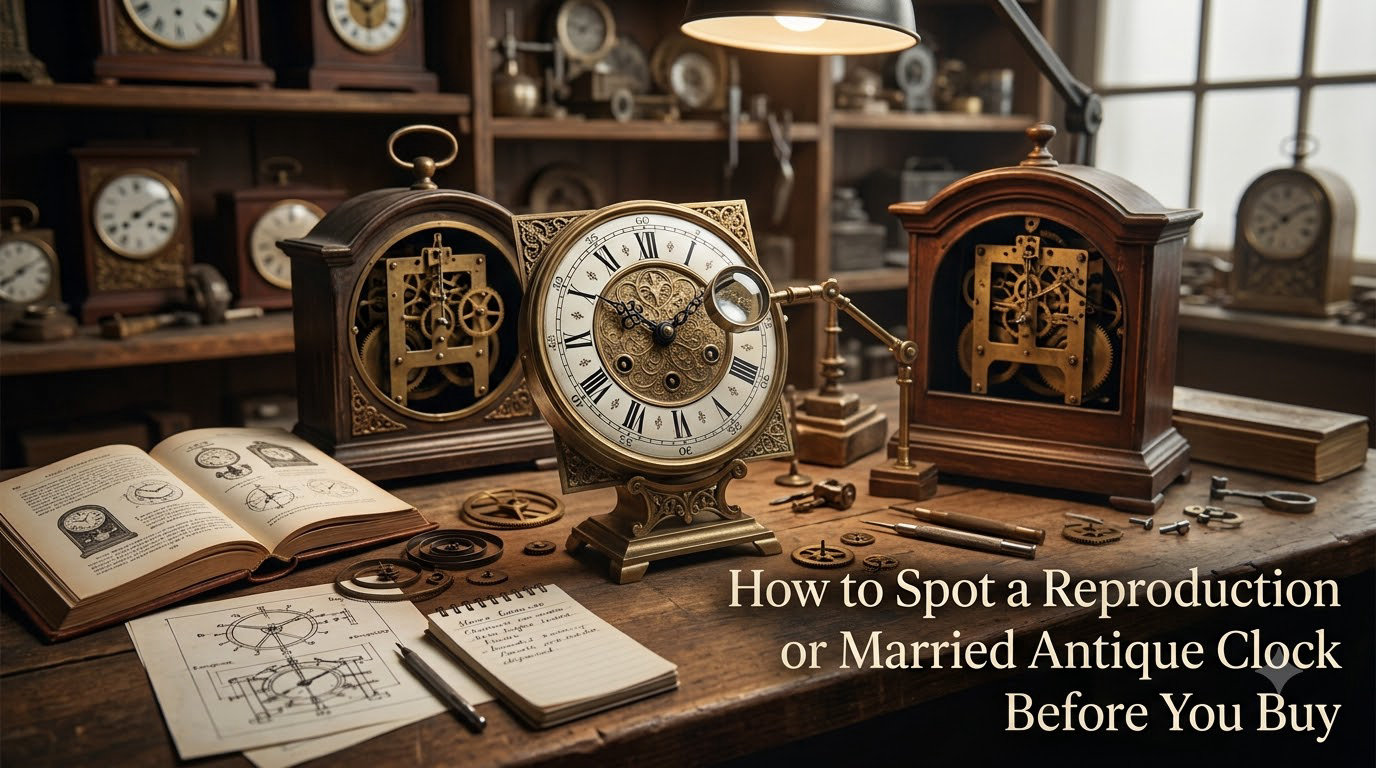
I have been collecting antique clocks for over fifteen years, and I have made every mistake in the book. Two of those mistakes cost me more than I want to admit. That is why I wrote this guide on how to spot a reproduction or married antique clock before you buy, so you do not have to learn the hard way like I did.
Every weekend, thousands of well-meaning buyers walk into estate sales, antique shops, and online auctions looking for that dream longcase or mantel clock. Most of them have no idea that up to 40% of “antique” clocks on the secondary market are either reproductions, marriages, or heavily modified pieces. In this guide, I will walk you through the exact forensic techniques I now use to authenticate any clock before I hand over a single dollar.
Table of Contents
What Is a Married Antique Clock (and Why Does It Matter)?
A married antique clock is a clock where the movement and case were not originally paired by the maker. Someone, often decades ago, took a movement out of one broken case and stuffed it into a different case. A reproduction is a clock that was deliberately made to look old but is entirely new, sometimes from the 1970s-80s mass production wave or even more recent runs.
Understanding the difference matters for one big reason: money. An original matched clock from a maker like Seth Thomas or Ansonia can be worth 2-5x more than the same movement dropped into a salvaged case. I learned this when I refinanced a 1905 Seth Thomas that turned out to have a 1920s movement squeezed into its original case. The price I paid was based on a “matched” clock, but the value was based on a married one.
Before we go further, let me clarify the antique versus vintage distinction because auction listings often blur it. A clock is generally considered antique when it is over 100 years old. Vintage clocks are 30 to 99 years old. Anything newer is just modern or contemporary. This matters because most “antique” reproductions are actually less than 50 years old, even when they are artificially distressed.
How to Inspect the Movement Backplate Like a Pro
The movement backplate is the single most important authentication surface on any antique clock. Don’t just look at the dial. Anyone can swap a dial. The backplate is where the maker’s stamp, serial number, and patent dates live, and it is much harder to fake convincingly.
Here is my step-by-step process for inspecting a movement backplate:
Remove the dial or open the back door of the case to access the movement.
Look for a maker’s stamp, usually on the upper or lower plate.
Check for a serial number, which helps date the piece.
Look for patent dates stamped into the brass.
Check the mounting blocks to see if screw holes line up with the case.
Look for additional or “ghost” screw holes that suggest the movement was moved.
For weight-driven versus spring-driven mechanisms, the backplate gives clear clues. Weight-driven movements tend to be larger, with prominent brass drums and chains or cables. Spring-driven movements, like most American mantel clocks, are more compact and have a mainspring barrel visible through the backplate. Mismatches between the movement type and the case style are a major red flag.
Another trick I use is the birdcage test. On longcase clocks, the movement sits on a “birdcage” frame that is bolted to the case seat. If the bolts do not line up with the original threaded holes, or if you see filled holes from a previous mount, the clock is almost certainly married. A forum user on the NAWCC message board found this exact issue on a supposedly bargain longcase, and it saved him from a $3,000 mistake.
Maker’s Marks and Signatures: Reading the Clues
Maker’s marks are the fingerprints of antique clocks, and learning to read them is half the battle. For Seth Thomas clocks, the company used a date code system on the backplate that changed almost every year from 1860 to 1920. The code is usually a single letter or a letter paired with a number. Without the right reference, you cannot decode it, but any NAWCC member or experienced dealer can.
Ansonia clocks are usually signed on the dial with the iconic Ansonia logo and on the movement backplate with their characteristic stamp. Waterbury clocks often appear on kitchen and wall clocks with bold lettering. German movements, found in many imported black forest clocks, usually have a maker’s mark stamped on the backplate along with a serial number and sometimes a “German” or “Made in Germany” stamp.
One of the most common frustrations I hear from buyers is the retailer versus maker confusion. A dial might say “Sold by John Smith, Boston” but that does not mean John Smith built the clock. He just sold it. The actual maker’s name is on the movement backplate. Always check the backplate first, then cross-reference the dial signature.
Date codes, serial numbers, and patent dates together create a timeline. If a serial number says a clock was made in 1895, but the patent date stamped on the movement is from 1908, you have a problem. Serious collectors call this an “anachronism,” and it is one of the fastest ways to spot a reproduction or a marriage with mismatched components.
Case Construction and Materials: What’s Hiding Under the Veneer
The case tells its own story if you know where to look. Genuine antique clock cases were built from solid hardwoods like oak, walnut, mahogany, and cherry. They were joined using hide glue, a traditional animal-based adhesive that yellows and crystallizes over time. If you scrape a hidden spot inside the case and find white, rubbery glue, the clock is almost certainly a 20th-century reproduction.
Veneer versus plywood is another tell. Antique cases used thin slices of expensive wood (veneer) glued over solid wood. Mid-century and modern reproductions often use plywood or even particle board. Plywood was not widely used in furniture until the 1930s, so any antique case with plywood construction is either a marriage or a fake. One forum user describes it perfectly: real veneer looks like skin, plywood looks like layered cardboard.
Hide glue identification is a skill worth learning. Old hide glue is brittle, yellowish, and sometimes crystallized into a powdery residue. It chips rather than flexes. Modern PVA and yellow carpenter’s glue stays flexible, glossy, and rubbery forever. If you see glue that looks “too clean,” assume it is modern. This is one of those forensic details that catches a lot of reproduction attempts, especially on cases from the 1970s-80s reproduction boom.
Finally, inspect the screws. Antique clock cases and movements were assembled with handmade or early machine-cut slotted screws. If you see bright, shiny Phillips head screws throughout, especially on the movement plates, walk away. Phillips screws were not mass-produced until the 1930s, and they are a clear sign of later repair, replacement, or reproduction. A clock full of Phillips screws is almost never original.
Warning Signs of a Reproduction Antique Clock
After hundreds of inspections, I have learned to trust my gut when something feels off. Here are the biggest red flags that should make you pause before buying:
Bright, shiny Phillips head screws anywhere on the movement or case.
Particle board, plywood, or MDF in a case being sold as “antique.”
Quartz movement inside a clock advertised as antique (true antiques are mechanical).
Serial numbers that don’t match the maker’s records or timeline.
Patent dates that predate the supposed maker’s founding year.
Excessive “distressing” that looks artificial rather than worn.
Glossy, modern-looking glue anywhere in the case joints.
Birdcage or mounting screws that don’t line up with the seat holes.
One phrase that should make you immediately suspicious is “each time a clock is sold, it gets 10 years older.” This is forum shorthand for sellers gradually inflating the age of a clock with each resale. By the time it reaches the fourth or fifth owner, a 1960s clock is being sold as a 1920s piece. Always ask for the original bill of sale or any provenance documentation.
Step-by-Step Authentication Checklist Before You Buy
I run through this checklist every single time, whether I am at an estate sale, an auction preview, or a dealer’s showroom. It takes about 15 minutes and has saved me thousands of dollars over the years.
Photograph the clock from every angle, including the back and inside the case.
Remove the back door or pendulum and inspect the movement backplate.
Look for the maker’s stamp, serial number, and patent dates.
Cross-reference the serial number with the maker’s records if available.
Check the mounting blocks for original, lined-up screw holes.
Look for ghost holes, filled holes, or extra holes indicating movement swaps.
Inspect the case wood type and check for plywood or particle board.
Scrape a hidden spot to check for hide glue versus modern glue.
Examine all screws for slotted versus Phillips head construction.
Verify the mechanism is mechanical, not quartz.
Check the dial signature and confirm it matches the movement maker.
Ask for any provenance documentation, including original receipts.
Ask the seller directly how they acquired the clock and what they know about its history.
When buying at auction, request a condition report and ask about access to the movement.
If anything feels off, walk away or get a third-party opinion before paying.
Use a small flashlight and a magnifying glass, and bring a mirror for hard-to-reach areas. NAWCC members often recommend the mirror trick for inspecting the back of a longcase movement without removing it from the case.
Where to Buy Safely and How to Protect Your Investment
Not all venues are equal. Estate sales can be treasure troves, but they also attract buyers who strip and remix clocks. Auctions are high-pressure and rarely allow movement inspection. Antique dealers and clock specialists are usually the safest bet, especially NAWCC-affiliated dealers who stake their reputation on authenticity.
Look for sellers who offer a written guarantee of authenticity and a return policy. Reputable dealers will often provide a certificate of authenticity and have a known history in the trade. If a seller refuses to let you inspect the movement or refuses to provide provenance, that is your answer.
For high-value purchases, pay for a professional appraisal before you commit. A pre-purchase appraisal costs $100 to $300 but can save you thousands. Look for appraisers who are members of the NAWCC or the American Society of Appraisers. The peace of mind alone is worth it.
Forums like the NAWCC message board and the r/clocks subreddit are excellent places to post photos and ask for second opinions before buying. The community is knowledgeable and usually quick to spot a problem. Just be sure to share clear photos of the movement backplate, the case interior, and any signatures.
FAQs
How to tell if an antique clock is valuable?
An antique clock’s value depends on three factors: originality, condition, and provenance. A matched clock from a known maker like Seth Thomas or Ansonia with original parts, working movement, and documented history will be worth 2-5x more than a married or reproduction piece. Always check the movement backplate for maker’s marks and serial numbers before buying.
What makes a clock antique vs vintage?
A clock is antique when it is over 100 years old. Vintage clocks are 30 to 99 years old, and anything younger is modern or contemporary. Most auction house listings blur these terms, so always ask the seller for the exact year of manufacture and look for the date on the movement backplate.
How to identify a vintage clock?
To identify a vintage clock, inspect the movement backplate for the maker’s stamp, serial number, and patent dates. Cross-reference the serial number with the maker’s records. Check the case for solid hardwood, hide glue, and slotted screws. Avoid clocks with Phillips head screws, plywood, or quartz movements if you want genuine vintage or antique.
How do you identify vintage clock maker’s marks?
Maker’s marks are usually stamped on the movement backplate, not the dial. Seth Thomas used a date code system that changed almost yearly. Ansonia clocks have a distinctive logo stamp. German movements typically have a maker’s mark with a serial number and a ‘Made in Germany’ stamp. Always cross-reference the maker’s mark with the dial signature to confirm a match.
How do I identify my antique clock?
Start by removing the back door or dial to access the movement backplate. Photograph the maker’s stamp, serial number, and patent dates. Use the NAWCC database or a reference guide like the Complete Clockmaker to decode the serial number. Post clear photos on the NAWCC message board or r/clocks subreddit for community help.
What are the red flags when buying an antique clock?
The biggest red flags are bright Phillips head screws, plywood or particle board cases, quartz movements in antique clocks, glossy modern glue, mismatched serial numbers and patent dates, and excessive artificial distressing. Sellers who refuse to let you inspect the movement or provide provenance should also be avoided.
Final Thoughts: Trust, but Verify
Learning how to spot a reproduction or married antique clock before you buy is less about becoming an expert horologist and more about doing the slow, careful work of inspection every single time. The 15-minute checklist I shared above has saved me thousands of dollars and probably a few bitter disappointments.
If you take only one thing away from this guide, let it be this: never buy an antique clock without inspecting the movement backplate and verifying the marriage between the case and movement. A matched, original clock with proper provenance will always be worth more and bring more joy than a Frankenstein reproduction, no matter how pretty it looks on the shelf.
For more in-depth guides on antique clock identification, restoration, and collecting, browse the rest of our resource library here at Exquisite Clock. We update our content regularly and welcome your questions in the comments.
Disclosure: This article is for educational purposes. Always consult a qualified appraiser before making a significant antique clock purchase.