
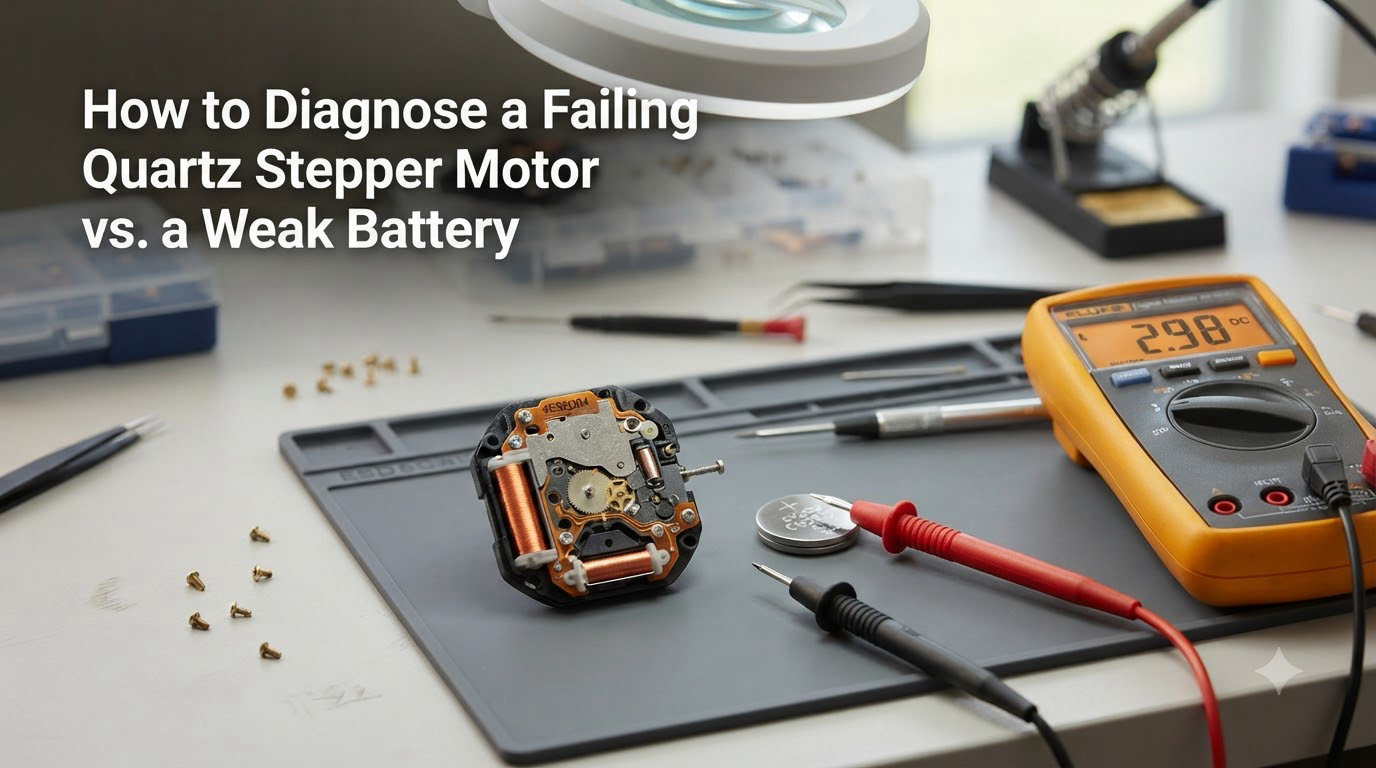
When a quartz wall clock suddenly stops, the two suspects are almost always a weak battery or a failing stepper motor. I have pulled apart dozens of dead clocks over the years, and I can tell you that guessing wrong costs time and money. Replacing a movement when the battery was the real problem is frustrating, and replacing a battery when the motor has died feels pointless. In this guide, I will walk you through how to diagnose a failing quartz stepper motor vs. a weak battery the same way I do it on my own workbench, so you only replace what actually needs replacing.
Table of Contents
Quick Answer: How to Diagnose a Failing Quartz Stepper Motor vs. a Weak Battery
To diagnose a failing quartz stepper motor vs. a weak battery, follow this short checklist in order:
- Open the battery compartment and install a fresh, name-brand alkaline AA.
- Watch the second hand for 60 seconds. A weak battery causes hesitation, irregular stepping, or total silence. A bad motor often lets the second hand jump in uneven bursts or stop entirely even with a new battery.
- Clean the battery contacts with isopropyl alcohol and a cotton swab if the clock still misbehaves.
- Test the stepper motor coil with a multimeter set to ohms. A healthy quartz clock coil reads between 100 and 300 ohms. Zero ohms or infinite (open) means the motor is dead.
- If the coil resistance checks out but the clock still fails, suspect the integrated circuit or quartz crystal, which usually means replacing the whole movement.
If you only have a minute, this checklist is the fastest way to tell the two problems apart. The rest of this guide explains the reasoning behind each step.
Understanding How a Quartz Clock Movement Works
A quartz stepper motor is a small electromagnetic device that converts electrical pulses from a single AA battery into precise mechanical rotations. The battery sends 1.5 volts into an integrated circuit that counts oscillations from a quartz crystal resonating at 32,768 Hz.
Every time the circuit counts 32,768 vibrations, it fires a single electrical pulse to the stepper motor. The most common design used in wall clocks is called a Lavet-type stepping motor. It uses a tiny coil wrapped around a stator and a permanent magnet rotor.
Each pulse flips the polarity of the magnetic field, which rotates the rotor by exactly one step. That step is geared down through a small gear train that drives the second, minute, and hour hands.
The whole movement sits on a single plastic or metal plate. Because there are so few moving parts, quartz movements usually run for 10 to 20 years before something gives out. When something does fail, it is almost always the battery contacts, the battery itself, or the stepper motor coil.
Understanding this chain of components is what makes the diagnosis fast. The battery provides the power, the contacts deliver that power, the circuit counts time, and the stepper motor converts the count into motion. A failure anywhere in that chain looks similar from the outside, but each has different symptoms.
Weak Battery Symptoms Checklist
A weak or dying battery is by far the most common cause of a stopped quartz clock. I check this first every single time. These are the symptoms I look for:
- The second hand moves normally for a while, then freezes for several seconds before resuming.
- The clock runs slow, losing several minutes per day before stopping completely.
- The clock works after a gentle tap or shake, then stops again within minutes.
- You see white or greenish corrosion on the battery terminals or the battery itself.
- The clock stopped during a cold snap or a heat wave. Batteries lose voltage in extreme temperatures.
- The clock stopped within 12 to 24 months of its last battery change.
To verify a weak battery, swap in a fresh alkaline AA from a sealed package. If the clock springs back to life and keeps accurate time for at least a week, the battery was the only issue. If a brand-new battery does nothing, the problem is downstream.
One trick I learned from forum members at r/clocks: even new batteries can be duds if they have been sitting on a shelf for years. Cheap zinc-carbon batteries lose charge quickly in storage. Stick with a name-brand alkaline or lithium AA for testing.
Failing Stepper Motor Symptoms Checklist
When the battery is fresh and the clock still misbehaves, I move on to the stepper motor. These are the signs that point to a failing quartz stepper motor:
- The second hand stutters, jumps in irregular bursts, or skips multiple seconds at once.
- You can hear the ticking sound, but the hands are not moving, or only the second hand moves while the minute hand stays put.
- The clock runs perfectly for hours, then suddenly stops. After sitting unused, it may start again briefly.
- The minute hand loses time even with a brand-new battery.
- The clock has not been opened in over 15 years, and the symptoms started gradually rather than suddenly.
- Gentle tapping on the case makes the second hand jump forward in a single motion.
What is happening internally is that the coil windings have developed a partial short or the magnet has weakened. The circuit is still pulsing, but the magnetic field is no longer strong enough to advance the rotor reliably.
From my experience, the second-hand stutter is the single most reliable symptom. If the second hand seems to be walking through glue, you are almost certainly looking at motor wear rather than a battery problem.
Failing Stepper Motor vs. Weak Battery: Side-by-Side Comparison
This comparison table is the heart of the diagnostic process. I built it after years of mixed results, and it is the resource I wish I had when I started fixing clocks.
| Symptom | Likely Weak Battery | Likely Failing Stepper Motor |
|---|---|---|
| Clock stopped suddenly with no prior warning | Sometimes | Often |
| Second hand hesitates or jumps irregularly | Rare | Very common |
| Clock loses a few minutes per day before stopping | Very common | Rare |
| Clock starts again after a tap or shake | Sometimes | Often |
| Visible corrosion on battery contacts | Very common | Not related |
| Ticking sound but no hand movement | Rare | Very common |
| Clock worked fine on previous battery until end of life | Very common | Rare |
| Coil resistance reads 0 or infinite on multimeter | Not related | Confirmed motor failure |
| Clock is over 15 years old | Possible | More likely |
If you see three or more symptoms in one column, that is almost certainly the culprit. When symptoms overlap, run through the diagnostic procedure below to confirm.
Step-by-Step Diagnostic Procedure
Before you start, gather a few tools. You will need a fresh alkaline AA battery, a small Phillips screwdriver, cotton swabs, isopropyl alcohol, and a digital multimeter. A movement replacement movement in the correct shaft length is optional but useful.
Step 1: Replace the Battery and Observe
Open the battery compartment and install a fresh alkaline AA. Watch the second hand for a full minute. If the second hand advances smoothly every second, the battery was your problem and you are done. If the second hand stutters, jumps, or stays frozen, keep going.
Step 2: Clean the Battery Contacts
Dip a cotton swab in isopropyl alcohol and rub the metal contacts inside the battery compartment. Look for green, white, or crusty buildup. These are oxidation deposits that block current even from a good battery. Let everything dry for two minutes, then reinstall the battery.
This single step solves what looks like a dead motor roughly 20 percent of the time in my experience. If you skipped it, you might replace a perfectly good movement for no reason.
Step 3: Test the Stepper Motor Coil with a Multimeter
This is the definitive test for diagnosing a failing quartz stepper motor vs. a weak battery. Set your multimeter to the 2,000-ohm resistance setting.
Locate the two coil terminals on the back of the movement. They are usually two small solder pads or pin contacts near the battery clip. Touch one multimeter probe to each terminal.
A healthy quartz clock motor coil reads between 100 and 300 ohms, with most wall clock movements sitting around 200 ohms. If your reading is within that range, the coil is electrically intact. If the reading is 0 ohms (a short), infinite (open), or wildly unstable, the motor has failed internally.
Forum users at r/watchrepair confirm this range across dozens of tested movements. Anything outside the 100 to 300 ohm window is grounds for replacement.
Step 4: Check for Voltage at the Movement
With the battery still installed, switch your multimeter to DC volts and touch the probes across the battery contacts while the clock is running. You should see at least 1.45 volts. If voltage drops below 1.3 volts while the second hand tries to advance, the battery is sagging under load and the motor is starved of power.
Step 5: Inspect the Hands for Mechanical Drag
Bend the minute hand slightly back from the dial and confirm nothing is touching the hour hand. Hands rubbing against each other or against the glass can mimic motor failure by creating drag the motor cannot overcome. If the hands are tight, bend them back into clearance and re-test.
Step 6: Decide Repair or Replacement
If the multimeter reading confirms a bad motor, replacement is the practical path. Quartz clock movements are not designed to be repaired at the coil level. The plastic parts and integrated circuit are sealed. A new movement costs less than most repair shop hourly rates and installs in about 10 minutes with a screwdriver.
When to Replace the Movement vs. Repair
The general rule on my workbench is simple: if the coil resistance is bad, replace the movement. If the battery, contacts, or hand alignment is the issue, repair. There is no middle ground that makes financial sense for a standard quartz wall clock.
A typical replacement quartz clock movement runs well under the cost of a single hour at most clock repair shops. New movements include the motor, gear train, hands, and hardware. Match the shaft length to your dial thickness (the standard is 13/16 inch, but always measure before ordering).
For vintage or sentimental clocks, a professional clockmaker can sometimes source specialty coils or rebuild a movement. For everyday wall clocks, the universal replacement movement is faster and cheaper.
Quartz movement lifespan is typically 10 to 20 years depending on quality and environment. If your clock is approaching the two-decade mark and the symptoms match motor failure, replacement is the right call even before testing.
Prevention Tips to Extend Quartz Clock Lifespan
Most quartz clock failures are preventable with a few habits I have picked up over the years:
- Replace the battery every 12 months, even if the clock is still running. Old batteries leak and corrode contacts.
- Use name-brand alkaline or lithium batteries. Cheap zinc-carbon cells leak more often.
- Remove the battery if the clock will be stored or unused for more than a month.
- Avoid hanging clocks in direct sunlight, above radiators, or in kitchens where grease and steam can damage the movement.
- Wipe battery contacts with a dry cloth once a year during battery changes.
- Do not hang a quartz clock above a fireplace or in a damp bathroom. Temperature swings shorten motor life.
Following these six tips should comfortably double the practical lifespan of any quartz movement. I have mantel clocks from the early 2000s still running on their original movements because of these habits.
Frequently Asked Questions
How to tell if your stepper motor is bad?
The most reliable signs of a bad stepper motor are a stuttering or jumping second hand, ticking without hand movement, and the clock failing even with a fresh battery. A multimeter coil resistance test reading 0 ohms or infinite confirms motor failure.
What happens when a stepper motor goes bad?
When a stepper motor fails, the coil windings short out or the rotor magnet weakens. The integrated circuit still fires pulses, but the magnetic field cannot move the rotor consistently, causing the second hand to hesitate, jump, or stop entirely.
How to test a stepper motor with a multimeter?
Set your multimeter to the 2,000-ohm resistance range and touch the probes to the two coil terminals on the movement. A healthy quartz clock motor reads between 100 and 300 ohms. Zero or infinite readings mean the motor coil is damaged.
Do quartz clock movements wear out?
Yes, quartz clock movements typically last 10 to 20 years before the stepper motor or quartz crystal begins to fail. Quality of construction, environmental conditions, and battery habits all affect the exact lifespan.
Why is my quartz clock ticking but not moving?
A ticking sound with no hand movement usually means the stepper motor coil has failed or the hands are mechanically binding. Test the coil resistance with a multimeter and check that the hour and minute hands are not rubbing each other.
Why is my quartz clock losing time with a new battery?
If your quartz clock loses time with a new battery, the stepper motor is likely wearing out or the quartz crystal frequency has drifted. Test the coil resistance first. A reading outside 100 to 300 ohms confirms motor failure.
Final Thoughts on Diagnosing a Failing Quartz Stepper Motor vs. a Weak Battery
Diagnosing a failing quartz stepper motor vs. a weak battery does not require a workshop or specialty tools. A fresh battery, a cotton swab, and a basic multimeter are enough to tell the two apart with confidence. Start with the battery, clean the contacts, test the coil resistance, and only replace the movement when the numbers tell you to. That sequence has saved me more wasted replacement parts than anything else on my workbench, and it will do the same for you.