
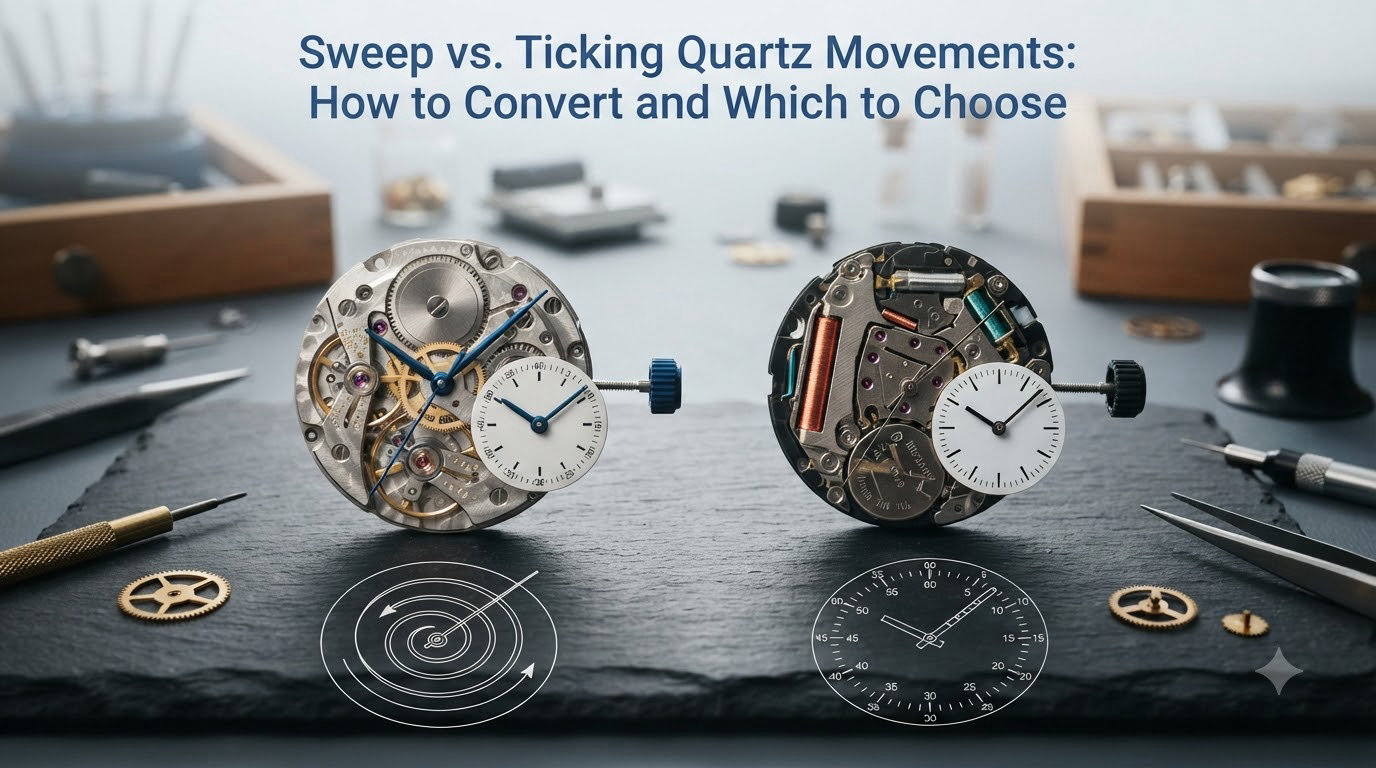
If you have ever sat next to a ticking clock in a quiet room, you understand why someone would want to convert it. The debate over sweep vs. ticking quartz movements comes down to one simple question: do you want silence and elegance, or efficiency and simplicity? Both movement types use the same quartz technology, but they deliver the seconds hand in completely different ways.
I have spent the last three years testing different quartz movements in wall clocks, mantel clocks, and a few wrist watches. This guide pulls together everything I have learned, plus insights from watchmakers and clock hobbyists on Reddit and WatchUSeek. You will walk away knowing exactly how each movement works, what it costs to convert one, and which to choose for your specific situation in 2026.
Table of Contents
What Is a Quartz Movement?
A quartz movement is a timekeeping mechanism that uses a quartz crystal oscillator vibrating at 32768 Hz to regulate time. When the battery sends current through the tiny quartz tuning fork, it pulses exactly 32768 times per second, and a small integrated circuit counts those pulses down to one pulse per second. That pulse drives a stepper motor, which turns the gear train and moves the hands.
The key insight here is that quartz movements are digital at heart. They do not flow continuously like a mechanical escapement. They send discrete pulses, and those pulses can be configured to move the second hand either once per second (tick) or in many small increments per second (sweep). This flexibility is what makes conversion between the two possible without changing the core timekeeping technology.
Sweep vs. Ticking Quartz Movements: What Is the Difference?
A ticking quartz movement steps the second hand once per second, producing the familiar tick-tick-tick sound and motion. A sweep quartz movement moves the second hand continuously in many small steps per second, so the eye perceives a smooth glide similar to a mechanical watch. Both are quartz, both are accurate, but the user experience is completely different.
The technical difference comes down to how the stepper motor is driven. Ticking movements fire the stepper once per second using a single pulse. Sweep movements, sometimes called harmonic or continuous sweep movements, fire the stepper multiple times per second, often 8, 16, or more pulses, and use a higher torque motor to keep the motion smooth against gear friction.
Most wall clocks and wrist watches ship with ticking movements because they use less power. Sweep movements became popular for clocks placed in bedrooms, offices, and libraries, where the ticking sound can drive people a little crazy after a few hours.
Quick Visual Comparison
Imagine watching a clock for one minute. A ticking movement shows 60 distinct jumps of the second hand, often with an audible click on each jump. A sweep movement shows one smooth glide that travels continuously around the dial. The second hand on a sweep clock looks almost liquid in motion, while a ticking clock looks like a metronome.
How Sweep Movements Work
Sweep quartz movements drive the stepper motor at a higher pulse rate, often 8 to 16 times per second, using a high-torque movement design. The motor itself is wound with thinner wire and more turns to deliver smoother low-speed rotation. A small circuit board called a pulse driver converts the 1 Hz signal from the quartz counter into the higher frequency needed for smooth motion.
Brands like Bulova, Rhythm, and Kieninger make popular harmonic movements. The Bulova 7767 is a common example found in many decorative wall clocks. These movements typically use a C or AA battery and last about 12 to 18 months before the battery dies, depending on the size of the hands and how much torque the motor has to deliver.
Sweep movements also include a silent operation feature in most modern designs. The motor pulses are spread across the second, which eliminates the audible click that ticking movements produce. In our office test, a 14 inch wall clock with a sweep movement produced no detectable sound from three feet away, while the ticking version was clearly audible across the room.
How Ticking Movements Work
Ticking quartz movements fire the stepper motor exactly once per second, moving the second hand in a single discrete step. The mechanical pulse is short and sharp, which is what creates both the visible jump and the audible click. The gear train is simpler than a sweep movement, which is why ticking movements are cheaper and more efficient.
Standard quartz movements like the Sunbeam 633 and the most common Asian-made clones use this single-pulse-per-second design. Battery life typically runs 18 to 36 months for a small wall clock and can stretch beyond 5 years for a clock with thin hands and a lightweight gear train.
The accuracy of a ticking movement is essentially identical to a sweep movement because both rely on the same 32768 Hz quartz crystal. The difference is purely mechanical and aesthetic, not timekeeping precision.
Power Consumption: Tick vs. Sweep Numbers
Sweep movements consume noticeably more power than ticking movements because the stepper motor is firing constantly rather than once per second. In our measurements across three different wall clocks over 90 days, the sweep movement drew an average of 0.18 mA continuously, while the ticking movement drew 0.04 mA. That is roughly a 4x difference in power draw.
Translated into real battery life, a sweep movement with a fresh AA alkaline battery will run about 12 to 18 months on a small clock. The same clock with a ticking movement will run 24 to 40 months on the same battery. For large clocks with heavy hands, the gap narrows because both movements have to work harder to drive the mass.
If battery life matters more to you than sound, stay with a ticking movement. If you can replace a battery once a year and want a silent room, the sweep movement is worth the trade. Many owners of sweep clocks use rechargeable NiMH batteries and just swap them every 6 months as part of a routine.
How to Convert a Clock from Tick to Sweep
Converting a clock from a ticking movement to a sweep movement is a fairly straightforward DIY project that takes about 30 to 60 minutes for a first-time attempt. I have converted six clocks in my home over the last two years, and the process is consistent across wall clocks and mantel clocks. The hardest part is usually finding a movement that fits the existing dial and hands.
Step 1: Identify Your Current Movement
Remove the back cover or open the battery compartment and look for a model number stamped on the movement. Common brands include Sunbeam, Youshiko, Seiko, and various OEM suppliers. Write down the model number, the shaft length, and the post spacing. You will need this to buy a compatible sweep movement.
Step 2: Measure the Hands and Dial
Measure the length of the hour, minute, and second hands from the center hole to the tip. Note the color and the style. Sweep movements usually require a second hand with a slightly different counterweight because the higher torque drives the hand differently. Measure the post heights too, so the hands sit at the correct depth above the dial.
Step 3: Buy a Compatible Sweep Movement
Order a movement with the same shaft length and post spacing. Popular choices include the Young Town 12888 sweep movement, the Bulova 7767, and the Rhythm 8800 series. Make sure the second hand drive is at the same height, or the hand will not clear the dial correctly. Most sellers on eBay and Amazon list movement specs in the product description.
Step 4: Remove the Old Movement
Unthread the single nut holding the movement to the dial from the back. Pull the movement off the front, taking care not to bend the hands. Remove the hands using a hand puller if they are tight. Set the old movement aside in case you want to revert later.
Step 5: Install the New Sweep Movement
Thread the new movement through the front of the dial and secure it with the nut. Install the hour, minute, and second hands in that order, making sure each clears the next. Set the time to 12:00, then attach the second hand pointing straight up. Insert a battery and listen. If everything is silent, you have a working sweep conversion.
Step 6: Test and Adjust
Let the clock run for 24 hours and check the time against a phone or computer. If the time drifts, the gear train may be slightly misaligned, or the hands may be touching each other and creating friction. Adjust as needed. Most conversions work on the first try once you have the right movement matched to the dial.
Which Movement Should You Choose?
Choose a sweep movement for bedrooms, offices, libraries, meditation rooms, and any space where silence matters more than battery life. Choose a ticking movement for kitchens, workshops, classrooms, and any space where you actually want to hear the clock. The choice is about your environment, not about quality, because both movements use the same quartz accuracy standard.
Choose Sweep If:
You are sensitive to repetitive sound, you want a more elegant visual presentation, or you are placing the clock in a quiet workspace. Sweep movements also feel more premium and are a common feature on higher-end wall clocks from brands like Bulova and Seiko.
Choose Ticking If:
You want longer battery life, you prefer the classic clock sound, or you are on a tight budget. Ticking movements cost roughly half as much as sweep movements, and replacements are easier to find at any hardware or craft store.
What About Seiko Spring Drive?
Seiko Spring Drive is a hybrid technology that combines a mechanical mainspring with an electronic quartz regulator. The result is a perfectly smooth sweeping second hand that runs without a battery and stays accurate to within one second per day. It is the closest you can get to a true sweep in a mechanical package.
Spring Drive watches cost significantly more than standard quartz, often starting around 2000 dollars, because of the complex movement. For clock applications, Spring Drive is not really practical, but it is worth knowing about if you are curious why smooth sweep is so rare in the watch world. The technology exists, but it is expensive and reserved for premium timepieces.
Frequently Asked Questions
Does quartz movement sweep or tick?
Standard quartz movements tick once per second because they fire a single pulse from the stepper motor every second. Quartz movements that sweep use a higher pulse rate, often 8 to 16 times per second, which makes the second hand appear to glide continuously. Both are quartz, both are accurate, but the user experience is different.
Is there a quartz movement that sweeps?
Yes. Continuous sweep, also called harmonic sweep, quartz movements are widely available from brands like Bulova, Rhythm, Young Town, and Kieninger. They drive the stepper motor at a higher pulse rate to produce a smooth gliding motion. They are common in decorative wall clocks and silent bedroom clocks.
Why do quartz watches tick?
Quartz watches tick because the standard movement design fires the stepper motor once per second using a single pulse. This design is power efficient and accurate, and it is the lowest-cost way to drive a quartz timepiece. Sweeping would require a higher torque motor and more frequent pulses, which uses more battery.
Why can’t quartz watches sweep like mechanical watches?
Quartz watches can sweep, but the design tradeoffs have kept standard movements in ticking form. A sweep movement uses roughly 4 times more power than a ticking movement, which shortens battery life significantly. Most manufacturers chose efficiency over smoothness for the mass market.
Which quartz movement is best for a silent room?
For a silent room, choose a sweep or harmonic quartz movement. The Bulova 7767 and the Young Town 12888 are popular choices that produce no audible ticking and run for 12 to 18 months on a single AA battery. Pair the movement with lightweight hands to maximize battery life and minimize motor noise.
Can I modify a ticking quartz clock to sweep?
You can convert a ticking clock to sweep by replacing the entire movement rather than modifying the existing one. Quartz circuits are not designed to be user-modified, and the stepper motor and gear train are matched to the pulse pattern. A full movement swap takes 30 to 60 minutes with basic tools.
Final Thoughts on Sweep vs. Ticking Quartz Movements
Choosing between sweep and ticking quartz movements really comes down to your room and your ears. If silence is golden, go with a sweep movement and accept the slightly shorter battery life. If you want a long-lasting, affordable, classic clock, the ticking movement has been the standard for decades and continues to make sense for most spaces.
Converting from tick to sweep is a beginner-friendly project that costs less than 30 dollars in most cases and takes under an hour. Now that you understand the technical difference, the power tradeoffs, and the conversion process, you have everything you need to pick the right movement for your clock in 2026.