
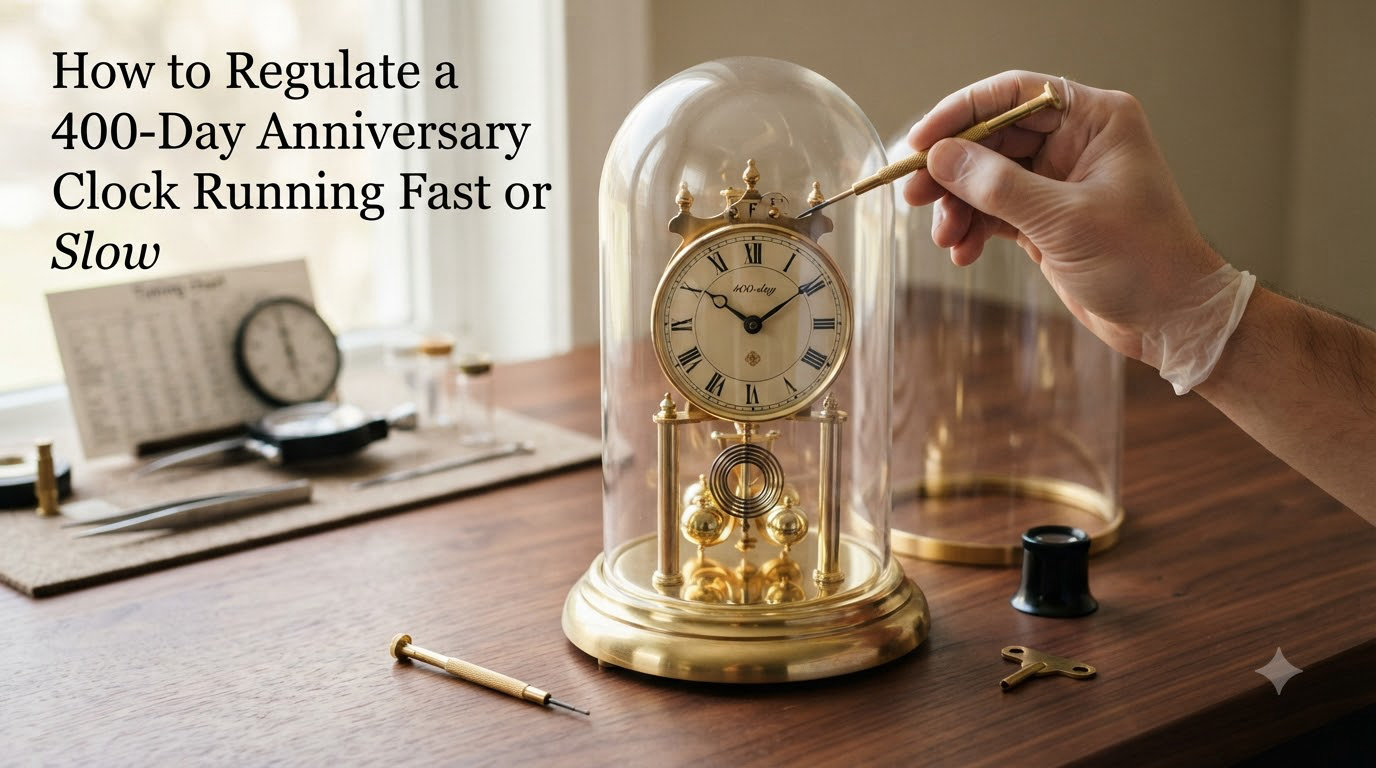
On most 400-day anniversary clocks, turning the regulating disc clockwise slows the clock down and turning it counterclockwise speeds it up. The disc is the small serrated wheel just above the pendulum, and most are marked with F (fast) and S (slow), or A (advance) and R (retard) so you can confirm the direction at a glance.
If you learn one thing from this guide, learn that rule. It is the single most important adjustment on a torsion clock, and once you understand it, the rest of the regulation process is mostly patience.
I have worked on Schatz, Kundo, Kern and Hermle 400-day clocks for more than a decade, and in this guide I will walk you through the entire procedure. That includes how to tell if your clock is “in beat,” what to do when the regulation disc is maxed out, the suspension spring warnings every owner should read first, and why even a perfectly adjusted 400-day clock will drift across the seasons.
Table of Contents
What Is a 400-Day Anniversary Clock?
A 400-day clock, also called a torsion clock or anniversary clock, is a mechanical timepiece designed to run for roughly a year on a single winding. The mechanism was popularised by Anton Harder in Germany around 1880 and later produced in large numbers by Schatz, Kundo (Kieninger & Obergfell), Kern & Sohne, and Hermle.
Instead of a swinging pendulum, these clocks use a torsion pendulum. That is a horizontal rotating disc carrying small weights, suspended from a thin torsion spring, that slowly twists back and forth. The slow rotation, often only about a half-turn in each direction, is exactly what allows the clock to run for so long on a single mainspring.
The “anniversary” nickname came from marketing. You wind the clock on a meaningful date, a birthday, an anniversary or New Year, and it runs until the same date next year. That year-long convenience is the whole point of the design.
How a 400-Day Clock Keeps Time
Inside the movement, a coiled mainspring stores energy and releases it slowly through a gear train. At the end of the train, an escapement delivers tiny impulses to the torsion pendulum through a small fork attached to the suspension spring.
The rate at which the pendulum rotates back and forth sets how fast the clock runs. That rotation rate depends on two things: the stiffness of the suspension spring, and the distance of the pendulum weights from the centre of rotation.
Moving the weights outward slows the rotation, because the pendulum has more rotational inertia. Moving them inward speeds it up. This is exactly what the regulating disc does, sliding the weights along the pendulum arms by a fraction of a millimetre per turn.
Once you understand this, the rest of the regulation procedure is just turning the disc in the right direction and waiting.
How to Regulate a 400-Day Anniversary Clock Running Fast or Slow
Here is the step-by-step procedure I use on every 400-day clock that comes across my bench. Work slowly and never force anything, because these clocks are forgiving to adjust but very easy to damage.
Step 1: Level the clock first. A torsion clock will not keep time if it is not perfectly level, because the pendulum needs to rotate symmetrically around centre. Use the three levelling screws on the base and a small spirit level, checking both front-to-back and side-to-side.
Step 2: Let the clock run for at least a day before adjusting. You need a baseline. Note the exact time you set it and compare it against a known-accurate reference, like your phone, 24 hours later.
Step 3: Calculate the error. If the clock gained 5 minutes in 24 hours, that is a significant rate error and you will need a larger adjustment. A minute or two per day is normal for a freshly regulated 400-day clock.
Step 4: Stop the pendulum. On most Schatz and Kundo models, you gently bring the pendulum to rest with your fingers, or use the pendulum lock lever if your clock has one. Never adjust the regulating disc while the pendulum is rotating.
Step 5: Turn the regulating disc a small amount. Start with a quarter-turn in the correct direction: clockwise to slow down, counterclockwise to speed up on Schatz and Kundo. Try a half-turn if the error is large.
Step 6: Restart the pendulum with a gentle quarter-turn twist in either direction, then let the clock run for at least 30 minutes. Re-check the rate against your reference clock.
Step 7: Repeat with smaller adjustments. As you get close, drop each change down to an eighth of a turn. Final fine-tuning can take a week or more of patient watching.
A 400-day clock that keeps time to within a minute or two per week is doing very well. Do not expect atomic-clock precision, because these mechanisms were designed for year-long convenience, not chronometer-grade accuracy.
Which Way Do I Turn the Regulating Disc?
The direction depends on the brand, and this is the source of most of the confusion I see in forum questions. Here is the breakdown.
On Schatz and Kundo clocks, by far the most common 400-day clocks you will encounter, turning the regulating disc clockwise moves the pendulum weights outward and slows the clock down. Turning it counterclockwise moves the weights inward and speeds the clock up.
On many Kern clocks and other German makes, the marking system does the work for you. Look for the letters F (fast) and S (slow), or A (advance) and R (retard), or simply + and − stamped into the disc or the plate next to it. Turn the disc toward the letter you want.
If your clock has no markings at all, use the universal rule: turn the disc in the direction that moves the pendulum weights outward to slow the clock, or inward to speed it up. This works regardless of brand because it is based on rotational inertia, not on which way the threads happen to run.
A quick safety note: The disc should turn with light finger pressure. If it resists, stop. Forcing a seized regulating disc can shear the threads or, worse, snap the delicate suspension spring directly below it.
How to Tell If Your Clock Is “In Beat”
A torsion clock is “in beat” when the pendulum rotates an equal distance to the left and right of centre. If the pendulum swings further one way than the other, the clock is out of beat and will run erratically or stop.
The simplest check is to look at the pendulum from directly above as it rotates. Note the rest position, where the pendulum hangs when the clock is not running. Then watch a full rotation, and the pendulum should travel the same number of degrees to the left as to the right.
If your pendulum is rotating, say, 270 degrees to the left but only 90 to the right, your clock is badly out of beat. This is almost always caused by the clock not being level, not by anything wrong with the movement itself.
Fix it by re-levelling the clock first. If levelling does not correct the beat, the fork on the suspension spring may have slipped and you will need a clock repairer to reposition it. This is a fiddly job and a very common cause of “my clock was working perfectly and now it will not run” complaints.
One telltale sign that you are out of beat is an uneven or “fluttering” tick. A healthy 400-day clock has a soft, even tick-tick-tick with the same interval between each impulse.
Suspension Spring Safety: Read This Before Touching Anything
The suspension spring is the single most fragile part of a 400-day clock. It is a thin strip of hardened steel, often only a few thousandths of an inch thick, and it is the only thing supporting the pendulum and connecting it to the escapement fork.
If you bend it, kink it, or snap it, your clock will not run until it is replaced. Replacement springs cost only a few dollars, but fitting one correctly is a job for someone with experience. The wrong thickness of spring will throw your rate completely off.
Three rules I never break on my bench:
1. Never spin the pendulum to “test” the clock or to wind it. This instantly over-twists the spring.
2. Always lock the pendulum, or carefully rest it on a soft surface, before moving the clock. Even a small bump can kink the spring.
3. Never bend the spring back into shape if it is already kinked. Replace it.
If your spring looks corroded, has visible kinks, or has clearly been bent, stop and source a replacement before doing any other regulation work. Many “regulation problems” I see in clocks brought to my bench are actually suspension spring problems in disguise.
Troubleshooting When the Regulation Disc Is Maxed Out
This is the single most common question I see on the NAWCC forums and r/clocks: “My regulating disc is at its limit and the clock is still running too fast, or too slow.” Here is what is actually going on.
If the clock is running fast even at the slowest setting, the most likely cause is a suspension spring that is too thick, too stiff, or has been replaced with the wrong size. The Horolovar 400-Day Clock Repair Guide lists the correct suspension spring thickness for virtually every 400-day movement ever made, so if you suspect a wrong spring, look up your movement number.
If the clock is running slow even at the fastest setting, the spring may be too thin, weakened from years of use, or simply fatigued. Again, the fix is usually a correctly-sized replacement spring, not more adjustment of the disc.
Other causes worth ruling out before you blame the spring:
Is the clock actually level? An out-of-level clock runs erratically and will not regulate properly.
Has the movement been cleaned and oiled recently? Old gummed oil increases friction and changes the rate.
Is the mainspring fully wound? A partially run-down mainspring delivers less power and the rate drifts.
Has the fork on the suspension spring slipped down? A low fork changes the impulse and the rate.
If you have ruled out all of these and the disc is still maxed out, take the clock to a repairer. Attempting to thin a suspension spring yourself by sanding or filing almost always makes things worse.
Setting Up, Levelling, and Starting Your Clock
If your clock is new to you, or has been in storage, here is the proper sequence before you even think about regulation.
1. Inspect the suspension spring. Look for kinks, corrosion, or a missing spring before anything else.
2. Place the clock on a firm, level surface. 400-day clocks hate vibration, so mantelpieces over working fireplaces and wobbly shelves are poor choices.
3. Level the clock with the three base screws, checking both directions with a spirit level.
4. Attach the pendulum if it was removed for transport. Hang it gently on the suspension spring hook, and never force it.
5. Wind the mainspring. Most 400-day clocks take about seven full turns of the winding key. Stop when you feel firm resistance, because over-winding can damage the mainspring.
6. Start the pendulum with a gentle quarter-turn twist in either direction. A larger twist risks damaging the suspension spring.
7. Set the time using the minute hand only. Never move the hour hand directly, because it follows the movement automatically.
8. Wait 24 hours before making any rate adjustments.
Many owners wind their 400-day clock only once a year, because it can run that long. I wind mine every two to three months instead. A partially wound mainspring delivers less consistent power, which translates to drift across the year, and more frequent winding keeps the rate much steadier.
Temperature, Amplitude, and Why 400-Day Clocks Drift
Even a perfectly regulated 400-day clock will drift across the year, and most of that drift comes from temperature.
The suspension spring is made of steel, and steel changes stiffness with temperature. A cold room makes the spring slightly stiffer, which speeds the clock up. A warm room softens it, which slows the clock down. The Horolovar springs used in most quality restorations are temperature-compensated, but older clocks and cheap replacements often are not.
This is why the same clock can run perfectly in winter and gain time in summer. It is also why I tell owners to expect seasonal re-regulation rather than a single set-and-forget fix.
Pendulum amplitude, how far the pendulum rotates each direction, also matters. A healthy 400-day clock rotates between about 270 and 360 degrees each way from centre. If the pendulum is barely turning a quarter revolution total, something is wrong: usually a weak mainspring, a dirty movement, or a stiff suspension spring.
Small amplitude directly affects the rate, because the escapement impulse happens at a slightly different point in the rotation. If you have regulated the disc, the clock is level, the spring is correct, and the rate still wanders, look at amplitude next. A clock that has lost its swing usually needs cleaning and oiling, not more disc adjustment.
FAQs
Why is my 400 day clock so slow?
A slow 400-day clock is usually caused by a suspension spring that is too thin or fatigued, a partially wound mainspring, or a pendulum that is out of beat. Start by fully winding the clock and re-levelling it. If it still loses time, check the pendulum rotation, because a small swing usually means the movement needs cleaning and oiling.
How do I adjust the speed of an anniversary clock?
Turn the regulating disc just above the pendulum. On Schatz and Kundo clocks, clockwise slows the clock and counterclockwise speeds it up. On other brands, look for F (fast) and S (slow) or + and minus markings on the disc. Make small quarter-turn adjustments and wait at least 30 minutes between changes.
What are the common problems with anniversary clocks?
The most common issues are suspension spring damage from spinning the pendulum or moving the clock unlocked, the clock not being level which causes erratic running, a worn or wrong-thickness suspension spring which causes persistent rate errors, and the fork on the suspension spring slipping out of position. Old oil in the movement is also a frequent culprit.
How to fix a clock that is running fast?
To slow a fast-running 400-day clock, turn the regulating disc clockwise on Schatz and Kundo models, or toward the S (slow) marking. Start with a quarter-turn and check the rate after 30 minutes. If the disc is already at the slow limit and the clock is still fast, suspect a too-thick suspension spring.
How do I adjust the time on my anniversary clock?
Use the minute hand only, turning it clockwise to the correct time. Never move the hour hand directly, because it follows the movement automatically. If you need to set the time backwards, do it by gently turning the minute hand counter-clockwise.
Why won’t my anniversary clock keep running?
Usually the clock is not level, the mainspring is run down, the suspension spring is damaged, or the fork has slipped. Check level first, then check that the pendulum rotates freely and the spring is not kinked. If the pendulum barely swings, the movement likely needs service and cleaning.
How to speed up a 400-day clock?
Turn the regulating disc counterclockwise on Schatz and Kundo models, or toward the F (fast) marking on other brands. This moves the pendulum weights inward, reducing rotational inertia and speeding up the pendulum. Make small adjustments and let the clock run for at least 30 minutes between changes.
Conclusion
Regulating a 400-day anniversary clock is not difficult, but it does take patience and the right procedure. The most important rule to remember is the direction: clockwise slows the clock down and counterclockwise speeds it up on Schatz and Kundo models, with the F/S or A/R markings on the disc telling you the same story on other brands.
Always level the clock first, never adjust the disc while the pendulum is rotating, and treat the suspension spring like the fragile part it is. If the regulation disc reaches its limit and the clock is still running fast or slow, the answer is almost always the suspension spring, either the wrong thickness, fatigued, or damaged, and not more disc adjustment.
I have been working on these beautiful clocks long enough to know that almost any 400-day clock can be regulated to within a minute or two per week with the right setup. Take your time, follow the steps above, and you will be rewarded with a clock that runs beautifully for another year between windings.