
If you have ever watched a pendulum clock tick steadily on a wall and wondered what keeps that swing so consistent, the answer lies in a part you can barely see. The suspension spring is a thin strip of metal, often less than an inch long, that quietly governs every oscillation your clock makes. I have spent years studying, repairing, and adjusting pendulum clocks, and this tiny component never fails to surprise me with how much it controls.
Understanding how the suspension spring controls a pendulum clock’s swing matters whether you are a collector, a hobbyist, or someone trying to fix a clock that has stopped keeping time. This small spring connects the pendulum to the movement, transfers energy, and shapes the arc of every swing. Get it wrong, and your clock loses minutes a day or stops altogether.
In this guide, I will walk you through exactly what a suspension spring does, the physics behind its role, how it interacts with the escapement, and what happens when it wears out. You will also learn how to identify problems, choose the right replacement, and make adjustments that bring your clock back to accurate timekeeping. Everything here comes from hands-on experience with mechanical clocks, from modest mantel pieces to tall grandfather clocks.
Table of Contents
What Is a Suspension Spring?
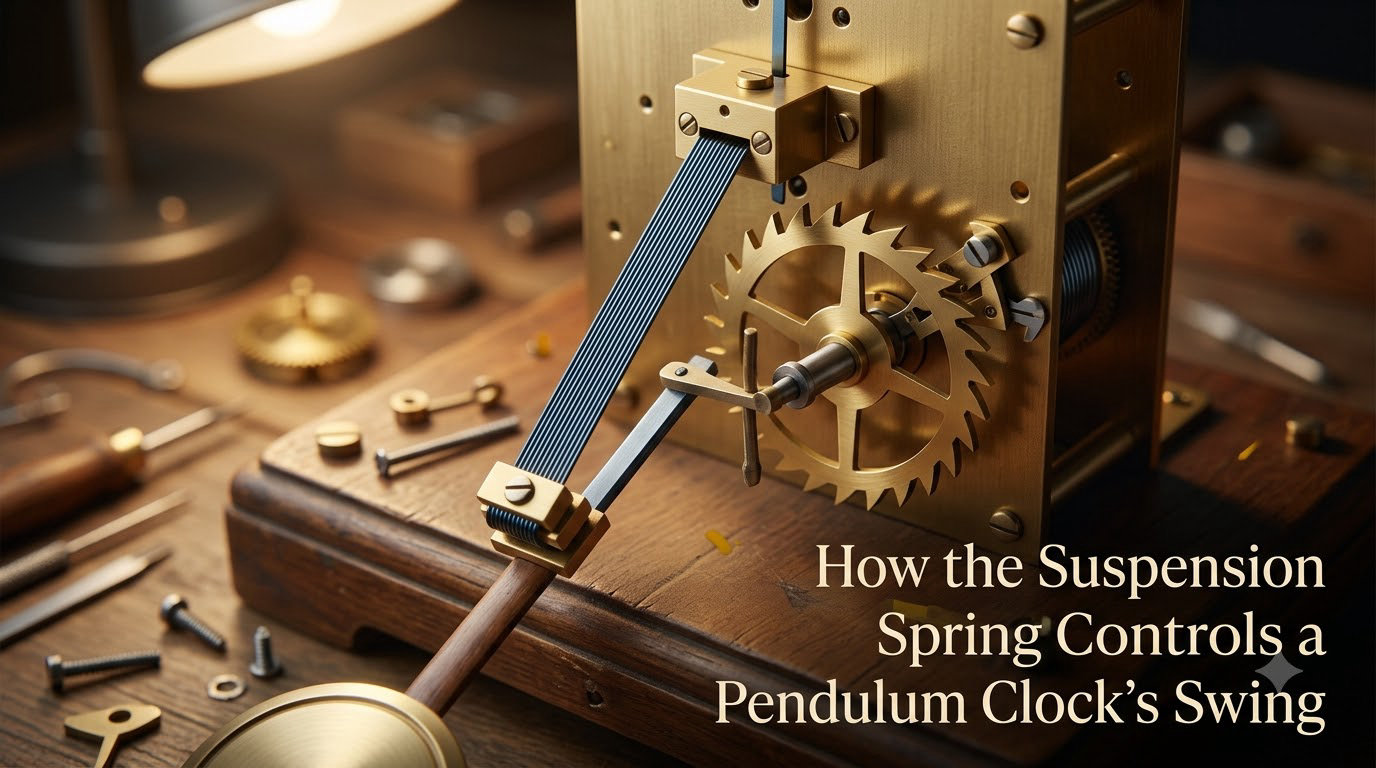
A suspension spring is a thin, flexible metal strip that connects the top of the pendulum rod to the clock movement. It is typically made of spring steel, though some high-end clocks use special alloys like Elinvar or Nivarox that resist temperature changes. The spring suspends the full weight of the pendulum while allowing it to swing freely back and forth.
Think of it as the flexible hinge at the very top of the pendulum assembly. Without it, the pendulum would have no pivot point. With it, the pendulum can oscillate in a controlled, predictable arc that the clock movement can measure and regulate.
The suspension spring has a deceptively simple appearance. It is usually a flat rectangle, sometimes only 3 to 5 millimeters wide and a fraction of a millimeter thick. Despite its small size, it performs three critical jobs: it carries the pendulum’s weight, it flexes to allow oscillation, and it transfers the energy impulse from the escapement to keep the pendulum moving.
Most suspension springs attach at the top to a fixed block on the movement plate and at the bottom to a pendulum leader or the pendulum rod itself. The top block often has two small screws or a clamping plate that holds the spring firmly in place. The bottom connection usually slides into a slot or hooks onto a small bracket.
Here are a few key terms that will help you follow the rest of this guide:
Amplitude: The distance the pendulum bob travels from center to one side of its swing. A larger amplitude means a wider arc.
Escapement: The mechanism that converts the steady force of a weight or mainspring into the impulses that keep the pendulum swinging. The anchor and deadbeat are the two most common types in pendulum clocks.
Beat alignment: The condition where the pendulum swings equally to both sides of center. A clock “in beat” ticks with even spacing between each tick.
Isochronism: The property of a pendulum where its swing period stays constant regardless of amplitude. The suspension spring plays a role in achieving this ideal.
How the Suspension Spring Controls a Pendulum Clock’s Swing
This is the heart of the matter. The suspension spring controls a pendulum clock’s swing through a combination of flexibility, stiffness, and precise positioning. It acts as both a pivot and an energy conduit, and every aspect of its design influences how the pendulum behaves.
The ideal suspension spring is stiff enough to hold the pendulum steady but flexible enough to allow a natural swing. Clockmakers describe this as the spring being “invisible” to the clock, meaning it interferes as little as possible with the pendulum’s natural oscillation frequency. When the spring is correct, the pendulum swings at the rate gravity and its length dictate, not at a rate the spring imposes.
The Flex Pattern and Arc Control
Every time the pendulum swings to one side, the suspension spring flexes near its top mounting point. This flexion creates a bending motion that defines the arc of the swing. The spring does not bend uniformly along its entire length. Instead, most of the bending happens in the upper portion closest to the fixed block.
This concentrated flex pattern matters because it determines the effective pivot point of the pendulum. A stiffer spring creates a pivot slightly higher, while a more flexible spring allows the pivot to drift lower as the spring bends more deeply. The position of this effective pivot changes the effective length of the pendulum, which in turn changes the swing period.
If the spring flexes too much, the pendulum’s center of oscillation shifts and the clock runs fast or slow. If the spring is too stiff, the pendulum cannot build enough amplitude and the swing becomes shallow or stalls entirely. The correct spring finds the narrow middle ground.
Energy Transfer Through the Spring
A pendulum alone would eventually stop swinging due to air resistance and friction. The clock movement prevents this by delivering a small push, or impulse, to the pendulum on each swing. This impulse travels through the suspension spring.
Here is how the cycle works. As the pendulum swings past center, the escapement releases a gear tooth, and a small amount of force pushes against the crutch or pendulum leader. That force travels up through the suspension spring to the pendulum. The spring must be stiff enough to transmit this push without absorbing too much of it, yet flexible enough that the push does not jar or disturb the natural oscillation.
I have seen clocks where a worn or incorrect spring absorbs so much of the impulse that the pendulum cannot sustain its swing. The energy simply dissipates into the metal instead of reaching the bob. The result is a clock that stops after running for a few hours or days.
How Spring Thickness Changes the Swing
Suspension spring thickness is one of the most critical and least understood factors in pendulum clock performance. Even a difference of one-thousandth of an inch changes how the clock runs.
A thicker spring is stiffer, which means it flexes less per swing. This stiffness raises the effective pivot point slightly and tends to produce a faster, more forceful swing. A thicker spring can also reduce amplitude because the pendulum has to work harder to bend the metal. In some cases, the extra stiffness prevents the escapement impulse from reaching the bob efficiently.
A thinner spring flexes more easily, which can create a larger, more natural arc. But if it is too thin, it cannot support the pendulum’s weight and may sag, kink, or break under the load. A spring that is too thin also transmits the escapement impulse poorly, since the energy gets lost in the excessive flexing.
The correct thickness depends on the pendulum weight, the desired amplitude, the escapement type, and the movement design. Manufacturers specify exact thicknesses for each movement, and deviating from those specs almost always causes timekeeping problems.
The Physics of Pendulum Oscillation
To really understand why the suspension spring matters so much, you need to understand what drives a pendulum in the first place. A pendulum is a classic example of harmonic motion, where a restoring force pulls an object back toward equilibrium after it has been displaced.
Gravity provides that restoring force. When you pull the pendulum bob to one side and release it, gravity pulls it back toward center. The bob overshoots center due to momentum, swings to the other side, and gravity pulls it back again. This back-and-forth motion is what we call oscillation.
Harmonic Motion and the Swing Period
The time it takes for a pendulum to complete one full swing, from one side back to the same side, is called the period. Christiaan Huygens, who built the first practical pendulum clock in 1656, recognized that the period depends primarily on the pendulum’s length and the acceleration due to gravity.
For a simple pendulum, the period is proportional to the square root of the length. This means a longer pendulum swings more slowly and a shorter one swings faster. A typical mantel clock pendulum might have a period of about half a second per swing, while a grandfather clock pendulum with a one-second period is about 39 inches long.
The suspension spring enters this equation because it affects the effective length. Since the spring flexes rather than acting as a perfect pivot, the true center of oscillation sits slightly below the physical top of the pendulum. The spring’s flexibility shifts this point, and any shift changes the effective length and thus the period.
Isochronism and Why Small Arcs Matter
Isochronism is the goal every clockmaker chases. An isochronous pendulum takes the same time to complete each swing regardless of how wide the arc is. In theory, a simple pendulum is perfectly isochronous only for small angles, roughly under 20 degrees.
In practice, pendulum clocks operate at much smaller angles, often just 2 to 5 degrees of arc. At these small angles, the pendulum is very nearly isochronous, and variations in amplitude caused by winding, temperature, or air pressure changes barely affect the rate.
The suspension spring supports this isochronism by providing a consistent, repeatable flex pattern. When the spring is in good condition and the correct thickness, the pendulum maintains a stable arc and the period stays constant. When the spring wears or is the wrong spec, the arc becomes irregular and the period drifts.
I have tested this myself. A clock with a slightly worn spring might gain or lose several seconds a day even though the pendulum length has not changed. The variation comes entirely from the changing flex pattern of the deteriorating spring.
The Escapement Connection
The suspension spring does not work alone. It is part of a system that includes the escapement, the gear train, and the power source. The escapement is the mechanism that both regulates the pendulum’s swing and keeps it moving.
Here is how the interaction works. The power source, either a wound mainspring or a descending weight, turns the gear train. The gear train ends at the escape wheel, which has specially shaped teeth. A lever called the crutch connects the pendulum to the escapement through the pendulum leader.
As the pendulum swings in one direction, the crutch moves the escapement lever, which releases one tooth of the escape wheel. The escape wheel advances by one tooth, and in doing so, it delivers a small push to the lever. That push travels back down the crutch, through the suspension spring, and into the pendulum.
The suspension spring is the critical link in this energy chain. It must transmit the impulse cleanly and consistently. If the spring is too flexible, it absorbs the impulse and the pendulum loses energy. If it is too stiff, it resists the natural swing and the pendulum cannot maintain a smooth arc.
The most common escapement types interact with the suspension spring differently. The anchor escapement, found in many older clocks, delivers a relatively strong impulse that requires a moderately stiff spring. The deadbeat escapement, common in higher-quality clocks, delivers a gentler, more precise impulse that works well with a thinner, more flexible spring.
In torsion pendulum clocks, such as anniversary clocks, the concept is similar but the geometry is different. Instead of a traditional pendulum swinging back and forth, a weighted ball or disc rotates back and forth on a thin suspension wire. The wire serves the same role as a suspension spring, providing the restoring force and the pivot for oscillation. These clocks typically have periods of several seconds per swing, much slower than conventional pendulum clocks.
Factors That Affect Suspension Spring Performance
Even the best suspension spring cannot maintain perfect performance indefinitely. Several factors influence how well the spring does its job, and understanding these helps you diagnose and prevent problems.
Temperature and Humidity Effects
Temperature changes affect suspension springs in two ways. First, metal expands and contracts with temperature. A warmer spring becomes slightly longer and thinner, which changes its flex characteristics. A cooler spring shortens and thickens, stiffening the response.
Second, the elastic modulus of the spring material changes with temperature. Most spring steels become slightly softer at higher temperatures, meaning the spring flexes more easily. This increased flexibility shifts the effective pivot point and changes the swing period.
High-quality clocks address this with temperature-compensating pendulums, such as mercury pendulums or gridiron pendulums, which adjust the bob position to counteract temperature effects. Some modern clocks use special alloys like Elinvar or Invar for the suspension spring because these materials have very low thermal expansion and stable elastic properties across a wide temperature range.
Humidity has a smaller direct effect, but it contributes to corrosion over time. A rusted or tarnished suspension spring loses flexibility and develops weak spots that can lead to failure.
Wear, Fatigue, and Material Degradation
Suspension springs undergo millions of flex cycles over their lifetime. A clock that runs for ten years puts the spring through roughly 300 million flex cycles at one-second periods. This constant bending causes metal fatigue.
Fatigue typically shows up as a gradual stiffening of the metal or as microscopic cracks near the clamping point, where the bending stress is highest. You may not see these cracks with the naked eye, but they change how the spring flexes and reduce its ability to transmit energy.
Sometimes a spring fails suddenly. The metal snaps at the clamping point, and the pendulum drops. More often, the deterioration is gradual. The clock slowly loses amplitude, the swing becomes uneven, and eventually the pendulum stops.
Replacement intervals vary. Some springs last decades, while others fail after just a few years, especially in clocks that run continuously without maintenance. I recommend inspecting the suspension spring during every regular cleaning and oiling service.
Leveling and Beat Alignment
The suspension spring can only do its job if the clock is perfectly level. When a clock is tilted, the pendulum’s center of swing shifts to one side, and the suspension spring flexes unevenly. One side of the swing gets more amplitude than the other.
This condition is called being “out of beat.” The ticks sound uneven, with a long pause followed by a short pause. A clock that is badly out of beat may stop entirely because the escapement cannot deliver consistent impulses.
Fixing beat alignment involves leveling the clock case and sometimes adjusting the crutch position relative to the pendulum leader. Some clocks have a beat adjustment mechanism on the suspension block that lets you shift the spring’s position slightly to center the swing.
I have seen clock owners chase timekeeping problems for weeks, trying pendulum adjustments and spring replacements, only to discover the clock was simply sitting at a slight angle. Always check level first.
Suspension Spring Types and Movement Compatibility
Not all suspension springs are interchangeable. Different clock movements require specific spring dimensions, and using the wrong type leads to poor performance or failure.
The three most common movement manufacturers for modern mechanical clocks are Hermle, Urgos, and Kieninger. Each uses suspension springs with particular widths, thicknesses, and block styles. Hermle springs, for example, are widely available and come in several standard sizes. Urgos and Kieninger springs have their own specifications, and some are no longer manufactured, requiring aftermarket substitutes.
American clock movements, such as those from Seth Thomas, Sessions, and New Haven, use their own suspension spring styles. These are often thicker and wider than modern European springs. The block style also differs, with some American clocks using a T-end spring that slides into a slotted crutch.
Anniversary clocks use torsion springs, which are completely different in design. These are thin wires that twist rather than bend, and their thickness determines the rotation period. Torsion springs are measured by their wire diameter and overall length, and they must be matched precisely to the pendulum ball weight.
When replacing a suspension spring, always note the original dimensions. Measure the width, thickness, and length of the old spring before discarding it. If possible, take the old spring to a parts supplier for matching. Guessing at dimensions almost never works.
Common mistakes include choosing a spring that is too thick, which restricts the swing, or too thin, which sags under the pendulum weight. Another frequent error is using a spring with the wrong block attachment style, which prevents proper mounting on the movement plate.
How to Tell If Your Suspension Spring Is Worn
Suspension spring problems develop gradually, and the symptoms can mimic other clock issues. Here are the signs I look for when diagnosing a suspect spring.
Reduced amplitude: The pendulum swing becomes noticeably smaller than it used to be. If the bob barely moves past center, the spring may be stiffening from fatigue or the escapement may not be delivering enough impulse through a weakened spring.
Stopping after winding or movement: The clock runs fine until you wind it or move the case slightly, then the pendulum stops. This often indicates a spring that has developed a weak spot and cannot handle even minor disturbances.
Visible kinks or bends: Inspect the spring under good light with a magnifier. Any visible bend, kink, or crease means the spring is damaged and should be replaced. Even a small deformity changes the flex pattern enough to affect timekeeping.
Uneven ticking: The clock ticks with uneven spacing, even after leveling. This can indicate a spring that flexes differently in each direction due to asymmetric wear.
Corrosion or discoloration: Rust, heavy tarnish, or dark spots on the spring suggest material degradation. A corroded spring is weaker and more prone to sudden failure.
To test a spring, gently remove it from the clock and flex it between your fingers. A healthy spring bends smoothly and returns to flat without any hesitation. If you feel any roughness, resistance, or unevenness in the bend, the spring is fatigued or cracked.
You can also compare the suspect spring against a new one of the same specification. Hold them side by side and flex each one. The worn spring will feel stiffer or less responsive than the new one.
Adjusting and Replacing a Suspension Spring
Replacing a suspension spring is a task that most clock owners can handle with patience and the right approach. Here is the process I follow, step by step.
Step 1: Stop the clock and remove the pendulum. Gently stop the pendulum and lift it off the suspension leader. Set it aside on a soft surface to avoid scratching the rod or bob.
Step 2: Remove the old spring. Loosen the screws on the suspension block at the top of the movement. Slide the old spring out of the block and disconnect it from the pendulum leader at the bottom. Note the orientation and how it was mounted.
Step 3: Inspect the old spring and measure it. Use a micrometer or caliper to measure the width and thickness. Measure the total length from the top of the block end to the bottom of the leader end. Record these dimensions for ordering a replacement.
Step 4: Install the new spring. Insert the top end into the suspension block and tighten the screws firmly but not excessively. Over-tightening can crush or deform the spring. Attach the bottom end to the pendulum leader in the same orientation as the original.
Step 5: Rehang the pendulum and check the beat. Place the pendulum back on the leader and start it swinging gently. Listen to the ticking. The intervals should be even. If they are not, adjust the clock’s level or the crutch position until the beat is even.
Step 6: Monitor for a few days. Let the clock run and check its rate against a reliable time source. Minor adjustments to the pendulum bob position may be needed to fine-tune the rate.
Common mistakes to avoid: using a spring with different dimensions, over-tightening the block screws, bending the spring during installation, and forgetting to check beat alignment afterward. Each of these can cause problems worse than the one you were trying to fix.
If your clock has a complex movement or a rare suspension spring style, consider consulting a professional clock repairer. Forcing an incorrect spring into a movement can damage the escapement or the suspension block.
A Brief History of Suspension Spring Design
The suspension spring evolved alongside the pendulum clock itself. When Galileo first proposed using a pendulum to regulate time in the late 1500s, he envisioned a simple string pivot. Huygens made the concept practical in 1656, but early clocks used silk threads or crude knife-edge pivots.
The flexible metal suspension spring emerged as clockmakers sought more durable and consistent pivot mechanisms. By the 1700s, thin steel springs had become standard in quality clocks. Clockmakers discovered that the spring’s properties directly affected timekeeping, and they began specifying exact dimensions for different movements.
The 1800s brought improvements in steel manufacturing, producing more uniform and reliable spring stock. American clockmakers of the industrial era standardized suspension spring dimensions to simplify mass production and replacement.
In the 1900s, temperature-compensating alloys like Elinvar and Invar were developed for precision regulators and observatory clocks. These materials minimized the thermal sensitivity that had plagued pendulum clocks for centuries. The Fedchenko suspension, developed in the Soviet Union for precision astronomical clocks, used a specially shaped spring that forced the pendulum into a nearly perfect parabolic arc.
Today, most replacement suspension springs are manufactured to specifications matching the original movements. While the basic design has changed little in over a century, the availability of precise materials and standardized dimensions makes it easier than ever to maintain and repair pendulum clocks built decades ago.
What does a clock suspension spring do?
A clock suspension spring is a thin metal strip that connects the pendulum to the movement. It suspends the pendulum’s weight, allows it to swing freely back and forth, and transfers the energy impulse from the escapement to keep the pendulum oscillating. The spring’s flexibility controls the swing arc, and its stiffness affects how efficiently energy reaches the pendulum bob.
What causes a clock pendulum to stop swinging?
The most common causes are a clock that is not level, a worn or broken suspension spring, crutch misalignment, insufficient power from the mainspring or weight, and dirt or old oil in the movement. Check the clock’s level first, then inspect the suspension spring for damage, and verify the escapement is receiving enough power from the gear train.
How do you release an overwound clock spring?
An overwound mainspring typically means the spring is fully wound and the clock lacks proper service rather than being damaged. Let down the mainspring power using a let-down key and a pair of pliers on the winding arbor, turning slowly to release tension gradually. If you are not comfortable with mainspring work, take the clock to a professional, as a fully wound spring can release suddenly and cause injury.
What is the screw on the bottom of a pendulum clock for?
The screw on the bottom of the pendulum rod is the rating nut. Turning it raises or lowers the pendulum bob, which changes the effective length of the pendulum. Raising the bob makes the clock run faster, and lowering it makes the clock run slower. Make small adjustments, about one turn at a time, and check the rate over 24 hours.
Why is my pendulum clock running fast?
A pendulum clock runs fast when the effective pendulum length is too short. Lower the rating nut to drop the bob and lengthen the pendulum. Other causes include a suspension spring that is too thick or stiff, temperature changes that have shortened the pendulum, or a pendulum bob that has shifted upward. Check the spring specifications if rate adjustments do not solve the problem.
How does suspension spring thickness affect pendulum speed?
A thicker suspension spring is stiffer and flexes less, which raises the effective pivot point and can make the clock run slightly faster while reducing swing amplitude. A thinner spring flexes more easily, which can slow the clock and increase amplitude. The correct thickness is specified by the movement manufacturer, and even a small deviation affects timekeeping accuracy.
Conclusion
The suspension spring may be the smallest and least visible part of a pendulum clock, but it is one of the most important. It controls the swing arc, transfers energy from the escapement, and determines whether your clock keeps accurate time or drifts by minutes each day.
Understanding how the suspension spring controls a pendulum clock’s swing gives you the knowledge to diagnose problems, choose the right replacement parts, and make adjustments with confidence. Whether your clock is a treasured heirloom or a weekend project, this small spring deserves your attention and respect.
If your clock has stopped or is running inconsistently, start by checking the level and then inspecting the suspension spring. A few minutes of examination and a correctly specified replacement can restore years of reliable timekeeping.