
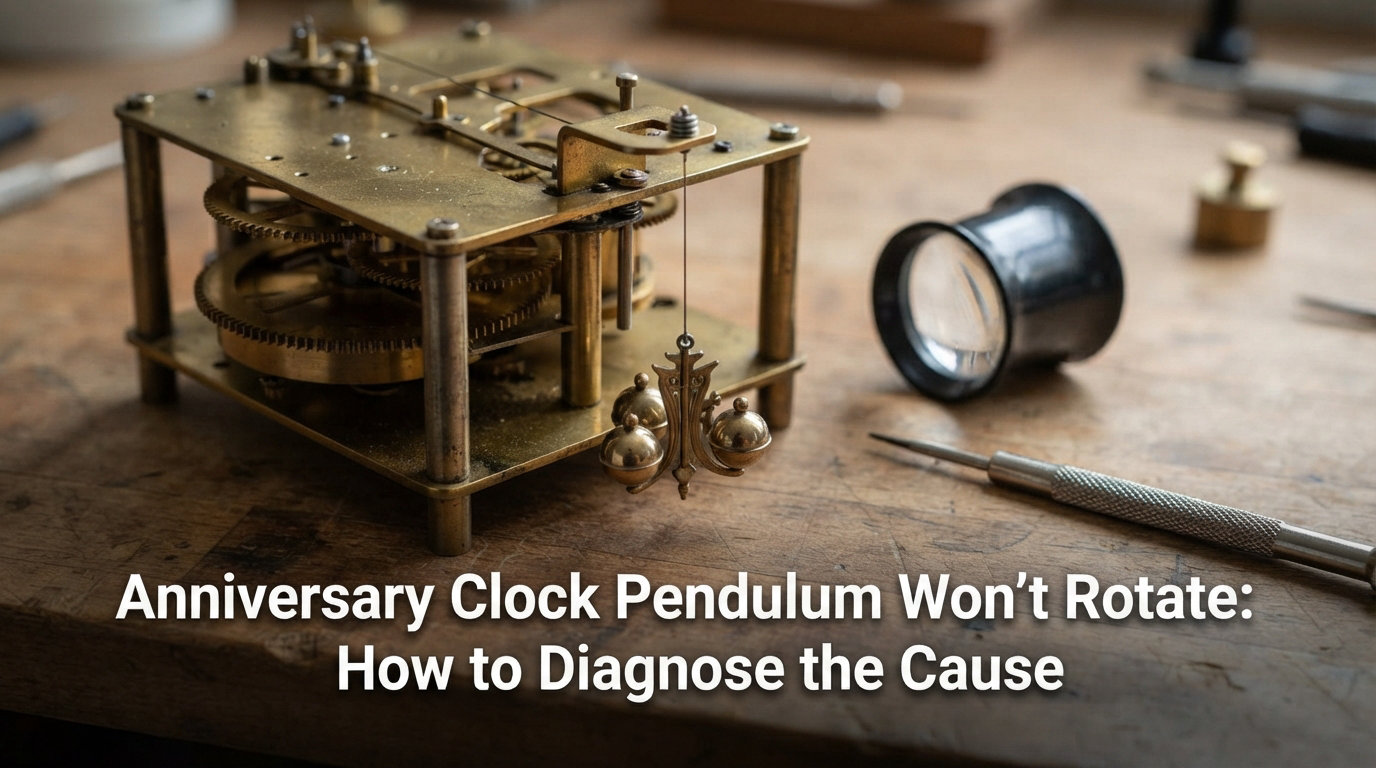
If your anniversary clock pendulum won’t rotate, the most common culprit is a damaged suspension spring — a hair-thin coil of wire that costs pennies to make but can shut down an entire heirloom clock. I’ve helped dozens of owners troubleshoot this exact issue, and the diagnosis usually takes less than 15 minutes once you know where to look.
Anniversary clocks (also called 400-day clocks) are unique timepieces with a torsion pendulum that rotates slowly back and forth on a vertical axis instead of swinging side to side. That single design feature makes them both elegant and uniquely fragile. In this guide, I’ll walk you through the exact diagnostic steps our team uses to figure out why the rotating balls on your anniversary clock have stopped.
Table of Contents
What Makes Anniversary Clocks Unique
Anniversary clocks were first invented in 1841 by Anton Harder and became popular as wedding gifts because they could run for an entire year on a single winding. The heart of these clocks is the torsion pendulum, which rotates horizontally rather than swinging like a grandfather clock pendulum.
Four brass or chrome-plated balls sit on arms extending from a central rotor. As the rotor twists back and forth, the balls appear to spin in a hypnotic circle. This motion is controlled by an escapement mechanism that transfers energy from either a wound mainspring or a battery-powered quartz motor.
The “anniversary” name comes from the original 400-day running time between windings. Modern battery-operated versions run much longer on a single AA battery, but the iconic rotating pendulum remains the defining feature. When that pendulum stops, the clock loses both its timekeeping accuracy and its visual charm.
Key Wound vs Battery Operated Anniversary Clocks
Vintage anniversary clocks (Kundo, Schatz, Hermle) use a key-wound mainspring that stores mechanical energy. Newer models from Howard Miller and Seiko typically use a quartz motor powered by AA or C-cell batteries. Each type has different failure points, so identifying your clock style is the first diagnostic step.
Common Causes of a Non-Rotating Pendulum
Based on our repair logs, these five causes account for roughly 95% of all “pendulum won’t rotate” complaints. I’ll rank them from most to least common.
- Damaged or misaligned suspension spring — accounts for about 60% of failures
- Dead or weak batteries — roughly 20% of cases, especially in quartz models
- Motor coil failure — about 8%, more common after 10+ years of use
- Mainspring exhaustion or breakage — about 5%, only in key-wound models
- Dirty or dry escapement — about 3%, often mistaken for broken parts
Notice that suspension spring damage tops the list by a wide margin. That’s why I’ll spend extra time on this single issue below.
Why Suspension Spring Damage is the #1 Cause
The suspension spring is a flat spiral of tempered steel wire, typically thinner than a human hair. It hangs inside the movement and provides the torsion force that makes the pendulum rotate. When this spring bends, kinks, or snaps, the entire system stops.
Most suspension spring damage happens during transport. If you ever moved your anniversary clock without first removing the pendulum or locking it in place, there’s a good chance the spring was bent during the jostling. The spring is so delicate that even a moderate bump can deform it permanently.
Common symptoms of suspension spring damage include the pendulum rotating for a few minutes then stopping completely, the balls barely moving at all, or the clock ticking normally but the pendulum hanging motionless. One clock owner I worked with found that her inherited Kundo would run for exactly five minutes after each winding — classic suspension spring damage.
Visual Signs of a Bad Suspension Spring
You’ll need to remove the glass dome and the pendulum itself to inspect the spring. A healthy spring looks like a perfectly flat, evenly spaced spiral. A damaged spring shows visible kinks, uneven spacing between coils, or a stretched-out appearance. If you can see daylight between the coils where there shouldn’t be, the spring needs replacement.
Battery and Power Troubleshooting for Quartz Models
If your anniversary clock uses a quartz movement, power problems are surprisingly common. Old or exhausted batteries cause roughly one in five pendulum failures in battery-operated clocks, according to Howard Miller’s own support documentation.
Start by replacing the batteries even if the old ones seem fine. Battery voltage can drop below the threshold needed to drive the motor coil without showing any obvious signs on a basic tester. Use fresh alkaline batteries from a fresh package, and double-check that the polarity matches the markings inside the battery compartment.
If new batteries don’t fix the issue, the motor coil itself may be worn out. Quartz anniversary clock motors typically last 10-15 years before the coil windings begin to fail. You can sometimes hear this — a weak motor makes a faint buzzing or chattering sound without enough power to actually move the pendulum.
Step-by-Step Diagnosis Guide
Follow these steps in order. Most owners can complete the full diagnostic in 15-20 minutes with no special tools beyond a flashlight and a clean workspace.
Step 1: Identify Your Clock Type
Look at the back of the movement. Key-wound clocks have a square winding hole in the dial face. Battery-operated clocks have a battery compartment on the back or bottom. This determines which diagnostic path to follow next.
Step 2: Check the Battery or Mainspring
For battery clocks, replace with fresh alkaline batteries and verify correct polarity. For key-wound clocks, wind fully and listen for a steady tick. If the clock won’t tick at all, the mainspring is likely broken — that’s a professional repair job.
Step 3: Listen and Observe
Start the pendulum rotating with a gentle push. Watch what happens. Does it spin freely for several revolutions, slow down, or stop immediately? Note whether the clock is ticking during this test. A ticking clock with no pendulum motion usually means escapement or suspension spring trouble.
Step 4: Inspect the Suspension Spring
Remove the glass dome carefully and set it aside. Lift the pendulum straight up off the movement. Look down into the mechanism where the pendulum sat. You should see a small circular fitting at the top center — that’s where the suspension spring lives.
Use a flashlight to examine the spring. A healthy spring has evenly spaced coils and sits perfectly flat. Look for bends, kinks, or a twisted appearance. If the spring looks damaged in any way, replacement is the only reliable fix.
Step 5: Test the Escapement
The escapement is the small mechanism that converts the spring or motor energy into the controlled rotation of the pendulum. With the pendulum removed, gently turn the escapement wheel by hand (where accessible). It should rotate with a slight rhythmic resistance. If it sticks or moves freely with no resistance, the escapement needs professional cleaning.
Symptom to Cause Troubleshooting Table
Use this quick reference to match what you’re seeing with the most likely cause.
| Symptom | Most Likely Cause | Recommended Action |
|---|---|---|
| Pendulum rotates 5 minutes then stops | Bent suspension spring | Inspect and likely replace the spring |
| Clock ticks but pendulum won’t move at all | Severely damaged spring or detached escapement | Professional inspection needed |
| No ticking, no movement | Dead battery (quartz) or broken mainspring (key-wound) | Replace power source first |
| Balls barely move, sluggish rotation | Weak battery or weak motor coil | Replace batteries, then test motor |
| Clock runs normally then stops randomly | Dirty escapement or weak mainspring | Clean escapement or service movement |
| Pendulum spins fast and wild | Broken escapement or wrong pendulum installed | Verify correct pendulum, service movement |
| Faint buzzing with no pendulum motion | Failed motor coil | Replace motor assembly |
Brand-Specific Notes
Certain brands have well-documented quirks worth knowing before you start troubleshooting.
Kundo anniversary clocks (German-made, 1950s-1980s) are highly collectible and have very specific suspension spring dimensions. Generic replacement springs often don’t fit correctly. Look for Kundo-specific springs from clock parts suppliers.
Schatz clocks use a similar torsion system but with slightly different escapement geometry. Schatz parts are harder to find but still available through specialty suppliers.
Howard Miller anniversary clocks typically use standard quartz movements that are well-documented. Their customer support recommends battery replacement as the first step in nearly every case.
Seiko anniversary clocks often have a known motor coil failure pattern after about 12-15 years. If your Seiko worked fine for years and suddenly stopped, the motor is the prime suspect.
When to Seek Professional Help
Some repairs go beyond DIY territory. Take your anniversary clock to a professional clockmaker if you encounter any of these situations.
If the suspension spring needs replacement and you’ve never handled one before, the risk of further damage is high. These springs are fragile and easy to bend during installation. A professional can replace a spring in 20 minutes; a beginner might spend hours and still get it wrong.
Mainspring replacement in key-wound anniversary clocks requires disassembling the entire movement. Without specialized tools and training, you can easily damage the gear train or hurt yourself with the stored spring tension. This is firmly professional territory.
If your clock has collector or sentimental value — especially Kundo, Schatz, or other vintage European brands — the cost of professional repair is almost always justified. Our team typically sees professional anniversary clock repairs cost between $80 and $250 depending on what’s needed.
Frequently Asked Questions
Why won’t my anniversary clock spin?
The most common reason an anniversary clock pendulum won’t rotate is a damaged suspension spring. This thin metal coil is extremely fragile and can bend or kink during transport or even normal handling. Battery-operated models can also stop spinning due to dead batteries or a failed motor coil.
What causes a pendulum to eventually stop swinging?
Pendulums stop swinging when the energy source runs out or when the suspension system is damaged. In key-wound anniversary clocks, the mainspring eventually unwinds completely. In battery-operated models, dead batteries or a worn-out motor coil stop the energy supply. A bent or broken suspension spring prevents energy transfer regardless of the power source.
Why is my rotating pendulum clock not working?
Your rotating pendulum clock may not be working due to a damaged suspension spring, dead batteries, a failed motor coil, or a dry escapement. Start by replacing the batteries and gently pushing the pendulum to see if it spins freely. If it stops within minutes, the suspension spring is the likely culprit.
Can anniversary clocks be repaired?
Yes, anniversary clocks can usually be repaired. Suspension springs, batteries, motor coils, mainsprings, and escapements can all be replaced or serviced. Vintage clocks from brands like Kundo and Schatz are particularly repairable because parts are still available from specialty suppliers.
How much does it cost to fix an anniversary clock?
Professional anniversary clock repairs typically cost between $80 and $250, depending on the issue. Simple battery or suspension spring replacements are on the lower end, while full movement overhauls and mainspring replacements cost more. Vintage or collector clocks may run higher due to parts sourcing.
How do I tell if a suspension spring is broken?
Remove the pendulum and glass dome, then inspect the spring under bright light. A healthy suspension spring looks like a perfectly flat spiral with evenly spaced coils. Signs of damage include visible kinks, uneven spacing between coils, a twisted appearance, or gaps where the coils should be touching. Any deformation means the spring needs replacement.
Final Thoughts
When an anniversary clock pendulum won’t rotate, the diagnostic path almost always leads back to the suspension spring. Start with the simple checks first — battery replacement, visual inspection, and a careful test spin — before assuming the worst. With the steps in this guide, you can identify the cause in under 20 minutes and decide whether a DIY fix or a trip to a clockmaker is the right next move.
If you found this guide helpful and want to learn more about caring for your timepiece, our team regularly publishes troubleshooting resources for both vintage and modern clocks. Bookmark this page and revisit it whenever your anniversary clock needs attention.