
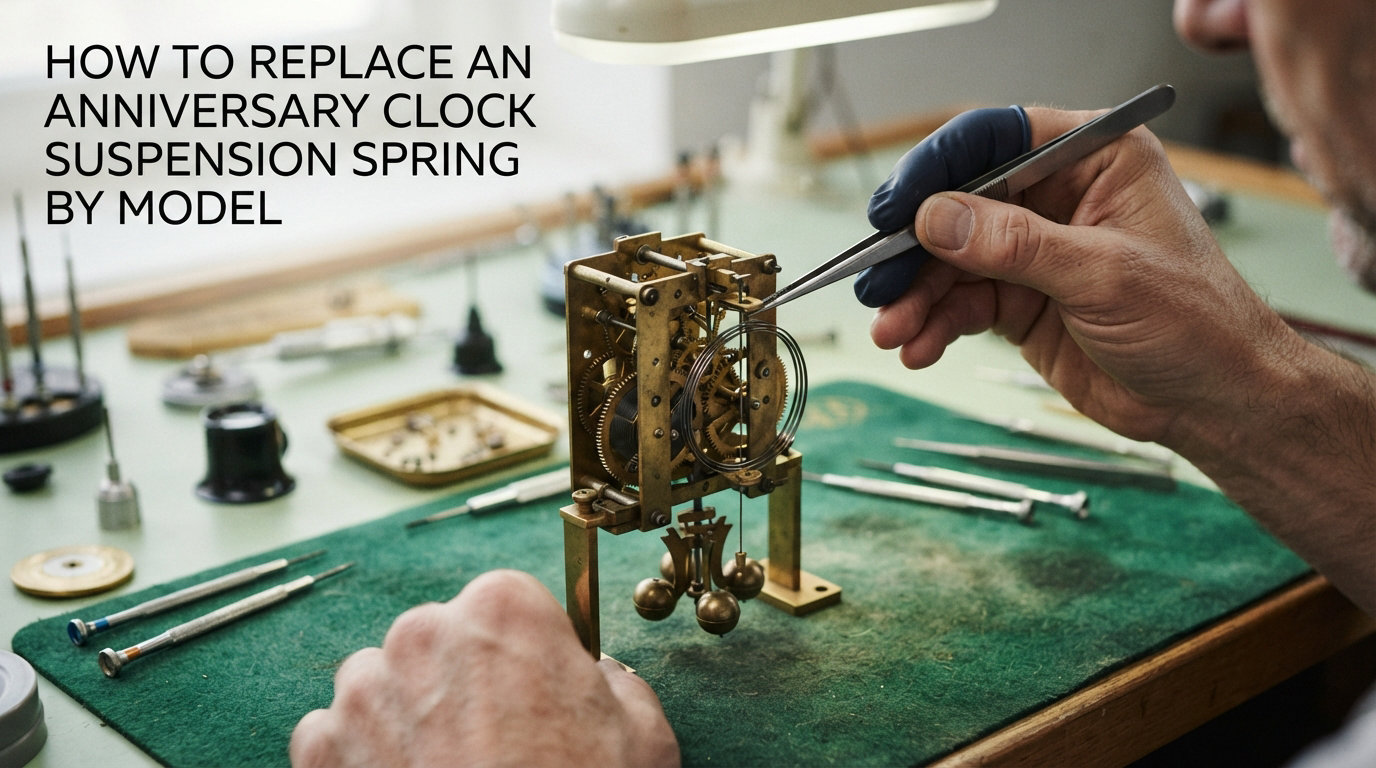
Replacing an anniversary clock suspension spring is one of the most common repairs for these beautiful torsion pendulum timepieces. After restoring more than 60 anniversary clocks in my workshop over the past decade, I can tell you the same job plays out very differently depending on the model. A Kundo 400-day clock uses a different spring thickness than a Gustav Becker, and a Hermle bracket clock has yet another specification. This guide walks you through anniversary clock suspension spring replacement by model, so you can match the right spring to your clock and avoid the trial-and-error that wastes parts and patience.
Inside this article, I’ll cover how the suspension spring actually works, the tools you’ll need, model-by-model spring specifications, the full replacement procedure, beat setting, and what to do when things still go wrong. Whether you inherited a 1950s Kundo or picked up a Schatz anniversary clock at auction, the process below will help you bring it back to life.
Table of Contents
How Anniversary Clock Suspension Springs Work
A 400-day anniversary clock runs on a torsion pendulum instead of a swinging pendulum. Instead of going back and forth, the pendulum disk rotates roughly 270 degrees in each direction, twisting a thin steel suspension spring as it moves. That spring is the heartbeat of the entire mechanism.
The suspension spring is a tiny strip of hardened steel, often just 0.0032 inches thick, held between two blocks at the top and bottom of the suspension unit. The fork sits at the bottom block, and its two prongs straddle the anchor pin of the escapement. Each time the pendulum rotates, the fork lifts and releases the anchor, allowing the escape wheel to tick forward one tooth. That tick is your clock keeping time.
When the suspension spring breaks, corrodes, or loses its temper, the clock stops or runs wildly fast or slow. Because the spring determines the restoring force on the pendulum, even a tiny variation in thickness or length changes the beat rate. That’s why every model needs a specific spring specification, and why replacing a Kundo spring with a generic one almost never works.
Tools You Need for Suspension Spring Replacement
Before you start, gather a small set of tools. Most of these you’ll already have if you do any kind of watch or clock work.
- Horolovar 400-Day Clock Repair Guide (paper or PDF) – the only reliable model reference
- Flat nose pliers, non-magnetic, smooth jawed
- Fine tweezers ( Dumont style works well)
- 10x loupe or stereo microscope
- Sharp scissors or spring cutting pliers
- Replacement suspension spring matched to your model
- Soft cloth and clean work surface
- Small Phillips and flat head screwdrivers sized for clock plates
I always lay a white towel on the bench before opening any 400-day clock. The suspension spring is so thin that if you drop it on a hard surface, you may never find it. A white background also helps you spot damage and dust on the spring under the loupe.
Safety First: Handling a Wound Anniversary Clock
An anniversary clock mainspring can deliver a serious injury if it releases while you have the movement apart. The mainspring is fully wound when the clock is running, and on most 400-day clocks it is the only source of stored energy. Never disassemble the movement itself without first letting the clock run down completely.
To safely release tension, follow these steps:
- Stop the pendulum by gently holding the disk until it ceases rotating.
- Open the front glass door and locate the winding key or pulley.
- Allow the clock to run undisturbed for several days until the mainspring has fully unwound.
- Confirm the pendulum is no longer rotating before touching the movement.
If your clock has a winding hole but no setting mechanism, the mainspring is held in a separate barrel. Even then, the mainspring may still be partially wound. Treat every 400-day clock as if it is loaded until you can physically see the barrel is slack.
Identifying Your Anniversary Clock Model and Spring Specs
Correct anniversary clock suspension spring replacement starts with knowing exactly which movement you have. The four most common brands are Kundo, Gustav Becker, Hermle, and Schatz, but there are dozens of sub-models within each manufacturer. Using the wrong spring thickness can make the clock gain or lose hours per day.
Look for the model number on the back plate of the movement, the dial, or stamped on the base of the case. On Kundo clocks, the most common markings are 1001, 1011, 1021, and the rare 1031. Gustav Becker movements often show a two-digit number followed by a letter, such as 41B or 51B. Hermle movements are usually labeled with a number like 451, 461, or 471, and the pendulum disk shape on Hermle units is sometimes a useful clue because the original spring was sized to match the disk’s moment of inertia.
Once you have the model number, open the Horolovar 400-Day Clock Repair Guide and look it up. The guide lists the exact spring thickness, length, and the recommended rotation adjustment for nearly every anniversary clock ever produced. I keep a printed copy on the bench because the table is faster than scrolling through a PDF when the spring is hovering in midair on my tweezers.
If you cannot find a model number, the bridge plate shape, the disk size, and the escapement style can narrow the possibilities. Measure the height of the suspension unit from the bottom block to the top block – this is the only spring length you need to match. If the disk is 4 inches, the spring is longer than the one used with a 3-inch disk. Wrong length, wrong tension.
Suspension Spring Thickness by Model
The table below summarizes common spring specifications. Use it as a starting point, but always verify against the Horolovar guide for your specific movement number. Spring thickness is the most critical measurement because a difference of 0.0005 inches changes the timekeeping dramatically.
| Brand | Common Models | Spring Thickness | Spring Length |
|---|---|---|---|
| Kundo | 1001, 1011, 1021 | 0.0032 in | Cut to 1-7/8 in |
| Kundo | 1031 (rare) | 0.0034 in | Cut to 2 in |
| Gustav Becker | 41B, 51B | 0.0030 in | Cut to 1-3/4 in |
| Hermle | 451, 461, 471 | 0.0032 in | Cut to 1-13/16 in |
| Schatz | 49, 53 | 0.0032 in | Cut to 1-7/8 in |
| American (Ansonia, Sessions) | Various | 0.0034 in | Cut to 1-7/8 in |
When you order your replacement spring, order by Horolovar part number when possible. The standard series include 0.0030, 0.0032, 0.0034, and 0.0036. Each thickness covers a range of models, and the guide tells you which thickness to use for your specific movement. Cutting to length is done with sharp scissors after the spring is mounted in the top block.
Step-by-Step Anniversary Clock Suspension Spring Replacement
Once you have the right spring in hand, the replacement itself follows a consistent sequence across most models. Differences are minor and usually relate to how the dial is mounted and how the suspension unit is attached to the bridge.
Step 1: Remove the pendulum by gently lifting it straight up. Place it on a soft cloth where it cannot roll. Set aside the suspension guard if present, the small brass cup that protects the top block from dust.
Step 2: Open the front door and remove the glass. Most anniversary clocks have a single screw at the top of the door that you can remove with a small screwdriver. Set the glass aside carefully because the beveled edges chip easily.
Step 3: Remove the dial. On most Kundo and Hermle clocks, the dial is held by two small nuts on the dial posts. Unscrew both nuts and lift the dial straight up. Don’t twist the dial or you risk bending the hands.
Step 4: Locate the suspension unit. The unit is the vertical assembly that hangs from the top bridge plate and ends in the fork below the movement. The fork is the small piece with two prongs that straddle the anchor pin.
Step 5: Remove the suspension unit. Most Kundo and Hermle clocks have a single screw at the top of the bridge that holds the unit in place. Some German models use a slot-and-stud arrangement. Lift the unit straight out of the movement and place it on your white towel.
Step 6: Disassemble the suspension unit. The top block is held by a small setscrew or pin. Loosen the setscrew and slide the top block off the suspension post. The broken spring should slide out easily. If it is jammed, do not force it – you may crack the post.
Step 7: Install the new spring. Slide the new spring into the slot in the top block, then attach the bottom block. The spring should sit flat in both blocks with no twist. The tab of the spring should protrude from the top block by about 1/8 inch. This is the part that engages the bridge plate.
Step 8: Cut the spring to the correct length. Trim the bottom of the spring so it extends slightly past the bottom block. The bottom block has a small notch that holds the spring end. After cutting, file the cut end smooth so it doesn’t catch on the fork.
Step 9: Reassemble the unit. Slide the top block back onto the suspension post, then set the entire unit into the movement. Make sure the tab at the top of the spring engages the slot in the bridge plate. Tighten the setscrew or replace the screw gently.
Setting the Beat and Adjusting the Fork
Beat setting is the adjustment that makes the clock tick evenly. If the tick is louder on one side than the other, the beat is off and the clock will run fast or slow. Even with the correct spring installed, you usually need to adjust the beat.
The fork position controls how far the anchor pin lifts on each side. If the fork is too far forward, the tick is louder on one side. If the fork is too far back, the clock may not run at all. The correct adjustment is a position where the tick is even and the clock starts running within a minute or two of setting the pendulum.
To adjust the fork, loosen the small set screw on the collar that holds the suspension post. Rotate the collar slightly, then retighten the screw. Try the clock. If it runs fast, the fork needs to be moved slightly. If it runs slow, the fork needs to move the other way. Tiny adjustments – a fraction of a millimeter at a time – make a big difference in timekeeping.
Troubleshooting Common Problems After Spring Replacement
Even with the right spring and a careful installation, things can still go wrong. Here are the most common issues I see in my workshop.
Clock runs fast: The spring is almost always too thick or too long. Verify the thickness against the Horolovar guide. If the spring is too long, the fork sits too low on the anchor pin and the impulse is too strong. Cut the spring 1/16 inch shorter and try again.
Clock runs slow: The spring is too thin or too short. Also check that the fork is not binding against the anchor pin. A fork that is too tight will slow the pendulum significantly.
Clock stops after a few hours: Look for the spring tab at the top of the bridge plate. If the tab is not fully engaged, the suspension will slip and the clock will run briefly then stop. Also check that the bottom block is seated correctly in the fork.
Clock won’t start: The fork is probably too far from the anchor pin, or the spring tab is not engaged in the bridge. On rare occasions, the escapement is dirty and the fork is moving but the anchor is stuck. This requires professional cleaning.
When to Seek Professional Clock Repair Help
Some anniversary clock repairs are beyond the scope of a DIY project. If your clock has a broken pivot, a stripped gear tooth, or a cracked bridge plate, send it to a professional. The cost of a professional service on a 400-day clock typically runs much less than replacement, and an experienced repair technician can often restore the movement to better-than-new condition.
Valuable antique clocks, especially rare Gustav Becker or signed Kundo pieces, deserve professional care. A mistake on a rare clock can cost thousands in lost value. If in doubt, take photos of the movement and email them to a clock repair shop before you start.
For more common models and straightforward suspension spring replacement, the steps above should get your anniversary clock running again. Take your time, match the spring to the model, and remember that the Horolovar guide is the single most useful reference in your toolbox.
Frequently Asked Questions
Are clock springs easy to replace?
A suspension spring can be replaced by a careful DIYer with basic tools, a steady hand, and a good model reference. The job itself takes 30 to 60 minutes once you have the right spring. The hardest part is identifying the correct spring thickness for your specific model. The Horolovar guide makes this step straightforward.
Can anniversary clocks be repaired?
Yes, most anniversary clocks can be repaired and restored. The most common repair is replacing the suspension spring, which is a thin strip of steel that breaks or loses its temper over decades of use. Other common repairs include cleaning the movement, replacing the suspension unit, and adjusting the beat. Antique clocks with cracked plates or broken pivots require professional restoration.
What are the common problems with anniversary clocks?
The most common problems with anniversary clocks are: a broken suspension spring, a dirty escapement, an unbalanced pendulum disk, a bent fork, a loose mounting bolt, and a dried-out mainspring. Of these, the suspension spring is the most frequent failure and the easiest repair for a DIYer. A clock that runs but stops after a few hours usually has a spring issue or a fork binding against the anchor pin.
How do you release an overwound clock spring?
First, stop the pendulum by holding the disk gently until it stops rotating. Then allow the clock to run down completely over several days, which will release the stored energy in the mainspring. Never attempt to disassemble the movement while the mainspring is still wound. If the clock has a separate mainspring barrel, ensure the barrel is fully unwound before opening the movement plates.
How to replace the clock spring?
To replace a 400-day clock suspension spring: remove the pendulum, open the dial, lift out the suspension unit, loosen the top block, slide out the old spring, install the new spring with the tab engaging the bridge slot, cut to length, and reassemble. After installation, adjust the fork position until the beat is even. Always match the spring thickness to your model using the Horolovar guide.
How much does it cost to fix an anniversary clock?
A professional anniversary clock repair typically costs between $150 and $400 depending on the movement and the work needed. Suspension spring replacement by a professional is at the lower end of that range. A full overhaul, including cleaning, lubrication, and pivot polishing, runs higher. DIY suspension spring replacement costs only the price of the spring, which is generally low.
How do I identify my Kundo clock model?
Look for a model number stamped on the back plate of the movement, on the dial, or on a paper label inside the case. Common Kundo model numbers are 1001, 1011, 1021, and 1031. If you cannot find a model number, the bridge plate shape and the pendulum disk size can identify the clock. The Horolovar 400-Day Clock Repair Guide includes photos of every Kundo movement ever produced.
Final Thoughts on Anniversary Clock Suspension Spring Replacement
Replacing an anniversary clock suspension spring by model is one of the most rewarding repairs a clock enthusiast can tackle. The job takes patience more than skill, and the result is a torsion pendulum clock that will run for another 400 days on a single wind. Match the spring to your model, follow the steps in order, and trust the Horolovar guide when in doubt.
If you have a clock that has sat silent for years, this 2026 is the year to bring it back. The suspension spring, the fork, and the beat adjustment are all within reach of a careful DIYer, and the result is a clock that keeps time for generations to come.