
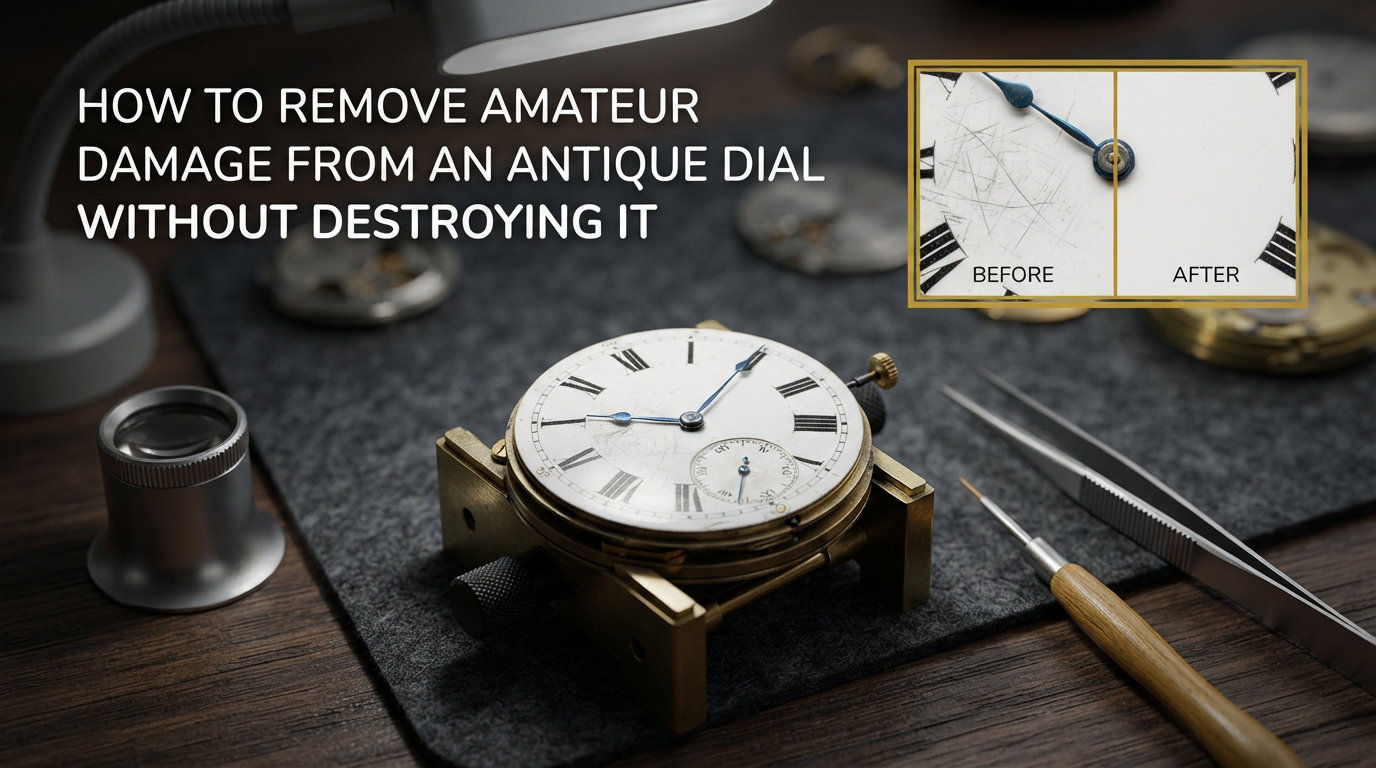
Imagine wiping a cloth across your grandfather’s clock dial and watching the painted numeral “6” transfer onto the fabric in real time. That exact scenario plays out in collector forums every week. Someone inherits a beautiful antique timepiece, tries to “freshen up” the dial, and accidentally destroys decades of original craftsmanship in seconds.
The goal of this guide is to teach you how to remove amateur damage from an antique dial without destroying it. We will cover material identification, safe cleaning techniques, which damages are reversible, and exactly when you should put the cloth down and call a professional.
Unlike case polishing or movement cleaning, dial work carries almost no margin for error. Silver plating can measure less than a thousandth of an inch thick. Painted numerals on vintage dials often sit on the surface with binders that dissolve on contact with common household cleaners. Celluloid dials can swell and warp from moisture alone.
I have spent years studying NAWCC forum archives, watchmaker community discussions, and restoration case studies. The consensus is clear: most amateur dial damage is preventable, and a surprising amount of it is partially reversible if you act carefully and know your material. Let me walk you through the process step by step.
Table of Contents
What Counts as Amateur Damage on an Antique Dial?
Amateur damage refers to any unintended harm caused by a non-professional attempting to clean, polish, or repair an antique dial. The damage is almost always well-intentioned. Someone wants their clock or watch to look cared for, so they reach for the same products they would use on any other household surface.
The most common forms of amateur damage include dissolved painted numerals, stripped silver plating, ink bleeding from felt-tip marker touch-ups, celluloid warping from moisture, and deep scratches from abrasive polishing. One collector on the NAWCC forums described watching the “6” and “7” numerals vanish from their dial in seconds after applying Windex. The ammonia attacked the paint binder, and the numerals literally slid off the surface onto the cleaning cloth.
What makes antique dials so vulnerable is their construction. Many clock dials feature numerals and decoration that were painted or inked onto the surface rather than fired into the material. A fired porcelain dial bonds its decoration at high temperature, making it relatively durable. But a painted metal dial relies on a thin layer of pigment held in place by organic binders that age, weaken, and become soluble over decades.
Silvered brass dials add another layer of fragility. The silvering is a plating applied over brass, and it can be extraordinarily thin. Even gentle rubbing with a damp cloth can remove it entirely, exposing the raw brass underneath and destroying the dial’s original appearance.
The distinction between patina and damage also matters here. A naturally aged dial with even tarnish and warm coloration has patina, which collectors value. Amateur damage is different. It is uneven, localized destruction that breaks the dial’s visual continuity and reduces both its aesthetic appeal and monetary worth.
Identify Your Dial Material Before Touching Anything
You cannot choose a safe cleaning method until you know what your dial is made of. Each material reacts differently to water, solvents, and mechanical pressure. Guessing wrong is the single fastest way to ruin an antique dial.
Here is how to identify the four most common antique dial materials and what makes each one vulnerable.
Silvered Brass Dials: Thin Plating, High Stakes
Silvered brass dials are found on many antique clocks, including Comtoise, French carriage clocks, and quality English mantel clocks. The brass base is coated with a thin layer of silver, which may have been treated with a matte or frosted finish rather than a high polish.
The defining risk with silvered brass is plating loss. The silver layer can be so thin that even a damp cloth rubbed across the surface removes it. Once the silver is gone, the exposed brass yellows and tarnishes differently, creating a blotchy, irreparable appearance. NAWCC experts consistently advise leaving silvered dials untouched unless you are certain of your technique.
Identification cues: a silvery-white or slightly warm gray surface, often with a matte texture. You may see faint brass coloring at edges or wear points. The surface feels smooth but not glassy.
Porcelain Enamel Dials: The Most Forgiving Surface
Porcelain enamel dials are made by fusing powdered glass onto a metal base at extremely high temperatures. The numerals and markings are typically fired into the enamel, meaning they are bonded at the molecular level rather than painted on top.
This makes porcelain the most durable and cleanable antique dial material. Fired numerals will not dissolve in water or mild soap. However, porcelain is brittle. A hairline crack can spread from thermal shock or mechanical impact, and once cracked, the dial is structurally compromised.
Identification cues: a glossy, glass-like surface that feels smooth and cool. The finish is uniform and reflective. You can see depth in the surface, as if looking through a thin layer of glass. Tap it gently with a fingernail and it produces a sharp, ceramic ring.
Celluloid Dials: The Most Dangerous to Clean
Celluloid is an early plastic used as a dial overlay on some early twentieth-century clocks and watches. It was valued for mimicking ivory or porcelain at low cost. The problem is that celluloid is chemically unstable, highly moisture-sensitive, and prone to warping.
Water is the primary enemy of celluloid dials. Even a damp cloth can cause the material to swell, bubble, or warp permanently. Solvents will melt it outright. A forum contributor described a celluloid dial swelling and distorting after what they thought was a cautious wipe with a barely moist cloth.
Identification cues: a slightly warm, ivory-like tone that may have yellowed with age. The surface may have developed fine surface cracks called crazing. Celluloid feels lighter and less dense than porcelain. It does not produce a ceramic ring when tapped.
Painted Metal Dials: Numerals at Highest Risk
Painted metal dials are common on American antique clocks, including kitchen clocks, gingerbread clocks, and many spring-driven mantel clocks. The metal base, usually zinc or tin, is painted white or cream, and numerals and decorations are painted or printed on top.
These dials are the most vulnerable to amateur cleaning damage. The paint binders holding the numerals in place age and weaken over decades. Ammonia-based cleaners, alcohol, and even prolonged moisture exposure can dissolve them. Forum members frequently report numerals smearing, fading, or disappearing entirely after cleaning attempts.
Identification cues: a flat, non-reflective painted surface. Numerals may appear slightly raised. The paint may show fine cracking or flaking, especially at the edges. Unlike porcelain, the surface does not have a glassy depth.
Five Cleaning Mistakes That Permanently Destroy Antique Dials
Before discussing what to do, you need to understand what not to do. These five mistakes account for the vast majority of catastrophic amateur dial damage documented in collector communities.
1. Ammonia-Based Cleaners Like Windex
Ammonia is a powerful solvent that dissolves the organic binders in old paint. When applied to a painted dial, it liquefies the numerals on contact. This is the most commonly reported dial disaster in forums. The damage happens in seconds, it cannot be reversed, and it typically removes multiple numerals before the user realizes what is happening.
2. Water on Silvered Dials
Water alone may seem harmless, but on silvered brass it acts as a lubricant that allows your cloth to abrade away the silver plating. Even soft cotton can remove silvering when wet. One NAWCC member described silver plating rubbing off during what they believed was a “gentle” water cleaning, leaving raw brass patches across the dial.
3. Felt-Tip Markers for Numeral Touch-Ups
Amateurs sometimes try to “refresh” faded numerals using felt-tip pens or permanent markers. The ink does not stay where you put it. It seeps along hairline cracks, spreads through the paint layer, and creates dark bleeding halos around each numeral. This type of damage is nearly impossible to reverse.
4. Abrasive Polishes and Cloths
Brass polishes, metal polishing cloths, and even microfiber pads with slight texture can remove patina, thin plating, and painted details. Polishing compounds work by mechanically abrading the surface. On an antique dial, that abrasion removes exactly the thin layers that give the dial its character and original finish.
5. Ultrasonic Cleaners
Ultrasonic cleaning tanks use high-frequency vibrations in a liquid bath. For watch parts, they are useful. For complete dials, they are destructive. The vibrations can crack porcelain, delaminate paint from metal substrates, and cause celluloid to disintegrate. Never put an antique dial in an ultrasonic cleaner.
How to Remove Amateur Damage From an Antique Dial Without Destroying It: Step by Step
Now for the core process. The following six steps give you a safe, methodical approach to removing amateur damage from an antique dial. Follow them in order, and stop at any point if you encounter resistance, unexpected color transfer, or visible deterioration.
Step 1: Photograph and Document Current Condition
Before touching the dial, photograph it from multiple angles under good lighting. Document every area of damage, every discolored patch, and every suspicious mark. These photos serve two purposes. They give you a baseline to measure progress, and they provide a record for a professional restorer if you eventually need one.
Use side lighting to reveal surface texture, scratches, and raised paint. Take close-up shots of numerals, chapter rings, and any areas with visible amateur damage. If you have a macro lens or phone attachment, use it.
Step 2: Confirm Your Dial Material
Using the identification guide above, determine what your dial is made of. This is not the step to guess. If you are uncertain whether your dial is celluloid or painted metal, treat it as the more fragile option. Porcelain is the only material you can be somewhat confident about due to its glassy, reflective surface.
When in doubt, photograph the dial and post it to the NAWCC forums or a watch repair community. Experienced collectors can usually identify the material from clear photos within hours.
Step 3: Test on an Inconspicuous Area First
Never apply any cleaning method to the entire dial at once. Choose the smallest, least visible area possible. The edge near the dial foot or a spot hidden by the bezel works well. Apply your chosen technique, wait, and inspect.
Check for color transfer onto your cleaning tool, surface dulling, swelling, or any textural change. If you see any of these signs, stop immediately. That cleaning method is not safe for your dial material.
Step 4: Choose the Safest Cleaning Method by Material
For porcelain enamel dials: This is the only material where moisture-based cleaning is generally safe. A Polident denture tablet dissolved in room-temperature water is widely recommended in collector communities. It lifts dirt through chemical action without abrasion. Soak the dial briefly, then rinse with clean water and pat dry with a soft, lint-free cloth. Avoid hot water, which can cause thermal shock and crack the enamel.
For silvered brass dials: Dry cleaning only. Use a soft, dry sable brush or a puffer bulb to remove loose dust. For light grime, Rodico watchmaker’s putty can lift surface dirt by dabbing, never rubbing. Do not use water, liquids, or polishing compounds of any kind.
For celluloid dials: Dry methods only, and only if absolutely necessary. Use a soft brush to remove dust. Avoid all moisture, all solvents, and all pressure. If the celluloid is already crazed or warped, leave it entirely alone. Any intervention risks accelerating deterioration.
For painted metal dials: Use a dry, soft-bristled brush for loose dust. For adhered grime, a barely damp cotton swab rolled gently across the surface can work, but only if testing confirms the paint is stable. The key technique is rolling the swab, not wiping. A forum contributor described successfully using “a small amount of water or WD-40 and cotton wool bud, dabbing not swiping.” Proceed with extreme caution and stop at the first sign of color transfer.
Step 5: Address Specific Types of Amateur Damage
Removing surface dirt and grime: For all materials, start with the least aggressive method. Dry brushing removes most loose particulate. Rodico putty is effective for lifted grime on non-porous surfaces. Always work from the dial edge inward, and never apply pressure.
Addressing light tarnish on silvered dials: Accept it. Tarnish on a silvered dial is part of its natural aging. Attempting to remove it risks stripping the silver layer. The NAWCC community consistently advises that a lightly tarnished silvered dial in original condition is worth more than one that has been cleaned and partially stripped.
Removing fresh felt-tip marker ink: If the ink was applied recently and has not yet penetrated deeply, Rodico putty applied with gentle dabbing may lift some of it. Act quickly, because ink migrates through paint layers and hairline cracks over time. Old marker damage that has bled is generally permanent.
Reducing wax or adhesive residue: Old adhesive from tape or labels can sometimes be lifted with Rodico putty applied gently. Never scrape with a tool. For wax residue on porcelain only, a brief soak in denture cleaner solution may help dissolve it.
Smoothing raised paint blobs from amateur touch-ups: If someone applied thick paint touch-ups that sit above the original surface, do not attempt to remove them yourself. This requires precision tools and a restorer’s judgment to avoid pulling surrounding original paint away with the touch-up material.
Step 6: Protect the Dial After Cleaning
Once you have completed your careful cleaning, the goal is to prevent future damage. For silvered brass dials, some restorers apply a thin coat of microcrystalline wax, such as Renaissance Wax, as a protective barrier. This seals the surface without altering its appearance and can slow further tarnish development.
For porcelain dials, no protective coating is typically needed. The glass surface is naturally resistant. Just make sure the dial is completely dry before reassembly.
For celluloid and painted dials, avoid applying any coating. Sealants can interact unpredictably with aged celluloid, and painted surfaces may not bond well with waxes. The best protection for these materials is a stable environment with controlled humidity and minimal handling.
Reversible vs Permanent Damage: Knowing When to Stop
One of the hardest skills in dial restoration is recognizing the boundary between damage you can improve and damage you cannot. Pushing past that boundary is where most catastrophic losses happen.
Reversible or improvable damage includes loose surface dust, light environmental grime, fresh adhesive residue, and recently applied marker ink that has not penetrated deeply. These can often be reduced or removed with the conservative techniques described above.
Potentially reversible but risky damage includes light surface tarnish and minor wax buildup. These respond to intervention, but the risk of causing additional harm during treatment means you should only proceed if the current appearance is truly unacceptable.
Permanent and irreversible damage includes dissolved or missing numerals, stripped silver plating exposing bare brass, warped or bubbled celluloid, ink that has bled through crack networks, and deep scratches into the dial substrate. No cleaning technique will restore these. Attempts usually make the surrounding area worse.
Warning signs that you should stop immediately include any color transfer to your cleaning tool, visible dulling of the surface, paint edges softening or lifting, textural changes such as bubbling, and any chemical smell from the dial surface indicating a reaction is underway.
The NAWCC community has a blunt but useful framing: “Dial restoration ends up in only two possible states. Either you find a donor dial, or you learn to live with it.” This is not pessimism. It is a realistic acknowledgment that original dials are finite, fragile resources that do not regenerate.
When to Call a Professional Restorer
Some dial damage requires skills, tools, and materials that no amateur guide can provide. Knowing when to hand off to a professional can save a valuable timepiece from further destruction.
Professional dial restoration typically costs between $200 and $500 or more, depending on the dial material, the extent of damage, and the rarity of the piece. For a valuable antique clock or collectible watch, this investment often preserves or increases the item’s value significantly more than the cost of restoration.
Professional restorers can hand-paint missing numerals to match the original style and pigment, re-silver brass dials with period-appropriate techniques, stabilize cracked porcelain, and address celluloid deterioration in controlled conditions. They have access to historical pigment references, specialized lacquers, and precision airbrush equipment that produce invisible repairs.
You should consult a professional when: the dial is on a piece worth more than $500, the damage involves missing numerals or stripped plating, the dial material is celluloid and showing warping, the piece has significant historical or family sentimental value, or you feel uncertain about any step of the process.
The NAWCC forums and regional horological societies maintain directories of qualified restorers. Getting multiple opinions before committing to restoration work is standard practice among serious collectors
FAQs
How do you release an overwound clock spring?
An overwound clock spring is typically caused by dirt and old oil creating friction, not by the spring being too tight. Do not force the mainspring. The correct approach is to have the movement professionally cleaned and lubricated. Forcing the spring can damage both the movement and potentially the dial if components shift during the failure.
How to remove patina from watch dial?
Patina on a watch or clock dial should generally be left alone. Patina is natural oxidation that collectors value as evidence of age and authenticity. Attempting to remove it risks stripping silver plating, dissolving painted numerals, or scratching the surface. If the patina is uneven and bothersome, consult a professional restorer rather than attempting removal yourself.
Is it safe to clean vintage watch dials with alcohol?
No. Alcohol is a solvent that can dissolve the binders in painted numerals and decorations on vintage dials. Even dials with fired numerals can have alcohol-sensitive components like lacquer coatings or applied markers. Never use alcohol or alcohol-based products on any vintage dial without professional guidance.
Can you use WD-40 on clock movements?
WD-40 is not appropriate for clock movements. It is a penetrating oil that attracts dust, leaves a sticky residue, and does not provide the precise lubrication clock mechanisms require. For dial cleaning specifically, some collectors report using a tiny amount on a cotton swab for dabbing surface grime on certain materials, but this should only be attempted after careful testing and is not recommended for beginners.
Should I attempt to clean my antique dial myself?
Only if you can positively identify your dial material, have tested your method on an inconspicuous area, and are prepared to accept the risk. For valuable or sentimental pieces, professional assessment is always safer. The most conservative and widely recommended approach is dry brushing for dust removal, leaving deeper cleaning to specialists.
How much does professional dial restoration cost?
Professional antique dial restoration typically costs between $200 and $500 or more, depending on the dial material, the extent of damage, and the rarity of the timepiece. Porcelain dial repairs tend to be at the lower end, while hand-painted numeral restoration on silvered brass commands higher fees.
Final Thoughts on Antique Dial Preservation
Learning how to remove amateur damage from an antique dial without destroying it comes down to three principles: know your material, use the least aggressive method possible, and stop before you make things worse. The difference between a successful careful cleaning and a dial-destroying disaster often comes down to seconds and millimeters.
Prioritize preservation over perfection. A dial with honest age and light wear in original condition will always be worth more to collectors and more meaningful to future generations than one that was aggressively cleaned and partially destroyed. When in doubt, document the condition, consult experienced collectors, and remember that doing nothing is always a valid choice.
Your antique timepiece has survived decades or centuries to reach you. Treat its dial with the respect that history deserves, and it will continue telling its story for decades to come.