
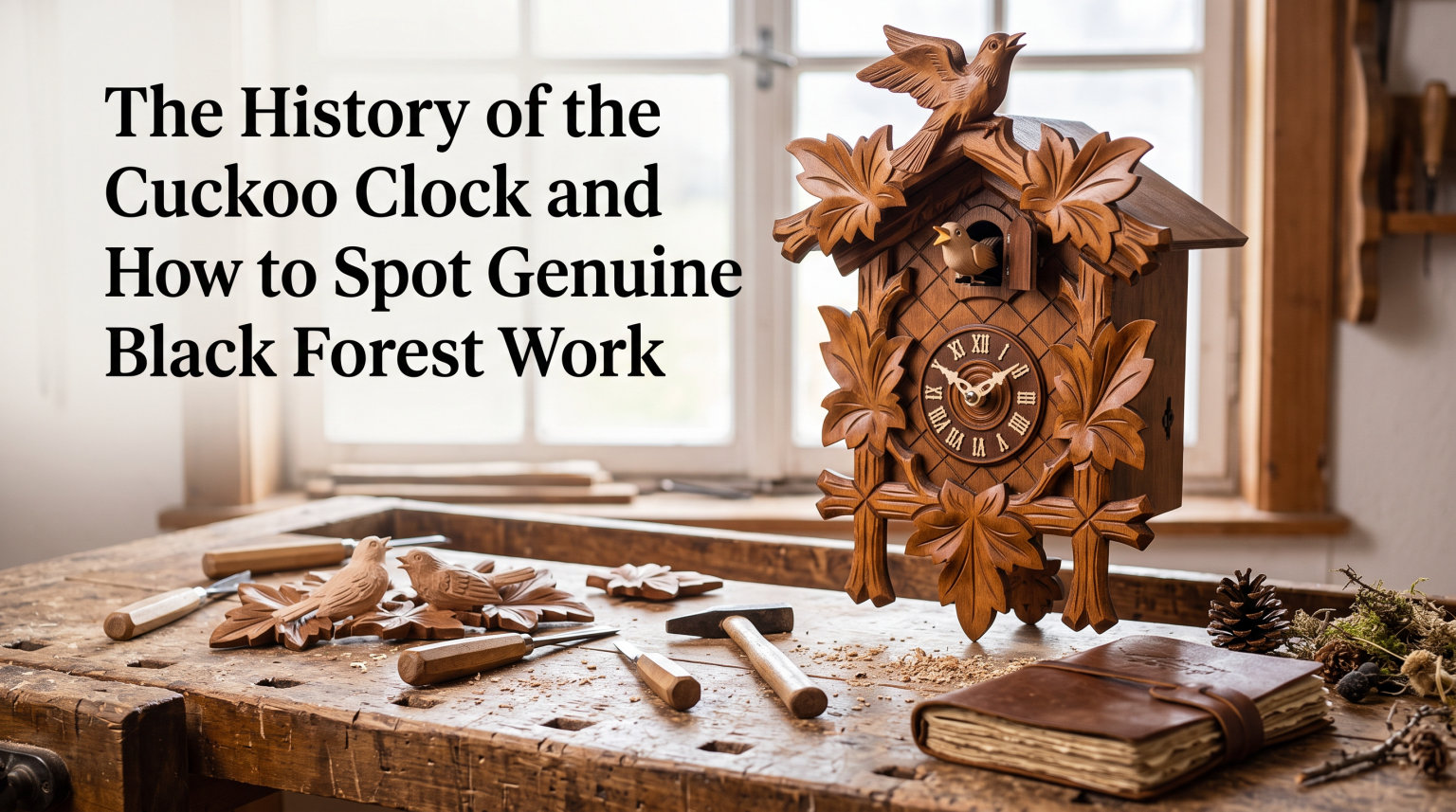
I have always been fascinated by the moment a cuckoo clock chimes in. That little wooden bird that pops out on the hour is more than a novelty. It is the result of nearly 400 years of German craftsmanship rooted in the misty highlands of the Black Forest.
This guide walks you through the full story of the cuckoo clock, from its 17th century origins to the certified makers still operating today. You will also get a practical checklist for telling a genuine Black Forest cuckoo clock from a clever imitation, plus advice on dating vintage pieces by era and keeping them in good working order for decades.
The cuckoo clock history Black Forest tradition is one of the most fascinating stories in European decorative arts. Few objects combine folk art, mechanical engineering, and family legacy in such a way. By the end of this article, you will understand exactly what to look for when you buy one.
Table of Contents
How the Black Forest Cuckoo Clock Story Began (1629 to 1650)
The story of clock making in the Black Forest begins around 1629, in a small triangle of villages in what is today the state of Baden-Württemberg. Long winters, rocky soil, and sparse farming harvests forced resourceful families to find a second income. They found it in wood, iron, and time.
By the early 1600s, the region already had skilled metalworkers making simple iron plate clocks. These were small wall clocks with iron movements, wooden gears, and a single bell. They were affordable, robust, and easy to repair. They were also perfect for peddling because they survived long trips on foot.
The Central Black Forest Region and Its Clock-Making Roots
The central Black Forest is the cradle of every authentic cuckoo clock you can buy. The triangle of Schonach, Triberg, and Furtwangen still produces nearly all certified pieces today. Villages like Schönwald, Villingen, and Furtwangen sit high in the wooded hills where iron ore and soft linden wood were both easy to find.
This region was ideal for clock making because the ingredients were local and the climate supported patient indoor work during winter. Watch parts and wooden clock cases could be produced by families in their farmhouses during the cold months, then carried out by peddlers once the snow melted.
The farms sat on hillsides where flat land was scarce. Small hamlets like Schönwald, Schonach, and Villingen became clusters of clock workshops. In each farmhouse, the family had a role: the father cut gears, the mother painted dials, the children assembled movements. By the 1650s, an estimated 60 percent of all clocks sold in southern Germany came from this Black Forest triangle.
Why the First Clock Peddlers Set Out in 1629
The first known clock peddler, Johannes Bueß, set out from the Black Forest in 1629 carrying clocks strapped to his back. He walked south through Switzerland and west into France and the Netherlands. By the mid 1600s, hundreds of these peddlers, called Hausierer, brought Black Forest clocks to markets across Europe.
The peddler trade was essential because the farms were isolated. A farmer could not simply open a shop on a main road. He had to walk his product to market. The peddlers worked on commission for the workshops, collecting batches of clocks in the spring and walking them to distant towns.
The peddlers also brought back ideas. They saw musical clocks and tower clocks in city centers. They heard chimes in cathedrals. Those influences eventually fed back into the workshops of Schönwald and Schonach, where clockmakers started experimenting with sound.
By 1700, the peddler networks reached as far as Russia, Scandinavia, and the Ottoman Empire. The Black Forest clock had become one of Germany’s earliest export industries, long before any railway or motor engine made shipping easy.
Franz Anton Ketterer and the Birth of the Cuckoo Mechanism
The first Black Forest cuckoo clock is attributed to Franz Anton Ketterer, a clock maker from the village of Schönwald in the mid 1650s. His innovation was to add a small bellows mechanism that mimicked the call of the local cuckoo bird, replacing the silent bell chimes used in earlier clocks.
Who Invented the Cuckoo Clock?
Franz Anton Ketterer is widely credited as the inventor of the cuckoo clock mechanism. He lived and worked in Schönwald, a tiny village just a few kilometers from the modern borders of the Black Forest clock district. According to local records, he experimented with small wooden organ pipes and leather bellows to imitate the two-note cuckoo call heard in the forest at dusk.
Before Ketterer, most weight-driven clocks struck a single bell on the hour. His design added personality. The clock now spoke. Within a few decades, nearly every Black Forest workshop was building cuckoo clocks of some kind.
Some historians argue that Ketterer built on earlier organ clock designs from Augsburg and Strasbourg. Others credit a clockmaker named Michael Dilger with co-developing the bird door. What is agreed is that Schönwald became the symbolic birthplace of the cuckoo clock and remains so today.
How Ketterer’s Design Changed Clock-Making Forever
Ketterer’s design split the clock into two clear parts. The movement handled timekeeping, while the sound module handled the call. That separation is why a modern cuckoo clock still has removable bellows and a sound box that can be repaired without disturbing the gears.
The design also made the clock cheaper to build. A skilled carpenter could carve the case while a junior clockmaker assembled the movement. This division of labor helped the industry grow across dozens of small family workshops.
Within 50 years of Ketterer’s first prototype, the village of Schönwald had more than 50 clockmakers. The cuckoo call had become a Black Forest signature, and customers in distant cities began asking specifically for the singing clock from the highlands.
The Peddler Tradition and the Growth of the Industry
By 1800, an estimated 700 clock peddlers left the Black Forest each spring carrying around 1,900 clocks per person, totaling over a million clocks a year sold across Europe. This trade built the wealth of the region and turned clock making from a winter side job into the dominant industry of the central highlands.
The peddlers also shaped what a cuckoo clock looked like. Customers in cities wanted something distinctly Black Forest. Carvers added leaf details, hunting scenes, and the small chalet roofs that became the visual signature of the region.
By the mid 1800s, the railway ended the peddler era. Workshops in Schonach and Triberg responded by exporting through wholesalers and opening retail stores that catered to the new tourist trade, which is also when the chalet style started to dominate.
The German Clock Museum in Furtwangen, founded in 1858, became the cultural anchor of the industry. It still houses the largest collection of Black Forest clocks in the world and tells the peddler story to over 100,000 visitors each year.
Friedrich Dilger and the Industrial Leap
In the early 19th century, master clockmaker Friedrich Dilger introduced iron tooth wheels cut by machine, replacing the older wooden pinion gears. This small change made the movements far more accurate and far easier to produce. Dilger’s factory in Schonach set the template for the next generation of Black Forest makers.
Dilger also pioneered the use of brass movements in the 1840s. Brass does not rust, wears more slowly, and can be machined to tight tolerances. Within a generation, iron movements had disappeared from the region, and brass had become the standard.
How the Cuckoo Mechanism Actually Works
A cuckoo clock produces its call using two miniature bellows that push air through two wooden organ pipes of different lengths. Each bellows makes one of the two cuckoo notes, and they fire in sequence to imitate the bird’s natural two-note song.
Bellows, Pipes, and the Cuckoo Call
The bellows are small leather-and-wood boxes mounted inside the case. When the clock’s movement reaches the hour, a cam lifts the bellows lever, air rushes through the pipe, and you hear the cuckoo. A second cam then opens the bird door, lets the carved wooden bird lean out, and triggers the bellows to match the hour count.
On a quality clock, the two bellows produce slightly different tones. The low note sounds like a hoot, the higher note like a chirp. Together they create the characteristic cuckoo-cuckoo rhythm you know.
Most modern clocks also chirp on the half hour with a single note. The two-note full call happens only on the hour. The number of calls equals the hour, so a clock at 3 pm will produce three pairs of cuckoo notes before the bird retreats.
Regula Movements: The Backbone of Black Forest Clocks
Nearly every modern Black Forest cuckoo clock runs on a movement made by the Regula company, founded in 1936 in Villingen. Regula now supplies movements to almost all certified manufacturers, including Hekas, Anton Schneider, Rombach and Haas, and August Schwer.
Regula movements come in two main versions. A one-day movement needs winding every 24 hours. An eight-day movement runs for a full week before needing new weights on its chains. Eight-day clocks are heavier, more expensive, and prized by collectors.
The pendulum length is calibrated to the movement. A one-day pendulum swings once per second. An eight-day pendulum swings slower because the heavier weights give the escapement more energy. Always move a cuckoo clock with the pendulum removed and the weights taken off the chains to prevent damage.
Styles of Authentic Black Forest Cuckoo Clocks
Authentic Black Forest cuckoo clocks come in three main styles. Traditional shield-style clocks have a flat painted face. Bahnhäusle clocks show a small railway station house. Chalet clocks feature a full Alpine chalet with moving figures like dancers, woodcutters, and waterwheels.
Traditional Shield-Style Clocks
The traditional shield-style clock is the oldest design still in production. It has a flat wooden case shaped like a shield or rounded rectangle, a hand-painted face with Roman numerals, and carved leaf and bird details around the edges. This style dates back to Ketterer’s era and remains the most common among VdS-certified makers.
Shield clocks are popular with collectors because they keep the focus on the mechanism and the dialect of the carver. Many have no bird door at all, only the call. Others have a small wooden bird that emerges from a leaf carved over the number 12.
Bahnhäusle and Chalet Style Clocks
The Bahnhäusle style began around 1850 when peddlers sold small railway station clocks in town markets. The chalet style grew out of the Bahnhäusle in the early 1900s when tourists wanted something more romantic. Today, chalet clocks often include moving dancers, a mill wheel that turns on the hour, and even a tiny figure chopping wood.
All three styles are authentic. The choice comes down to taste. Collectors usually start with a shield clock because of its historical roots, then add a chalet for the animated charm.
The most elaborate chalet clocks include up to 12 moving figures, a rotating Maypole, a sawmill wheel, and a water feature. Some play 12 different melodies on the hour, accompanied by a moving procession. These are the kind of clocks that anchor an entire room.
The Black Forest Association and the VdS Certificate
The Black Forest Clock Association, known in German as the Verband der Deutschen Schwarzwälder Uhrenhersteller, was founded in 1999 to protect genuine Black Forest clocks from cheap imitations. Its seal, the VdS certificate, is the single most reliable sign that a clock is truly made in the Black Forest.
Why the Association Was Founded in 1999
By the late 1990s, mass-produced clocks from outside Germany were being sold under Black Forest labels. Buyers could not tell the difference. Workshops in Schonach and Triberg were losing sales. The Black Forest Association was founded in 1999 with the mission to certify clocks that meet strict rules of origin and craftsmanship.
Today the Association has roughly 12 to 15 member companies, plus a small number of suppliers. Only their clocks can carry the VdS seal.
The Association also runs the German Clock Route, a tourist trail that connects working workshops, museums, and showrooms across the central Black Forest. Visitors can watch carvers and movement makers at work, then shop in the connected factory store.
What the VdS Seal Actually Guarantees
The VdS seal guarantees four things. The case must be made in the Black Forest. The movement must come from a certified German maker. Final assembly must happen in the region. And quality control must follow Association rules.
If a clock carries the VdS seal, you can be confident it is not a Chinese replica with a German-sounding brand name. This is why collectors and serious buyers always look for the seal before anything else.
The seal itself is a small round badge with the VdS letters and a stylised cuckoo. Genuine seals are embossed or printed on thick card with metallic accent. Look for a tiny serial number printed on the back of the seal that can be verified with the Association.
How to Spot Genuine Black Forest Work: 7 Authentication Markers
To spot a genuine Black Forest cuckoo clock, look for the VdS quality seal, a Made in Germany stamp on the back of the case, the name of the manufacturer engraved nearby, hand-carved linden wood details, a heavy mechanical movement, brass gear chains, and a price that reflects real craftsmanship.
1. Look for the VdS Quality Seal
The VdS seal is a small round badge showing a cuckoo and the letters VdS. It is usually affixed to the dial or the inside of the case door. If the seal is missing, blurry, or printed on plain paper, the clock is not certified. This is the single strongest authentication marker you can check.
2. Check for the Made in Germany Stamp
Every genuine Black Forest clock carries a Made in Germany stamp on the back of the case. The stamp usually includes the maker’s name, the city, and sometimes a serial number. If the back of the clock is blank or only has a generic sticker, treat it as a warning sign.
3. Inspect the Hand-Carved Details
Authentic Black Forest clocks use carved linden wood, also called basswood. The leaves, birds, and figures should have crisp, asymmetric cuts. Machine-made replicas have soft edges and identical repeats. Run your finger along the carvings. Real hand carving has tiny variations.
Look for chisel marks inside the carved openings. Genuine hand carving leaves small ridges where the chisel exited the wood. Machine carving has smooth, sanded interiors and no ridges.
4. Listen to the Cuckoo Call Quality
A genuine cuckoo call has two clear tones and a slight echo inside the wooden case. Imitation quartz clocks often use electronic recordings that sound flat or tinny. Wind the clock and listen. A real bellows-driven call has natural breath in the sound.
5. Weigh the Clock and Examine the Movement
An authentic mechanical cuckoo clock is heavy. The brass movement, the chain weights, and the solid wood case all add up. A typical one-day clock weighs between 4 and 6 kilograms. If the clock feels light and runs on AA batteries, it is almost certainly not a traditional Black Forest piece.
6. Verify the Serial Number and Maker’s Mark
Most certified makers stamp a serial number somewhere inside the case. Combined with the maker’s logo, this number lets you date the clock to a specific decade and look up its records. Makers like Rombach and Haas, Hekas, and August Schwer all keep archives that respond to inquiries.
7. Confirm the Price Reflects Craftsmanship
Real Black Forest cuckoo clocks start at around 200 EUR for a small one-day shield clock. Quality eight-day chalet clocks run from 600 EUR into the thousands. If a seller offers a Black Forest cuckoo clock for under 100 EUR, it is either a fake, a heavily damaged antique, or a quartz imitation.
Dating Your Black Forest Cuckoo Clock by Era
You can date a Black Forest cuckoo clock by looking at the dial, the movement markings, and the case style. Pre-1850 clocks have iron movements and hand-painted dials. Late 1800s clocks show brass movements and printed numerals. Bahnhäusle clocks are mostly 1850 to 1950. Post-1950 chalet clocks have stamped metal movements and chain weights.
For very early pieces, look at the dial hands. Iron hands with a blue sheen suggest a clock made before 1850. Brass hands with a slim profile suggest post-1850. The pendulum bob shape also shifts by era. Earlier bobs are round wooden disks. Later ones are brass.
The musical box in a clock is also a dating clue. Early clocks played only the cuckoo. Clocks from 1880 onward may include a small music box playing one or two tunes. Post-1950 chalet clocks with 12 melodies are usually mid-century or later.
Most certified makers have an online archive where you can enter a serial number and get production year and original configuration. If you cannot find the name of the maker, the archives at the German Clock Museum in Furtwangen can sometimes help identify unmarked pieces.
Warning Signs of a Fake or Tourist-Trap Cuckoo Clock
The clearest warning signs of a fake are a missing VdS seal, no Made in Germany stamp, plastic parts instead of carved wood, a quartz-only movement without bellows, and a price that seems too low. Avoid buying from tourist markets where the seller cannot name the maker.
Online marketplaces are full of clocks labeled as German that ship from overseas warehouses. If the listing does not name a real manufacturer and does not show the VdS seal, assume it is an imitation. Buy directly from certified makers or from authorized dealers who can show paperwork.
Red flags include vague brand names that sound Germanic but cannot be traced, a clock shipped from outside Europe, and a seller who refuses to provide the maker’s name. Reputable sellers are proud of their Association membership and will display the VdS seal in their marketing materials.
Caring for a Genuine Black Forest Cuckoo Clock
To keep a Black Forest cuckoo clock in good condition, mount it on a solid wall away from direct sunlight and heat sources. Keep the room humidity steady between 40 and 60 percent to prevent the wood case from cracking. Wind the clock at the same time each day so the mechanism develops a consistent rhythm.
Clean the movement every 5 to 7 years with a soft brush and a drop of clock oil on the bearings. Avoid spraying any lubricant into the bellows, as this can damage the leather. If the cuckoo call changes pitch or skips a note, the bellows likely need a leather replacement, which any certified workshop can do in a few hours.
The New European Quality and Origin Seal
In 2026, the Black Forest Association began rolling out a new European Quality and Origin Seal that meets EU geographic indication standards. This seal goes beyond the VdS certification by adding a numbered QR code that buyers can scan to verify the exact workshop, the production date, and the materials used.
The new seal protects the Black Forest name at the European level and makes it easier to block fakes at customs. For buyers, it adds another layer of confidence. Look for the European seal on new purchases from certified makers in 2026 and beyond.
Investment Value of Black Forest Cuckoo Clocks
Genuine Black Forest cuckoo clocks hold their value well, and rare antique pieces can appreciate significantly. A working 19th century shield clock in original condition typically sells for between 800 and 5,000 euros at auction. Eight-day chalet clocks from the 1920s and 1930s in untouched condition can fetch 10,000 euros or more.
The biggest factors in value are the maker, the condition, and the originality. A clock with its original pendulum, weights, and hands is worth more than one with replacement parts. Documented provenance, such as a bill of sale or family record, can also raise the auction price.
The cuckoo clock history Black Forest tradition is now over 390 years old. Pieces from the early 1800s are genuine historical artifacts, and serious collectors are starting to pay museum-grade prices for them.
FAQs
How do I know if my cuckoo clock is authentic?
Check for the VdS quality seal, a Made in Germany stamp on the back of the case, the maker’s name engraved nearby, hand-carved linden wood, and a heavy mechanical movement. If any of these are missing, treat it as a warning sign.
Who invented the cuckoo clock?
Franz Anton Ketterer, a clockmaker from Schönwald in the Black Forest, is credited with inventing the cuckoo clock mechanism in the 1650s. He added bellows and pipes to mimic the two-note call of the local cuckoo bird.
What is the VdS certificate?
The VdS certificate is the quality seal of the Black Forest Clock Association. It guarantees that the case was made in the Black Forest, the movement comes from a certified German maker, final assembly happened in the region, and the clock passed quality control.
How to date a Black Forest cuckoo clock?
Date a Black Forest cuckoo clock by examining the dial, hands, movement, and case style. Iron hands and wooden pendulum bobs suggest pre-1850. Brass hands and printed numerals suggest late 1800s. Bahnhäusle cases are mostly 1850 to 1950. Post-1950 chalet clocks use stamped metal movements.
Are Black Forest cuckoo clocks worth anything?
Yes. Genuine VdS-certified clocks hold their value well because production numbers are limited and craftsmanship is high. Antique pieces from the 1800s in working condition can sell for several thousand euros at auction.
Who makes the best Black Forest cuckoo clocks?
Top VdS-certified makers include Rombach and Haas, August Schwer, Hekas, Anton Schneider, and Hönes. Each has decades of history and offers both traditional and chalet styles. The best maker depends on the style you want and your budget.
Bringing It All Together
The history of the cuckoo clock is a story of resourceful farmers, traveling peddlers, and one clever clockmaker named Franz Anton Ketterer who turned silence into song. Nearly 400 years later, the Black Forest still produces the only clocks that carry the VdS seal of authenticity.
Before you buy, check for the VdS seal, the Made in Germany stamp, and the maker’s mark. Inspect the carvings, lift the clock to feel its weight, and listen to the cuckoo call. A genuine Black Forest cuckoo clock is more than a timepiece. It is a piece of living German heritage that will outlast trends and outlive most of the furniture in your home.
Whether you choose a traditional shield clock, a chalet with dancing figures, or a rare antique from the 1800s, you are buying into a tradition that has been refined for nearly four centuries. Pass that knowledge along, and the cuckoo will keep singing for generations.