
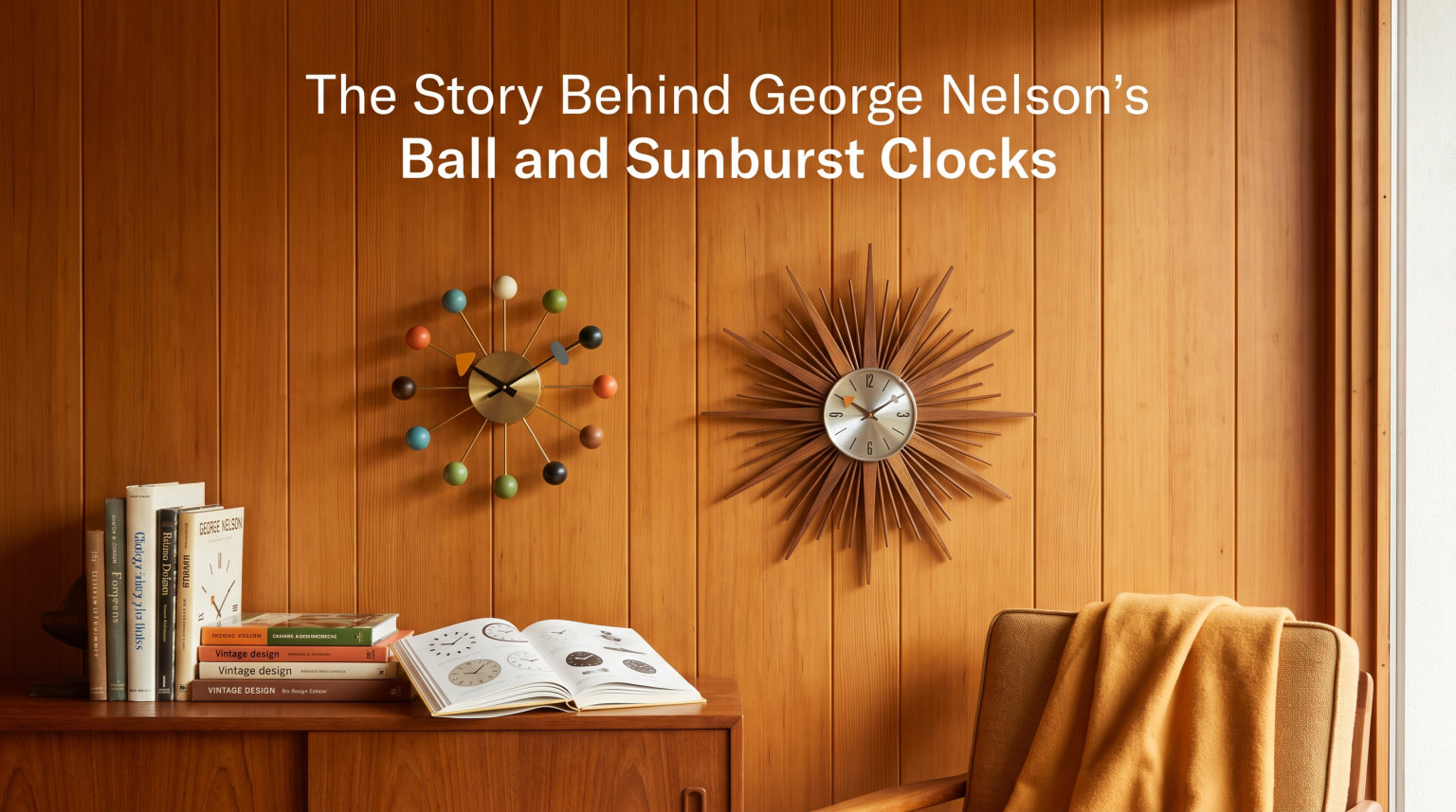
Few objects capture the spirit of mid-century modern design quite like the George Nelson Ball and Sunburst Clocks. I have spent years studying these sculptural timepieces, and what strikes me most is not just their visual appeal but the remarkable human story behind them. A single evening in 1947, four legendary designers, and a few too many drinks produced one of the most recognizable wall clocks ever made.
The George Nelson Ball and Sunburst Clocks reshaped how we think about a wall clock. Before 1947, clocks were functional objects with numbers, hands, and a glass face. After Nelson and his team finished their work, a clock could be a wooden sunburst, a constellation of brass balls, or a sculptural statement that happened to tell time.
In this article I want to walk you through the full story behind these designs. We will cover the legendary 1947 evening, the design philosophy that made them revolutionary, the manufacturing partnership with Howard Miller, how to authenticate vintage pieces, and why these clocks still define mid-century modern interiors in 2026. By the end, you will understand why a clock without numbers became one of the most collectible design objects of the twentieth century.
Table of Contents
The 1947 Evening That Changed Clock Design Forever
The George Nelson Ball and Sunburst Clocks trace their origin to a single evening in late 1947 at George Nelson’s design studio in New York City. Nelson had gathered three of the most influential creative minds of the twentieth century: Isamu Noguchi, the sculptor and landscape designer; Buckminster Fuller, the architect and inventor of the geodesic dome; and Irving Harper, the young designer who would become one of the most important figures at George Nelson Associates.
The story goes that the group was discussing how to design a new kind of wall clock. Drinks flowed. Ideas piled up. Drawings covered the walls. According to George Nelson’s own account, recorded years later in Stanley Abercrombie’s biography, the evening produced a remarkable sketch.
“There were three of us and we were all somewhat high on something or other. We were making drawings on the wall, and I don’t remember who made the sketch of the Ball Clock.”
This is the now-famous “drunken draft” moment. Nelson himself could not recall whether he, Noguchi, Fuller, or Harper had actually drawn the first Ball Clock. The sketch simply appeared, and when the group woke the next morning, the drawing was still on the wall. Nelson later admitted in interviews that no one in the room was entirely sure who deserved credit.
Modern design historians now lean toward Irving Harper as the most likely author of the Ball Clock. Harper, who joined George Nelson Associates in 1947, was the studio member most directly responsible for the intricate drawings and models that defined the Nelson clock collection. He also designed the iconic Marshmallow Sofa and contributed heavily to the Chrysler Pavilion at the 1964 World’s Fair.
Whatever the exact attribution, that 1947 evening became the launchpad for the most consequential wall clock series of the twentieth century. The Ball Clock went into production in 1948 and reached the market in 1949 under the model number 4755. It was an immediate sensation.
Why That Evening Mattered
The 1947 evening was not just about alcohol and accidental sketches. It represented a new way of thinking about design collaboration. Nelson ran his studio as a collective of brilliant contributors rather than a single-author workshop. That approach let ideas cross-pollinate between architecture, sculpture, industrial design, and fine art in ways no solo designer could match.
This collaborative model is why the George Nelson Ball and Sunburst Clocks feel so rich. They carry traces of Noguchi’s sculptural sensibility, Fuller’s geometric rigor, and Harper’s meticulous drafting. The result is design that no single hand could have produced alone.
Who Was George Nelson?
George Nelson was an American architect, writer, and industrial designer who became one of the most influential figures in twentieth-century design. Born in Hartford, Connecticut in 1908, Nelson studied architecture at Yale University and earned a degree in 1931. A traveling fellowship then took him to Europe, where he studied under leading modernist architects and met many of the figures who would shape post-war design.
What made Nelson unusual was his parallel career as a writer and editor. In the 1930s and 1940s he worked as an associate editor and later co-editor at Architectural Forum, the influential design magazine published by Time-Life. That role gave him a deep understanding of how design, business, and culture intersected. He was not just drawing objects. He was thinking about the systems that produced them.
In 1945, Herman Miller founder D. J. De Pree hired Nelson as the company’s director of design. Nelson agreed on one condition: he would not produce furniture himself but would commission designs from a roster of talented designers. That single decision reshaped American furniture. Under Nelson’s direction, Herman Miller introduced the Eames storage units, the Eames Lounge Chair, and the Noguchi table, among dozens of other iconic pieces.
George Nelson Associates
In 1946 Nelson founded George Nelson Associates, an independent design studio in New York City. The studio took on projects for clients beyond Herman Miller, including the Howard Miller Clock Company, which was founded by D. J. De Pree’s brother-in-law Howard Miller. This is the connection that gave Nelson’s studio the chance to design wall clocks for a serious manufacturer.
The studio became a training ground for some of the most talented designers of the era. Besides Irving Harper, alumni included John Pile, Ernest Farmer, and Don Ervin. Their collective output over thirty years included furniture, exhibits, graphics, packaging, and the famous wall clocks we are discussing here.
Nelson himself also designed standalone icons. His Bubble Lamps, introduced in 1952, were inspired by a Swedish hanging lamp and used a steel skeleton covered with a translucent plastic spray. The Marshmallow Sofa, which he is often credited with though Harper likely had a larger hand, used colorful circular cushions mounted on a steel frame. Together with the Ball and Sunburst Clocks, these pieces cemented Nelson’s reputation as a defining voice of mid-century modernism.
The Design Philosophy: Numbers Are Unnecessary
The radical idea behind the George Nelson Ball and Sunburst Clocks is that a clock does not need numbers. Nelson observed that almost nobody actually reads the numerals on a wall clock. We glance at the position of the hands and infer the time. Once you accept that insight, the entire visual vocabulary of a clock opens up.
This insight was not entirely original to Nelson. The Swiss designer Max Bill had been experimenting with abstract clock faces in the 1940s, and Bauhaus designers had explored similar ideas in the 1930s. What Nelson brought was scale, marketing reach, and an American sensibility that turned a European design idea into a household product.
Clocks as Decorative Sculpture
Nelson believed that every object in a home should be honest about what it really does. A wall clock spends 99 percent of its life as decoration, he argued, and only occasionally as a tool. So why not design it as sculpture first and as a timepiece second? This reversal of priorities produced the radical forms we now recognize instantly.
Instead of a printed dial and Arabic numerals, the Ball Clock uses twelve wooden balls arranged on radiating metal spokes. The Sunburst Clock uses solid wooden spokes that fan out from a center disk. The Asterisk Clock uses slender metal rods forming a starburst pattern. None of them have numbers because numbers are not needed.
Atomic age motifs permeated these designs. The Ball Clock in particular resembles the Bohr model of an atom, with a central nucleus and orbiting electrons. Released just two years after the atomic bombings of Hiroshima and Nagasaki, the design tapped into a cultural fascination with nuclear physics that defined the 1950s. Buckminster Fuller’s geodesic thinking and his tensegrity structures influenced the geometric logic of the entire collection.
How the Clocks Actually Worked
Functionally, the clocks were straightforward. Each used a small electric movement, originally a synchronous motor and later a quartz movement powered by a single AA battery. The hands rotated from a central point. Time was read by the angle of the hands relative to the positions of the twelve ball markers, spokes, or rods. Users adapted instantly because their brains were already trained to read hand positions rather than numerals.
This combination of radical aesthetics and conservative mechanics is a big reason the clocks succeeded. They looked like sculpture but behaved like a normal kitchen clock. Anyone could install one with a single nail and a battery.
George Nelson Ball and Sunburst Clocks: The Ball Clock as First Design
The George Nelson Ball and Sunburst Clocks series begins with the Ball Clock, designated Model 4755, which reached the market in 1949. It consists of twelve polished wooden balls mounted on brass spokes that radiate from a small central hub. The hour and minute hands sweep across the arrangement. There are no numerals, no printed face, and no glass cover.
The original Ball Clock measured approximately 13 inches in diameter. The wooden balls were typically birch or walnut, finished to a smooth satin sheen. The spokes were brass, often with a lacquered coating that resisted tarnish. The clock ran on an electric synchronous motor plugged into a standard wall outlet, which kept excellent time as long as the household current stayed accurate.
What made the Ball Clock revolutionary was not the materials, which were ordinary. It was the decision to abandon the clock face entirely. Every wall clock for the previous century had featured some kind of printed or painted dial. The Ball Clock replaced that dial with empty space. The balls themselves served as the markers, and the wall behind the clock became part of the design.
The Atomic Age Connection
The Ball Clock looked like a diagram of an atom, and that was not a coincidence. Nelson and his circle were obsessed with the imagery of mid-century physics. Bohr’s atomic model, with electrons orbiting a nucleus, was everywhere in popular magazines. The Ball Clock turned that scientific diagram into a piece of household art.
This connection to atomic age imagery helps explain why the Ball Clock felt so modern in 1949. It spoke the visual language of progress, science, and optimism that defined post-war America. Hanging one on your kitchen wall was a small way of declaring yourself part of the future.
Ball Clock Specifications Through the Years
Over the decades, the Ball Clock appeared in several variations. Early Howard Miller versions used walnut balls and brass spokes. Later runs substituted different woods and finishes. Diameter ranged from 12 to 13.5 inches depending on the year and the intended market. Movement technology evolved from electric synchronous motors in the 1950s to quartz battery movements by the 1980s.
Original 1949 models in good condition are now highly collectible. The combination of brass, wood, and age gives them a warmth that modern reproductions struggle to match. If you find a true vintage Ball Clock with its original Howard Miller label intact, you are looking at a piece of design history.
The Sunburst Clock: Radiating Wooden Spokes
The Sunburst Clock followed the Ball Clock within a year or two and quickly became the second most iconic design in the Nelson clock collection. Where the Ball Clock used discrete wooden balls on metal spokes, the Sunburst Clock used solid wooden wedges that radiated outward from a circular center. The result looks like a stylized sun or a stylized flower in full bloom.
The Sunburst Clock is typically larger than the Ball Clock, with a diameter around 18 to 19 inches. The wooden spokes are usually walnut or natural cherry, sometimes finished in deep black lacquer. Each spoke terminates in a rounded tip, giving the design a soft, organic quality that contrasts with the geometric precision of the Ball Clock.
Ball Clock vs Sunburst Clock: Key Differences
If you are choosing between the Ball and the Sunburst, the decision usually comes down to scale and tone. The Ball Clock is smaller, more technical, and more obviously tied to atomic age imagery. It looks at home in kitchens, offices, and smaller wall spaces. The Sunburst Clock is larger, warmer, and more sculptural. It works better as a focal point in a living room or above a sideboard.
Material wise, the Ball Clock combines wood and brass, giving it a slightly more industrial feel. The Sunburst Clock is almost entirely wood, which gives it a craft quality that suits mid-century modern interiors built around walnut and teak. Both clocks use the same abstract logic, but the Sunburst leans more decorative while the Ball leans more graphic.
From an interior design standpoint, the Sunburst Clock has become the more photogenic of the two. Its larger size and warmer materials make it a favorite for shelter magazines and Instagram interiors. The Ball Clock, by contrast, remains the darling of design historians and serious collectors because of its origin story and its atomic age symbolism.
The Howard Miller Partnership and 130+ Clock Collection
The Howard Miller Clock Company, based in Zeeland, Michigan, manufactured the George Nelson Ball and Sunburst Clocks and dozens of related designs. Howard Miller was the brother-in-law of Herman Miller founder D. J. De Pree, and the two companies shared family ties and design sensibilities. This connection gave Nelson’s studio a manufacturing partner capable of producing high quality clocks at scale.
Between 1948 and roughly 1980, George Nelson Associates designed more than 130 different wall clock models for Howard Miller. The collection expanded far beyond the Ball and Sunburst. The Star Clock used a five pointed starburst of polished metal. The Asterisk Clock featured slender radiating rods that resembled an oversized typewriter symbol. The Spindle Clock used vertical wooden spindles. The Turbine Clock looked like a jet engine fan. The Eye Clock used two elliptical forms that resembled a cartoon eye.
The Flock of Butterflies Clock
One of the most whimsical designs in the collection was the Flock of Butterflies Clock. It used multiple triangular wedges arranged around a center, creating the impression of butterflies in flight. The design is playful, sculptural, and unmistakably mid-century. Like the Ball and Sunburst, it has been reissued by Vitra and remains a collector favorite.
The sheer breadth of the collection shows how fertile the studio was during its peak years. Nelson and his team produced clocks that ranged from austere graphic statements to exuberant sculptural celebrations. They explored almost every possible interpretation of the abstract clock idea, and in the process they effectively created the modern wall clock category as we know it today.
Many of these clocks are now available as authorized reissues. The George Nelson Ball and Sunburst Clocks remain the bestsellers, but the Asterisk, Sunflower, and Eye Clocks have developed devoted followings of their own. Each one extends the original philosophy that a clock should be honest about being decoration first.
How to Authenticate Vintage George Nelson Clocks
Authenticating a vintage George Nelson clock requires checking four things: the label, the materials, the movement, and the construction details. The market is flooded with reproductions, replicas, and honest modern reissues, so learning to tell them apart is essential if you are shopping for a true vintage piece.
Check the Howard Miller Label
Authentic vintage Nelson clocks from the Howard Miller era should carry a foil label, paper sticker, or metal plate somewhere on the back. The label usually reads “Howard Miller Clock Company” along with the model number and sometimes the country of origin. A genuine label from the 1950s through the 1970s has a distinctive aged patina that is very hard to fake convincingly.
The label location varies by model. Ball Clocks typically had the label on the back of the central hub. Sunburst Clocks usually had it on the back of the center disk. Asterisk and Star Clocks placed it on a small flat area near the movement housing. If a clock has no label at all, or has a suspiciously pristine label, proceed with caution.
Inspect the Materials
Original Ball Clocks used real wooden balls, typically birch, walnut, or ash. Reproductions from budget brands often substitute plastic balls finished to look like wood. The difference is obvious if you tap the ball gently with a fingernail. Wood produces a soft, dull sound. Plastic produces a sharp, hollow click.
Authentic Sunburst Clocks use solid wood spokes, not veneered composite. Look at the edges of the spokes where the finish has worn. You should see continuous wood grain running through the spoke, not a thin veneer over a particleboard core. Brass spokes on Ball Clocks should have a warm, slightly uneven patina, not the bright uniform finish of new brass.
Examine the Movement
Vintage Nelson clocks from the 1950s and 1960s originally used electric synchronous motors that plugged into a wall outlet. By the 1970s, Howard Miller began transitioning to battery powered quartz movements. If you find a clock advertised as a 1950s original with a modern quartz movement, ask whether the movement has been replaced. Replacement movements are common and do not necessarily mean the clock is a fake, but the seller should disclose the swap.
Reddit users on the Mid_Century subreddit frequently share photos of their vintage Nelson finds and debate the era based on the movement, the label style, and the sticker typography. If you are unsure, post clear photos of the back, the movement, and the label to a mid-century modern community before buying.
Beware the George Nelson Signature
One important trust signal: authentic vintage Nelson clocks never had George Nelson’s signature printed on the front of the dial. If you see a clock with “George Nelson” written across the face, it is almost certainly a reproduction. Nelson’s name appeared only on labels, marketing materials, and the original packaging, not on the clock itself.
Vitra reissues produced since 1999 are considered authentic authorized reproductions. They carry a small Vitra label or stamp and are made to the original specifications. These are excellent clocks in their own right and are not fakes, but they should be priced and identified as modern reissues, not as vintage originals.
Where to Buy Authentic Nelson Clocks
For genuine vintage pieces, your best sources are established mid-century modern dealers, reputable auction houses, and the curated vintage sections of sites like 1stDibs. Expect to pay a premium for documented provenance. For modern authorized reissues, Vitra and authorized Vitra retailers like Design Within Reach are the safe choice. Avoid generic online marketplaces unless the seller can demonstrate provenance.
The Vitra Reissues and Modern Legacy
The Vitra Design Museum acquired the rights to manufacture the George Nelson Ball and Sunburst Clocks along with the rest of the Nelson clock collection. Production of authorized reissues began in 1999, after Vitra spent years cataloging the original drawings, materials specifications, and production methods in the Nelson archive.
The Vitra archive contains more than 7,400 manuscripts, drawings, and photographs related to George Nelson Associates. This depth of documentation allowed Vitra to reissue the clocks with remarkable fidelity to the originals. The wooden balls are still turned from real hardwood. The brass spokes are still polished and lacquered. The proportions are unchanged from the 1949 specifications.
Modern Limited Editions
Vitra has periodically released limited edition colorways that update the original designs without changing their form. Recent years have brought the Ball Clock in muted pastels and the Sunburst Clock in unexpected colors like coral and sage. These limited runs sell out quickly and often appreciate in value among collectors.
For 2026, Vitra continues to produce the full Nelson clock collection, including the Ball, Sunburst, Asterisk, Star, Spindle, Eye, and Flock of Butterflies models. Prices reflect the craftsmanship and the licensed status of the designs. A new Ball Clock from Vitra typically retails in the mid-hundreds, while a documented 1949 original can command several thousand dollars on the vintage market.
Why These Clocks Still Define Mid-Century Modern Style
The George Nelson Ball and Sunburst Clocks remain the most recognizable wall clocks in mid-century modern interiors because they distilled a complex design philosophy into a single, reproducible form. They look like nothing else, they function reliably, and they photograph beautifully. That combination has kept them in continuous production for over seventy-five years.
The Eames House in Pacific Palisades, California famously featured a George Nelson clock in its living space. The connection between Nelson, Charles and Ray Eames, and the broader Herman Miller design family means these clocks belong to a tight knit circle of mid-century modern icons. Hanging one in your home places you inside that lineage.
From an investment standpoint, well documented vintage Ball and Sunburst Clocks have shown steady appreciation over the past two decades. The combination of name recognition, documented provenance through Howard Miller, and active reissues by Vitra keeps demand strong. They are one of the few mid-century objects that work equally well as everyday household objects and as serious design collectibles.
Frequently Asked Questions
What is the history of the starburst clock?
The Sunburst Clock, often called the starburst clock, was designed at George Nelson Associates around 1948 and released shortly after the original Ball Clock. It used solid wooden spokes radiating from a center disk, with no numbers on the dial, and was manufactured by the Howard Miller Clock Company. The design tapped into atomic age motifs and became one of the most recognizable mid-century modern wall clocks ever made.
Who designed the ball clock?
The Ball Clock was created at George Nelson Associates in late 1947 during an evening that included Nelson, Irving Harper, Isamu Noguchi, and Buckminster Fuller. Nelson himself said he did not remember who actually drew the original sketch. Modern design historians generally credit Irving Harper as the most likely author, since he produced most of the studio’s detailed clock drawings.
What is the asterisk clock George Nelson?
The Asterisk Clock is one of the more than 130 wall clocks designed by George Nelson Associates for the Howard Miller Clock Company. It uses slender metal rods radiating from a central point to resemble an oversized typewriter asterisk symbol. Like the Ball and Sunburst Clocks, it has no numbers and is considered an authorized Vitra reissue today.
Why are grandfather clocks no longer popular?
Grandfather clocks declined in popularity as homes grew smaller, design preferences shifted toward minimal and sculptural objects, and quartz technology made accurate timekeeping cheap and silent. George Nelson’s Ball and Sunburst Clocks embodied the new preference for wall clocks that acted as decorative art rather than mechanical heirlooms, helping accelerate the shift away from traditional floor clocks.
The Enduring Legacy of George Nelson Ball and Sunburst Clocks
The George Nelson Ball and Sunburst Clocks began with a slightly drunken evening in 1947 and grew into one of the most influential design stories of the twentieth century. They rejected numbers, embraced sculpture, and treated wall clocks as objects worthy of serious design attention. More than 130 related designs followed, all rooted in the same belief that a clock should be honest about being decoration first.
If you take one thing from this article, let it be that great design often emerges from collaboration rather than solitary genius. The Ball Clock exists because four brilliant people shared an office and an evening and trusted each other enough to leave the sketch on the wall. That spirit of collective creativity is what makes these clocks feel alive even now, more than seventy-five years later.
Whether you are hunting for a documented 1949 original, shopping for a Vitra reissue, or simply admiring the form from across a room, the George Nelson Ball and Sunburst Clocks reward attention. They are proof that a small idea, that numbers are unnecessary, can reshape an entire product category and stay relevant in 2026. That is the mark of true design permanence.