
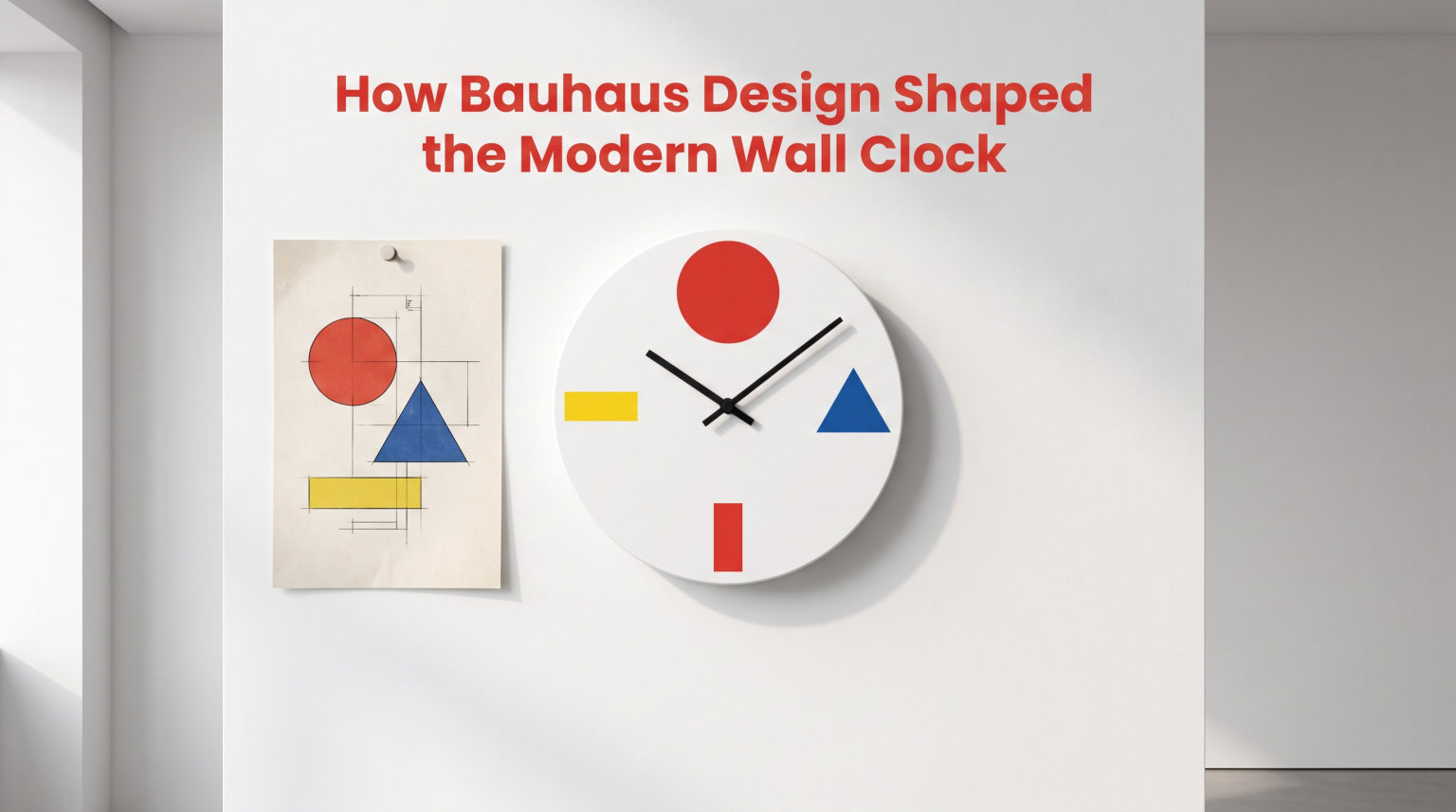
Next time you glance at a clean, minimalist wall clock with bold numbers and a simple face, you are looking at the Bauhaus design modern wall clock legacy in action. The wall clock hanging in your kitchen or office owes its quiet elegance to a radical design movement born in Germany over a century ago.
The Bauhaus school operated for just fourteen years, between 1919 and 1933, yet its philosophy reshaped how we think about everyday objects. Designers at the school believed that functional items could also be beautiful, and they set out to prove it through furniture, architecture, lighting, and yes, clocks.
In this article, we trace exactly how Bauhaus design shaped the modern wall clock. We cover the movement’s origins, its core principles, the specific designers who applied those principles to timekeeping, and why Bauhaus-inspired clocks remain some of the most popular designs available in 2026.
Table of Contents
What Was the Bauhaus Movement?
The Bauhaus was a German school of art, design, and architecture founded by architect Walter Gropius in 1919 in the city of Weimar. It was born out of the ashes of World War I, at a time when Germany was rebuilding and designers were searching for a new visual language that rejected the heavy ornamentation of the past.
Gropius had a simple but radical idea: bring together fine art and practical craft under one roof. Painters, sculptors, metalworkers, weavers, and architects would all learn from each other. The goal was to create objects that were both useful and beautiful, objects that ordinary people could afford and appreciate.
The school moved twice during its short life. It relocated from Weimar to Dessau in 1925, where Gropius designed the now-famous Bauhaus building that became a symbol of modernist architecture. In 1932, political pressure forced another move to Berlin. The school closed permanently in 1933 when the Nazi regime shut it down.
Fourteen years might seem brief. But the Bauhaus packed more invention into that window than most institutions manage in a century. Its faculty included some of the most influential artists and designers of the twentieth century, including Wassily Kandinsky, Paul Klee, László Moholy-Nagy, and Marianne Brandt.
The movement was deeply influenced by earlier ideas from the De Stijl movement in the Netherlands and the Arts and Crafts movement in Britain. But Bauhaus pushed further. It embraced industrial mass production rather than resisting it, arguing that machines could help create well-designed objects accessible to everyone.
This embrace of industrial manufacturing is what connected Bauhaus thinking so naturally to clock design. Clocks were already being mass-produced by companies like Junghans and Siemens in Germany. Bauhaus designers saw an opportunity to improve these everyday timekeeping devices through better design.
How Bauhaus Design Shaped the Modern Wall Clock
Bauhaus design shaped the modern wall clock by applying five core principles to timekeeping: form follows function, geometric simplicity, strategic use of primary colors, industrial materials, and absolute legibility. These principles stripped away decorative excess and left only what a clock actually needs to tell time clearly.
Form Follows Function
The most famous Bauhaus principle is “form follows function,” meaning the shape of an object should be determined by what it does. A clock’s job is to tell time quickly and accurately. Therefore, every element on a Bauhaus clock exists to serve that purpose.
Ornamental scrollwork, decorative hands shaped like arrows or leaves, and unnecessary bezels were eliminated. What remained was a pure expression of timekeeping. The clock face, the numerals, the hands, and the movement were all that mattered.
This philosophy directly produced the minimalist wall clocks we see everywhere today. When you look at a clock with a plain white face, thin black hands, and simple numerals, you are looking at form following function in practice.
Geometric Simplicity
Bauhaus designers loved geometry. Circles, squares, and triangles formed the visual vocabulary of the movement. The circle was especially significant because it naturally represents the passage of time, from the rotation of clock hands to the cycle of hours.
Designers used these simple shapes to create visual harmony without decoration. A round clock face on a square wall creates a pleasing geometric contrast. Triangular hour markers or circular dots at the twelve, three, six, and nine positions add interest without clutter.
This geometric approach also made clocks easier to manufacture. Simple shapes are cheaper to stamp, print, and assemble than complex decorative elements. The aesthetic and the economic goals aligned perfectly.
Primary Colors and Typography
Bauhaus designers worked with a distinctive palette of primary colors: red, blue, and yellow, often set against black, white, and gray. On clocks, this typically translated to a white or cream background with black numerals and hands for maximum contrast.
When color appeared, it was used sparingly and intentionally. A single red accent on the twelve position or a yellow second hand could add visual interest without compromising legibility. The restraint was the point.
Typography was equally considered. Bauhaus designers favored sans-serif typefaces with clean, uniform strokes. Numerals on Bauhaus-inspired clock faces tend to be bold, rounded, and easy to read from a distance. This typographic clarity became a hallmark of modern clock design.
Industrial Materials
The Bauhaus embraced materials that reflected the industrial age. Molded plastic, stamped metal, chrome-plated steel, and tempered glass replaced traditional wood and brass. These materials were cheaper, more durable, and better suited to mass production.
For wall clocks, this meant cases made from pressed steel or early plastics like Bakelite. Clock faces were printed on enameled metal for durability. Hands were stamped from thin steel and often powder-coated black. Every material choice served both function and cost.
This material honesty was itself a design statement. Bauhaus designers did not try to make plastic look like wood or metal look like stone. They celebrated the authentic qualities of each material.
Accessibility for Everyone
Perhaps the most radical Bauhaus idea was that good design should be available to everyone, not just the wealthy. By embracing mass production and industrial materials, designers could create beautiful, functional objects at prices ordinary people could afford.
This philosophy transformed the wall clock from a luxury item into an everyday essential. A factory worker could own a clock with the same design integrity as one hanging in a wealthy family’s parlor. Design democratization was central to the Bauhaus mission.
How These Principles Transformed Clock Design
Before the Bauhaus, wall clocks were often elaborate status symbols. Grandfather clocks with carved wooden cases, mantel clocks with ornate brass details, and decorative wall clocks with floral motifs dominated the market. The Bauhaus approach changed everything by treating the clock as a functional tool first and a decorative object second.
Legibility Above All Else
The single most important job of a clock is to tell time accurately and quickly. Bauhaus designers made legibility their top priority. This meant large, high-contrast numerals, uncluttered faces, and hands long enough to be read from across a room.
Every design decision was filtered through this lens. Should the clock include a date window? Only if it does not interfere with reading the time. Should the numerals be decorative? No, they should be clear. Should there be a brand logo on the face? Minimally, if at all.
This obsession with legibility produced the clean clock faces we take for granted today. The white face with black numerals and hands became the standard precisely because Bauhaus thinking proved it works best.
The Dial Revolution
Bauhaus designers rethought the clock dial from scratch. Traditional clocks often used Roman numerals, which can be difficult to read quickly. Bauhaus clocks favored Arabic numerals or simple index markers that could be understood at a glance.
Some designs went further and eliminated numerals entirely, using only geometric markers. A dot at the twelve position, paired with simple lines for the other hours, created a face that was even cleaner and more abstract. This approach influenced decades of clock and watch design that followed.
The spacing and sizing of hour markers were also carefully calculated. Bauhaus designers understood that visual balance on a circular face required precise proportional relationships between elements. This mathematical approach to design gave their clocks a sense of effortless rightness.
Manufacturing for the Masses
Bauhaus design was inseparable from manufacturing. Designers worked closely with factories so their creations could be produced efficiently. This meant designing for stamping, molding, and assembly rather than handcrafting.
Wall clocks benefited enormously from this approach. Stamped metal cases could be produced by the thousands at low cost. Printed paper or enameled metal faces could be standardized. Quartz movements, which emerged later, were a natural extension of the Bauhaus manufacturing philosophy.
The result was that well-designed clocks became affordable. By the mid-twentieth century, a family could purchase a beautiful, functional wall clock for a reasonable price. The Bauhaus vision of design democracy had become reality.
Minimal Ornamentation as a Statement
Perhaps the most visible change Bauhaus brought to clock design was the elimination of unnecessary ornamentation. This was not merely an aesthetic preference. It was a philosophical position that decoration without purpose was wasteful and dishonest.
A clock did not need carved wooden scrolls to tell time. It did not need brass filigree to function. By removing these elements, designers forced viewers to appreciate the essential beauty of the clock’s form, its proportions, its materials, and its function.
This minimalist approach resonated deeply with twentieth-century sensibilities. As modernism spread through architecture and interior design, the pared-down wall clock became the perfect complement to clean, uncluttered spaces.
The Designers Who Defined Bauhaus Clocks
Several key figures brought Bauhaus principles to clock design. Their work established the visual language that defines minimalist timepieces to this day. Each designer contributed something unique while sharing the common Bauhaus commitment to function, simplicity, and accessibility.
Marianne Brandt
Marianne Brandt was the only woman in the Bauhaus metalwork workshop and eventually became its director. She is best known for her metal tableware and lighting designs, but her approach to industrial metalwork deeply influenced how Bauhaus principles applied to precision instruments like clocks.
Brandt’s work demonstrated that functional metal objects could possess extraordinary beauty through pure form. Her ashtrays, tea sets, and lamps used spun and pressed metal in ways that celebrated industrial processes. This same material sensibility informed the metal cases, hands, and dials of Bauhaus-era clocks.
Her insistence on geometric purity and material honesty set a standard that other designers followed. When you see a clock with a perfectly round pressed-metal case and a clean face, you are seeing Brandt’s influence.
Max Bill
Swiss designer Max Bill was not formally a Bauhaus member, but he studied at the Bauhaus in Dessau and carried its principles throughout his career. He is perhaps the single most important figure in bringing Bauhaus design philosophy to clock making.
In the 1950s, Bill designed a series of wall clocks and watches for the German manufacturer Junghans. These timepieces became icons of twentieth-century design. His wall clock featured a pure white face, ultra-thin black hands, and minimal line markers instead of numerals.
The Junghans Max Bill wall clock remains in production today and is widely regarded as one of the finest examples of Bauhaus-inspired clock design ever created. Reddit communities focused on clocks and watches consistently recommend it as the quintessential modernist timepiece.
Bill’s designs proved that the Bauhaus philosophy could produce commercially successful products decades after the school closed. His work demonstrated that good design is timeless, remaining relevant long after its creation.
The Collective Workshop Spirit
It is worth noting that Bauhaus design was rarely the product of a single genius working alone. The school’s workshop model meant that designs emerged from collaboration between designers, craftsmen, and technicians. Clock designs benefited from this collective approach.
Metalworkers, graphic designers, and mechanical engineers all contributed to the final product. This cross-disciplinary collaboration produced clocks that were not only beautiful but also mechanically sound and practical to manufacture. The workshop spirit lives on in modern design studios that bring together diverse talents.
Iconic Bauhaus Wall Clocks That Changed Everything
Several specific clock designs became touchstones of the Bauhaus aesthetic. These timepieces demonstrated the movement’s principles in tangible form and influenced countless designs that followed. They remain collectible and inspirational today.
The Junghans Max Bill wall clock, designed in the 1950s, is the most famous example. Its minimalist white face with thin markers and sweeping hands distills clock design to its purest form. Junghans continues to manufacture this design, and it appears in design museums and modern homes alike.
The Braun wall clock line, developed in the 1960s and 1970s by designers Dieter Rams and Dietrich Lubs, extended Bauhaus thinking into the electronic age. Braun clocks featured the same commitment to legibility and simplicity but incorporated modern materials and quartz movements. Rams famously said that good design is as little design as possible, a direct echo of Bauhaus philosophy.
Earlier prototypes developed during the Bauhaus period itself, including designs from the metalwork workshop, explored concepts like asymmetrical dial layouts and unconventional marker placements. While fewer of these reached mass production, they established the experimental spirit that defined Bauhaus clock design.
The Modern Legacy of Bauhaus Clock Design
The Bauhaus influence on wall clock design did not end when the school closed in 1933. In fact, its impact only grew as modernism spread globally. Today, nearly every minimalist wall clock on the market owes something to Bauhaus principles.
Major manufacturers like Junghans, Braun, and Seiko continue to produce clocks that are directly descended from Bauhaus designs. Independent designers and smaller studios around the world draw on the same vocabulary of clean lines, geometric forms, and functional clarity.
The Scandinavian design movement, which shares many values with Bauhaus, has further popularized minimalist clocks. Brands like IKEA, which is indeed influenced by Bauhaus thinking, have made simple, functional wall clocks accessible to millions of homes worldwide. The democratization of design that Gropius envisioned has become a global reality.
Digital clock design also reflects Bauhaus values. The clean typography, high contrast, and uncluttered interfaces of digital timekeeping apps and smart clocks trace their lineage back to the same emphasis on legibility and function that defined the Bauhaus approach to analog dials.
In 2026, as smart home technology transforms how we interact with time, the Bauhaus reminder that form should follow function feels more relevant than ever. A clock that tells time clearly and looks beautiful doing it is not a relic of the past. It is a design ideal that continues to evolve.
Frequently Asked Questions
How has Bauhaus influenced modern design?
Bauhaus influenced modern design by establishing the principle that functional objects should be beautiful, affordable, and mass-produced. Its emphasis on clean lines, geometric shapes, and minimal ornamentation shaped architecture, furniture, graphic design, and product design throughout the twentieth century and continues to guide designers today.
What are two main features of Bauhaus design?
The two main features of Bauhaus design are functionalism, meaning every element serves a practical purpose, and geometric simplicity, which uses basic shapes like circles, squares, and triangles to create visual harmony without unnecessary decoration.
What shapes are used in Bauhaus design?
Bauhaus design primarily uses three geometric shapes: circles, squares, and triangles. These basic forms were considered the building blocks of all visual design. On clocks and watches, the circle dominates as the natural shape for a timekeeping dial, while triangles and squares appear in markers and case designs.
What is Bauhaus and how is their style used in products today?
Bauhaus was a German design school (1919-1933) that merged art and industrial craft to create functional, minimalist products. Today its style appears in wall clocks, watches, furniture, lighting, and electronics through clean lines, simple geometry, primary color accents, and a focus on legibility and usability over decoration.
What influenced Bauhaus design?
Bauhaus design was influenced by the Arts and Crafts movement, which valued handcraftsmanship, the De Stijl movement from the Netherlands with its geometric abstraction, and constructivism from Russia. It was also shaped by the industrial revolution and the desire to make well-designed products available to ordinary people through mass production.
Why were the Bauhaus principles considered as groundbreaking in design history?
Bauhaus principles were groundbreaking because they rejected centuries of decorative ornamentation and instead demanded that every design decision serve a functional purpose. This radical approach combined art with industrial production, making good design accessible to everyone rather than reserving it for the wealthy elite.
Is IKEA influenced by Bauhaus?
Yes, IKEA is significantly influenced by Bauhaus design philosophy. The Swedish company shares the Bauhaus commitment to affordable, functional, mass-produced furniture and home goods with clean lines and minimal decoration. IKEA’s democratic design approach directly echoes the Bauhaus goal of making good design accessible to everyone.
Conclusion
The Bauhaus design modern wall clock connection is not just historical trivia. It is the reason your wall clock looks the way it does. Every clean face, every bold numeral, and every uncluttered dial traces its lineage back to a school in Germany that believed beautiful design should serve everyone.
From Marianne Brandt’s metalwork to Max Bill’s iconic Junghans clock, Bauhaus designers proved that stripping away the unnecessary reveals something better. Their philosophy of form following function, geometric simplicity, and accessible design continues to shape how we tell time in 2026 and will for generations to come.
If this exploration of design history has you thinking about your own timepieces, take a closer look at the clocks in your home. Chances are, you are already living with the Bauhaus legacy.