
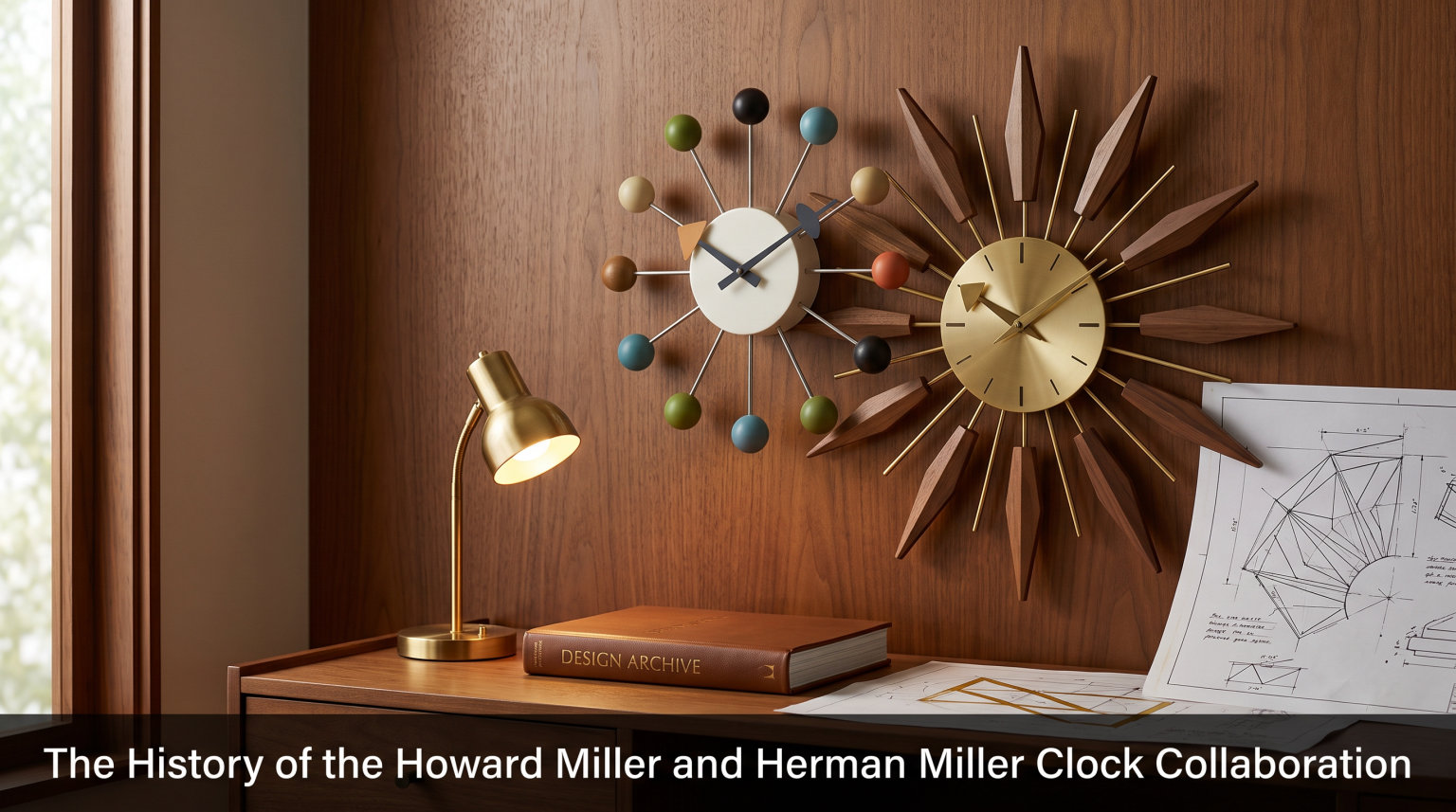
Few stories in American manufacturing are as intertwined as the history of the Howard Miller and Herman Miller clock collaboration. One name became globally famous for office furniture, while the other grew into the world’s largest grandfather clock manufacturer. Yet they share the same roots, the same family, and the same Michigan origins.
If you’ve ever wondered whether Howard Miller and Herman Miller are the same company, you’re not alone. Our team has seen this question appear constantly in clock collector forums and furniture enthusiast communities. The answer reveals a century-long story of family ambition, design innovation, and entrepreneurial spirit.
In this guide, we trace the Howard Miller Herman Miller clock collaboration history from its 1926 founding to 2026. We cover the family connections, the George Nelson design era, strategic acquisitions, and the recent developments that nearly ended the company before a dramatic rescue.
Understanding this history matters whether you’re a collector, an interior designer, or simply someone who inherited a Howard Miller clock. The story explains why these timepieces carry such significance and why the shared Miller name continues to generate curiosity.
Table of Contents
What Is the Howard Miller Herman Miller Clock Collaboration History?
The Howard Miller Herman Miller clock collaboration history began in 1926, when Howard C. Miller founded a clock division within the Herman Miller Furniture Company in Zeeland, Michigan. Howard was the son of Herman Miller himself, and his father had previously partnered with D.J. De Pree to build a furniture business. The clock division operated under Herman Miller’s corporate umbrella for over a decade before spinning off as an independent company in 1937.
This origin story explains the shared name and the frequent confusion between the two brands. While Herman Miller focused on groundbreaking office furniture designs, Howard Miller pursued clockmaking excellence. Both companies remained based in Zeeland, Michigan, and maintained close ties even after their corporate separation.
The collaboration left a lasting mark on American design. Many mid-century clocks carry the Howard Miller name while sharing design DNA with Herman Miller furniture. The George Nelson design collaborations, in particular, created pieces that sit at the intersection of both legacies and remain highly sought after by collectors today.
The Founding Story: How It All Began in 1926
The Howard Miller Clock Company traces its founding to 1926. Howard C. Miller, born in 1905, had trained in clockmaking in the Black Forest region of Germany, where some of the world’s finest clockmaking traditions originated. He returned to Michigan with expertise that few American clockmakers possessed at the time.
His father, Herman Miller, had already established himself in the furniture trade. In 1923, D.J. De Pree, who worked for the Michigan Star Furniture Company, convinced Herman Miller to help purchase the business. De Pree then renamed the company Herman Miller Furniture Company in his father-in-law’s honor, creating a brand that would become internationally recognized.
When Howard C. Miller approached his father and De Pree with the idea of launching a clock division, the timing was ideal. The American market wanted quality chiming wall clocks and mantel clocks, and Howard had the technical knowledge to deliver them. The new division launched under the name Herman Miller Clock Company in 1926.
The early products focused on chiming wall clocks and mantel clocks built with traditional craftsmanship. These pieces emphasized precision movements and quality materials, qualities that would define the brand for decades to come. Howard Miller personally oversaw quality standards, drawing on his German training.
The Great Depression tested the young company severely, as it did every American manufacturer. Like many businesses of the era, Howard Miller had to adapt quickly to survive drastically reduced consumer spending. The company tightened operations and waited for economic recovery.
During World War II, the company pivoted to support the war effort by producing anti-aircraft covers for the military. This wartime work demonstrated the manufacturing flexibility that would later define the company’s growth strategy. It also kept the business solvent during a period when luxury goods production was severely limited.
When consumer demand returned after the war, Howard Miller was positioned to scale rapidly. The company invested in expanded manufacturing capabilities and began developing the product lines that would eventually make it the world’s largest grandfather clock manufacturer.
The Family Connection: Are Howard Miller and Herman Miller Related?
Yes, Howard Miller and Herman Miller were directly related. Howard C. Miller was the son of Herman Miller, the businessman for whom the famous furniture company was named. This family connection is the foundation of the entire Howard Miller Herman Miller clock collaboration history.
Herman Miller himself was a West Michigan businessman of Dutch descent who had built a reputation in the regional furniture industry. His son Howard, born in 1905, grew up around the furniture trade but gravitated toward the precision and artistry of clockmaking. The elder Miller supported his son’s different path, and the furniture company provided the platform for Howard to launch his clock division.
D.J. De Pree played the pivotal connecting role between both entities. He was Herman Miller’s son-in-law, married to Miller’s daughter, and the driving force behind the furniture company’s growth. When De Pree renamed the furniture business after his father-in-law in 1923, he created a brand name that would become globally recognized in both furniture and clocks.
Three years later, De Pree supported Howard Miller’s vision for a clock division within the same company. This means the Howard Miller Herman Miller clock collaboration history is fundamentally a family story. Father, son, and son-in-law all contributed to building what would become two distinct American manufacturing icons.
The shared family DNA runs through both companies’ commitment to quality, design, and Michigan-based production. Both brands valued craftsmanship and long-term durability over mass-market shortcuts. These values, instilled by the Miller family, defined both companies’ approaches for generations.
For collectors, understanding this family tree matters because many Howard Miller clocks from the 1940s through the 1960s carry design influences from the Herman Miller furniture world. The companies shared designers, including the legendary George Nelson, whose work appeared under both brand names during the mid-century modern period.
This shared heritage also explains why Herman Miller’s official website has published a story titled “The Other Herman Miller” exploring the clock company’s history. The two companies acknowledge their connected origins even though they have operated independently for nearly a century.
The 1937 Spin-Off: Becoming an Independent Company
In 1937, the clock division officially separated from Herman Miller and became the Howard Miller Clock Company. This corporate spin-off allowed Howard C. Miller to pursue his clockmaking vision independently while the furniture company followed its own trajectory. The separation was amicable and strategic for both parties.
The timing proved deliberate. Herman Miller was beginning its transformation into a design-forward furniture company under D.J. De Pree’s leadership. De Pree had started working with designer Gilbert Rohde, who would reshape the company’s aesthetic toward modernism and away from traditional reproductions.
Separating the clock business let each entity pursue its natural direction without competing for resources or attention. Howard Miller used the independence to expand aggressively, investing in new manufacturing capabilities and broadening its product range. By staying in Zeeland, Michigan, it maintained access to the skilled Dutch-American workforce that defined the region’s manufacturing culture.
The spin-off also created a clearer brand identity for consumers. Customers could associate Howard Miller specifically with clocks rather than furniture. This focus would prove essential as the company worked toward becoming synonymous with quality timekeeping in the American market.
The George Nelson Design Era
The George Nelson design era represents one of the most significant chapters in the Howard Miller Herman Miller clock collaboration history. George Nelson, an influential American industrial designer, worked extensively with Herman Miller’s furniture division starting in 1945 as its director of design. His design philosophy extended naturally to clocks as well.
Nelson and his firm, George Nelson Associates, created iconic clock designs that Howard Miller manufactured and sold throughout the 1950s and 1960s. These included the famous Ball Clock with its colorful wooden spheres arranged around a central dial, the Sunflower Clock, and the Asterisk Clock. Each piece reflected the mid-century modern aesthetic that defined post-war American design.
What made these collaborations special was how they bridged both Miller companies. Nelson designed for Herman Miller furniture and Howard Miller clocks simultaneously, creating a unified design language across both brands. A Nelson-designed clock sitting atop a Nelson-designed desk represented the perfect synthesis of both companies’ shared heritage.
The Nelson designs for Howard Miller broke new ground by stripping away ornate traditional detailing. Instead, they embraced clean lines, geometric forms, and playful use of color. This approach appealed to a new generation of post-war consumers who wanted modern, optimistic design in their homes and offices.
The collaboration also produced the Nelson Tempo Series, which featured innovative timekeeping displays and push-button chiming mechanisms. These clocks pushed technical boundaries while maintaining strong aesthetic appeal, reinforcing Howard Miller’s reputation for combining precision engineering with thoughtful design.
Nelson’s influence extended beyond Howard Miller to other brands in the Herman Miller ecosystem, including Bubble Lighting and collaborations with Vitra in Europe. This network of design relationships meant that Howard Miller clocks were part of a broader mid-century modern movement that reshaped American interiors.
Collectors today prize these mid-century Howard Miller clocks enormously, particularly the Nelson-designed pieces. Original examples in good condition can command significant prices at auction and through specialized dealers. The designs remain influential, with many still reproduced and sold by various manufacturers worldwide.
Becoming the World’s Largest Grandfather Clock Manufacturer
By the 1960s, Howard Miller had achieved a remarkable milestone: it became the world’s largest grandfather clock manufacturer. This wasn’t accidental but the result of decades of consistent investment in craftsmanship, manufacturing scale, and brand reputation. The company had earned its position through relentless focus on quality.
Grandfather clocks, also called longcase clocks or floor clocks, became the company’s signature product category. Howard Miller built these impressive timepieces with premium movements, many sourced from Kieninger in Germany, a renowned movement manufacturer founded in 1912. The combination of American cabinetmaking and German precision movements created clocks designed to last for generations.
The company’s grandfather clocks featured solid hardwood cases, detailed cabinetry, and sophisticated chiming mechanisms. Models ranged from traditional designs with ornate carving to more contemporary styles with cleaner lines. This variety allowed Howard Miller to serve different market segments, from traditionalists seeking classic designs to modernists wanting cleaner aesthetics.
Beyond grandfather clocks, the company expanded into wall clocks, mantel clocks, tabletop clocks, and even weather instruments. Each product category maintained the same commitment to quality that Howard C. Miller had established back in 1926. This consistency built deep trust with consumers who viewed Howard Miller clocks as heirloom-quality investments.
The emphasis on heirloom quality became central to the brand identity and marketing. Company materials emphasized that a Howard Miller clock was something you purchased once and passed down through generations, much like fine furniture. This positioning resonated strongly with American consumers who valued durability, craftsmanship, and family heritage.
The company also acquired Ridgeway Clocks, further consolidating its position in the grandfather clock market. This expansion strategy mirrored the aggressive growth that had characterized the company since its independence in 1937, always building on the foundation of quality clockmaking.
Strategic Acquisitions: Hekman, Kieninger, and Woodmark
Howard Miller’s growth strategy included several strategic acquisitions that broadened its capabilities and market reach significantly. These moves transformed the company from a specialized clockmaker into a diversified home furnishings enterprise while maintaining its core identity.
The acquisition of Hekman Furniture Company brought case goods manufacturing into the Howard Miller portfolio. Hekman, also based in Michigan, had built a strong reputation for quality wood furniture over many decades. This acquisition allowed Howard Miller to offer coordinated furniture and clock collections, creating broader appeal for interior designers and homeowners.
The Kieninger acquisition was particularly significant for the clock business itself. Kieninger, a German company specializing in premium clock movements, had been supplying Howard Miller for years. By bringing Kieninger directly under the Howard Miller umbrella, the company achieved vertical integration of its most critical component.
Owning the movement manufacturer guaranteed quality control and supply chain stability that competitors couldn’t easily match. Kieninger movements powered Howard Miller’s finest grandfather clocks, and having direct oversight of production delivered consistent excellence. This strategic advantage reinforced the company’s premium positioning in the marketplace.
Woodmark Upholstery rounded out the acquisitions by adding soft goods and upholstered furniture to the product mix. While less directly related to clockmaking, Woodmark completed the company’s transformation into a comprehensive home furnishings brand. The familiar branding “Woodmark, a Howard Miller Company” appeared on furniture pieces designed to complement the clock collections.
These acquisitions reflected the same entrepreneurial spirit that drove the original 1926 founding. Howard Miller’s leadership consistently looked for ways to grow and diversify while maintaining the core clockmaking business that defined the brand’s identity and reputation.
The Modern Era: Closure Plans and the Huizenga Acquisition
The Howard Miller Herman Miller clock collaboration history took a dramatic and unsettling turn in 2025. In July 2025, the company announced plans to cease operations, sending shockwaves through the collector and interior design communities. Fans of the brand worried that a century of clockmaking tradition was coming to an end.
The closure announcement reflected broader challenges facing American manufacturing. Rising production costs, changing consumer habits, and shifting market dynamics had made traditional clockmaking increasingly difficult to sustain profitably. Many long-time employees faced uncertain futures, and collectors worried about parts availability and repair service for their clocks.
Relief came in May 2026 when the J.C. Huizenga Group acquired Howard Miller, reversing the closure decision entirely. The Huizenga Group, known for its diversified business portfolio and commitment to heritage brands, saw genuine value in the company’s century of brand equity and market position. This acquisition preserved the company’s operations and its Zeeland, Michigan, manufacturing base.
The Huizenga acquisition represents a new chapter rather than simply a rescue operation. Under new ownership as of 2026, Howard Miller has emphasized its 100-year heritage and its commitment to continuing the traditions that made it famous worldwide. The company has stated its intention to maintain production of grandfather clocks, wall clocks, and mantel clocks.
For collectors and owners of Howard Miller clocks, the acquisition brought much-needed reassurance that the brand would survive and continue. It also raised hopes that service, parts, and technical support would remain available for existing clocks. The company’s official messaging has focused on continuity, quality, and honoring the legacy built since 1926.
The dramatic near-closure and rescue story adds another compelling chapter to the company’s history. It demonstrates the enduring value of the Howard Miller brand and the emotional connection that collectors and enthusiasts feel toward these timepieces. Few clock brands have generated such passionate community support during a crisis.
Key Milestones in Howard Miller History
Here is a chronological overview of the most important events in the company’s century-long story:
1905 – Howard C. Miller is born in Zeeland, Michigan.
1923 – D.J. De Pree renames the Michigan Star Furniture Company after his father-in-law, Herman Miller.
1926 – Howard C. Miller founds the Herman Miller Clock Company division, marking the beginning of the Howard Miller Herman Miller clock collaboration history.
1937 – The clock division spins off as the independent Howard Miller Clock Company.
1940s-1960s – George Nelson Associates designs iconic clocks for Howard Miller, defining the mid-century modern era.
1960s – Howard Miller becomes the world’s largest grandfather clock manufacturer.
Late 1900s – Strategic acquisitions of Hekman Furniture, Kieninger clock movements, and Woodmark Upholstery expand the brand.
July 2025 – The company announces plans to cease operations.
May 2026 – The J.C. Huizenga Group acquires Howard Miller and reverses the closure.
2026 – Howard Miller continues operations under new ownership, celebrating nearly 100 years of clockmaking heritage.
This timeline captures the essential arc from a family clock division to a global brand that nearly disappeared and was then rescued. Each milestone reflects the entrepreneurial determination and design commitment that have defined the company throughout its existence.
FAQs
What is the history of Howard Miller clocks?
The Howard Miller Clock Company was founded in 1926 by Howard C. Miller as a division of the Herman Miller Furniture Company in Zeeland, Michigan. After spinning off as an independent company in 1937, it grew to become the world’s largest grandfather clock manufacturer. The company collaborated with designer George Nelson on iconic mid-century modern clocks and acquired Hekman Furniture, Kieninger clock movements, and Woodmark Upholstery. In July 2025 the company announced closure plans, but in May 2026 the J.C. Huizenga Group acquired and revived the brand.
Why is Howard Miller clocks going out of business?
Howard Miller announced plans to cease operations in July 2025 due to rising manufacturing costs, changing consumer preferences, and market pressures on traditional American clockmaking. However, the company did not permanently close. In May 2026, the J.C. Huizenga Group acquired Howard Miller and reversed the closure decision, preserving the brand and its Michigan-based manufacturing operations.
Are Howard Miller clocks valuable?
Yes, Howard Miller clocks can be quite valuable, particularly older models and George Nelson-designed pieces from the 1950s and 1960s. Grandfather clocks with Kieninger movements, limited edition models, and clocks in excellent original condition tend to command the highest prices among collectors. The brand’s long-standing reputation for heirloom-quality craftsmanship contributes to strong long-term value retention.
How to tell the age of Howard Miller’s clock?
You can determine the age of a Howard Miller clock by locating the serial number and production information typically found on the clock’s back panel, movement, or original paperwork. Howard Miller included serial numbers and dating codes on their clocks that can be cross-referenced with company records. The brass identification plate, dial markings, and movement stamps also provide useful clues about the manufacturing period.
What is special about Howard Miller’s clocks?
Howard Miller clocks are known for their precision German Kieninger movements, solid hardwood construction, and heirloom-quality craftsmanship. The company’s collaboration with designer George Nelson produced iconic mid-century modern timepieces that remain influential in design history. As the world’s largest grandfather clock manufacturer, Howard Miller set industry standards for chiming mechanisms, cabinetry, and long-term durability over nearly a century of production.
Conclusion
The Howard Miller Herman Miller clock collaboration history spans nearly a century of American manufacturing, design innovation, and family enterprise. What began as a clock division within a furniture company in 1926 grew into an independent powerhouse that defined how Americans thought about timekeeping in their homes.
From the Black Forest training of Howard C. Miller to the George Nelson design collaborations, from wartime production to becoming the world’s largest grandfather clock manufacturer, the story reflects the determination and ambition that characterized American manufacturing at its finest.
The 2026 acquisition by the Huizenga Group means that this story continues rather than ends. For collectors, owners, and anyone who appreciates fine clockmaking, that outcome is worth celebrating. The Howard Miller Herman Miller clock collaboration history stands as proof of what happens when craftsmanship, family vision, and design excellence come together and endure across generations.
If you own a Howard Miller clock, take a moment to appreciate the century of history behind it. And if you’re considering adding one to your collection in 2026, you’re investing in a legacy that has survived and thrived through some of the most challenging decades in American manufacturing history.