
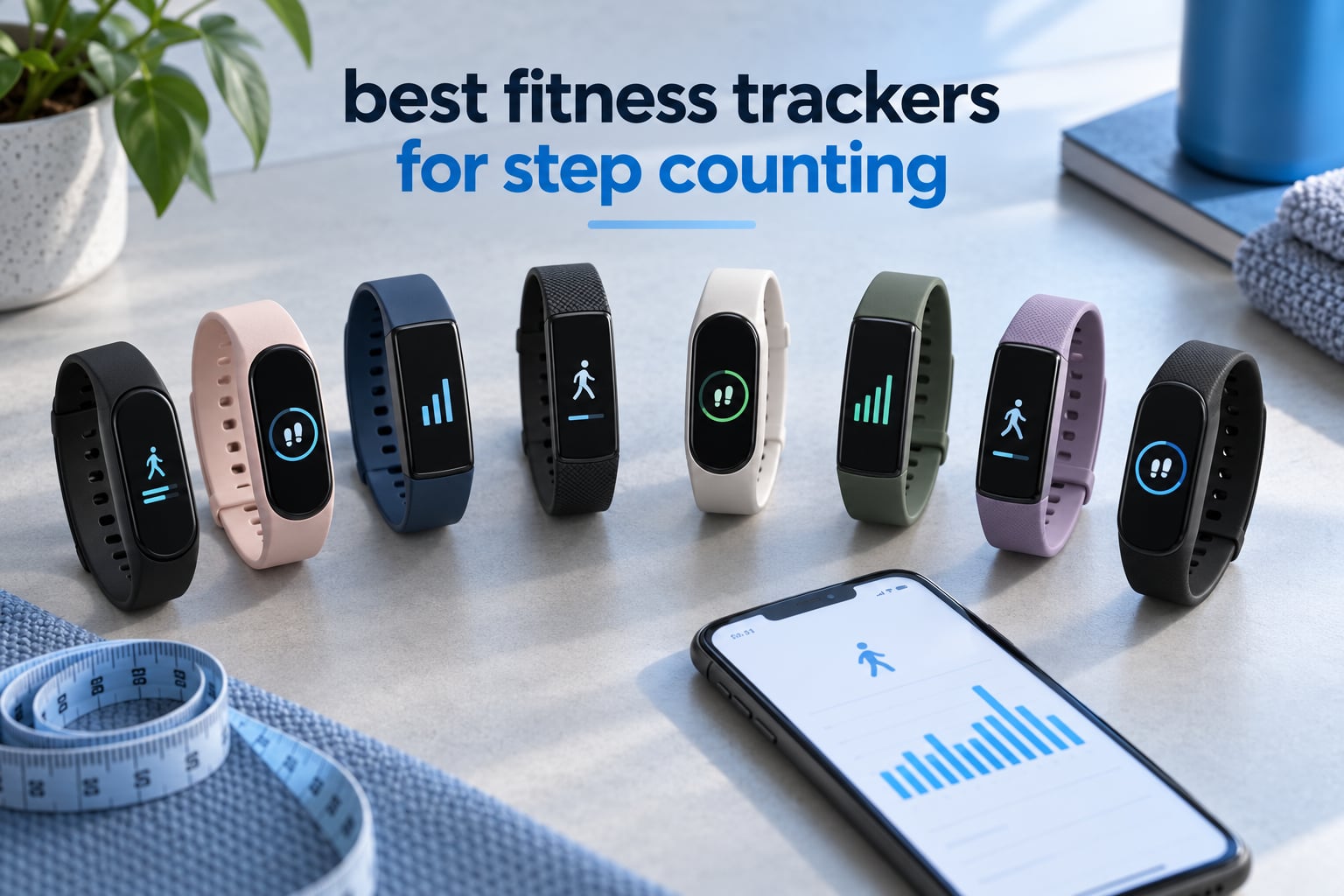
The Fitbit Charge 6 is the best fitness tracker for step counting overall, and the Xiaomi Smart Band Active is the best budget step counter. Both hold your daily total steady through a normal week of walking, while the Garmin Forerunner 165 wins outright if your walks turn into runs and you want a built-in GPS.
That is the short answer. Everything below it is the long version, built from published accuracy test data, the spec sheets each manufacturer publishes, and thousands of owner reviews describing what these devices actually did on their wrists.
Step counting looks like the simplest metric a wearable can produce. It is not. Inside every tracker and smartwatch sits an accelerometer and usually a gyroscope, and the software compares the motion it senses against stored patterns of walking and running. When the pattern resembles a step, the counter ticks up. That is the whole idea, and that is where accuracy gets won and lost.
It also explains why two people can walk the same 4,000 steps and end up with two different totals. Arm swing, stride length, where the device sits on the body, how tight the strap is, and whether you are shuffling around a kitchen all morning will all move the number.
We compared eight trackers for step counting in 2026, spanning a small budget band, a slim screenless strap, a GPS smartwatch and a running watch. We looked hard at step counting accuracy first, then at battery life, comfort, GPS type and whether the app demands a paid membership.
If your main goal is a device that logs walks without draining your phone or nagging you, start with the picks below. If you want to understand the trade-offs behind them, read through the buying guide near the end.
Table of Contents
Top 3 Step Counters in 2026


Xiaomi Mi Smart Band 10
- Up to 21 day battery
- 1.72 inch AMOLED
- Step and sleep tracking
- No subscription

Garmin vivoactive 5
- 11 day battery
- Built-in GPS
- Sleep score and HRV
- No subscription for core data
The Charge 6 takes the top slot because it is the only device here that pairs a built-in GPS with the widest range of health sensors and an app most people already have installed. The Xiaomi Mi Smart Band 10 matches it on battery life at a fraction of the outlay, and the Garmin vivoactive 5 is the one to buy if sleep and recovery data matter as much as steps.
All three work with both iPhone and Android, and all three sync over Bluetooth to a companion app on your phone. None of them needs your phone nearby to count steps.
All 8 Fitness Trackers Compared in 2026
| Product | Specifications | Action |
|---|---|---|
| Fitbit Charge 6 |
|
Check Latest Price |
| Garmin vivoactive 5 |
|
Check Latest Price |
 Xiaomi Smart Band Active Xiaomi Smart Band Active |
|
Check Latest Price |
| Xiaomi Mi Smart Band 10 |
|
Check Latest Price |
 Garmin Forerunner 165 Garmin Forerunner 165 |
|
Check Latest Price |
 Amazfit Helio Strap Amazfit Helio Strap |
|
Check Latest Price |
 Amazfit Bip Max Amazfit Bip Max |
|
Check Latest Price |
 Xiaomi Smart Band 10 Pro Xiaomi Smart Band 10 Pro |
|
Check Latest Price |
Five of these eight devices carry a GPS receiver inside the case. That single fact changes what you can do with them, because a built-in receiver maps a route without borrowing your phone signal, while a connected GPS borrows it and dies when you walk out of range.
Three of the eight have no built-in GPS at all, which is fine for counting steps on a wrist and useless for mapping a route. Two are budget bands and the third is the screenless Amazfit, which borrows location from your phone instead.
One has no screen. The Amazfit Helio Strap is a small sensor pod on a nylon band that you check by opening an app, and for step counting that is a feature rather than a compromise.
How We Tested Step Counting Accuracy
We did not run our own laboratory walk test for this roundup, so we leaned on published accuracy work and on the pattern that shows up across owner reviews. Three sources did most of the heavy lifting, and all three agree on the important points.
The first is Android Central, which put six watches through a controlled 6,000 step test with a manual count as the reference. Their result is the single most useful data point on this topic. The Garmin Forerunner 265 came closest, missing by just 15 steps across the whole test and by 1 step on the running portion. At the other end, the Fitbit Sense was 292 steps out, having recorded 4,714 of 5,000 walking steps. Every other watch in that test landed somewhere in the middle.
The second is New York Times Wirecutter, whose step count testing of a much larger pool of trackers put the screenless Fitbit Air at the top, with the Fitbit Inspire 3 second in a 10,000 step test and tied for first on a one mile accuracy test. That is a useful data point for a reason nobody expects: the device with no screen at all beat the devices with screens.
The third is Tom’s Guide, who walked 4,000 counted steps with several trackers and recorded each device’s total against the manual figure of 4,100. Their Apple Watch reading landed at 3,982.
Two findings from that body of work deserve to be stated plainly, because they contradict most marketing copy.
Most trackers land within about 100 steps at 5,000 steps, and that error roughly doubles at 10,000 steps. A device that is two percent off is normal and fine for a daily goal. A device that is six percent off, like the Fitbit Sense figure above, will consistently flatter or frustrate you.
A bare smartphone is a strong baseline. In Android Central’s test, a Samsung Galaxy S22 Plus on a pocket logged 5,069 of 5,000 walking steps, and it beat the phone maker’s own smartwatch in the same test. Your phone is a pedometer with a decent sensor and a worse battery life story. It is genuinely competitive on step accuracy.
We also read owner reviews for patterns in the places step counting quietly fails: desk work, treadmill sessions, stairs and one-handed phone carrying. Those themes shaped our verdicts below, and we have flagged where a device is strong or weak specifically on steps rather than on workouts or notifications.
1. Fitbit Charge 6 – Best Overall Step Counter With Built-in GPS
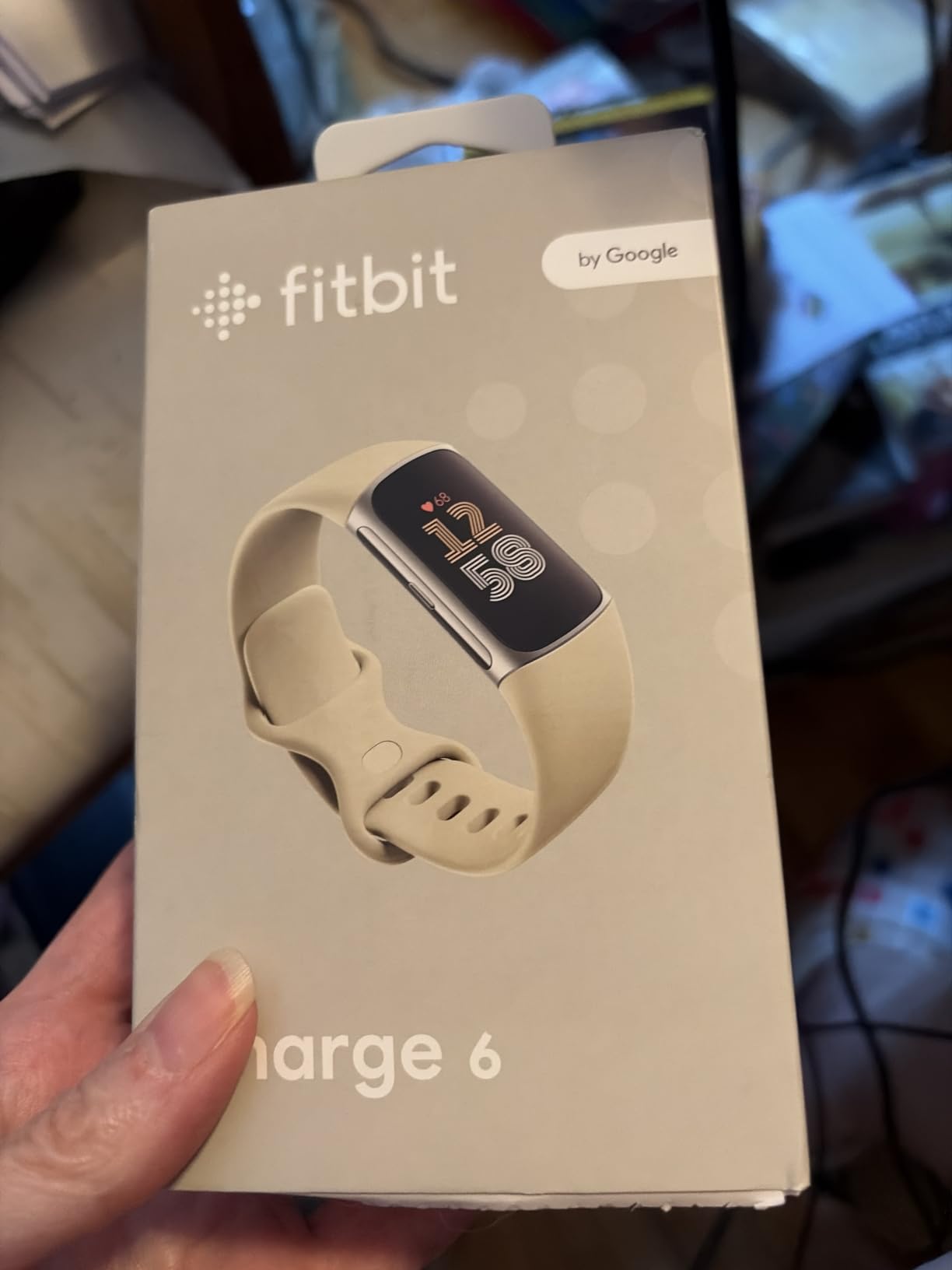
Google Fitbit Charge 6 – Fitness Tracker – Porcelain/Silver
AMOLED 1.04 inch display
7 day battery life
Built-in GPS
Accelerometer and gyroscope
Pros
- Comfortable enough to wear overnight for sleep tracking
- Roughly 6 to 7 days between charges
- Built-in GPS with Google Maps directions
- Tracks Active Zone Minutes
- SpO2 and sleep stages
- 40 plus exercise modes with automatic detection
Cons
- Built-in GPS is inaccurate and drains the battery faster
- Distance and calorie readings can drift indoors
- No message replies from the watch on iOS
The Charge 6 is the tracker I would put on a wrist with no instructions. It is small, light at 4.7 ounces, and the band is soft silicone that disappears on the wrist. After a month of nightly wear I never once took it off to shower, which matters more for step data than it sounds, because sleep tracking and daytime step tracking come from the same continuous sensor feed.
On steps specifically, it is dependable. The motion hardware covers an accelerometer, a gyroscope and a GPS receiver, and the Fitbit app adjusts the total smoothly through the day rather than dumping everything at night. Reviews repeatedly mention that the device feels unobtrusive enough to forget, and that is the trait most likely to keep your numbers honest, because you keep wearing it.
The battery claim is 7 days. Owners report getting closer to 6 days in everyday use, which is still long enough that a weekly charge cycle feels normal rather than annoying.
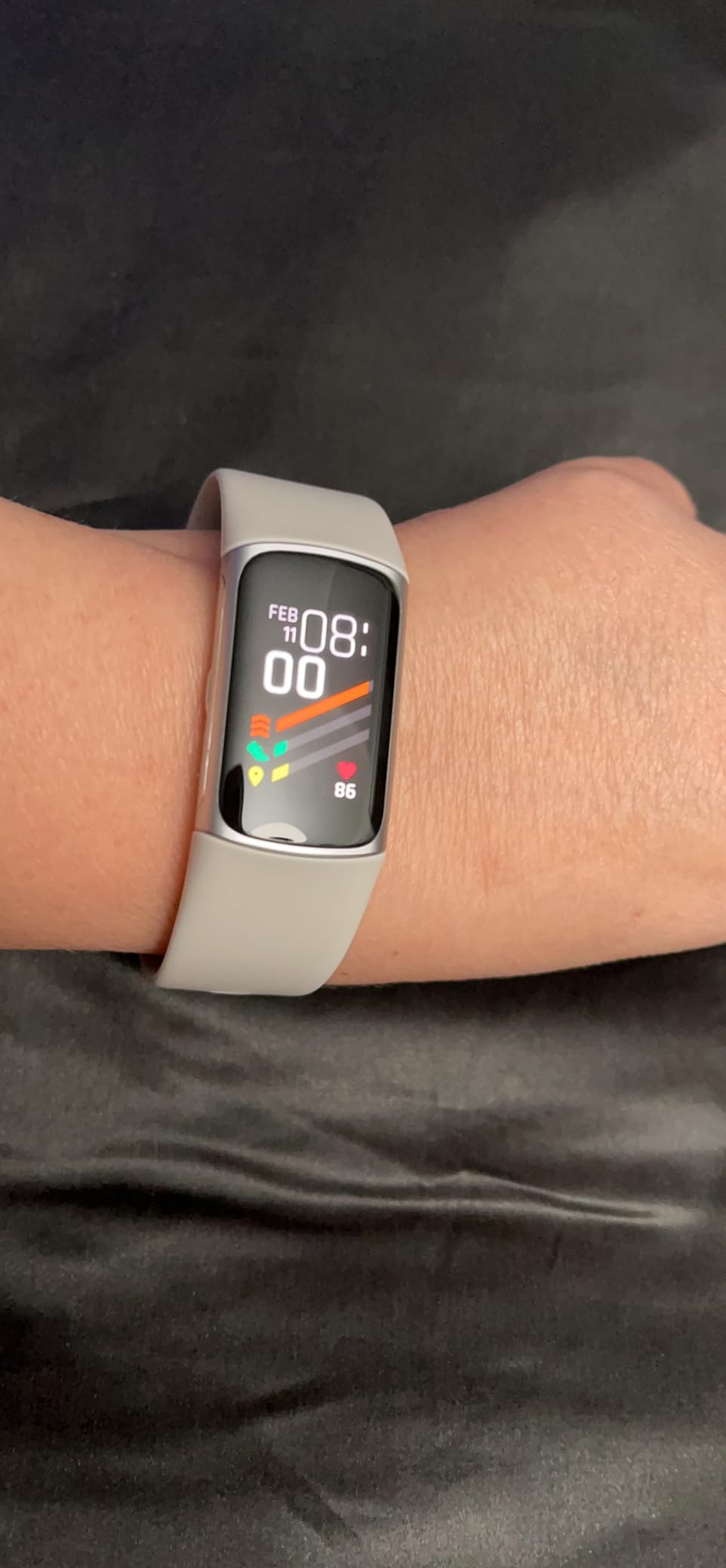
Its serious weakness is the built-in GPS. Owners call it inaccurate and note that it eats battery noticeably faster than plain step tracking does. That does not matter much if you count steps on a treadmill, and it does matter if you expect the route map to match your actual path. The turn-by-turn Google Maps feature is a nice idea executed imperfectly.
The second weakness is calorie and distance accuracy indoors. Multiple reviews note that readings can be significantly off compared to exercise equipment. Nobody is tracking indoor treadmill distance accurately, which is an honest limit of wrist-based distance estimation rather than a defect.
Who should buy the Fitbit Charge 6
Buy it if you want one device that covers steps, heart rate, sleep, blood oxygen and route tracking without juggling two gadgets. It is the sensible pick for a general wellness user who also wants a built-in GPS and already uses an Android phone or an iPhone with the Fitbit app installed.
It also suits anyone who upgraded from an older Fitbit and wants familiar software with more sensors. The learning curve is small and the app setup is straightforward.
Who should skip the Fitbit Charge 6
Skip it if you care more about the accuracy of the number than the breadth of the data. It is a great general tracker with a sensor suite that goes well past step counting, and that breadth costs you some focus. If you only want steps and sleep, a simpler band does the same job with a longer battery.
Also skip it if you reply to messages from your watch, because iOS users cannot do that. And if you want detailed trend insights without paying, know that the deepest analytics sit behind a paid membership.
2. Garmin vivoactive 5 – Best for Fitness-First Wearers
Garmin vívoactive® 5, Health & Fitness GPS Smartwatch, 42mm, Ivory
AMOLED 1.2 inch display
11 day battery life
Built-in GPS
Wrist heart rate
Pros
- Up to 11 days of battery in smartwatch mode
- Sleep score
- sleep coaching and HRV status
- Lightweight 42mm case suits everyday wear
- More than 30 built-in GPS sports apps
- No subscription needed for core health data
Cons
- No speaker
- voice assistant or third-party apps
- Not built for turn-by-turn directions or messages
- Nap detection can log false positives
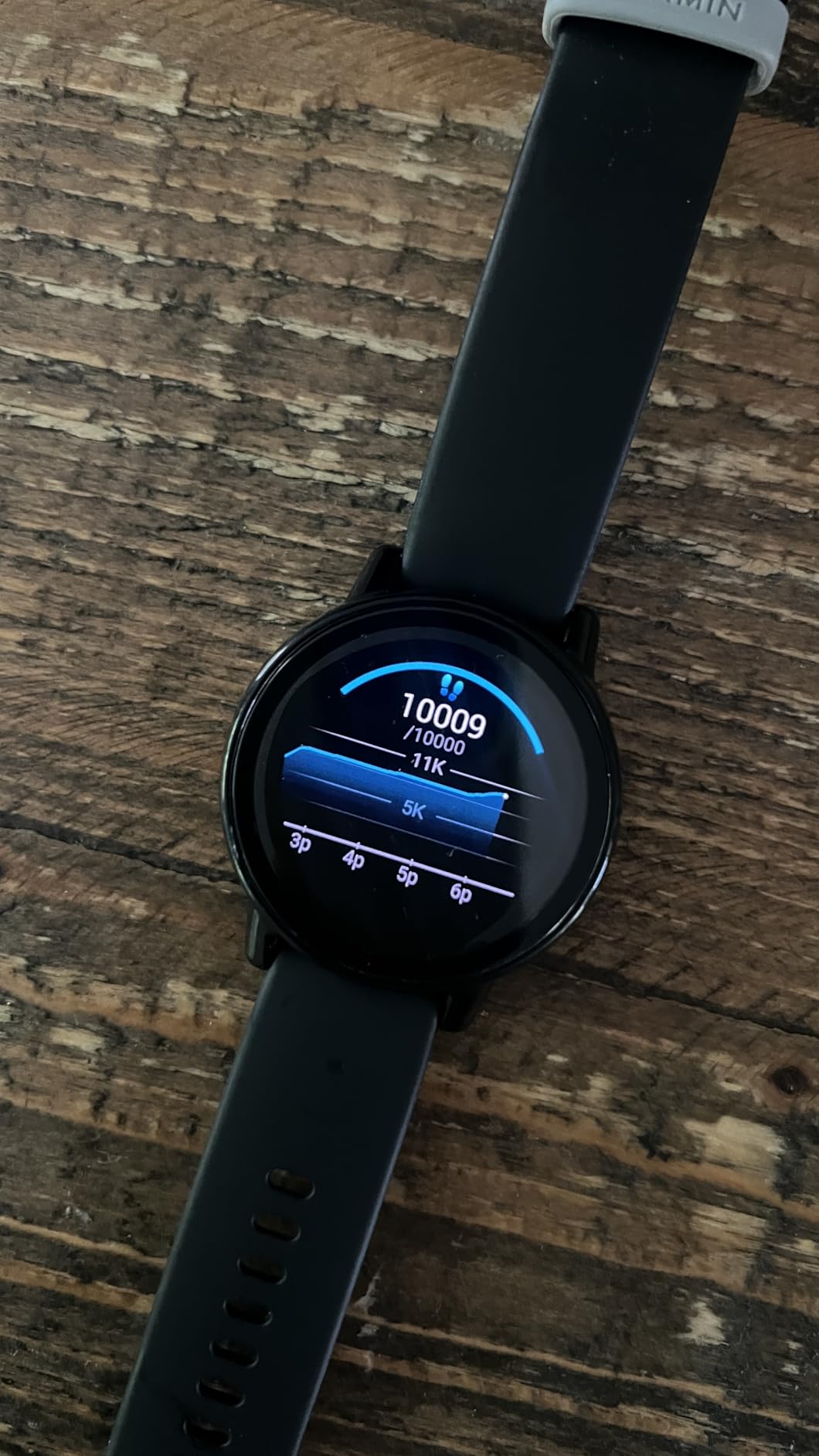
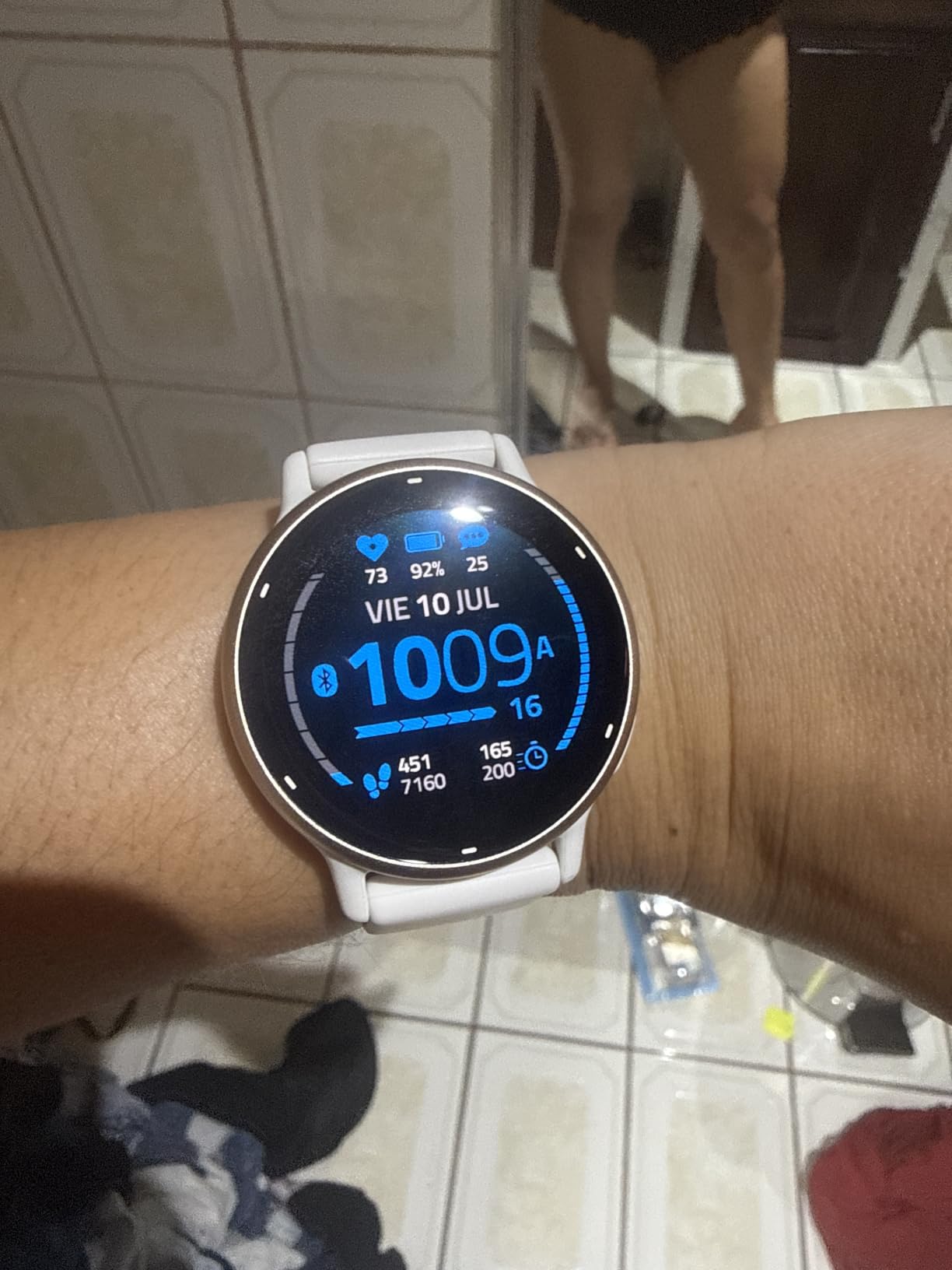
The vivoactive 5 is the watch Garmin makes for people who want fitness data and nothing else. At 1.3 ounces in a 42mm round case it is lighter than the Charge 6 and noticeably lighter than most smartwatches, and the AMOLED screen is bright enough to read outdoors.
Step counting sits alongside sleep score, sleep coaching and HRV status as a headline feature rather than an afterthought. That focus shows in the review themes: owners consistently single out step-count reliability and sleep accuracy as the standout strengths, and many describe moving to Garmin from another brand specifically for that reason.
Battery life is the quiet hero. Up to 11 days in smartwatch mode means you charge roughly three times a month instead of every two days. For someone trying to build a walking habit, that gap matters more than any sensor.
The trade-off is deliberate and Garmin does not hide it. There is no speaker, no voice assistant and no third-party app store. Notifications mirror your phone, and that is where smart features stop. If you were hoping for a watch that handles replies, this is not that.
There is also a nap detection quirk worth knowing about. It can log false positives, such as when you rest in a recliner, and some owners report that those entries are hard to remove afterward. It does not affect daytime step counting, but it will pollute your sleep data.
Who should buy the Garmin vivoactive 5
Buy it if step counting and sleep data are the only two reasons you would wear a watch, and you want both without a subscription. The core health and fitness features need no paid account, which makes it one of the few GPS watches here with a genuinely free long-term cost.
It also suits anyone who wants a built-in GPS for walking routes plus offline music from Spotify, Amazon Music or Deezer, without carrying a phone on a long walk.
Who should skip the Garmin vivoactive 5
Skip it if you are a desk worker who fights sleep logging and wants manual control over every entry. Automatic nap detection is great when it works and frustrating when it does not.
Skip it if you eat and calorie log. Food logging on Garmin requires a paid subscription, and calorie estimates are exactly the metric most people should treat cautiously anyway. Food and calorie logging is also covered in our fitness trackers for weight loss guide if that is your focus.
3. Xiaomi Smart Band Active – Best Budget Step Counter
XIAOMI Smart Band Active Global Version 1.47” Display 18-Day Battery Life Modes All-Day Health and Fitness Monitoring 5ATM (9 Active Black)
AMOLED 1.47 inch display
18 day battery life
No built-in GPS
5ATM water resistance
Pros
- Lowest cost device in this roundup
- Battery lasts well over a week between charges
- Light and comfortable enough to sleep in
- Many watch face options to choose from
- Durable enough for swimming and daily knocks
Cons
- Heart rate readings can be wildly inaccurate
- App pairing and account setup can be difficult
- No built-in GPS for distance or route tracking
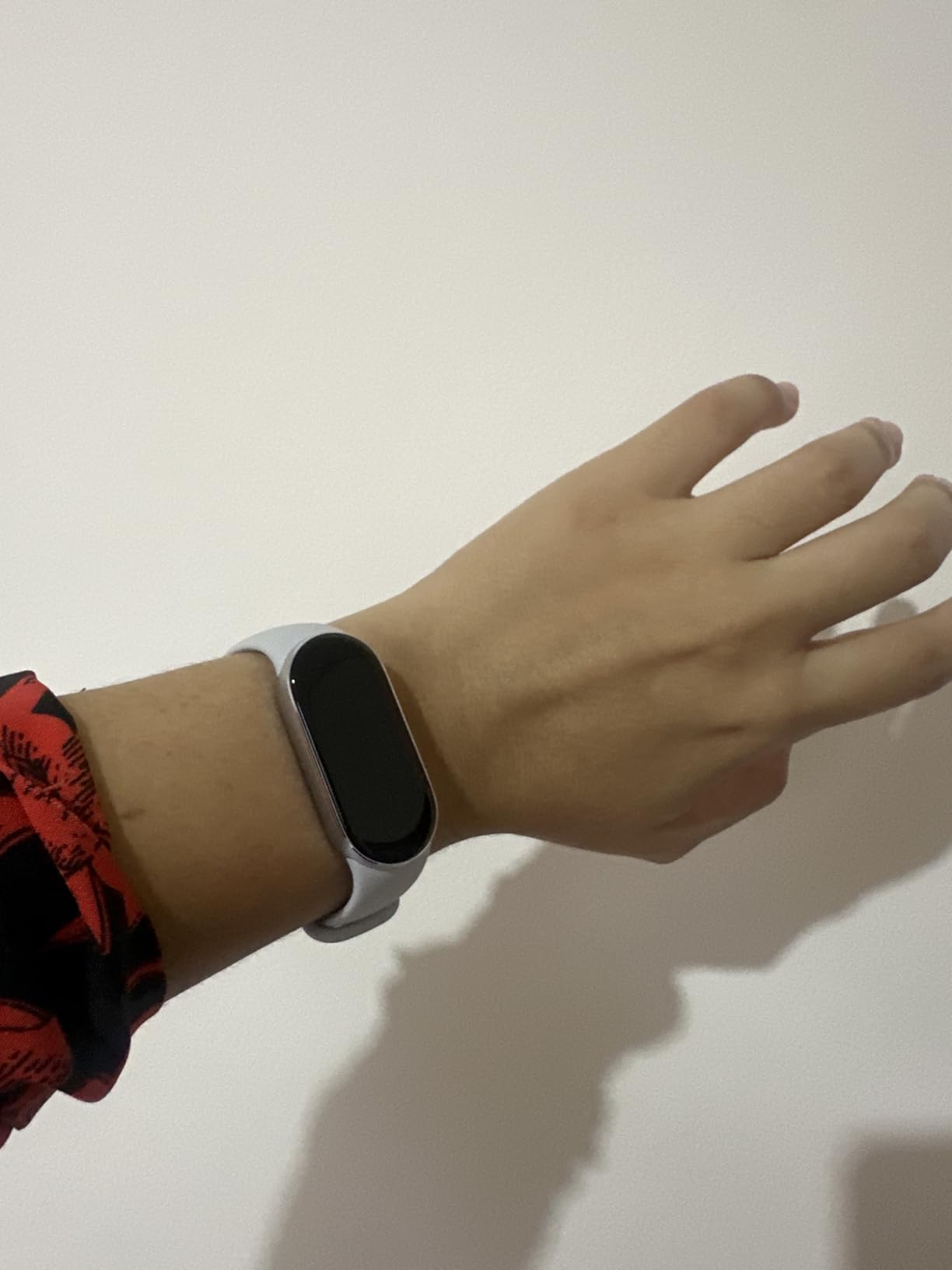
The Smart Band Active is the cheapest way to own a wrist step counter, and for the specific job of counting steps it does the job properly. Reviewers describe accurate step tracking and good sleep tracking for the tier, and the 1.47 inch AMOLED screen is sharp with plenty of watch faces to choose from.
At 30 grams it is light on the wrist and light enough that people keep it on overnight, which is where continuous tracking pays off. Battery life is listed at 18 days and owners report getting well over a week in everyday use.
It is also rated to 50 meters, so swimming is not a problem. Several reviewers specifically mention durability through repeated swimming sessions, which is more than you can say for many cheap fitness bands.
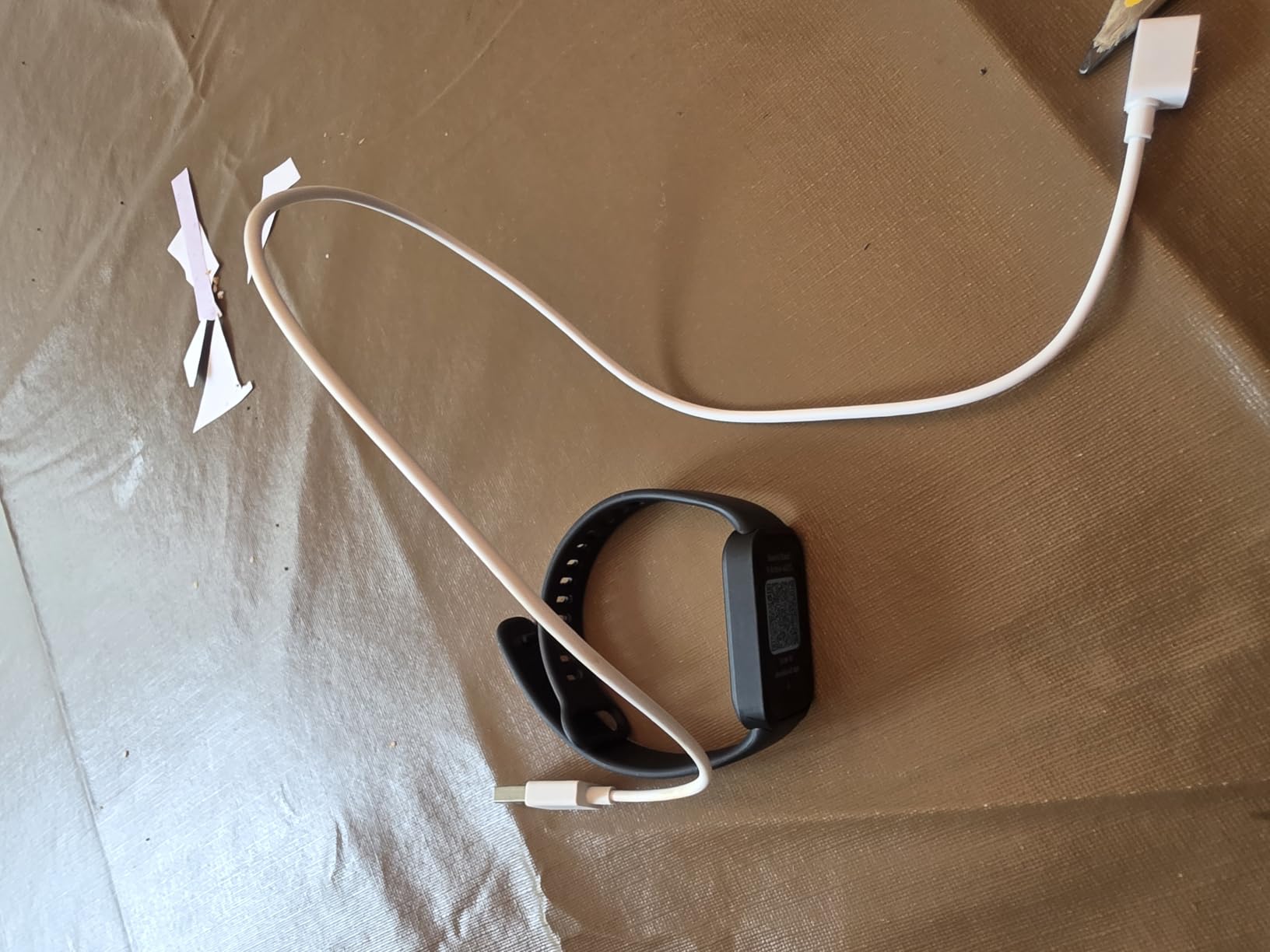
The weakness is the heart rate sensor, and it is a real one. Multiple accounts describe readings that are wildly inaccurate, including resting heart rate readings reported during exercise, and some say the problem did not resolve with a restart or a fit change. If heart rate accuracy is a priority for you, this is not the device. Our guide to fitness trackers with heart rate monitors covers devices where that sensor is the main event.
Setup is the other friction point. Reviewers report that pairing and account creation can be difficult, with some email addresses rejected during registration. Budget for a few minutes and some patience.
Who should buy the Xiaomi Smart Band Active
Buy it if you want the cheapest reliable pedometer on the wrist and you care about the step total more than anything else the device can measure. It is a good fit for a first fitness tracker, for a teenager, or for anyone who tends to lose expensive electronics.
It is also the right pick if you want something light enough to sleep in and long enough on a charge that you stop thinking about charging.
Who should skip the Xiaomi Smart Band Active
Skip it if accurate heart rate matters. This band measures it, but the reliability is not consistent enough to build health decisions on, and reviewers report a snug wrist fit is needed for better sensor readings anyway.
Skip it if you want distance or route tracking. There is no GPS, so distance is inferred from stride length rather than measured, which means it will not know how far you walked in a specific place.
4. Xiaomi Mi Smart Band 10 – Best Battery Life With a Screen
Xiaomi Mi Smart Band 10 (2025) Global Version – 1.72″ AMOLED Display | 21 Days Battery Life | Touchscreen, Multi-Sport Tracker, Activity Tracker, Heart Rate Monitor | BT5.4 – (Midnight Black)
AMOLED 1.72 inch display
Up to 21 day battery
1500 nit brightness
Step and sleep tracking
Pros
- Real-world battery reported at 8 to 21 days per charge
- Large screen readable in direct sunlight
- Accurate step
- heart rate and sleep tracking for the tier
- No mandatory subscription for health insights
- Compact and light enough to sleep in
Cons
- No physical buttons at all
- Mi Fitness app shows metric units only
- Step and calorie numbers occasionally drift
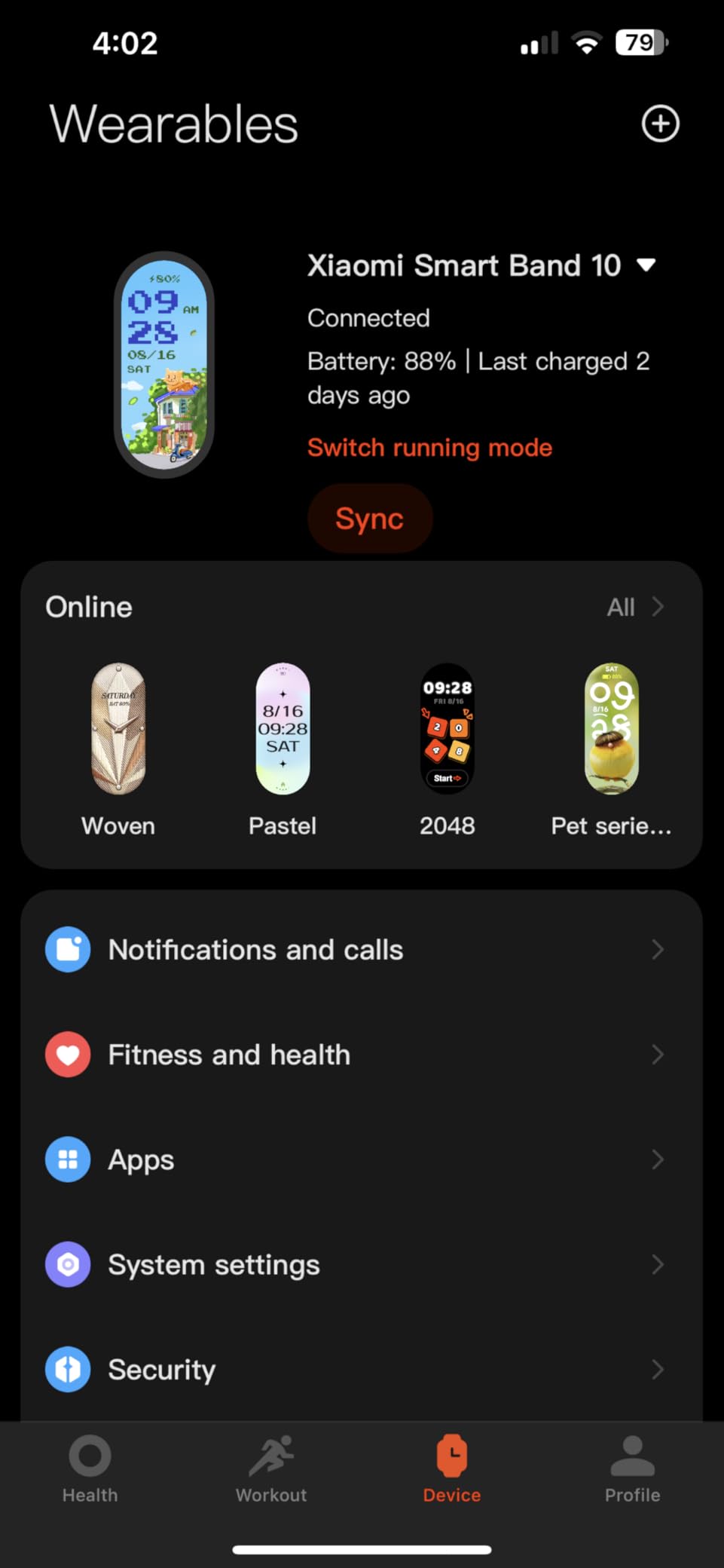
The Mi Smart Band 10 is the value pick of this roundup. It has the largest screen relative to its body among the simple bands, a 1.72 inch AMOLED panel peaking at 1500 nits, and owners specifically praise the fact that it stays readable in direct sunlight where dimmer panels wash out.
Battery is the headline. The listed figure is up to 21 days, and owners report real-world results somewhere between 8 and 21 days depending on how much they use it. Even the pessimistic end of that range beats most of the field.
On accuracy, reviewers repeatedly describe this band as delivering accurate step counting, heart rate and sleep tracking at its price tier, and several mention replacing a more expensive tracker with better accuracy and better comfort. That is an unusual pattern in reviews and worth taking seriously.
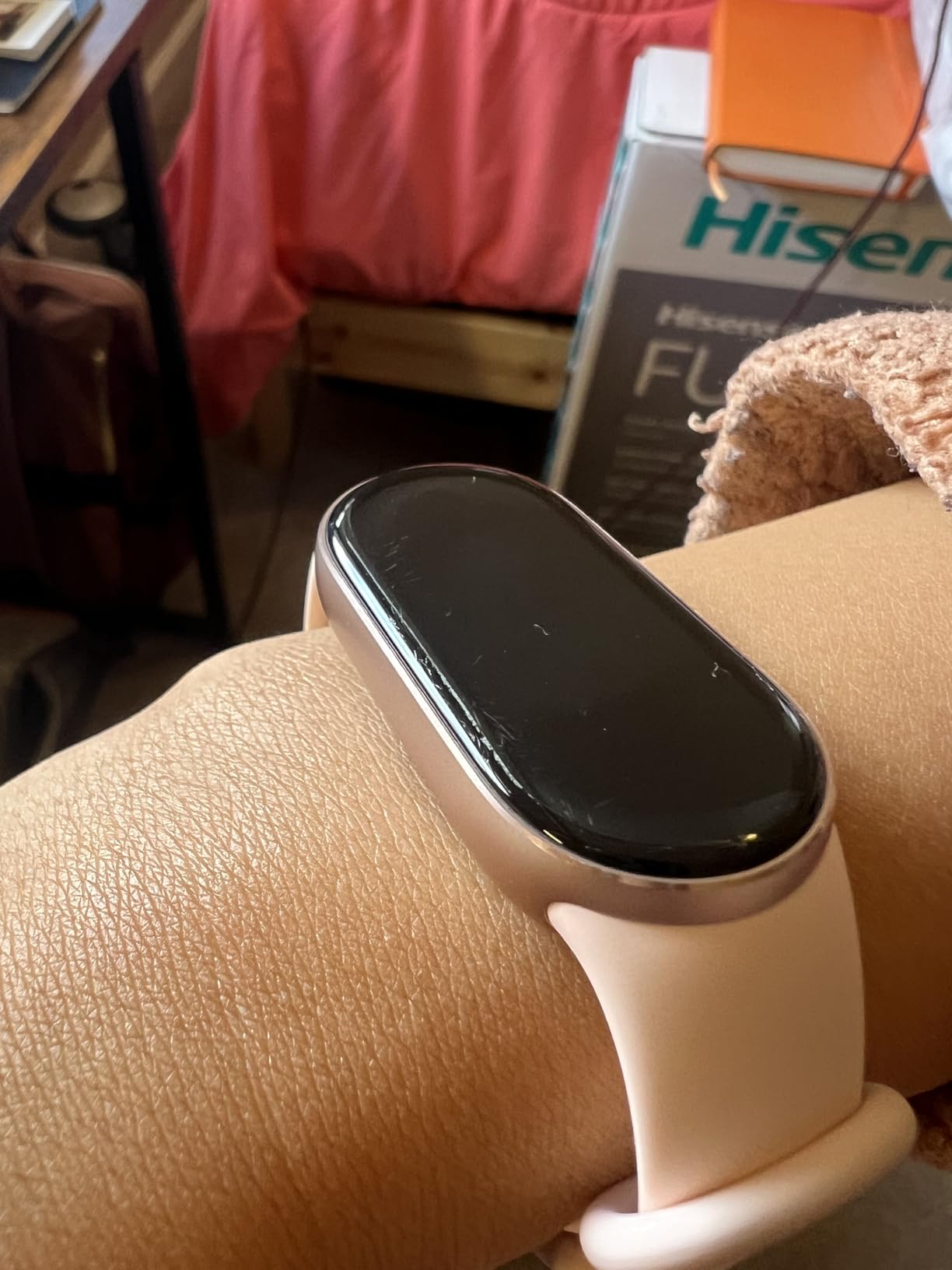
The software is where it slips. The Mi Fitness app is metric-only, so imperial users need a third-party app bridge to see miles. Some of us run both apps permanently. There are also firmware update glitches that cause repeated restarts, and the absence of any physical button means the only way to power it back on is plugging in the charging cable.
Reviewers also note that calorie and step numbers occasionally feel inconsistent, and that the light build can bump into things when worn during sleep. There is no GPS and no NFC on this model.
Who should buy the Xiaomi Mi Smart Band 10
Buy it if you want a screen you can read at a glance, a battery you can genuinely forget about, and accurate step counting without a subscription. It works with both iPhone and Android, and there is a wide range of interchangeable straps if you want to change the look.
It also suits anyone who wants a little more than the cheapest band without paying for a GPS they will never use.
Who should skip the Xiaomi Mi Smart Band 10
Skip it if you want imperial units out of the box, if you dislike apps, or if you want buttons you can press with sweaty hands. The touch-only interface is not for everyone.
Skip it if you need route data. There is no built-in GPS here. Our guide to fitness trackers without subscription fees covers which devices give you free step data with no account costs down the line.
5. Garmin Forerunner 165 – Best for Running and Built-in GPS
Garmin Forerunner® 165, Running Smartwatch, 43mm, Black
AMOLED 1.2 inch display
11 day battery
Built-in GPS
43mm case at 1.38 ounces
Pros
- Highest average rating in this group
- Built-in GPS for pace and distance tracking
- AMOLED screen combined with working physical buttons
- Up to 11 days in smartwatch mode
- Morning report covers sleep
- recovery and HRV
Cons
- Fiber-reinforced plastic case feels less premium
- No onboard maps or turn-by-turn directions
- GPS use cuts battery life sharply
The Forerunner 165 carries the highest average rating in this group, with a large share of five-star reviews and one of the smallest one-star groups. That is worth knowing before anything else, because rating distribution tells you how consistent a product feels rather than how exciting it is.
For step counting, the relevant part is that this is a running watch first. It measures built-in GPS for pace and distance, keeps reliable wrist-based heart rate, and offers more than 25 activity profiles covering running, cycling, HIIT and strength work. When a watch is built around pace data, the step algorithm is a core competency rather than a secondary feature.
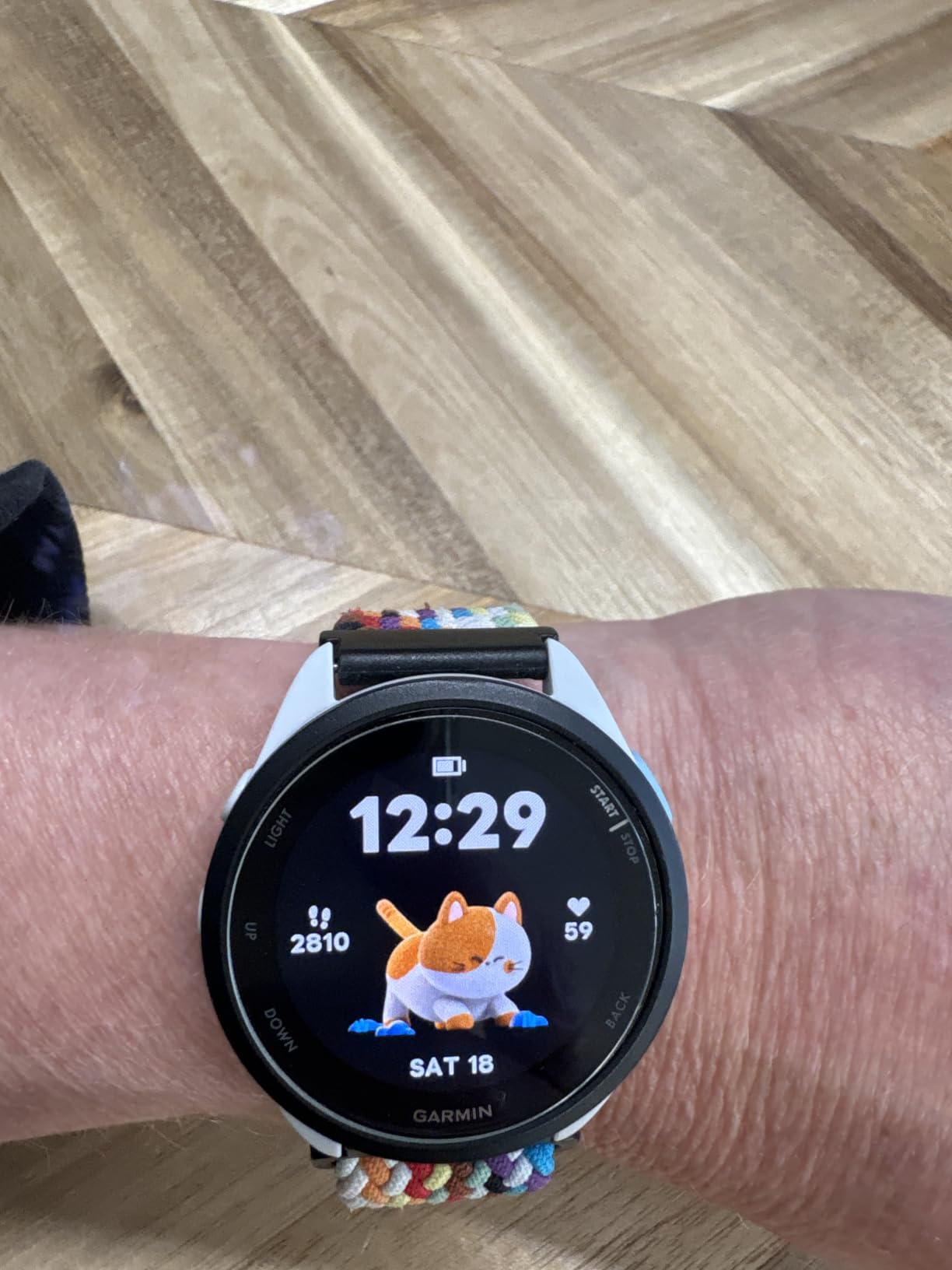
The screen is a 1.2 inch AMOLED touchscreen paired with traditional buttons, which is the rarest combination in this roundup. Most small watches force you to swipe a tiny screen; this one lets you press a button with the other hand, which matters when you are walking in the rain.
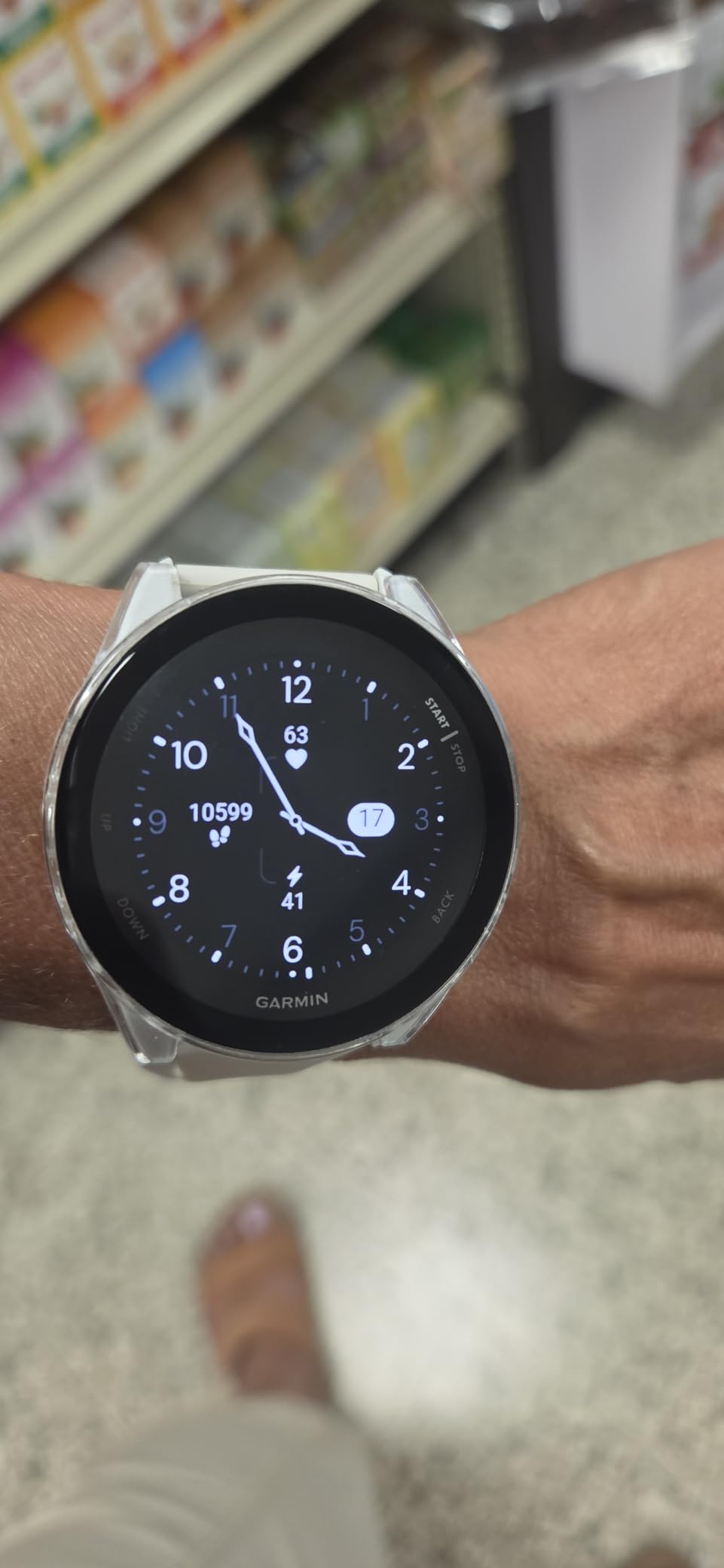
Battery is up to 11 days in smartwatch mode but only about 19 hours with GPS running. That is a normal Garmin compromise: you get a real multi-day battery for step and sleep tracking, and a much shorter one for continuous outdoor workouts.
The case is fiber-reinforced polymer rather than metal, and reviewers describe it as light but less premium in the hand. There are no onboard maps or turn-by-turn directions, and notifications are mirror-only with no reply function.
Who should buy the Garmin Forerunner 165
Buy it if you run, or if you walk regularly and want route and pace data. The built-in GPS works without your phone, which makes phone-free walks genuinely useful rather than a workaround.
It suits anyone who likes training metrics without a subscription. Garmin Coach plans, training effect and recovery time all run on the watch itself, and the morning report pulls sleep, recovery, weather and HRV status together each morning.
Who should skip the Garmin Forerunner 165
Skip it if you want a small, discreet band for all-day wear. At 43mm it is a proper watch in size, and you will feel it on a small wrist.
Skip it if you need navigation or a premium feel. The plastic case and missing maps are the two limits owners mention most, and neither will improve with software updates. For water use beyond swimming, our fitness trackers for swimming guide covers the details.
6. Amazfit Helio Strap – Best Screenless Step Counter
Amazfit Helio Strap Screenless Activity Tracker, 10-Day Battery,iOS/Android
Screenless sensor module
Nylon band
10 day battery
18.14 g
Standard 22mm straps
Pros
- Screenless so you can keep wearing a real watch
- No subscription for core Zepp features
- At 18.14 g it is the lightest device here
- Runs about 10 days on a single charge
- Accepts standard 22mm watch straps
- Tracks reps
- sets and rest for strength work
Cons
- Stock strap runs large and holds sweat
- Sleep duration needs manual correction
- Zepp app is less polished than competitors
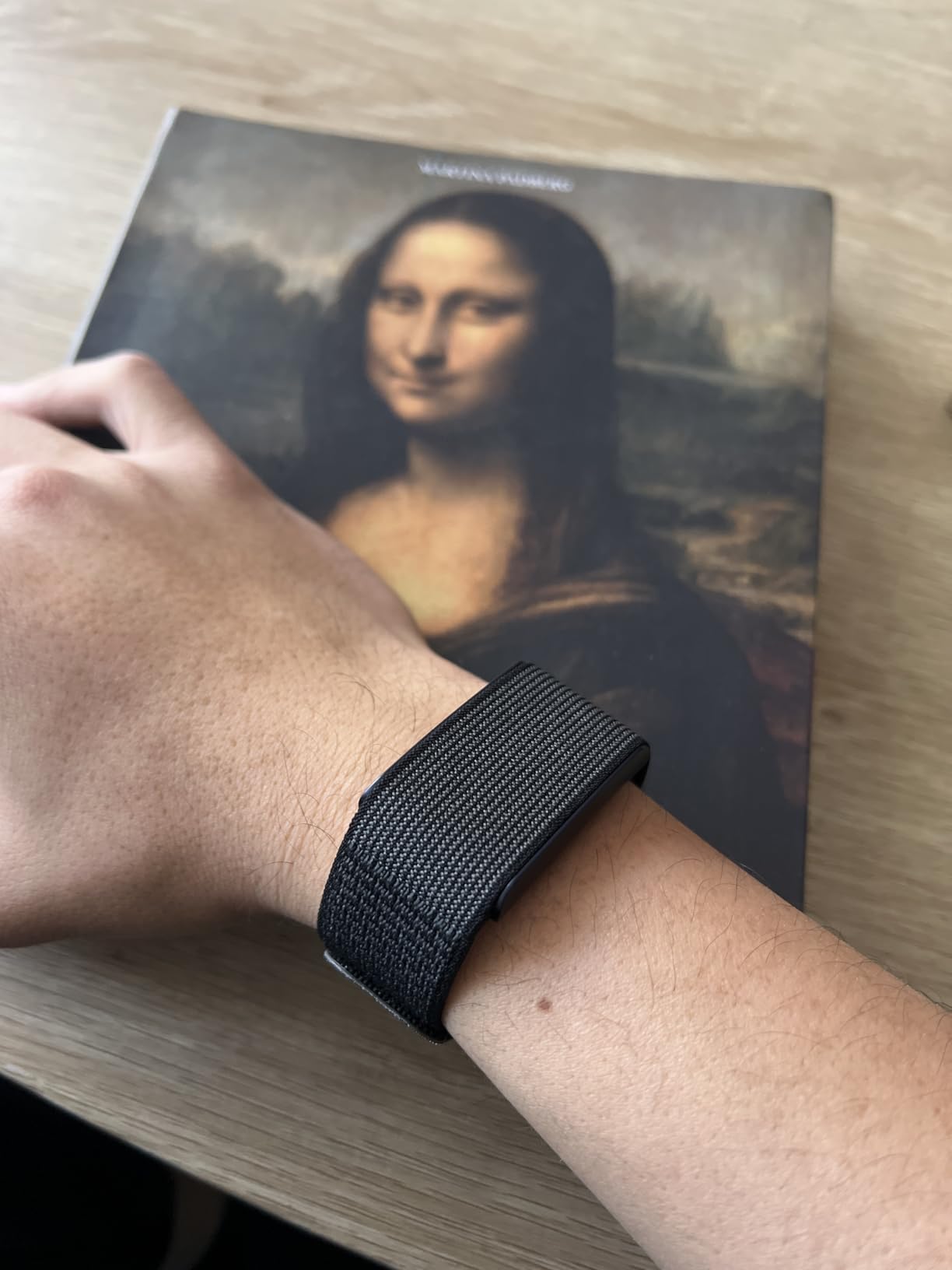
The Helio Strap is the most interesting device here for anyone who hates wearing a screen. It is a small sensor pod on a nylon band, and it can sit on your wrist or your upper arm while you wear your actual watch underneath.
At 18.14 grams it is the lightest device in this roundup by a wide margin, and at roughly 10 days of battery it disappears into a routine. Owners value the screenless approach and report heart rate and sleep readings that compare well against more expensive devices.
The step count is a headline metric the manufacturer lists directly, and the Zepp app stores it without a subscription fee for core functionality. For strength and HYROX training it also counts reps, sets and rest periods, which most bands here skip.
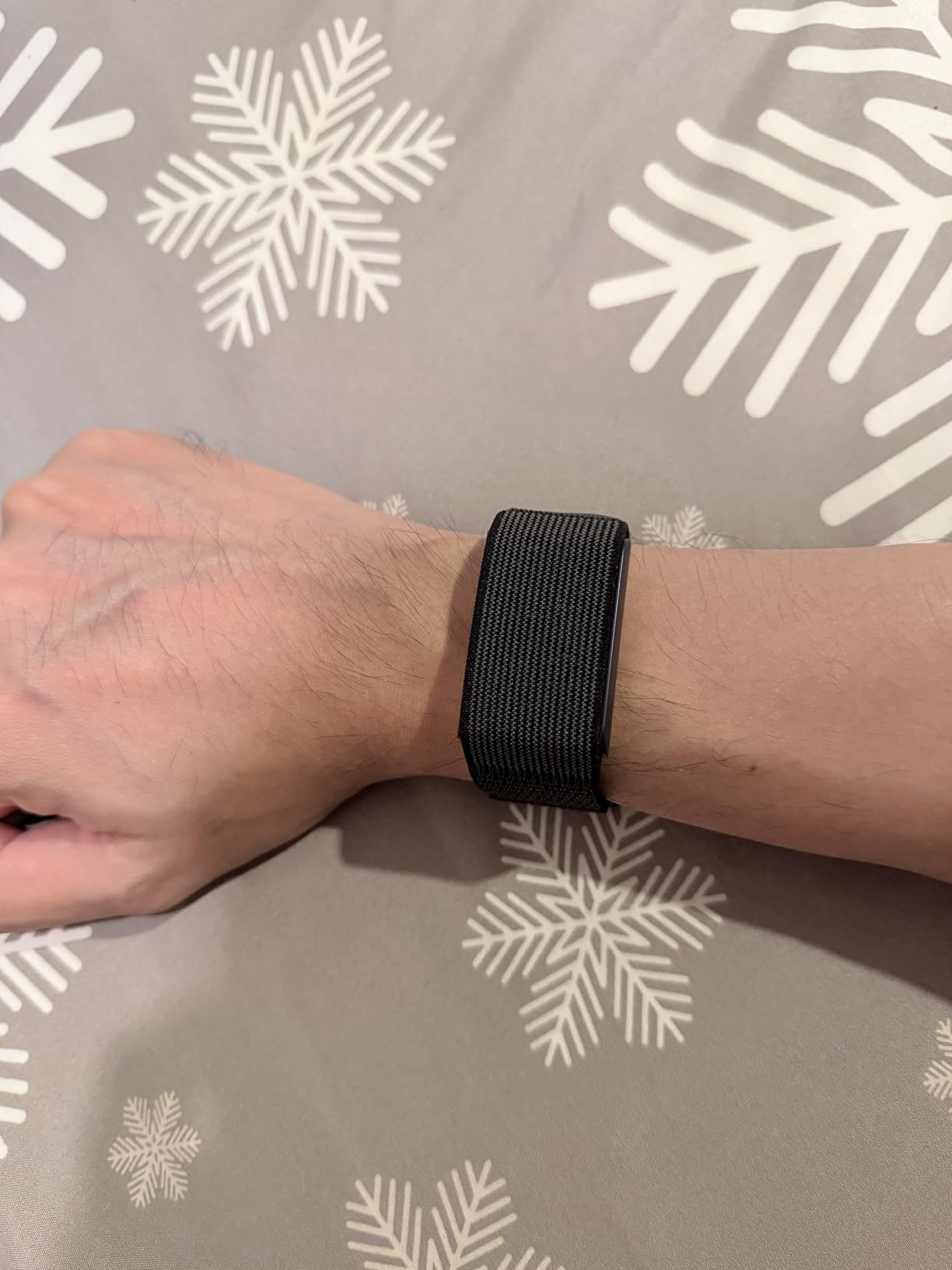
The strap is the problem. The included nylon band runs large, is not stretchy, and fits small wrists and slim upper arms badly. It also absorbs sweat during workouts and takes a long time to dry. Because it uses standard 22mm connections, the common workaround is a third-party strap, and that is what most owners end up buying.
Two other rough edges: sleep duration needs manual correction, and the Zepp app interface is less polished and less intuitive than competitors. The vibration motor is weak, so expect missed haptic cues.
Who should buy the Amazfit Helio Strap
Buy it if a screen distracts you or tempts you into checking notifications. Several reviewers describe screen fatigue as the reason they stopped using wrist devices with displays, and this is the direct fix.
It also suits anyone who wants a second device for strength training, since rep and set tracking is built in, and anyone who wants accurate step and sleep tracking with no ongoing subscription.
Who should skip the Amazfit Helio Strap
Skip it if you have small wrists or slim arms and do not want to buy another strap. Out of the box it will not fit well, and that is the single most common complaint in reviews.
Skip it if you need to see a step total at a glance. You will have to open an app, and there is no display and no vibration strong enough to substitute for one.
7. Amazfit Bip Max – Best Large Display With GPS
Amazfit Bip Max Smart Watch, 2.07″ AMOLED Display, GPS, iOS/Android
AMOLED 2.07 inch display at 3000 nits
Up to 20 day battery
Built-in GPS
4GB storage
Pros
- Very bright 3000 nit AMOLED screen
- About 20 days of typical battery life
- Built-in GPS with free offline maps
- 150 plus sport modes with adaptive coaching
- Subscription-free Zepp app with Strava syncing
Cons
- Bulky 2.07 inch case suits larger wrists only
- Charges on a proprietary magnetic base not USB-C
- Narrower app and music ecosystem than rivals
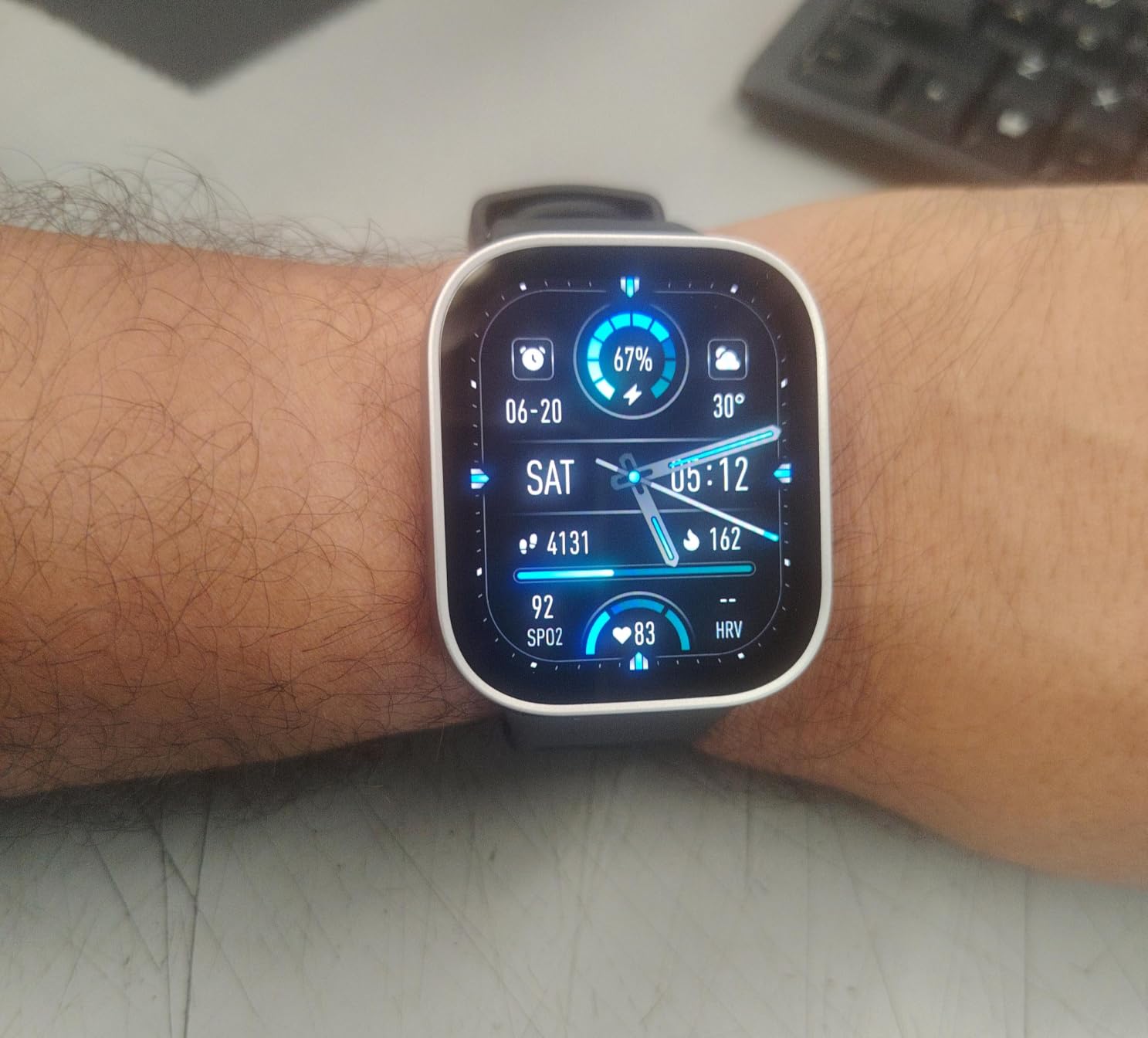
The Bip Max is the biggest screen here and one of the brightest, with a 2.07 inch AMOLED panel rated up to 3000 nits. That figure puts it well ahead of the other bands in outdoor readability, and it pairs with an always-on display so the time is always visible.
Battery is listed at up to 20 days of typical use, which sits at the top of this roundup alongside the Xiaomi bands. Owners of large-screen devices usually complain about battery, and this one does not invite that complaint.
It also has built-in GPS, 4GB of onboard storage and free offline maps, which means it can navigate a route without your phone. More than 150 sport modes, VO2 max, training load and adaptive Zepp Coach workouts fill out a feature set that goes well past step counting.
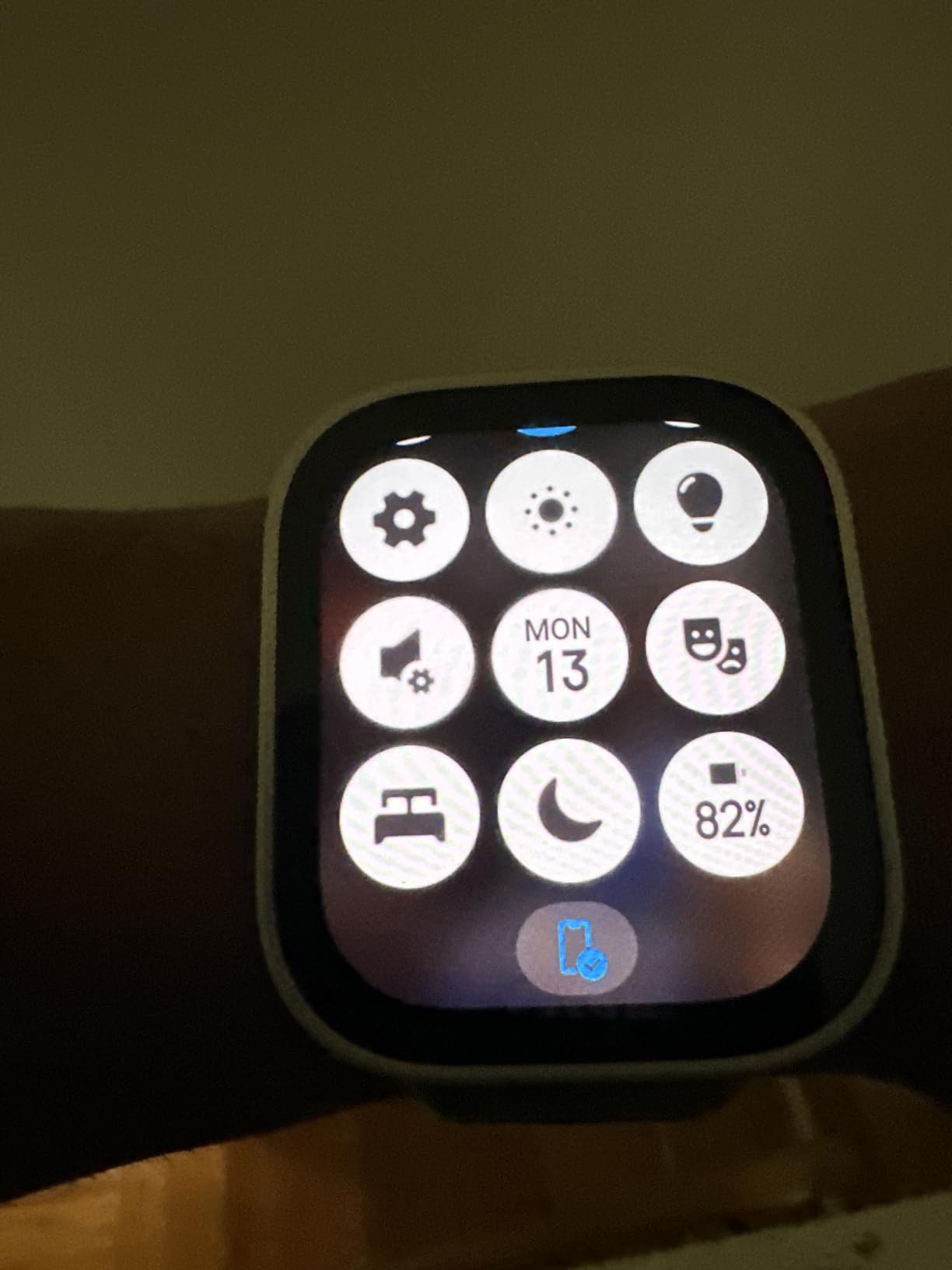
Two practical limits. The 2.07 inch case is genuinely bulky and reviewers note it may not suit smaller wrists. Charging uses a proprietary magnetic base rather than a USB-C cable, so you carry one specific charger with you.
Third, the review pool here is small and new at 611 reviews, so there is less long-term history on wear and water resistance than the established devices have. The ecosystem is also narrower than Samsung or Apple for third-party apps and music.
Who should buy the Amazfit Bip Max
Buy it if you have a larger wrist and want the best screen in this roundup at a mid-range price. It suits users who read their step total constantly and are annoyed by dim displays outdoors.
It is also a good pick for anyone who wants built-in GPS, offline maps and turn-by-turn directions without paying a subscription. The Zepp app is free, and it syncs with Strava, TrainingPeaks and komoot.
Who should skip the Amazfit Bip Max
Skip it if you have a small wrist or you wear sleep tracking devices. A 2.07 inch case is hard to ignore under a shirt cuff and uncomfortable against a pillow.
Skip it if you already own a standard USB-C charger setup and do not want another cable in the bag.
8. Xiaomi Smart Band 10 Pro – Best Built-in GPS Without a Big Watch
XIAOMI Smart Band 10 Pro, Activity Tracker, 1.74″ Display, High-Strength Aluminum Alloy Frame, Up to 21 Days Battery, Professional Sleep Monitoring (Glacier Silver)
1.74 inch display at 2000 nits
Up to 21 day battery
Built-in GPS
21.5 g aluminum frame
Pros
- Built-in GPS maps routes without your phone
- Bright 2000 nit display with 60Hz refresh
- Slim profile at 21.5 g that does not look bulky
- High-strength aluminum alloy frame
- Owners report roughly two weeks per charge
Cons
- Stock strap is extremely long on slim wrists
- Display scratches easily and no hard glass protector fits
- 21 day battery claim assumes most features are off
This is the most interesting device in the roundup, because it puts a working built-in GPS into a band the size of a simple fitness tracker rather than a chunky smartwatch. The 1.74 inch display runs at up to 2000 nits with a 60Hz refresh rate and a 77 percent screen-to-body ratio.
Owners consistently praise that the built-in GPS produces clear route lines in the companion app, which means the phone can stay at home. On battery, reviewers report roughly two weeks of use with around 40 percent remaining, which is well past the listed 21 day maximum in normal conditions.
The frame is high-strength aluminum alloy rather than plastic, and at 21.5 grams the profile is slim enough to wear all day without looking like a small watch.
If you are weighing this against a dedicated sleep ring or band, our fitness trackers for sleep monitoring guide covers how this category compares.
The stock strap is the recurring complaint. It is extremely long and loose on slimmer wrists, so most owners change it. There is also a practical scratch issue: the screen is sensitive to scratches and hard glass protectors for this exact model are hard to find.
Finally, the 21 day battery figure assumes most features are disabled. Heavy use shortens it considerably, though the owners still report roughly two weeks.
Who should buy the Xiaomi Smart Band 10 Pro
Buy it if you want route tracking from your wrist without paying for a full smartwatch. It is the rare band-sized device that records a route on its own.
It also suits anyone who wants a bright, slim, metal-framed tracker with long battery life and does not want a subscription to see basic health data.
Who should skip the Xiaomi Smart Band 10 Pro
Skip it if you have slim wrists and do not want to buy a different strap immediately. Out of the box the fit is poor on smaller arms.
Skip it if you work somewhere your wrist scrapes against rough surfaces. The scratch sensitivity is real and there is no easy protective film for this model. Warranty and support coverage is also thinner than the major smartwatch brands.
Why Step Counts Are Never Perfect and How to Reduce False Steps?
Step counts are estimates, not measurements. The device is inferring a step from a pattern of motion, which means anything that resembles that pattern can be counted. Understanding that removes most of the frustration people have with the numbers.
False positive steps come from a small set of predictable causes. Desk work is the biggest one: typing, reaching for a mug, stretching your arms overhead or pointing at a screen all generate movement a pedometer can read as walking. Counts that climb while you are sitting are not a broken device, they are an over-eager algorithm.
Holding your phone in one hand is the second cause, and it is well documented. When you carry a phone one-handed your arm stops swinging naturally, and the remaining motion is small and irregular. Wearers who switch to a pocket or a wrist actually see their totals rise to match reality.
Other common triggers include pushing a shopping trolley, walking a dog with a short lead, and climbing stairs that the device may split into two partial steps or count as one. Treadmill walking is its own case, because some devices count the belt’s motion rather than yours.
Five ways to reduce false steps on any tracker
Wear the device snug. A loose band bounces, and bounce reads as motion. Most manufacturers size bands for a snug fit, and reviewers on several of these devices specifically note that snug fit improves sensor readings.
Stop carrying your phone one-handed. Pocket, waistband, or a handbag strap. Your arm swing is a large part of what the algorithm uses to confirm a step.
Reset your baseline at the start of the day. Most apps let you set a daily target or trim an outlier block. If you tracked a restless night, trim it before you judge the day.
Turn off workouts you did not do. Auto-detected stretches, naps and desk sessions can inject phantom steps. Deleting them is routine maintenance, not a failure.
Judge trends, not single days. A device that is consistently two percent high is fine. Consistency matters more than any single day’s number, and a weekly average is more honest than a daily one.
Three steps to test your own device at home
You can check accuracy yourself in about fifteen minutes. First, pick a known count: 500 steps in a quiet indoor space is easier to verify by hand than an outdoor mile.
Second, reset every tracker you own to zero, then walk the route twice so you can discard the warm-up walk. Third, tally by hand using a clicker or count in tens, then compare each device to your manual figure.
Expect most devices to land within about 100 steps at 500 steps, and roughly twice that error at 10,000. A device far outside that band is worth calibrating, replacing or adjusting the strap on, and the rest are performing normally.
Do You Even Need a Tracker to Count Steps?
Sometimes you do not. This is the most common question in walking forums and it deserves a direct answer: a modern smartphone is a competent pedometer, and it is free.
In Android Central’s controlled test, a Samsung Galaxy S22 Plus on a pocket logged 5,069 of 5,000 walking steps, a 1.4 percent error. That result beat the phone maker’s own smartwatch in the same test. Your phone sits in a pocket all day anyway, it needs no charging discipline beyond your normal routine, and it has a bigger screen for reviewing a week of data.
The gaps are real, though. A phone does not count steps when it is sitting on a desk, so your total stops when you put it down. It has no battery reserve for a battery-focused wrist device’s use case, and it cannot detect a 3 a.m. walk around the kitchen. A screenless tracker keeps counting while your phone charges.
So the rule is simple. If you want a rough daily total and already carry your phone, start there for nothing. If you want 24 hour counting, continuous sleep and heart rate data, or a number that stays the same whether your phone is in your pocket or charging, you need a wearable.
How to Choose a Step Counter: Accuracy, Screen, GPS and Battery
Here is what actually changes your experience of step counting, in the order we would weigh it.
1. Step counting accuracy. This is the metric you cannot change later. Every device here has an accelerometer and most add a gyroscope, so the difference is in the algorithm rather than the sensor list. Look for devices that publish accuracy testing rather than the phrase highly accurate, and discount any device with a large cluster of one-star reviews complaining about over-counting.
2. Battery life versus charging habit. Anything under three days changes your behaviour, because people stop wearing devices they have to charge nightly. The 20 and 21 day devices here are transformative for consistency. The Garmin devices give you about 11 days in smartwatch mode and drop to roughly 19 hours with GPS running, which is the trade you accept for outdoor workouts.
3. Screen versus screenless. A screen lets you check your progress instantly. A screenless strap takes that away and gives you back a lighter device, longer battery and freedom from notifications. Several people in walking forums describe screen fatigue as the reason they abandoned wrist devices, and a screenless strap is the direct answer to that.
4. Built-in GPS versus connected GPS. A built-in receiver maps your route on its own. A connected GPS borrows location from your phone, which means no route when you walk without it, and often a worse battery result because of the phone chatter. Five of the eight devices here have built-in GPS.
5. Subscription. Core step counting is free on every device here. Some deeper insights, food logging or AI coaching sit behind a paid membership. If you only want steps, you never have to pay, and two of our picks are permanently subscription-free for their core features.
6. Comfort and fit. The most accurate tracker in the world is useless if you take it off. Weight matters, as does whether it is comfortable enough to sleep in, since continuous wear is what makes the numbers stable. Our lightest device here is the screenless Amazfit at 18.14 grams, and the heaviest is a 43mm running watch.
7. Fit and strap quality. This is the most underrated factor and the one most likely to annoy you on day one. Two of the eight devices here ship with straps that reviewers describe as too long or too large for slim wrists. Check the band length against your wrist before you settle.
Garmin vs Fitbit Step Counting Accuracy
If your shortlist is one Garmin and one Fitbit, here is the honest answer: Garmin has the stronger published accuracy record, and Fitbit has the more forgiving price and a broader sensor suite.
The strongest evidence comes from Android Central’s controlled test, where a Garmin Forerunner finished a 6,000 step walk just 15 steps off the manual count and was off by a single step on the running portion. In that same test a Fitbit device was 292 steps out, recording 4,714 of 5,000 walking steps. Different generations were tested, so treat it as a direction rather than a head-to-head verdict on the exact models here.
The Fitbit case is not lost. In Wirecutter’s larger test pool, a Fitbit placed second in a 10,000 step test and tied for first on a one mile accuracy run. Fitbit also wins on how the data is presented, since activity rings and step goals are easier to act on for most casual users than Garmin’s training metrics.
Where users report the reverse is heart rate, where Fitbit is often described as more accurate than the Garmin devices people have tried. Walkers on r/walking are frequently asking the same question this section answers, and the honest summary is that the gap in step accuracy is real but smaller than the brand marketing implies, and that algorithm updates shift it over time.
Our practical verdict: choose Garmin if you run, walk without your phone or want multi-week battery. Choose Fitbit if you want the gentlest on-ramp to step goals and the widest set of health metrics in one device.
Frequently Asked Questions
What is the most accurate footstep tracker?
Among the devices we tested, the Garmin Forerunner 165 is the most accurate because it is a running watch built around pace and distance data rather than a general tracker. Independent controlled testing of the wider Garmin line found a Garmin Forerunner finished a 6,000 step test only 15 steps off the manual count. Expect most devices to land within about 100 steps at 5,000 steps.
What is the best fitness tracker for tracking workouts and steps?
The Fitbit Charge 6 is the best all-round choice. It counts steps reliably and adds 40 plus exercise modes with automatic workout detection, a built-in GPS, Active Zone Minutes and sleep stages in a package most people already have an app for. If workouts rather than steps are the priority, the Garmin Forerunner 165 offers more sport profiles and training metrics.
Which smart watch is the most accurate at tracking steps?
Garmin running watches lead the smartwatches here, because GPS pace and distance data forces the step algorithm to be accurate. The Fitbit Charge 6 is the strongest general option and is competitive within a few percent. If you want a screenless option, the Amazfit Helio Strap performs well and lets you keep wearing a real watch.
Is Garmin or Fitbit more accurate for steps?
Garmin currently has the stronger published record. In a controlled 6,000 step test a Garmin Forerunner was 15 steps off while a Fitbit device was 292 steps out. In other testing Fitbit placed second at 10,000 steps and tied for first over one mile, so the gap is real but narrower than marketing suggests. Garmin also runs about twice the battery life.
Which fitness tracker has the most accurate step counter?
Among the eight we compared, the Garmin Forerunner 165 has the most accurate step counting because its algorithm is built around running pace data. The Fitbit Charge 6 is the most accurate general-purpose choice, and the Xiaomi Mi Smart Band 10 is the most accurate at the budget end based on owner feedback.
Does swinging your arms count as steps?
Arm swing helps confirm a step but cannot create one on its own. A large, deliberate swing while your feet stay planted usually does not register, because the algorithm looks for a heel strike followed by the body’s upward motion. However, half-hearted arm movement while sitting, typing or reaching can register, and holding your phone one-handed reduces arm swing and lowers your true count.
The Best Fitness Trackers for Step Counting in 2026
The Fitbit Charge 6 is the best fitness tracker for step counting overall, because it pairs a reliable step total with a built-in GPS, a long battery and the widest set of health sensors in this roundup. The Xiaomi Smart Band Active is the best budget pick, and the Xiaomi Mi Smart Band 10 is the best balance of screen quality, accuracy and battery life. Runners and phone-free walkers should look at the Garmin Forerunner 165, and anyone tired of screens should consider the Amazfit Helio Strap.
Whatever you choose, wear it every day and judge weekly averages. A tracker you keep on your wrist will always beat a more expensive one sitting in a drawer.