
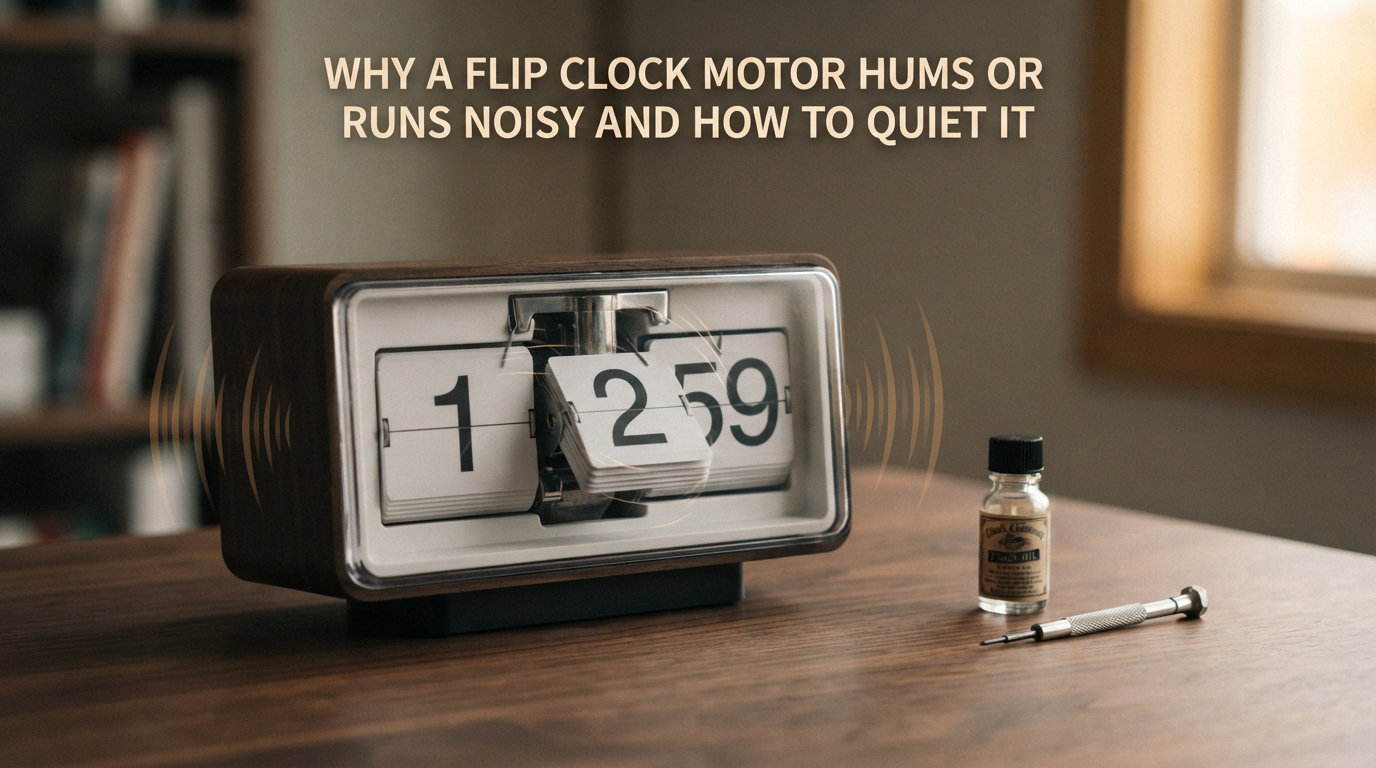
Flip clocks have a charm that digital displays simply cannot match. But when that satisfying flip of the digits gets drowned out by a loud hum, whine, or buzz coming from the motor, it can drive you up the wall, especially if the clock sits in a bedroom or a quiet office.
If you are dealing with a noisy flip clock motor humming noise, you are far from alone. Collectors and hobbyists on forums like FlipClockFans and Reddit have wrestled with this exact problem for years. The good news is that most causes are fixable, and many solutions cost nothing more than a few drops of the right oil.
In this guide, we break down exactly why your flip clock motor hums or runs noisy, how to diagnose the specific sound, and the step-by-step process to quiet it down. We also cover which oils work, which ones will ruin your motor, and when to call it quits and seek professional help.
Table of Contents
Why Does a Flip Clock Motor Hum or Run Noisy?
A flip clock motor hums or runs noisy because of one of five main culprits: dried or gummy lubrication, flywheel shaft wear, reduction gear friction, motor bearing deterioration, or loose mounting that transfers vibration to the clock housing.
The most common cause by far is lubrication that has dried up or turned gummy over decades of use. Vintage flip clocks from the 1960s and 1970s often still have their original factory grease, which has long since hardened into a sticky residue. This forces the motor to work harder, generating friction that translates into audible humming or whining.
Flywheel shaft wear is the second most frequent cause. The small metal shaft that holds the flywheel can develop wear over time, allowing lateral movement (side-to-side play) as the motor spins. This wobbling creates an inconsistent, whining noise that gets worse the more worn the shaft becomes.
Reduction gears inside the motor gearbox can also generate noise when their lubrication fails. These gears step down the motor speed to the slow rotation needed to flip the digit cards. When dry, the gear teeth grind against each other instead of meshing smoothly.
Motor bearing wear produces a deeper, rougher sound than simple lubrication failure. The bronze sleeve bearings inside synchronous motors can wear unevenly, creating a grinding sensation that oil alone will not fix.
Finally, loose mounting is an often-overlooked source of noise. If the motor is not securely fastened to the clock chassis, its vibration transfers directly into the plastic or metal housing, amplifying what would otherwise be a quiet hum into a noticeable buzz.
Noise Type Diagnosis: What Different Sounds Mean
One of the biggest content gaps we found across clock repair forums is that nobody maps specific noise types to their likely causes. So we built this diagnosis guide based on real user reports from FlipClockFans, Reddit, and vintage radio forums.
Here is what your flip clock motor noise is probably telling you.
Steady Low Hum or Buzz
A steady, low-pitched hum is often completely normal for a synchronous motor. As one Reddit user put it when describing their General Electric flip clock, the sound is “totally normal, a sort of quiet motor sound with slight cog noise.” If the hum is quiet enough that you only hear it in a silent room with your ear near the clock, your motor is likely healthy.
If that hum gets louder than usual, the motor probably needs lubrication. The friction from dried grease makes the motor strain harder, increasing the electromagnetic hum.
Whining or High-Pitched Squeal
A whining noise almost always points to flywheel shaft wear or bearing friction. When the shaft has developed lateral play, the flywheel wobbles as it spins, creating a high-pitched whine that can change pitch depending on the motor position.
As one FlipClockFans expert explained, when noise is “inconsistent and whiney,” it usually stems from wear and tear on the shaft rather than simple lubrication failure. Oil may temporarily quiet it, but the whine will likely return.
Clicking or Clacking
Clicking sounds typically indicate gear engagement issues inside the reduction gearbox. A gear tooth may be chipped, or a gear may have shifted out of alignment. This sound often occurs at regular intervals matching the gear rotation speed.
Grinding or Rasping
Grinding is the most alarming sound and usually means serious wear or debris inside the motor. This can indicate severely worn bearings, damaged gear teeth, or contamination that has entered the motor housing. Grinding warrants immediate attention before the motor seizes entirely.
Intermittent Noise That Comes and Goes
If your motor is quiet sometimes and noisy at other times, you are likely dealing with flywheel misalignment. The flywheel may be slightly bent, causing it to rub against the housing at certain points in its rotation. A pro restorer on FlipClockFans noted that the flywheel can sometimes be “bent back manually into alignment” to resolve this.
Understanding Flip Clock Motor Types
To understand the noise coming from your clock, it helps to know what kind of motor is inside it. Most vintage flip clocks use synchronous AC motors, with the Copal 227 being the most widely used model.
A synchronous motor runs at a speed locked to the frequency of your AC power supply (60 Hz in North America, 50 Hz in Europe and other regions). This design is what makes flip clocks surprisingly accurate, since the power grid frequency is tightly regulated. The motor itself spins at a fixed speed, typically 600 RPM for a Copal 227.
The Copal 227 motor is the heart of countless flip clocks from brands like General Electric, Panasonic, and Copal themselves. It is a small, cylindrical motor with a flywheel attached to one end and a reduction gearbox on the other. The gearbox steps down the motor speed through a series of gears until the output shaft turns at roughly one revolution per hour, which is what the flip mechanism needs.
The flywheel serves a critical purpose: it smooths out the pulsing torque of the synchronous motor, providing consistent rotation. When the flywheel shaft wears or the flywheel gets bent, that smooth rotation becomes jerky, and noise follows.
Some flip clocks use other motor types, but the Copal 227 and its variants account for the majority. If your clock plugs into the wall (not battery operated) and was made between 1960 and 1990, it almost certainly uses a synchronous motor of this type.
How to Lubricate a Flip Clock Motor
Lubricating a flip clock motor is the single most effective fix for noise, and it is something most clock owners can do themselves. The key is using the right oil and applying it correctly.
What Oils Work Best
Three types of oil are recommended by experienced clock restorers:
Clock oil is the gold standard. Products like Moebius clock oil or other synthetic clock oils are formulated specifically for low-speed mechanisms. They resist evaporation and oxidation, meaning one application can last for years.
Synthetic motor oil is a popular alternative that real users report excellent results with. One FlipClockFans user named Dricco shared that applying just 2 to 3 drops of synthetic motor oil to a Copal 227 motor made the noise “completely vanish.”
Silicone oil is another option, particularly effective for clocks with plastic gears. A contributor on the NAWCC (National Association of Watch and Clock Collectors) forum recommended applying silicone oil to gear teeth to eliminate noise in quartz movements.
Step-by-Step Oiling Process
Step 1: Unplug the clock. Never work on a clock motor while it is connected to power. This is non-negotiable for your safety.
Step 2: Open the clock case. Most flip clocks have screws on the back or bottom that release the housing. Remove them carefully and set them aside. Take note of how the digit cards are positioned so you can reassemble correctly.
Step 3: Locate the motor. The Copal 227 motor is typically a small metal cylinder mounted near the center or side of the mechanism. You will see the flywheel (a weighted disc) on one end.
Step 4: Access the motor shaft. Look for the small gap between the flywheel and the motor body. This is where the shaft bearing sits and where oil needs to go. You may need to remove a small cover or the flywheel retaining clip.
Step 5: Apply 2 to 3 drops of oil. Use a pin, toothpick, or precision oiler to place a small amount of oil directly on the shaft where it enters the bearing. Less is more here. Too much oil will attract dust and create a mess.
Step 6: Manually rotate the flywheel. Spin the flywheel by hand a few times to distribute the oil along the shaft and into the bearing.
Step 7: Reassemble and test. Put the clock back together, plug it in, and listen. The improvement should be immediate if lubrication was the issue.
If the motor has a sealed gearbox, you may not be able to oil the reduction gears directly. In that case, focus on the main shaft bearing and the flywheel, which are usually accessible.
The WD-40 Warning: Why It Damages Flip Clock Motors
If there is one thing every experienced clock restorer agrees on, it is this: do not use WD-40 on your flip clock motor.
WD-40 is a solvent-based penetrating oil, not a true lubricant. When you spray it into a clock motor, it dissolves and washes away the factory grease that coats the bearings and gears. This might seem to help at first, because the solvent reduces friction temporarily. But within days or weeks, the WD-40 evaporates and leaves the motor completely dry, often in worse condition than before.
The same principle applies to alcohol baths. Some guides suggest soaking clock motors in alcohol to clean them. This is a mistake for flip clock motors because alcohol strips away all lubrication, including grease packed inside sealed bearings that you cannot re-oil. A pro restorer on FlipClockFans warned specifically about this, noting that alcohol baths destroy the motor grease that was meant to last the lifetime of the clock.
The proper approach is to add fresh oil to the existing lubrication, not to strip it away. Clock oil and synthetic motor oil are designed to blend with existing grease and restore its lubricating properties without dissolving it.
If you have already used WD-40, all is not lost. You will need to clean the affected areas and apply fresh clock oil or synthetic motor oil to replace what was stripped away. The motor may need a thorough relubrication of all bearing surfaces.
Flywheel Inspection and Adjustment
After lubrication, the flywheel is the second most common source of flip clock motor noise. Here is how to inspect it and determine whether adjustment or replacement is needed.
First, check for lateral movement. With the clock unplugged and the case open, gently grip the flywheel and try to move it side to side along the shaft. There should be virtually no play. If the flywheel slides even a millimeter or two, the shaft is worn.
Next, check for axial play by gently pushing and pulling the flywheel along its rotational axis. A tiny amount of movement is normal, but significant play indicates bearing wear.
Spin the flywheel by hand and watch it carefully. If it wobbles visibly rather than spinning true, the flywheel itself may be bent. This can happen from impacts, shipping damage, or just age. As the FlipClockFans forum notes, a bent flywheel can sometimes be “bent back manually into alignment.” Use gentle, controlled pressure to straighten it, checking the rotation repeatedly as you go.
If the shaft itself is worn thin where it passes through the bearing, no amount of oil or adjustment will permanently fix the noise. The shaft surface has been polished down over decades of friction, creating a gap between the shaft and bearing that allows wobbling. In this case, the motor needs replacement.
Replacement Copal 227 motors do come up for sale on eBay and specialty clock parts sites. They are not always easy to find, so it is worth checking FlipClockFans and similar communities for leads on spare parts.
Signs of Motor Wear vs. Simple Lubrication Needs
One of the most common questions on clock forums is whether a noisy motor just needs oil or whether something more serious is going on. Here is how to tell the difference.
If the noise appeared gradually over time and is a steady hum or buzz, lubrication is almost certainly the fix. Apply clock oil or synthetic motor oil and see if the noise subsides. If it does and stays quiet, you are in the clear.
If you oil the motor and the noise disappears but returns within a few days or weeks, the shaft or bearings are likely worn. Oil is filling the gap temporarily but draining away because the clearance is too large. This means the motor is nearing the end of its serviceable life.
If the motor runs hot to the touch after extended operation, that is another sign of internal wear. A healthy synchronous motor runs barely warm. Excess heat means friction from worn surfaces.
Sealed motors present a special challenge. Some Copal motors have permanently sealed gearboxes that cannot be opened without destroying them. If your motor is sealed and oiling the accessible shaft does not help, your only options are to live with the noise or find a replacement motor.
Preventive Maintenance Tips
None of the competitor guides we reviewed include a maintenance schedule, so here is our recommendation based on restorer experience.
Lubricate your flip clock motor every 3 to 5 years if the clock runs continuously. If the clock is only used occasionally or seasonally, every 5 to 8 years is sufficient. Applying 2 to 3 drops of clock oil to the main shaft bearing is all it takes.
Store flip clocks in a temperature-stable environment. Extreme heat can accelerate lubricant breakdown, while extreme cold can make the lubricant thick and gummy. Avoid attics, garages, and basements with large temperature swings.
Keep the clock away from dust and humidity. Dust that enters the motor housing mixes with oil and creates an abrasive paste that accelerates wear. If your clock has ventilation slots, consider covering them loosely with a small piece of breathable cloth.
Inspect the flip mechanism annually. Make sure the digit cards flip freely without binding. Stiff or sticking cards put extra load on the motor, which can contribute to noise and premature wear.
If you purchase a vintage flip clock that has been in storage for years, lubricate the motor before running it continuously. Old grease that has sat unused for decades is almost certainly dried out, and running the motor dry will accelerate shaft and bearing wear.
FAQs
How to make a clock mechanism quieter?
To make a clock mechanism quieter, apply 2 to 3 drops of clock oil or synthetic motor oil to the motor shaft bearing, check the flywheel for misalignment, and ensure the motor is securely mounted to reduce vibration transfer. Avoid WD-40, which strips away factory lubrication and makes noise worse over time.
Can you use WD-40 on clock movements?
No, you should not use WD-40 on clock movements. WD-40 is a solvent-based penetrant that dissolves and washes away the factory grease protecting the motor bearings and gears. It may reduce noise temporarily, but once it evaporates, the motor will be drier and noisier than before. Use clock oil or synthetic motor oil instead.
Does a flip clock make noise?
Yes, a flip clock makes a faint hum or buzz from its synchronous motor, which is completely normal. You should only hear it in a very quiet room with your ear near the clock. If the noise becomes loud, whining, grinding, or intermittent, that indicates a problem like dried lubrication or flywheel shaft wear.
How to lubricate a clock motor?
To lubricate a clock motor, unplug the clock, open the case, locate the motor shaft where it enters the bearing, apply 2 to 3 drops of clock oil or synthetic motor oil using a pin or precision oiler, then manually rotate the flywheel to distribute the oil. Reassemble and test. Use clock oil, synthetic motor oil, or silicone oil, never WD-40.
What kind of oil do you use for clock mechanisms?
The best oils for clock mechanisms are synthetic clock oil (such as Moebius), synthetic motor oil, and silicone oil. These are formulated to resist evaporation and oxidation, lasting for years inside the mechanism. Avoid WD-40, 3-in-One oil, and cooking oils, which either dry out quickly or attract dust.
Conclusion
A flip clock motor that hums or runs noisy is almost always sending you a message about lubrication or wear. By diagnosing the specific sound, applying the right oil in the right amount, and inspecting the flywheel for alignment issues, you can silence most noisy motors and keep your vintage clock running quietly for years to come. Skip the WD-40, stick with clock oil or synthetic motor oil, and your flip clock will reward you with that satisfying, near-silent flip well into 2026 and beyond.