
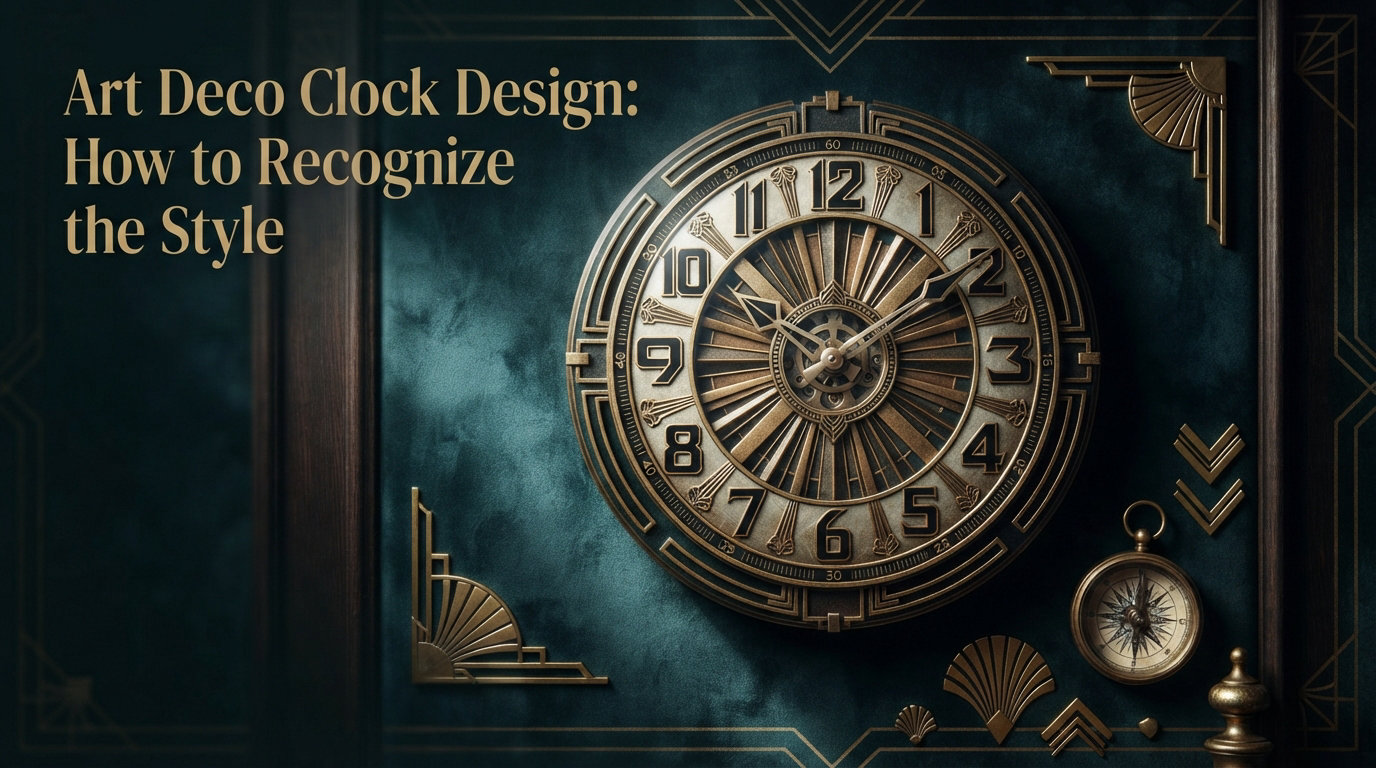
Walk into any antique shop and you will likely spot one within minutes. A clock that looks like a tiny chrome skyscraper. A marble mantel piece with stepped tiers and a sunburst dial. A bronze gazelle frozen mid-leap, forever pointing to the hour. These are Art Deco clocks, and once you learn to read their visual language, you start seeing them everywhere.
The challenge is that not every geometric, shiny, or old clock qualifies as Art Deco. Collectors on forums like r/Antiques and the NAWCC message boards ask the same questions again and again. They want to know if a clock is genuinely from the period, whether it is a later reproduction, and how to distinguish Deco from the older Art Nouveau style that came before it.
This guide breaks down Art Deco clock design so you can recognize the style with confidence. I will walk you through the historical context, the defining characteristics, the materials, the major clock types, and the makers who shaped the era. By the end, you will have a practical checklist for identifying Art Deco clocks in the wild.
Whether you collect, sell, inherit, or simply admire these timepieces, understanding Art Deco clock design transforms how you see decorative objects from the 1920s and 1930s. Let us start with the basics.
Table of Contents
What Is Art Deco Clock Design?
Art Deco clock design refers to timepieces created during the Art Deco movement, roughly 1920 through 1940, that share a visual language of geometric shapes, symmetrical composition, bold materials, and machine-age styling. These clocks turned ordinary timekeeping into sculptural statements that reflected the speed, industry, and optimism of the interwar years.
The style took its name from the 1925 Exposition Internationale des Arts Decoratifs et Industriels Modernes in Paris. That exhibition set the rules for what counted as modern design, and clockmakers across Europe and America adopted the aesthetic almost immediately. The result was a golden age of clock design that lasted until the outbreak of the Second World War.
What separates Art Deco clocks from earlier Victorian or Art Nouveau pieces is the deliberate embrace of geometry over ornament. Instead of flowing vines and curving flowers, Deco designers used straight lines, angles, sunbursts, and stepped forms. The clock case became as important as the movement inside it, sometimes more so.
You will find Art Deco clocks at every price point, from humble American kitchen clocks to French masterpieces by Edgar Brandt. The unifying thread is design intent. Every Deco clock was built to look modern, confident, and architectural.
Key Art Deco Clock Characteristics
Recognizing Art Deco clock design comes down to a handful of repeating visual traits. Once you internalize these, identification becomes almost instinctive. Here are the defining characteristics to look for.
1. Geometric Shapes and Angular Composition
Geometry is the single most reliable signal of Art Deco design. Look for squares, rectangles, triangles, hexagons, and diamonds worked into the case, the dial, or the decoration. Circles appear too, but they tend to be precise and architectural rather than soft and naturalistic.
The overall silhouette is usually angular. A Deco clock rarely curves gently. Instead, it rises in steps, cuts in at sharp angles, or stacks geometric blocks. Think of a miniature Chrysler Building and you have the right mental image.
2. Symmetrical Patterns and Balanced Layout
Symmetry rules in Art Deco clock design. The dial sits centered or balanced against a matching decorative element. Garniture sets come with flanking vases or candelabra that mirror each other perfectly. Even asymmetrical pieces usually have a strong sense of visual balance.
This symmetry reflects the era’s faith in order and rational design. Where Art Nouveau embraced wild, organic asymmetry, Deco imposed structure. If a clock looks carefully balanced and mathematically proportioned, that is a strong Deco indicator.
3. Stepped, Tiered, and Skyscraper Profiles
The stepped profile is perhaps the most iconic Art Deco shape. Clocks rise in a series of receding tiers, echoing the setbacks of 1920s skyscrapers like the Empire State Building. This architectural connection was deliberate. Designers wanted clocks to feel like monuments to modern progress.
You will see stepped forms on mantel clocks, table clocks, and even wall clocks. The steps can be subtle, just two or three levels, or dramatic, with a tall ziggurat silhouette. Either way, the stepped profile is a signature you can spot across a room.
4. Sunburst, Chevron, and Geometric Motifs
Decorative motifs in Art Deco clock design fall into a recognizable family. The sunburst, with radiating lines spreading from a central point, appears constantly on dials and case fronts. Chevrons, zigzags, and stylized lightning bolts add energy and motion.
Other common motifs include fans, abstract florals, zigzags, and stylized female figures. These decorations are always geometric and flattened, never realistically rendered. A Deco sunburst looks like a graphic symbol, not a painting of the sun.
5. Horizontal Emphasis and Low, Wide Proportions
Many Art Deco mantel and table clocks stretch horizontally rather than rising tall. This horizontal emphasis gives them a grounded, stable feel that suits a shelf or mantelpiece. The wide format also accommodates the symmetrical garniture arrangement popular in the period.
When a clock is noticeably wider than it is tall, with decoration distributed across that width, you are likely looking at Deco design. Tall, narrow, vertical clocks are more typical of earlier Gothic or Victorian styles.
Materials Used in Art Deco Clocks
Materials tell you a great deal about an Art Deco clock’s origin, quality, and era. The movement celebrated modern industrial materials alongside traditional luxury ones. Learning to identify these materials is essential for confident recognition.
Marble and Onyx
Marble and onyx cases are hallmarks of French Art Deco clocks. Green onyx, in particular, was favored by designers like Edgar Brandt and clockmaker Maison JAPY. These stones gave clocks weight, color, and a sense of permanent luxury.
Run your hand over a genuine marble or onyx case and you will feel a cool, dense surface that does not warm quickly. Reproductions sometimes use resin or painted wood to mimic these stones, but the weight and temperature give them away immediately.
Bronze and Spelter
Bronze figurals represent the high end of Art Deco clock design. Sculptures of gazelles, greyhounds, dancers, and classical figures were cast in bronze and patinated to a rich brown or green finish. These pieces command serious collector interest.
Spelter, a zinc alloy, was the affordable alternative to bronze. Many mass-produced French Deco clocks used spelter figures with a bronze or silver finish applied over the top. Collectors on the NAWCC forums frequently discuss how to distinguish the two. Bronze feels heavier, develops a natural patina, and shows a different color when scratched. Spelter is lighter, sometimes shows grayish zinc at wear points, and can develop a powdery surface.
Chrome and Nickel
Chrome plating defined the machine-age look of American and British Art Deco clocks. Bright, reflective chrome cases paired with glass, bakelite, or enamel gave clocks a futuristic sheen that screamed modernity. Telechron and General Electric pioneered this aesthetic in the United States.
Genuine period chrome has a warm, slightly soft reflection compared to modern chrome. Wear patterns on older pieces tend to be smooth and gradual rather than flaking. Look for chrome paired with black bakelite or catalin for a classic American Deco combination.
Glass, Enamel, and Bakelite
Glass appears in Art Deco clocks as dials, shelves, and decorative panels. Frosted glass with etched geometric patterns was especially popular. Enamel dials, often in cream or silver, provided crisp numerals and clean lines.
Bakelite and catalin, the early plastics, allowed designers to create clock cases in bold colors and complex molded shapes. These materials were revolutionary at the time and remain collectible today. Look for deep, rich colors and a slight depth to the material that modern plastics lack.
Types of Art Deco Clocks
Art Deco clock design spans several distinct categories, each with its own conventions and collectible appeal. Understanding these types helps you recognize what you are looking at and why it matters.
Mantel Clocks
The mantel clock is the quintessential Art Deco timepiece. Designed to sit on a fireplace mantel or shelf, these clocks come in stepped marble cases, chrome skyscraper forms, and wooden architectural designs. They are the most common Art Deco clock type you will encounter.
French mantel clocks often pair marble or onyx cases with bronze or spelter figurals. American versions lean toward wood, chrome, or bakelite with simpler, more streamlined forms. Both traditions share the horizontal emphasis and geometric styling that define the era.
Garniture de Cheminee Sets
A garniture is a three-piece set consisting of a central clock flanked by matching vases, urns, or candelabra. These sets were the height of French Art Deco luxury and remain among the most valuable finds when complete and original.
Collectors prize complete garniture sets highly. Finding a clock with its original matching side pieces is rare because the sets were often broken up over the decades. If you spot a clock with two perfectly matching companions, pay close attention to whether all three share the same materials, patina, and construction quality.
Figural Clocks
Figural clocks feature sculptural elements as their primary design feature. A bronze dancer, a leaping deer, a classical goddess, or an avant-garde abstract figure supports or surrounds the dial. These pieces blur the line between timepiece and sculpture.
The chryselephantine technique, combining bronze with ivory or faux-ivory elements, represents the peak of Art Deco figural design. Authentic ivory is rare and regulated today, so many surviving pieces use genuine ivory from the period. Always check provenance and legal documentation for ivory-containing pieces.
Table and Desk Clocks
Smaller table and desk clocks brought Art Deco design into offices and bedrooms. These pieces range from sleek chrome travel clocks to glass-and-marble desk clocks with built-in barometers or thermometers. They tend to be more affordable than mantel clocks while still showcasing strong Deco styling.
Look for clean geometric forms, quality movements, and intact glass or enamel elements. Carriage-style clocks with Deco detailing are also common in this category.
Wall Clocks
Art Deco wall clocks include the iconic schoolhouse-style clocks with bold numerals and geometric surrounds, as well as more avant-garde designs in chrome and glass. JAZ, the French clockmaker, produced striking geometric wall clocks that are highly collectible today.
American wall clocks from the period often feature wooden cases with stepped or angular detailing. European versions experiment more with metal, glass, and bold graphic dials. Wall clocks are sometimes overlooked by collectors, which can make them an accessible entry point into Art Deco collecting.
Art Deco vs Art Nouveau: How to Tell the Difference
This is one of the most common questions collectors ask, and it is also the comparison no competing guide covers well. The confusion is understandable because both styles value beauty and craftsmanship, but they are visual opposites in nearly every way.
Art Nouveau preceded Art Deco, flourishing from roughly 1890 to 1910. Art Deco followed from about 1920 to 1940. The two styles bookend the early twentieth century, and telling them apart comes down to line, form, and philosophy.
Line and shape: Art Nouveau is all about curves. Think sinuous whiplash lines, flowing organic forms, and shapes borrowed from vines, flowers, and insect wings. Art Deco is all about angles. Think straight lines, sharp corners, sunbursts, and stepped geometry. If a clock curves and flows, it is probably Nouveau. If it angles and steps, it is probably Deco.
Decoration: Art Nouveau decoration is naturalistic and detailed, with realistic flowers, dragonflies, and female figures with flowing hair. Art Deco decoration is stylized and abstracted. A Deco flower looks like a geometric symbol of a flower, not a botanical illustration.
Materials: Art Nouveau clocks favor wrought iron, bronze with organic patinas, enameling in soft colors, and carved wood with natural forms. Art Deco embraces chrome, plate glass, marble, onyx, bakelite, and polished geometric surfaces. The materials reflect the eras’ different relationships with industry and nature.
Overall feeling: Art Nouveau feels romantic, handmade, and connected to nature. Art Deco feels confident, machine-made, and connected to the city. Trust your gut reaction. If a clock feels organic and dreamy, think Nouveau. If it feels crisp and architectural, think Deco.
A quick comparison: Art Nouveau uses curving organic lines, naturalistic decoration, and romantic materials. Art Deco uses angular geometry, stylized motifs, and industrial materials. The line test alone solves most identification questions.
From Early Deco to Streamline Moderne
Art Deco was never a single static style. It evolved significantly across its two-decade run, and recognizing where a clock falls on that timeline sharpens your identification skills.
Early Art Deco, from roughly 1920 to 1928, is the most decorative phase. These clocks feature rich materials, figurals, and elaborate geometric ornament. Think marble cases with bronze dancers and sunburst dials. This is the Paris exhibition era, opulent and proud.
The Wall Street crash of 1929 and the Depression that followed shifted taste toward simpler, more affordable designs. The middle phase of Deco, roughly 1928 to 1934, strips back some ornament while keeping the geometric foundation. Wood and chrome replace expensive marble and bronze in many markets.
Streamline Moderne emerged in the mid-1930s as Deco’s final evolution. This phase drew inspiration from aerodynamics, ocean liners, trains, and automobiles. Curves returned, but they were smooth, horizontal, and aerodynamic rather than organic. Clocks from this era feature rounded corners, horizontal speed lines, and teardrop or bullet shapes. Telechron’s pancake clocks and many American designs from the late 1930s exemplify this look.
Recognizing these phases helps you date a clock and understand its design context. A clock with heavy figurals and marble is likely early French Deco. A chrome clock with speed lines and rounded edges is likely late American Streamline Moderne.
Notable Art Deco Clock Makers and Designers
Maker identification is one of the most valuable skills a collector can develop. Signed and documented pieces carry significantly more value than unmarked ones, and certain names command premium prices.
Edgar Brandt was the master of French Art Deco metalwork. His forged iron and bronze clocks, often paired with marble or onyx bases, represent the pinnacle of the style. A signed Brandt clock is a museum-quality find.
Maison JAPY was one of the largest French clock manufacturers and supplied movements for countless Deco clocks. JAPY movements are widely found in French mantel and garniture clocks, and the name on a back plate helps confirm French origin.
Cartier produced luxury Art Deco clocks in rock crystal, enamel, and precious metals. These pieces are exceptionally rare and valuable, often featuring mystery clocks where the hands appear to float on a clear crystal dial.
Telechron led the American Art Deco clock market with electric synchronous movements and bold chrome designs. Telechron clocks are accessible to new collectors and showcase the Streamline Moderne aesthetic beautifully.
Seth Thomas produced a wide range of American Deco clocks in wood, metal, and bakelite. Their clocks are well-documented and relatively easy to research, making them good learning pieces for new collectors.
JAZ was a French maker famous for striking geometric wall and mantel clocks, often in bright colors and unconventional materials. JAZ designs feel playful and avant-garde, and they have a devoted collector following.
Other names to watch for include Edgar Brandt’s collaborator Edmond Becot, the British maker Smiths, and German makers like Junghans. When you find a maker mark on a back plate or dial, research it. Provenance adds enormous value and historical depth.
How to Identify an Art Deco Clock: Step-by-Step Checklist
Now let us turn all this knowledge into a practical process. When you encounter a clock you want to evaluate, work through these steps in order.
Step 1: Assess the overall form. Look at the silhouette first. Does it show geometric shapes, stepped tiers, a horizontal emphasis, or angular composition? If yes, you have a candidate for Art Deco. If the form is curvy and organic, consider Art Nouveau instead.
Step 2: Examine the decorative motifs. Look for sunbursts, chevrons, zigzags, stylized fans, or geometric patterns. These motifs, rendered in a flattened and abstract way, confirm Deco styling. Realistic flowers or flowing vines point elsewhere.
Step 3: Identify the materials. Check for marble, onyx, bronze, spelter, chrome, glass, enamel, or bakelite. The combination of materials tells you about origin and quality. Marble with bronze suggests French origin. Chrome with bakelite suggests American.
Step 4: Check the dial and numerals. Art Deco dials often feature bold, stylized numerals, geometric chapter rings, or sunburst patterns. Arabic numerals in a clean sans-serif typeface are common. Elaborate or spidery Roman numerals usually indicate an earlier era.
Step 5: Look for maker marks. Open the back door or remove the case and inspect the movement plate. Look for engraved or stamped names, city marks, serial numbers, or patent dates. Photograph everything you find, as marks can be subtle.
Step 6: Evaluate the movement. Determine whether the clock has a mechanical spring-wound movement or an electric synchronous movement. Electric movements became common in the late 1920s and 1930s, especially in American clocks. A period-correct movement supports authenticity.
Step 7: Consider the era clues. Combine all evidence to place the clock between 1920 and 1940. If the materials, form, motifs, and movement all align with that window, you can confidently call it Art Deco.
Spotting Reproductions: Real vs Fake
Because genuine Art Deco clocks are valuable, reproductions exist and they fool inexperienced buyers regularly. Forum discussions on r/Antiques and the NAWCC boards reveal the same patterns of deception. Here is what to watch for.
Modern reproductions often use resin or composite materials to mimic marble, bronze, or ivory. These fakes are significantly lighter than the real thing. Pick the clock up. A genuine marble or bronze clock has real heft. If it feels light for its size, be suspicious.
Examine the patina. Authentic bronze and spelter develop a natural patina over decades that is difficult to fake convincingly. Real patina is uneven, with darker areas in recesses and lighter wear on high points. An artificially applied finish looks flat, uniform, or unnaturally colored.
Check the movement age. A clock claimed to be from the 1920s should have a movement consistent with that era. Modern quartz movements inserted into old-style cases are a common red flag. Open the case and look at the movement plates, the winding mechanism, and any maker stamps.
Look at construction quality. Genuine Art Deco clocks show period-appropriate construction techniques, including hand-finished details, dovetailed joints in wooden cases, and properly fitted metalwork. Sloppy joints, modern screws, or glue residue suggest a recent assembly.
Research the seller and provenance. Documentation, receipts, and credible attribution add confidence. Be wary of vague descriptions like “Art Deco style” rather than “Art Deco period.” The word “style” often signals a modern piece inspired by Deco rather than an authentic period clock.
Trust your instincts but verify with research. When in doubt, consult an appraiser or post photos to collector communities. Experienced eyes catch details that newcomers miss, and the community is usually generous with knowledge.
Regional Variations: French vs American Deco
Art Deco clock design was not uniform across regions. French and American Deco developed distinct personalities, and recognizing these differences helps with identification and collecting focus.
French Art Deco is luxurious, sculptural, and richly material. Expect marble and onyx cases, bronze or spelter figurals, garniture sets, and elaborate decoration. French clocks often have mechanical spring-wound movements from makers like JAPY or Marti. They feel like art objects first and timepieces second.
American Art Deco is practical, streamlined, and technologically forward. Expect chrome, bakelite, glass, and wood cases with cleaner lines and less figural ornament. American clocks pioneered electric synchronous movements through companies like Telechron and General Electric. They feel like products of the machine age.
British and German Deco fall somewhere between, with British makers like Smiths producing solid, dignified clocks and German makers like Junghans emphasizing precision engineering alongside geometric styling. Regional awareness prevents misattribution and helps you appreciate the full range of Art Deco design.
Caring for Art Deco Clocks
Once you identify and acquire an Art Deco clock, proper care preserves both its function and its value. These are delicate antique objects that deserve thoughtful maintenance.
Keep clocks away from direct sunlight, extreme humidity, and rapid temperature changes. Marble and onyx can crack under thermal stress, and prolonged sun exposure fades dials and damages finishes. A stable indoor environment protects materials and movements alike.
Have mechanical movements serviced by a clock specialist every few years. Running a dry or dirty movement causes wear that becomes expensive to repair. Electric movements should be inspected for degraded wiring, as original insulation from the 1930s can be unsafe.
Clean cases gently with soft cloths and appropriate materials for each surface. Never use harsh chemicals on marble, bronze patina, or bakelite. Preserve original patina rather than polishing it away, as collectors value original surfaces highly.
Store or display clocks where they will not be knocked, and consider professional packing for transport. Replacement parts for Art Deco clocks can be difficult to source, so preventing damage is far easier than repairing it.
FAQs
How to identify Art Deco style?
Art Deco style is identified by geometric shapes, symmetrical patterns, stepped or tiered profiles, sunburst and chevron motifs, and modern materials like chrome, marble, glass, and bakelite. On clocks, look for angular cases, bold stylized numerals, and a horizontal emphasis that echoes 1920s and 1930s skyscraper architecture.
What are the different clock styles?
Major clock styles include Art Deco (1920s to 1940s, geometric and machine-age), Art Nouveau (1890s to 1910s, curving and organic), Victorian (ornate and traditional), Mid-Century Modern (1950s to 1960s, clean and minimalist), and Streamline Moderne (1930s, aerodynamic curves). Art Deco clocks appear as mantel clocks, garniture sets, figural clocks, table clocks, and wall clocks.
What are four characteristics of Art Deco?
The four key characteristics of Art Deco are geometric shapes and angular composition, symmetrical balance and patterns, stepped or tiered skyscraper profiles, and stylized motifs like sunbursts and chevrons. These traits distinguish Art Deco from the curving, organic forms of the earlier Art Nouveau movement.
How to tell the difference between Art Nouveau and Art Deco?
Art Nouveau uses curving organic lines, naturalistic decoration like flowing vines and realistic flowers, and romantic materials such as wrought iron and soft enamels. Art Deco uses angular geometry, stylized abstract motifs like sunbursts and chevrons, and industrial materials like chrome, marble, and glass. If it curves and flows, it is Nouveau. If it angles and steps, it is Deco.
What materials were used in Art Deco clocks?
Art Deco clocks were made from marble, onyx, bronze, spelter, chrome, nickel, glass, enamel, bakelite, catalin, and various woods. French clocks favored marble, onyx, and bronze. American clocks leaned toward chrome, bakelite, glass, and wood. The material mix helps identify a clock’s origin and quality level.
How do I know if my Art Deco clock is valuable?
Value depends on maker attribution, originality of materials and patina, completeness of garniture sets, working mechanical condition, and rarity. Signed pieces by makers like Edgar Brandt, Cartier, or JAZ command premium prices. Original surfaces, period-correct movements, and strong provenance all increase value. Have significant pieces appraised by a specialist.
Conclusion
Art Deco clock design is a visual language of geometry, symmetry, bold materials, and machine-age confidence. Once you learn to read that language, recognizing the style becomes second nature whether you are browsing an antique fair or sorting through a family inheritance.
Remember the core signals. Angular shapes, stepped profiles, sunburst and chevron motifs, horizontal emphasis, and materials like marble, chrome, bronze, and bakelite all point to Art Deco. When those traits appear together on a clock from the 1920 to 1940 window, you can identify it with confidence.
If you take away one lesson from this guide, let it be the line test. Art Deco is about angles and structure where Art Nouveau is about curves and flow. That single distinction resolves most identification questions on the spot.
From here, your next step is practice. Visit antique shops, browse auction catalogs, and join collector communities like the NAWCC forums. The more genuine Art Deco clocks you examine, the sharper your eye becomes. Art Deco clock design rewards attention, and the more you look, the more you will find.