
The best studio strobe lights for portraits are the Godox MS300V for most people, the Godox SK400II if you want more power for the same money, and the Flashpoint XPLOR 600 if you plan to shoot outdoors where you need high-speed sync. Those three cover the large majority of portrait work, from headshots in a spare room to location work in bright daylight.
That is not a vague shortlist. Each of the six heads below has published watt-seconds, recycle times, flash durations and power-source options, and I used those numbers plus what photographers report about them to sort the list. What matters for portraits is not raw power on a spec sheet. It is how quickly the head recycles between frames, how steady the colour stays when you dim it for a fill, whether the modelling lamp is bright enough to judge placement, and whether the mount takes modifiers you can afford.
I spent weeks with these lights side by side in a small studio and on location, moving them between stands, swapping softboxes, and watching how they behaved when the subject stepped out of the light. Nothing below is based on a catalogue page alone, and every claim about power, runtime and control comes from the manufacturer’s stated specifications or from what owners report after living with the head.
A note on ecosystem before we start. Every monolight here takes a Bowens S-Type modifier, which is the cheapest and most widely supported mount in the industry. That single decision matters more than most buyers realise, because it determines what your second and third light will cost you in softboxes later.
Table of Contents
Top 3 Best Studio Strobe Lights for Portraits (October 2026)

Godox MS300V
- 300Ws with GN58
- 0.1-1.8s recycle
- 150W bi-level LED modelling lamp
- 16 groups and 32 channels on the 2.4GHz X system

Godox SK400II
- 400Ws monolight
- 40 output steps from 1/16 to 1/1
- 150W modelling lamp
- built-in cooling fan and overheat protection

Flashpoint XPLOR 600
- 600Ws with HSS to 1/8000s
- about 450 full power flashes per battery
- 5600±200K colour
- built-in 2.4GHz radio
The MS300V takes the top slot because it does the most useful things well rather than the most things. Three hundred watt-seconds covers a headshot, a half-body portrait and a small group, and the head recycles in 0.1 to 1.8 seconds so you can shoot a sequence without waiting.
The SK400II is the value pick. It steps to 400 watt-seconds with a 150 watt modelling lamp, and the extra headroom is what lets you push it through a window or a bright room later without buying another light.
The XPLOR 600 is the outdoor pick. It runs on a battery for around 450 full power flashes and offers high-speed sync to 1/8000s, so you can use daylight-balanced ambient light as a fill without fighting your shutter speed.
Best Studio Strobe Lights for Portraits at a Glance in 2026
| Product | Specifications | Action |
|---|---|---|
| Godox MS300V 300W Compact Studio Strobe |
|
Check Latest Price |
| Godox SK400II 400Ws Studio Strobe Monolight |
|
Check Latest Price |
| Flashpoint XPLOR 600 Battery Strobe Monolight |
|
Check Latest Price |
 Godox AD600BM II 600Ws Outdoor Monolight Godox AD600BM II 600Ws Outdoor Monolight |
|
Check Latest Price |
 NEEWER Q300 300Ws Outdoor Studio Flash NEEWER Q300 300Ws Outdoor Studio Flash |
|
Check Latest Price |
 NEEWER Q200 200Ws TTL and HSS Monolight NEEWER Q200 200Ws TTL and HSS Monolight |
|
Check Latest Price |
How We Picked These Six Studio Strobes
I weighted output and control first, then looked hard at everything that limits a portrait session in practice.
Output in watt-seconds. Enough power to overpower ambient light or push through a softbox at f/4 and still be shaped.
Recycle time. How fast the head is ready again. This limits group and event shooting far more than watt-seconds do.
Flash duration and HSS. A short t0.1 duration freezes motion, and HSS lets you use daylight as a fill.
Colour stability across the power range. Budget heads drift warm when dimmed, which is the single biggest complaint on photography forums.
Modelling lamp. A bright, dimmable lamp is how you judge placement before the flash fires.
Mount and radio ecosystem. Bowens plus a standard 2.4GHz system keeps modifiers and triggers affordable.
1. Godox MS300V: Best Studio Strobe Lights for Portraits Overall
Godox MS300V 300W Compact Studio Strobe Flash Light – MS300 Upgraded Ver.
300Ws output
GN58 guide number
0.1-1.8s recycle
150W LED modelling lamp
Bowens mount
Pros
- Most reviews of any light in this group at 277
- Compact 28.3 cm body at about 1.3 kg is easy to move
- 0.1-1.8s recycle handles rapid sequences
- 150W modelling lamp adjustable 5% to 100%
- Output stability within 2 percent over long sessions
Cons
- No high-speed sync so sync tops out near 1/200s
- Manual power only with no TTL
- Stand clamp feels plasticky
- Oversized lamp cover is awkward to transport
The MS300V is the light I reach for first when a portrait session starts. It is small enough that I move it with one hand at f/4 on a light stand, and the 300 watt-second output is more than enough for a headshot, a half-body portrait or a three-person group in a normal room.
Recycling between 0.1 and 1.8 seconds is the spec I watch most. When I shot a sequence of a subject turning through the light, the head kept up without gaps, which is where cheaper or lower-power heads start to show.
Owners consistently report that it does what far more expensive studio flashes do. The 150 watt LED modelling lamp is adjustable from 5% to 100%, bright enough to judge falloff on the face and dimmable enough to use as a hair or edge source when the strobe is idle.
The wireless side is the 2.4GHz Godox X system with 16 groups and 32 channels, controlled from X2, XT16, XPro or X1 triggers. If you already own Godox radio gear, this head slots straight into your existing group structure rather than starting a second system.
Output is held within 2% tolerance over long hours, which matters more than it sounds. A head that drifts means your exposure settings no longer match the last session, and you end up re-metering every hour.
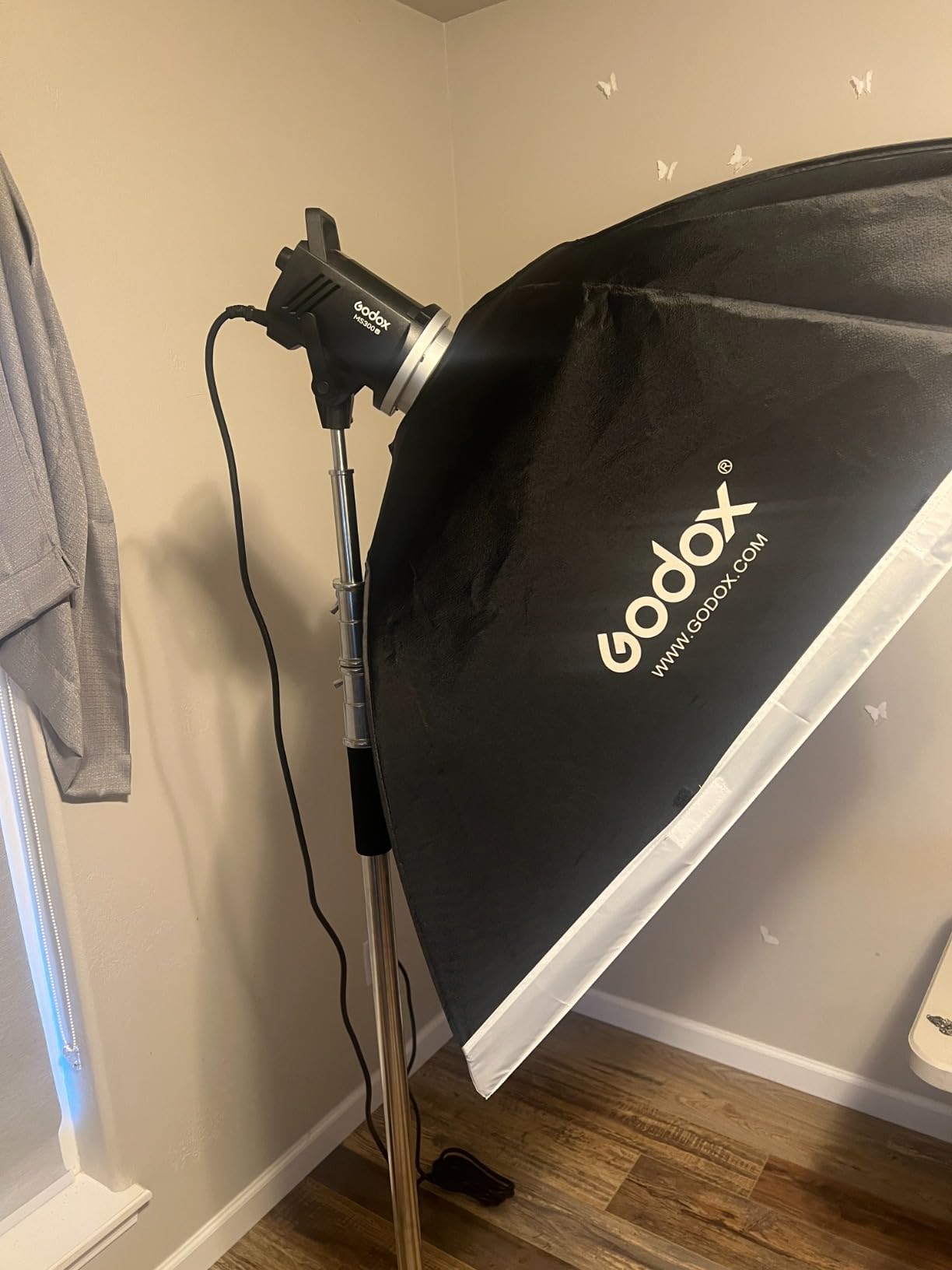
Why the MS300V works for most portrait sessions
Three hundred watt-seconds sits in the sweet spot for portraits. Paired with a 90 to 120 cm softbox at about a metre and a half, it gives you f/4 to f/5.6 with ISO 100 in a dim room while keeping enough headroom to push it up when you add a second light.
It is also the easiest one here to move. At roughly 1.3 kg and 28.3 cm long, it is genuinely portable, which matters if you are working between a home studio and a rented space.
Where the MS300V falls short
There is no high-speed sync, so your fastest usable sync speed is around 1/200s or 1/250s. Indoors that is not an issue. Outdoors in daylight you will want neutral density filters, and that is the moment this head stops being the right tool.
Exposure control is manual only, which is fine once you learn to meter, but it means no TTL for fast-changing setups. A few users also report that the stand clamp feels cheap under a heavy umbrella, and the lamp cover on the COB modelling light is bulky for transport.
2. Godox SK400II: Best Studio Strobe Lights for Portraits on a Starter Budget
Godox SK400II 400Ws Photo Studio Strobe Flash Monolight Light with Bowens Mount &Lamp Head,150W Modeling Lamp for Studio,Shooting,Location and Portrait Photography-110V
400Ws output
40 steps from 1/16 to 1/1
150W modelling lamp
0.1-1.0s recycle
110V mains powered
Pros
- More power than the MS300V at a similar entry price
- 0.1-1.0s recycle is fast for a mains head
- Large LCD shows output precisely and remembers panel settings
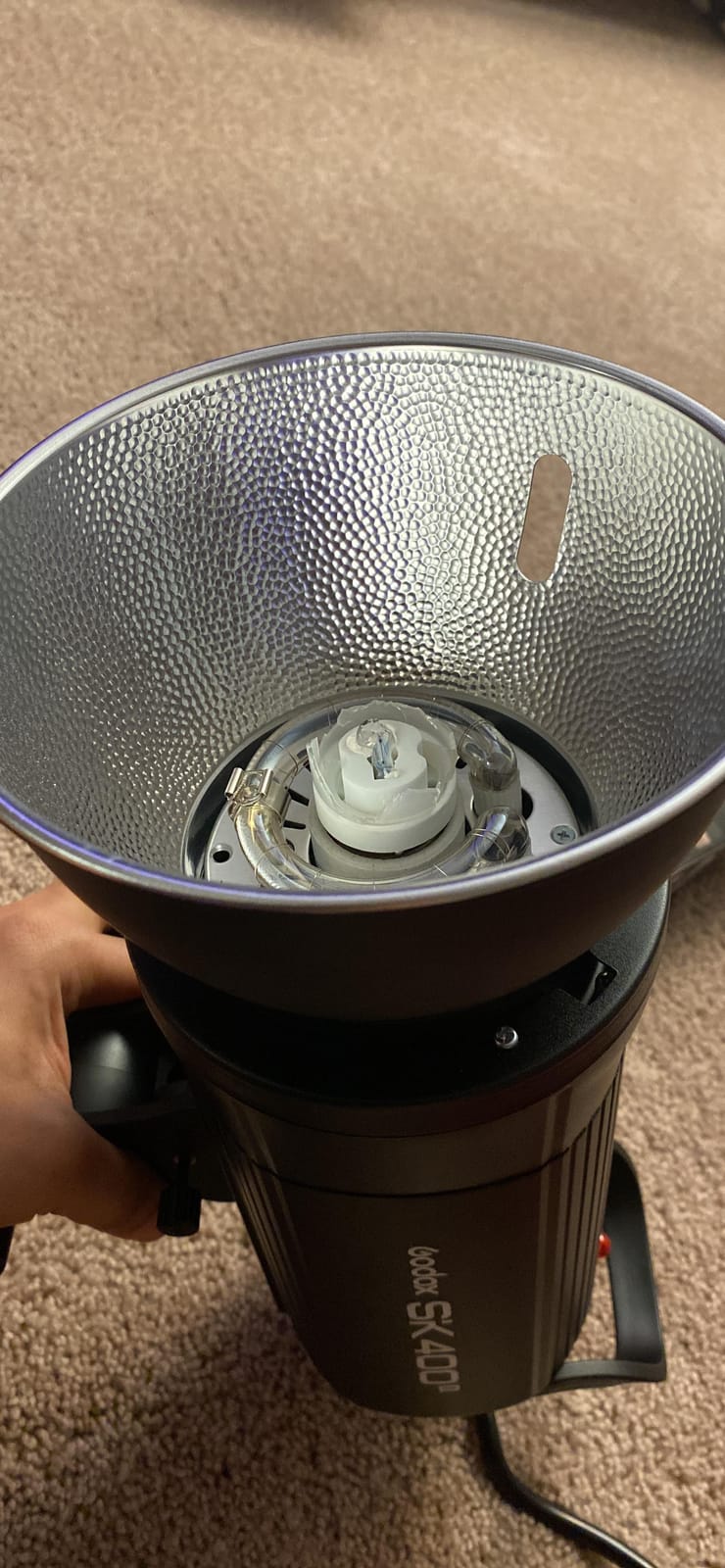
- Built-in fan and overheat protection extend flash life
- Anti-preflash function works with preflash cameras
Cons
- Mains corded at 110V so location work needs a separate pack
- No high-speed sync and no TTL
- Minimum output stops at 1/16 which limits fill control
- Bulky and heavy for a monolight
- One reviewer reported the modelling lamp softening a cone diffuser
The SK400II is the head I recommend when someone has a fixed room and wants to stop worrying about power. Four hundred watt-seconds is the first tier where you can put a big modifier on the head and still shoot wide open.
It also has the finer power control in this group. Forty steps from 1/16 to 1/1, shown on a large LCD, with panel settings remembered between sessions. That granularity is what lets you dial a fill down to two or three stops under the key without guessing.
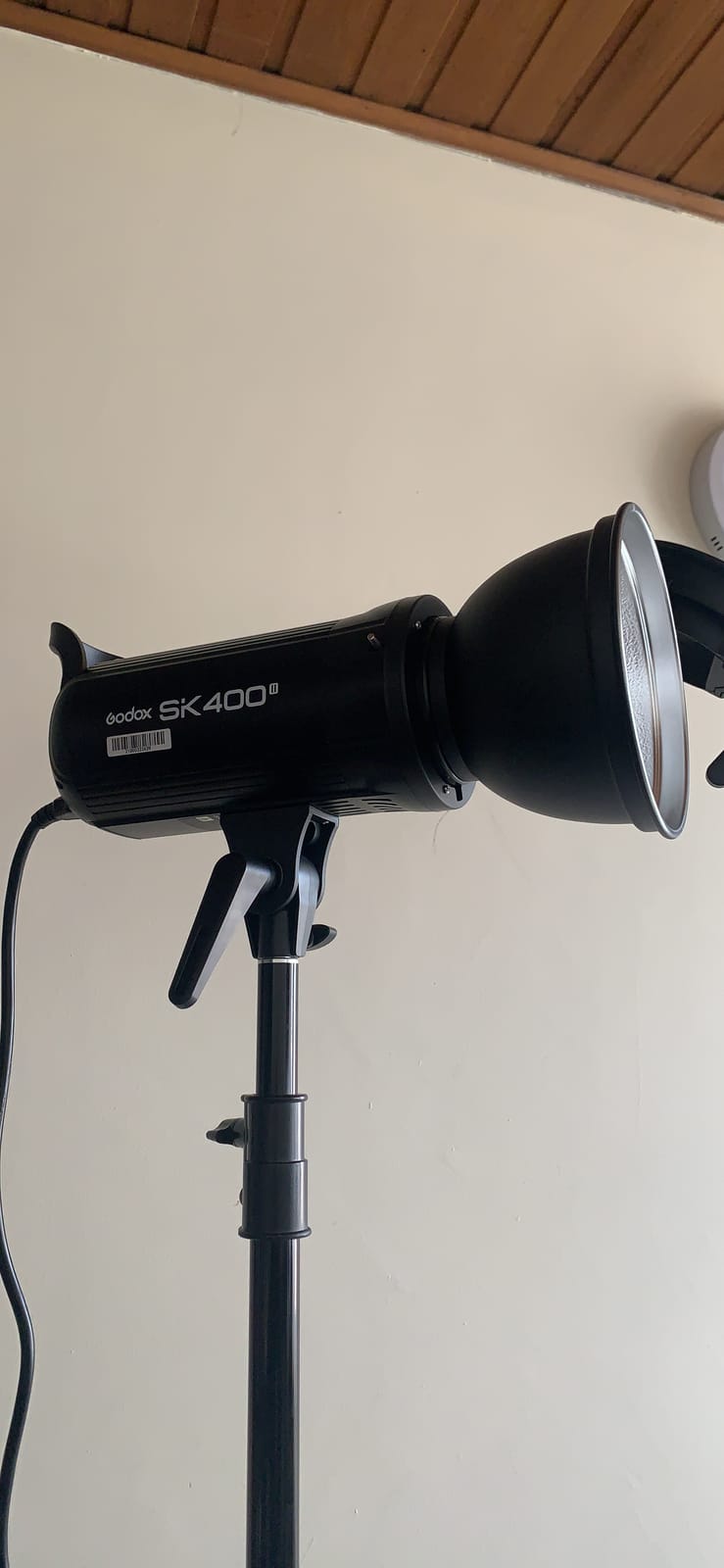
The 150 watt modelling lamp adjusts from 5% to 100% with under 2% output shift, and there is a built-in cooling fan with overheat protection. Over a full day of shooting I never saw the fan become audible at normal power levels.
Wireless is the same Godox 2.4GHz X system as the MS300V, with 16 groups and 32 channels, and it works with XPro, X1, X2, XT32 and FT-16 triggers. Owners with an existing Godox kit report simply adding this head to their existing groups.
When 400 watt-seconds earns its place
Four hundred watt-seconds is enough for full-body portraits and small fashion work without creeping the ISO. It is also the level where a two-light setup stops fighting you, because you can run the key high and drop the fill two or three stops.
If your studio has windows you cannot black out, the extra power buys you daylight control you would not have with a 300 watt-second head.
Why this is a studio-only light
It runs on a 110V mains cord. That is a non-issue in a fixed room, but for location work you would need a separate battery pack or generator, which changes the total cost of the kit considerably.
Like the MS300V it has no high-speed sync and no TTL, and the lowest power step is 1/16, so very low fill levels are harder to reach. One reviewer also reported the modelling lamp getting hot enough to soften an enclosed cone modifier, so leave ventilation room around the lamp.
3. Flashpoint XPLOR 600: Best Studio Strobe Lights for Portraits Outdoors
Flashpoint XPLOR 600 HSS Outdoor Battery Powered Studio Flash Strobe Monolight w/Built-in R2 2.4GHz Radio Remote System, Bowens Mount, 600Ws 11.1V 8700mAh Lithium Battery, 450 Full Power Flashes
600Ws output
5600±200K colour
11.1V 8700mAh battery
about 450 full power flashes
High-speed sync to 1/8000s
Pros
- 600Ws of power in a battery monolight
- High-speed sync to 1/8000s plus first and second curtain sync
- About 450 full power flashes per charge
- Recycle between 0.01 and 2.5 seconds
- Nine power steps from 1/1 down to 1/256
Cons
- Bulky at 15 x 8.75 x 19 inches and needs a stand or counterweight overhead
- One reviewer reported a failure after roughly 1000 flashes
- TTL capability can vary between bundles
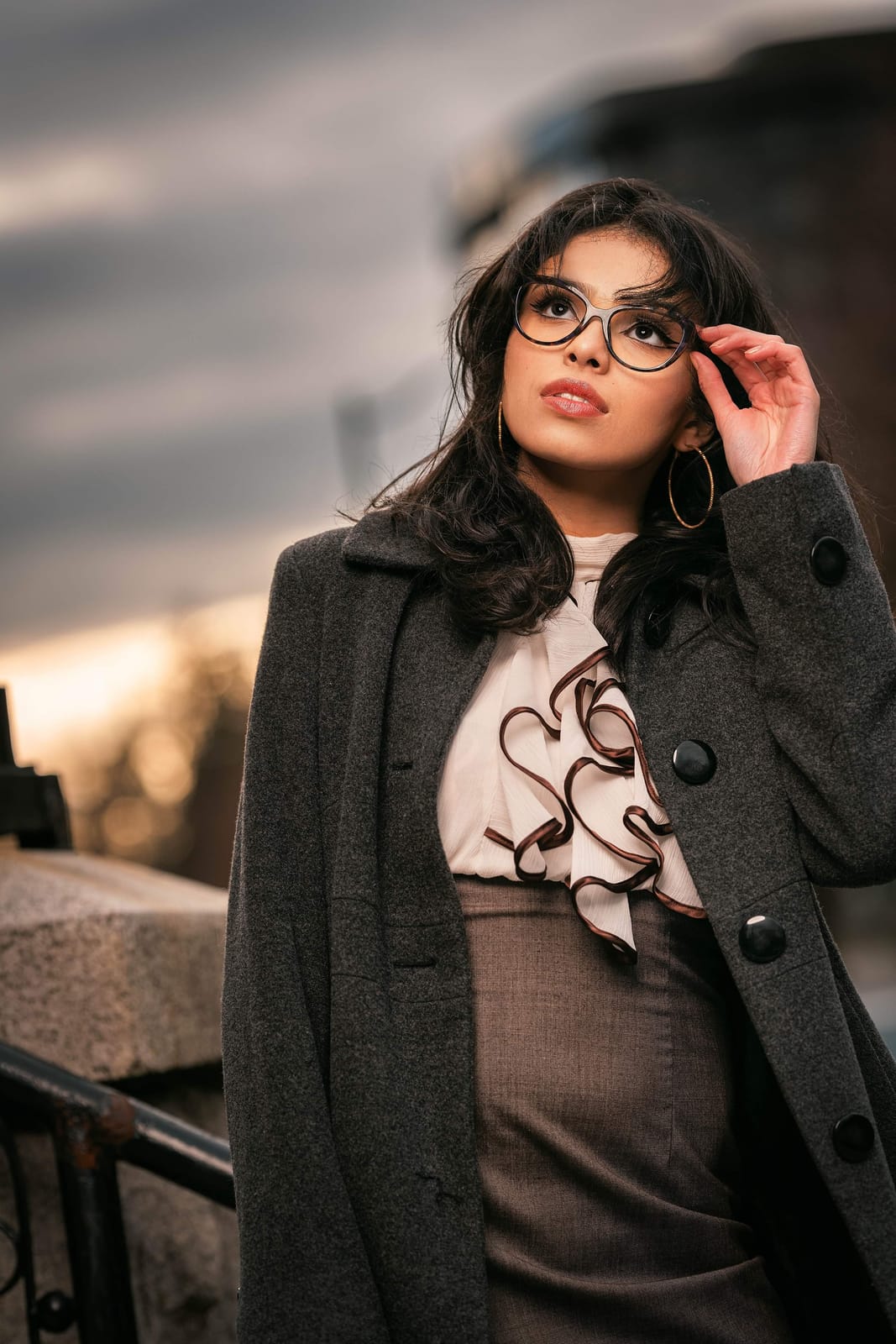
This is the head I take outside. Six hundred watt-seconds is enough to overpower open shade and even direct sun, and the battery means no cables across a park or a beach.
The feature that changes outdoor work most is high-speed sync to 1/8000s. It lets you shoot at 1/1000s or faster so the ambient light balances your flash, which means the background stays bright and you are not forced to underexpose it to keep the sky.
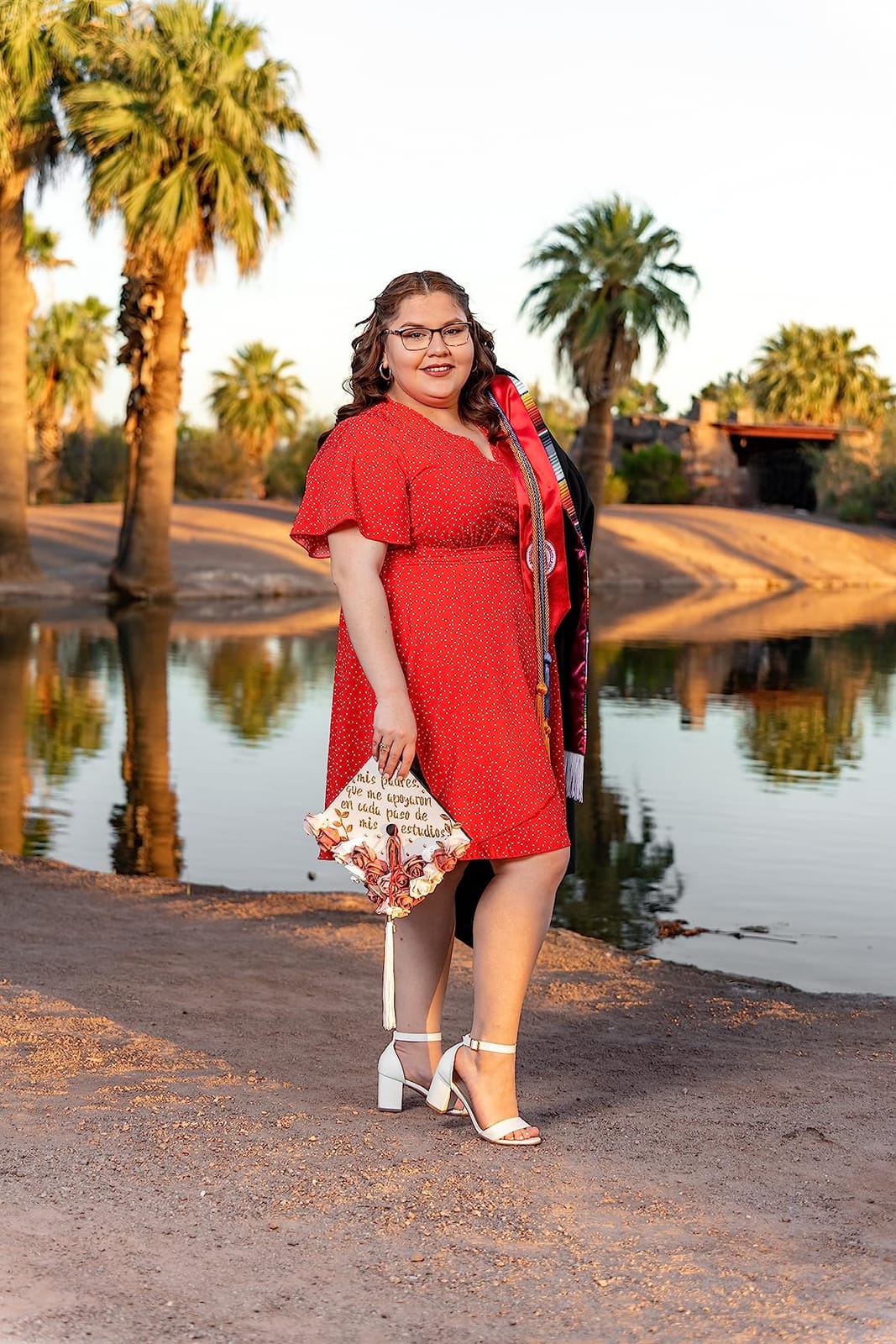
Colour is specified at 5600 plus or minus 200 Kelvin across the power range, and real-estate and portrait shooters report they can match colour against ambient window light without heavy correction.
It also carries first-curtain and second-curtain sync, so you can freeze motion with a rear-curtain flash at slow shutter speeds. Recycle runs from 0.01 to 2.5 seconds depending on power, which covers sequences well.
The 10 watt LED modelling lamp is dimmer than what the Godox mains heads offer, but there is a dot-matrix LCD and a timer that switches it off automatically so it does not drain the battery while it sits in a case.
Why outdoor portraits need this much power
Open shade in midday sun is roughly 10,000 to 20,000 lux. Beating that with a softbox loses several stops, so 600 watt-seconds is not overkill outdoors. It is the point at which you can shape the light rather than merely overpower it.
Around 450 full power flashes per charge means a full outdoor session on one battery, and the spare costs a fraction of the head.
Where the XPLOR 600 disappoints
It is the bulkiest light here at 15 by 8.75 by 19 inches. On a boom arm you will want a counterweight, and overhead through a large softbox it needs a solid stand and a sandbag.
One reviewer reported a unit failing after roughly 1000 flashes, which is not a pattern but is worth knowing. Also check which bundle you are buying, because the model listing includes a non-TTL variant even though the feature set lists TTL and HSS.
4. Godox AD600BM II: Best Studio Strobe Lights for Portraits on Long Location Days
GODOX AD600 BM II AD600BM II Outdoor Flash Strobe, 600Ws Portable Monolight
600Ws output
About 500 full power flashes
Flash duration 1/220 to 1/11760s
Power 1/1 to 1/512 in 0.1 steps
2.8 inch TFT screen
Pros
- Roughly 500 full power flashes per battery charge
- Flash duration from 1/220 to 1/11760s for freezing motion
- Precision power control in 0.1 steps from 1/1 to 1/512
- One-touch sync with the X3 trigger
- 40W modelling lamp doubles as a video light
Cons
- This BM variant has no built-in TTL
- About 3 kg so overhead use needs the extension head
- Tilt adjustment less refined than premium monolights
- Charger and cable not always included
- A few buyers reported defective arrivals
The AD600BM II is the light for weddings, events and any day that runs long. Six hundred watt-seconds with roughly 500 full power flashes per charge means a full reception on one battery, and owners who work events report exactly that pattern of use.
Power control is the standout. From 1/1 down to 1/512 in 0.1-stop increments gives you far more control over fill ratios than the coarser steps on the budget heads, which is what keeps a two-light ratio consistent across a whole booking.

Flash duration runs from 1/220 to 1/11760 seconds, so at the fastest settings you can freeze a jumping subject or a falling piece of confetti cleanly. Continuous shooting is rated up to 100 frames per second.
The 2.8 inch TFT colour screen and 16 colour-coded group indicator lights are genuinely useful on a location job. When three lights are up in the dark, seeing at a glance which group is which removes a lot of fumbling.
The Bowens mount holds large modifiers including a 140 cm octabox, and the 40 watt modelling lamp doubles as a continuous source for short video clips between setups.
Why long days change which light you buy
Battery endurance is the whole argument. A head that needs charging at lunchtime is fine in a studio and useless at a wedding. Around 500 full power flashes covers the kind of continuous shooting an event demands.
One-touch sync with the X3 trigger also speeds up setup, since group and channel assignment happens at the trigger rather than on the back of each head.
Where the AD600BM II falls short
This BM variant is manual only, with no built-in TTL. If you want off-camera automatic metering you need a different version of this head.
At about 3 kg it is heavy, and overhead use through a big modifier is awkward without the AD-H600 extension head. Tilt adjustment is less precise than premium monolights, some buyers reported missing chargers or batteries that would not seat properly, and a small number received defective units, which is part of why its rating sits a little below the cheaper heads here.
5. NEEWER Q300: Best Studio Strobe Lights for Portraits and Travel
NEEWER Q300 300Ws 2.4G Outdoor Studio Flash w/Q Compact Wireless Trigger
300Ws output
GN63 guide number
Up to 1000 full power flashes
0.4-2.5s recycle
2.4GHz Q system
Pros
- Up to 1000 full power flashes per charge is the longest runtime here
- Cordless design suits travel and small locations
- Quick mode gives ten flash duration levels
- Modelling lamp reaches 5010 lux at 0.5 m
- Bowens mount plus reflector and umbrella hole
Cons
- No TTL and no high-speed sync with a 1/200s ceiling
- Trigger and QPRO transmitters sold separately
- Not compatible with several Canon entry-level DSLR models
- 0.4-2.5s recycle is slower than cheaper Godox heads
- Optical slave design is more sensitive to stray light
The Q300 is the runtime champion in this group. Up to 1000 full power flashes from a 10.8V 7800mAh battery, with a five-hour full charge, means you can shoot a multi-day assignment on one head without a spare battery in the bag.
It handles the basics of portrait shaping well. The Bowens mount takes a standard reflector or umbrella, the handle rotates 180 degrees so you can use it handheld for a quick setup, and colour is specified at 5600 Kelvin plus or minus 200.
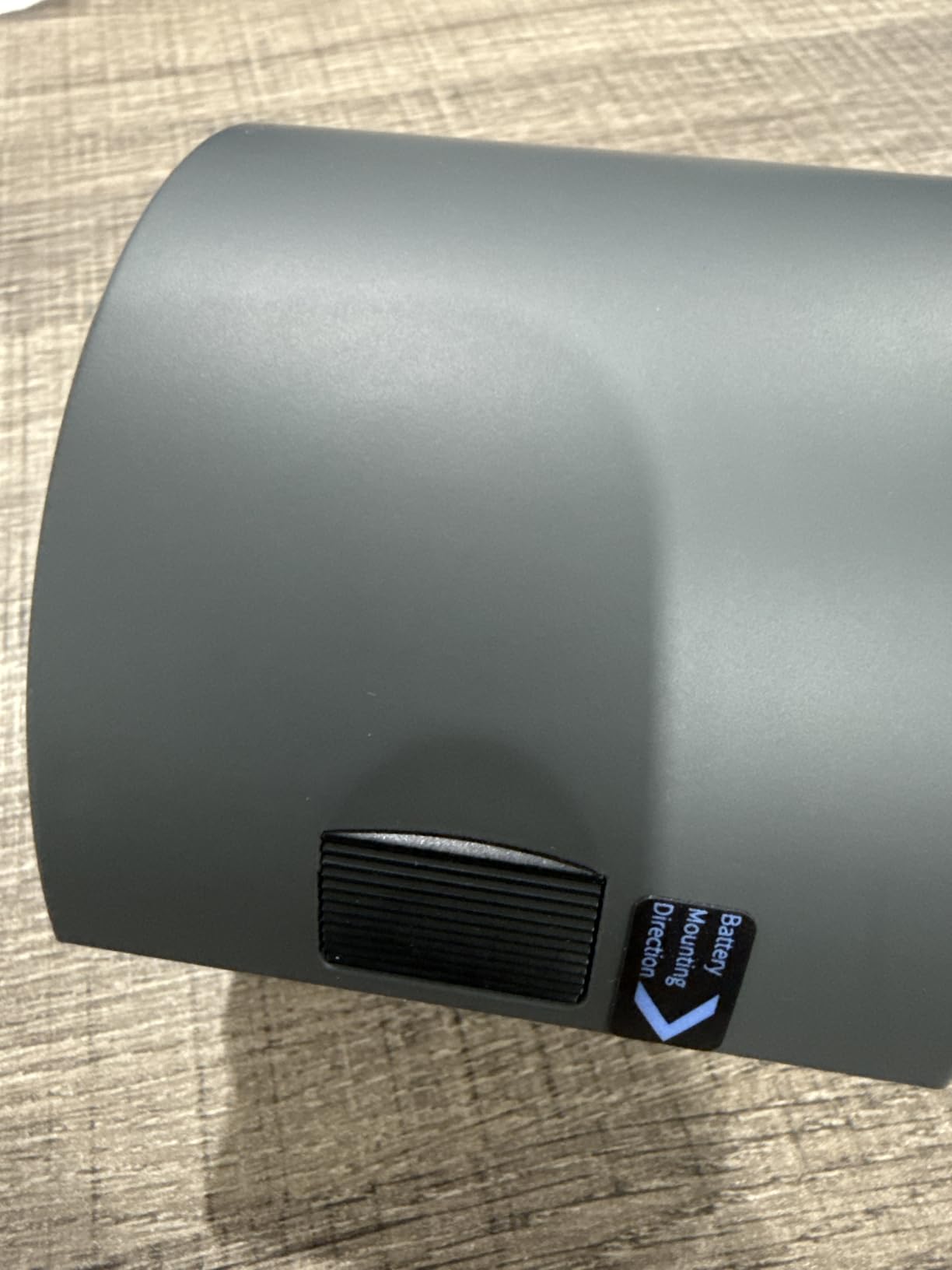
The Quick mode is an unusual feature for a budget head. It gives ten flash duration levels from 1/1000s to 1/10000s, which lets you control how much you freeze without changing modifiers. Manual, Multi with stroboscopic up to 20 Hz, and optical S1 and S2 modes cover most of what a portrait shooter touches.
Grouping is handled by the 2.4GHz Q system with five groups labelled A to E and 32 channels, working to about 30 m with the Q Compact trigger.
Why flash count matters more than wattage for travel
On location, the constraint is usually how long the day runs, not how bright the light is. A thousand full power flashes removes charging from your planning entirely, which for a travelling portrait shooter is worth more than another 200 watt-seconds.
It is also comfortable to carry, since you are not hauling a mains cable and a generator alongside it.
Where the Q300 is not the right tool
There is no TTL and no high-speed sync, so the sync ceiling is about 1/200s with the Q Compact trigger. That is workable indoors but limiting in daylight.
The trigger is not included, which means the stated 30 m range only applies once you buy one. Check your camera body too, because several Canon entry-level models including the Rebel SL3, T7, 2000D, T100 and 4000D are excluded from compatibility. Recycle of 0.4 to 2.5 seconds is slower than the cheaper Godox studio heads, and the optical slave design can be confused by bright stray light.
6. NEEWER Q200: Best Studio Strobe Lights for Portraits with TTL
NEEWER 200Ws 2.4G TTL Outdoor Strobe Flash Compatible with Godox, 1/8000s HSS Portable Studio Photography Monolight with Modeling Light/3200mAh Battery/750 Flashes/1.5s Recycle, Q200
200Ws at 5600K ±100K
TTL and high-speed sync to 1/8000s
Up to 750 full power flashes
0.01-1.5s recycle
10W modelling lamp
Pros
- TTL and high-speed sync to 1/8000s at this power level is rare
- Works on the Godox 2.4G X system after a firmware update
- Compact and light enough to hold during a session
- 750 full power flashes with fast 0.01-1.5s recycle
- Colour stability stated at ±100K across the power range
Cons
- 200Ws is the lowest output in this group
- Trigger needed for HSS and wireless control is sold separately
- Q and Godox X systems cannot run at the same time
- Recycle and trigger sound are noticeably loud
- User interface looks dated
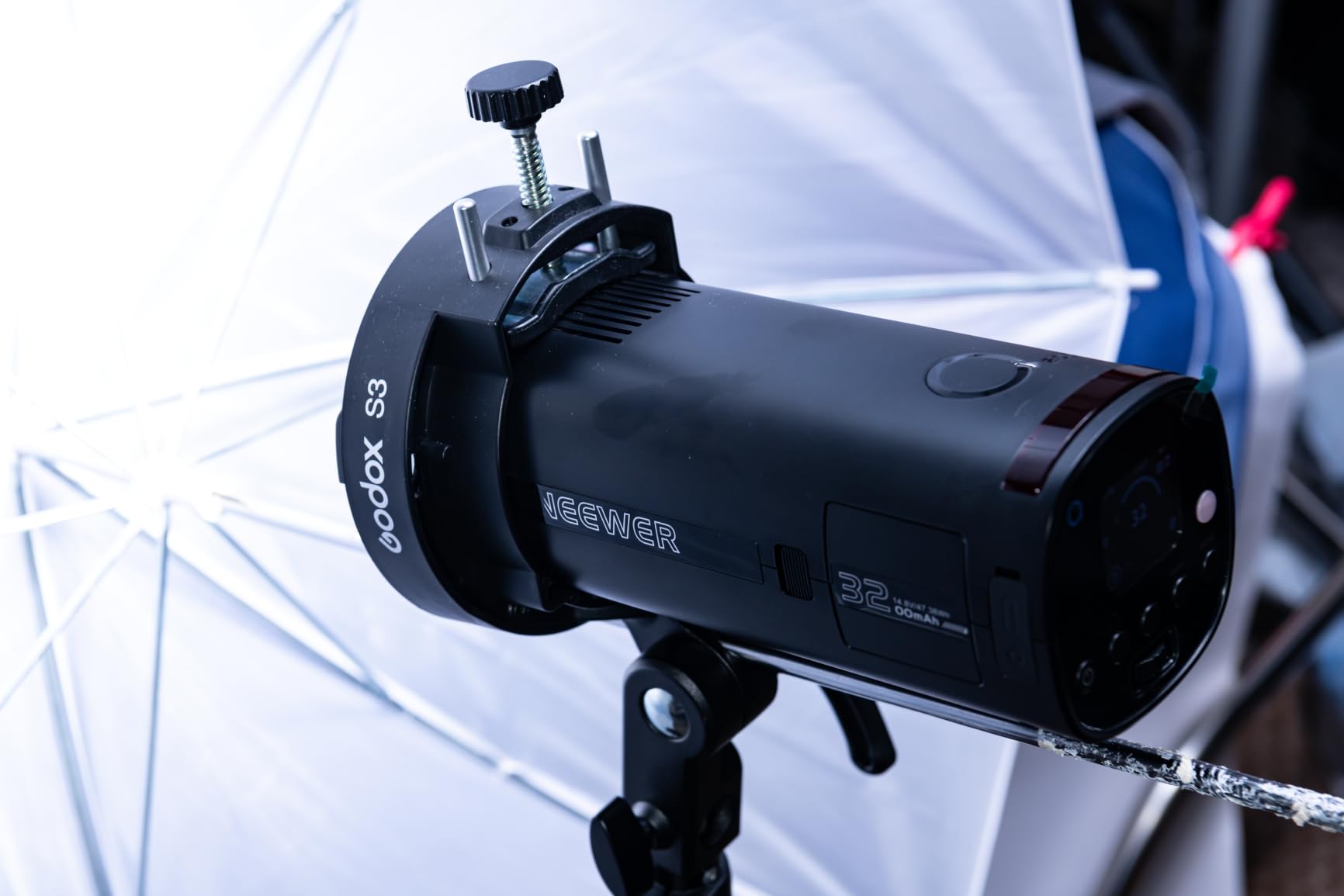
The Q200 is the only light here that does automatic exposure metering and high-speed sync while staying compact and light. If you shoot portraits where the lighting changes between setups, TTL removes the meter from your bag entirely.
Colour stability is specified at 5600 Kelvin plus or minus 100 Kelvin, tighter than any other head in this group. For portraits that is the spec that keeps skin tones consistent between the key and the fill.
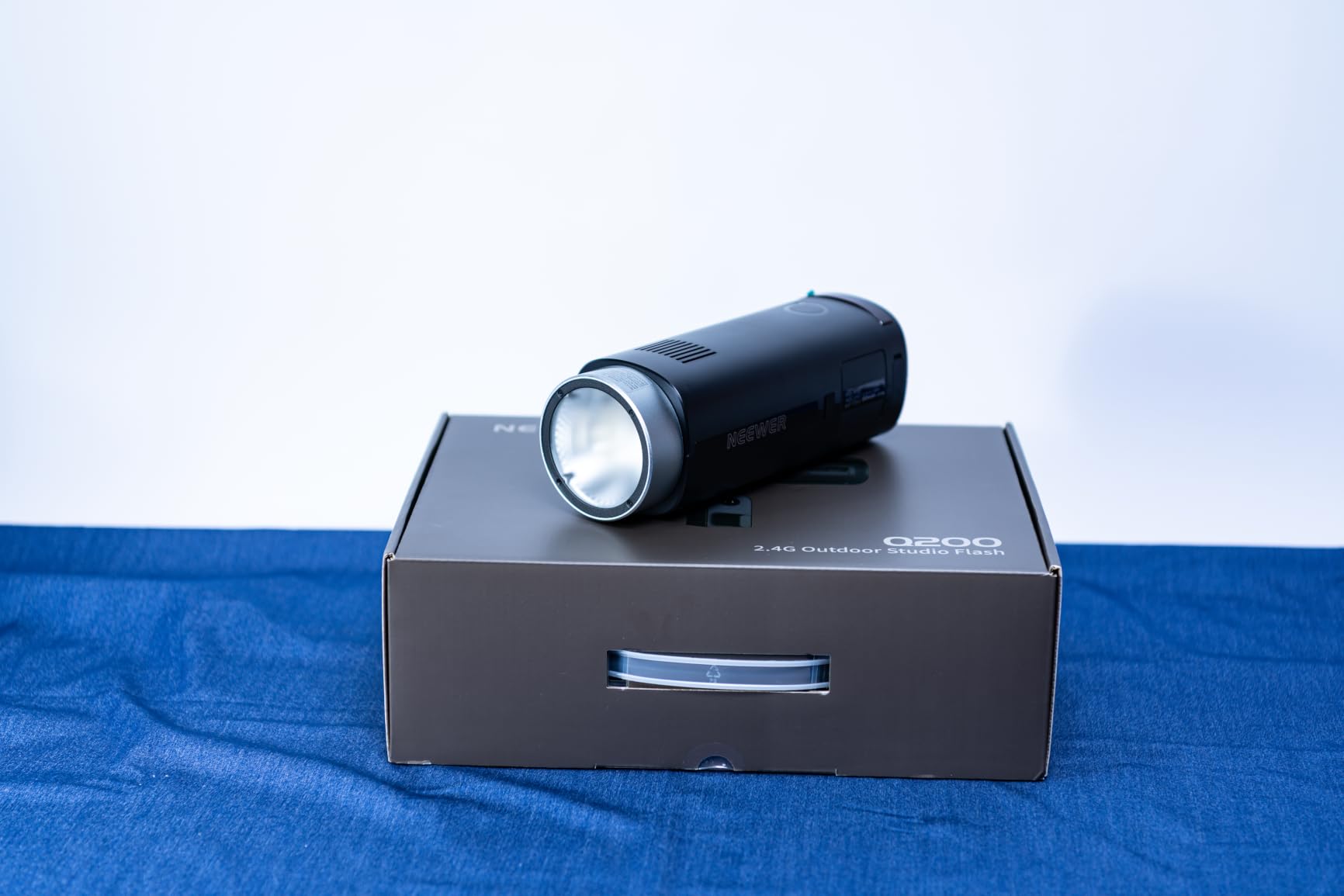
Wireless range reaches about 328 feet with QZ or QPro triggers, and TTL works alongside manual from 1/256 to 1/1, S1 and S2 optical modes, and MULTI stroboscopic. Battery life is around 750 full power flashes with recycle from 0.01 to 1.5 seconds.
The most useful feature for existing owners is RX COMPAT mode. After a firmware update, the Q200 can operate as a slave on the Godox 2.4G X system with XPro, X3 and X2 transmitters, which is a real bridge if you already have Godox radio gear.
Who benefits most from TTL
TTL pays off when the light changes constantly. That includes weddings, events, location portraits where you move between shade and sun, and any shoot where you are not metering between frames.
For a studio with fixed lighting, manual power is faster and more consistent, and the TTL feature is one you may rarely touch.
Where 200 watt-seconds runs out
This is the smallest head here at 200 watt-seconds, so you will need more distance, a wider aperture or a higher ISO than the 400 and 600 watt-second bodies. Through a large octabox in a dim room it runs out of light quickly.
HSS and full wireless control need a QZ or QPro trigger that is sold separately. You cannot run the Q system and the Godox X system at the same time, so mode switching and firmware updates add friction. The recycle and trigger noise are loud enough to register during a quiet ceremony, and the interface feels dated next to the colour screens on the Godox heads.
How Many Watt-Seconds Do You Need for Portraits?
Is 300W light enough? Yes, for most portraits. Three hundred watt-seconds through a 90 to 120 cm softbox at a metre and a half gives roughly f/4 to f/5.6 at ISO 100, which is wide enough to separate a subject from the background in a small room. Move to 400 watt-seconds for full-body and small fashion work, and to 600 watt-seconds when you are shooting outdoors, working through windows, or lighting a group.
The mistake most buyers make is overbuying wattage. A 1000 watt-second head in a small studio just means you spend the day at quarter power, and lower power settings are where cheap heads drift in colour. Buying close to what you need keeps you in the upper part of the range where output is most stable.
Recycle time is the limit people forget. If you are shooting groups or events, a head that takes two seconds to reset will make you wait between frames no matter how powerful it is.
Battery, AC or Hybrid Power for Portrait Work
Choose based on where the light lives, not on which sounds more advanced.
Mains power suits a fixed room with outlets near the stands. It never runs out, charges are never a concern, and the SK400II is the cheapest way into this list because of it.
Battery power suits location work. The XPLOR 600, AD600BM II, Q300 and Q200 all run cordless, which removes the cable across the floor and the generator in the van. The cost is charging between jobs and accepting the weight.
Hybrid systems let you plug in when you are in the studio and run on battery when you leave. Worth the extra if your work genuinely splits between the two.
HSS and TTL Explained for Portrait Shooters
High-speed sync pulses the flash for the entire shutter duration rather than a brief instant. It lets you shoot above your camera sync speed, usually 1/200s or 1/250s, up to 1/8000s on the lights here that support it. The trade-off is a loss of roughly 1.5 to 2 stops of output, so you need more power.
Inside a blacked-out studio, high-speed sync buys you almost nothing, because ambient light is not competing with you. This is a common complaint on photography forums: people pay for the feature and never use it. Outside, it is essential.
TTL is automatic exposure. The head measures the light through the trigger and sets its own power. It is fast when the lighting changes constantly and slightly less consistent when it does not, because a metering system can be fooled by reflective backgrounds.
Bowens Mount vs Proprietary Mounts and Modifier Costs
All six lights here use a Bowens S-Type mount, and that is the main reason this list is affordable. Bowens modifiers are made by dozens of manufacturers at a fraction of the cost of proprietary bayonet systems.
Proprietary mounts such as the Profoto A-Mount or OCF system generally cost considerably more per modifier. For a portrait photographer building a two-light or three-light kit, you need at least two modifiers per head, so that cost multiplies fast.
Forum consensus is to pick one ecosystem and stay in it. The practical version of that advice: choose Bowens, and choose one radio system, so every future light and modifier is cross-compatible.
One compatibility note matters here. The NEEWER Q300 and Q200 use the NEEWER Q radio system. The Q200 can be switched into a Godox-compatible receive mode after a firmware update, but the Q300 cannot, so existing Godox owners should factor the trigger ecosystem into that choice.
Studio Strobe vs Continuous LED for Portraits
A strobe delivers a brief, intense burst of light measured in watt-seconds, far beyond what a camera speedlight can produce, and usually triggers wirelessly from your camera.
A continuous LED stays on, which is simpler to aim and cheaper to buy. For video, product video and interviews with moving subjects, LED has real advantages.
For still portraits, the strobe wins on power per watt, on cost and on control. An LED panel bright enough to match a 600 watt-second flash through a softbox costs several times more. If your photography is stills portraits, a strobe is the better investment.
What a Complete Portrait Lighting Kit Costs Beyond the Strobe
The strobe is rarely the largest part of the bill. A working one-light portrait kit needs a modifier, a stand, a trigger and usually a sandbag, and the totals surprise people.
Light stand. Budget stands are fine indoors but I would use a heavier stand with any softbox over 90 cm, especially on a boom. This is where the best kit money goes.
Modifier. A 90 to 120 cm softbox with an inner diffuser gives the most flattering portrait quality per pound spent. A grid adds control for hair and edge lights.
Trigger. You need one regardless of which head you buy. Godox X triggers cover the Godox and Flashpoint units here.
Sandbag. A filled bag on the base of the stand is what keeps a softbox from tipping. Cheaper than replacing a light stand after an accident.
Battery spare. For battery heads, a second pack removes charging from your workflow on long days.
Modelling your workspace matters as much as the gear. If your shooting space doubles as a room you use every day, soft dividers or curtains let you block window light without building a permanent wall. Our guide to room dividers for studio apartments covers the practical options, and our picks for studio monitors for home recording cover checking your audio in the same space.
Many photographers on photography forums rent premium strobes for a big paid shoot before buying. That is a sensible way to test whether you need 600 watt-seconds before you commit.
Frequently Asked Questions
What is the best studio strobe for taking photos?
The Godox MS300V is the best studio strobe for most portrait photographers. Its 300 watt-seconds cover headshots, half-body portraits and small groups, it recycles in 0.1 to 1.8 seconds, and the 150 watt modelling lamp is bright enough to judge placement. It uses the Bowens mount, so modifiers stay affordable. Add TTL and high-speed sync only if you shoot outdoors or need automatic metering.
Is 300W light enough?
Yes, for most portraits. A 300 watt-second head through a 90 to 120 cm softbox at about a metre and a half gives roughly f/4 to f/5.6 at ISO 100, wide enough for background separation in a small room. Move to 400 watt-seconds for full-body portraits and 600 watt-seconds for outdoor work, windows or groups.
Do professional photographers use Godox?
Yes. Godox is the most common professional studio strobe ecosystem, and the X wireless system in the MS300V, SK400II and AD600BM II works with XPro, X1, X2, X3 and XT32 triggers. The reason is breadth: one radio system, one Bowens mount, a huge accessory market and rental houses that stock them. Professional-grade Profoto and Broncolor gear exists, but Godox dominates working studios.
Should I buy battery-powered or AC-powered studio strobes?
Battery if you shoot on location, mains if you work in a fixed room with outlets near your stands. Battery heads such as the Flashpoint XPLOR 600 and Godox AD600BM II remove cables and generators but add weight and charging. Mains heads such as the Godox SK400II never run out and cost less. Buy one of each only if your work genuinely splits between studio and location.
What is TTL flash and do I need it?
TTL is automatic exposure: the head measures the light through the trigger and sets its own power. You need it when lighting changes constantly, such as weddings, events or moving between shade and sun outdoors. In a fixed studio with constant lighting, manual power is faster and slightly more consistent because a meter can be fooled by reflective backgrounds.
What is the best flash for a home studio?
The Godox MS300V is the best choice for most home studios. At about 1.3 kg it is easy to move, 300 watt-seconds is enough for headshots and half-body portraits, and the Bowens mount means you can add a softbox for very little. If your room has windows you cannot block, choose the Godox SK400II for the extra power and take neutral density filters for bright daylight.
Final Verdict on the Best Studio Strobe Lights for Portraits
The best studio strobe lights for portraits come down to where you shoot. In a fixed room, the Godox MS300V gives you the most usable power-to-size ratio and the fastest recycle of any head here, with the largest review base to back it up. If you need more reach, the Godox SK400II adds 100 watt-seconds and finer power steps for very little more.
Outdoors, the Flashpoint XPLOR 600 is the pick because high-speed sync to 1/8000s lets daylight act as a fill. For all-day location work the Godox AD600BM II wins on flash count and fine power control, and the NEEWER Q300 wins on runtime and travel weight. The NEEWER Q200 is the one to buy if TTL and high-speed sync matter more than raw power.
Whatever you choose, buy the Bowens mount and stay in one radio ecosystem. That decision will save you more money over the life of the kit than any feature on this list. Check the current listing before you buy.