
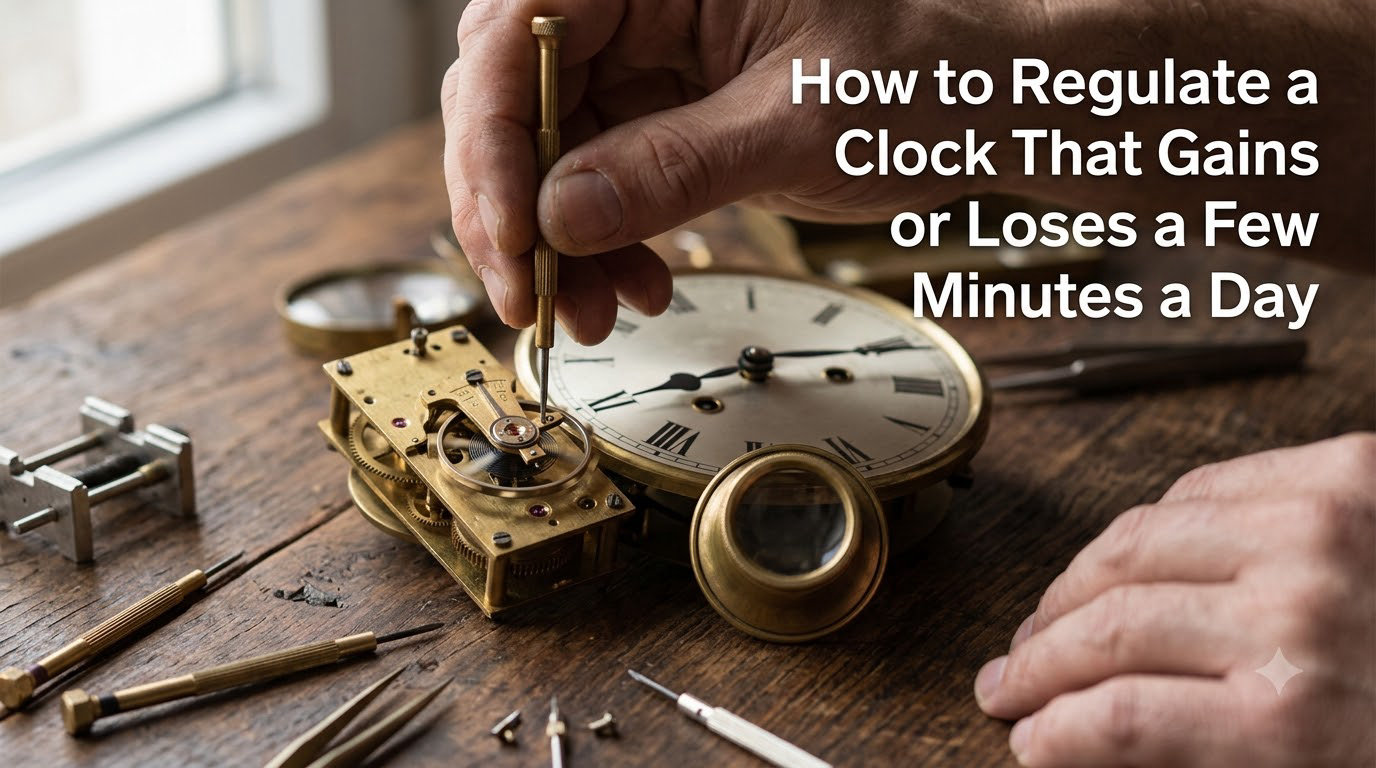
If your mechanical clock is running a few minutes fast or slow each day, the fix is usually simpler than you think. Learning how to regulate a clock means adjusting the pendulum or balance wheel so the timekeeping speeds up or slows down in small, controlled increments. Most clocks can be brought within a minute or two per week with patience and a few careful adjustments.
I have spent years working on grandfather clocks, mantle clocks, and wall clocks, and the regulation process follows the same core principles across all pendulum-driven movements. The key is understanding why your clock drifts, making one adjustment at a time, and waiting to see the results before changing anything else.
In this guide, we will walk through why clocks gain or lose time, the step-by-step pendulum method, the time equation calculation for precision, how to handle balance wheel clocks, and troubleshooting for the most common problems clock owners report.
Table of Contents
Why Clocks Gain or Lose Time
Clocks gain or lose time because no mechanical movement keeps perfect time under all conditions. The rate of a pendulum clock depends on the effective length of the pendulum, and anything that changes that length changes the speed of the clock.
Temperature is the biggest factor. As temperatures rise, metal pendulum rods expand and get longer, which slows the clock down. In cold weather, the rod contracts and the clock runs faster. Wooden pendulum rods are even more sensitive to humidity, which is why many clock owners on enthusiast forums report seasonal drift.
Friction from worn pivots, dirty oil, or a misaligned escape wheel can also throw off timekeeping. If your clock suddenly starts gaining or losing minutes after years of running fine, a cleaning or oiling may be needed before regulation will do any good.
Finally, a clock that is not level will not keep accurate time. The pendulum needs to swing evenly left and right, and an unlevel case throws off that balance before you ever touch the rating nut.
How to Regulate a Clock: The Pendulum Method
The most common way to regulate a clock is by adjusting the pendulum bob position using the rating nut at the bottom of the pendulum rod. Turning this nut moves the bob up or down, which changes the effective pendulum length and therefore the swing rate.
Here is the step-by-step method I use and recommend:
Step 1: Set the clock to the exact correct time using a reliable reference like your phone or an online atomic clock. Write down the date and time.
Step 2: Let the clock run undisturbed for a full 24 hours. Do not move, bump, or adjust anything during this period.
Step 3: After 24 hours, compare your clock to the reference time. Note exactly how many minutes and seconds it gained or lost, and write this down.
Step 4: Locate the rating nut at the bottom of the pendulum rod, just below the pendulum bob. This is a threaded nut that you turn to raise or lower the bob.
Step 5: Turn the rating nut to adjust the bob position. To slow down a clock that is running fast, lower the bob by turning the nut to lower it (usually clockwise). To speed up a slow clock, raise the bob by turning the nut the opposite direction (usually counterclockwise). One full turn typically changes the rate by about 30 seconds to 2 minutes per day, depending on the clock.
Step 6: Reset the clock to the correct time and let it run for another 24 hours. Compare again and write down the results.
Step 7: Repeat the process, making smaller and smaller adjustments each day, until your clock is within a minute or two per week. The rule to remember is simple: lower the bob to slow the clock, raise the bob to speed it up.
One common pitfall that clock owners report on forums is that the bob sits on top of the nut without actually moving when you turn it. Make sure the bob is threaded onto the rod and rises or falls with the nut. If the bob stays put while you turn the nut, you are not actually adjusting anything.
The Time Equation Method for Precise Adjustment
For clock owners who want a more scientific approach, the time equation method lets you calculate exactly how much to turn the rating nut based on measured time gain or loss. This method is favored by serious horology enthusiasts on the NAWCC forums.
The time equation works like this: First, measure exactly how many seconds your clock gains or loses over a known period, such as 24 hours. Then divide that number by the rate of change per turn of the rating nut on your specific clock.
Here is a practical example. Say your clock gains 3 minutes (180 seconds) per day. If one full turn of the rating nut on your clock changes the rate by about 60 seconds per day, you would turn the nut approximately 3 turns in the slowing direction (lowering the bob).
The exact rate of change per turn varies by clock. Shorter pendulums, like those on mantle clocks, typically have a larger effect per turn. Long grandfather clock pendulums may require several turns to achieve the same rate change. This is why you always measure first, then adjust.
Some clocks have a rating nut with a 360-degree scale marked on it. This lets you track partial turns precisely. If your clock has this feature, note the position of the indicator before and after each adjustment so you can track your changes accurately.
Keep a log. Write down the date, the time gained or lost, and the adjustment you made. After a week of tracking, you will have a clear picture of how your clock responds and how close you are to accurate timekeeping.
Adjusting a Clock That Runs Fast
A clock that gains time needs the pendulum bob lowered to slow it down. This increases the effective length of the pendulum, which increases the time each swing takes, which makes the clock run slower.
Turn the rating nut clockwise (in most cases) to lower the bob. The general rule among clock repair professionals is that one full turn will slow the clock by roughly 30 seconds to 2 minutes per day, depending on the thread pitch and pendulum length.
If your clock is already running fast with the bob at the bottom of its travel, you may have a deeper problem. The pendulum rod may be too short, the suspension spring may be incorrect, or the movement may need cleaning and oiling. At that point, professional service is worth considering.
Adjusting a Clock That Runs Slow
A clock that loses time needs the pendulum bob raised to speed it up. Raising the bob shortens the effective pendulum length, which decreases the swing time and makes the clock run faster.
Turn the rating nut counterclockwise (in most cases) to raise the bob. As with slowing a clock, one full turn will typically change the rate by 30 seconds to 2 minutes per day.
If the bob is already at the top of the threaded rod and the clock is still losing time, the pendulum rod may be too long for the movement, or the movement may have excessive friction from wear or dirt. A worn escape wheel or pallet fork can rob power and slow the clock down even with correct pendulum adjustment.
Regulating Balance Wheel Clocks (Non-Pendulum)
Not every clock has a pendulum. Many mantle clocks, carriage clocks, and smaller wall clocks use a balance wheel mechanism instead. Regulating these clocks works on the same principle, but the adjustment method is different.
A balance wheel oscillates back and forth at a rate determined by a hairspring, similar to a mechanical watch. Instead of a rating nut, these clocks typically have a regulator lever that you slide to speed up or slow down the balance wheel.
Look for a small lever or arm near the balance wheel, often marked with plus and minus signs or the letters F (fast) and S (slow). Move the lever toward the plus or F mark to speed up a slow clock, and toward the minus or S mark to slow down a fast clock.
The adjustments on a balance wheel regulator are very fine. Move the lever a tiny amount at a time, then let the clock run for 24 hours before making another change. Small movements on the regulator lever can shift the rate by several minutes per day.
Some older balance wheel clocks have a rating screw or collet instead of a lever. In those cases, you turn the screw slightly to change the effective length of the hairspring. If you are unsure which type of regulator your clock has, look for markings on the movement plate or consult the manufacturer’s documentation.
Checking Beat Alignment and Leveling
Before you can regulate any clock accurately, it must be in beat and sitting level. Beat refers to the evenness of the tick-tock sound. A clock in beat produces evenly spaced ticks, while a clock out of beat has an uneven rhythm like tick-tick-tock.
To check the beat, listen to the clock or watch the pendulum swing. The pendulum should travel an equal distance to the left and right of center. If it swings further one way than the other, the clock is out of beat and will not keep reliable time.
To put a clock in beat, first make sure the case is level using a small bubble level. If leveling does not fix the uneven tick-tock, you may need to adjust the crutch or bend the crutch wire slightly to center the pendulum swing. This is a delicate adjustment that is best done with the clock stopped.
A clock that is out of beat may stop after a few minutes, even if the movement is otherwise healthy. Many forum posts about clocks stopping prematurely trace back to beat alignment problems rather than regulation issues.
Troubleshooting Common Regulation Problems
Sometimes regulation alone does not solve the problem. Here are the most common issues clock owners encounter, based on questions from clock repair forums and our own experience.
Clock Stops After a Few Minutes
This is usually a beat problem, not a regulation problem. Check that the clock is level and that the pendulum swings evenly. Also verify that the clock is fully wound. If the movement is dirty or the oil has dried out, the clock may not have enough power to keep the pendulum swinging. A cleaning may be necessary.
Pendulum Bob Is Not Moving With the Nut
This is a surprisingly common issue. If the bob is sitting on top of the nut but not threaded onto the rod, turning the nut does nothing. Make sure the bob is actually threaded onto the pendulum rod so that it rises and falls with the nut. If the threads are stripped or the bob is loose, you may need a replacement pendulum assembly.
Chime Timing Is Off After Restart
If you stopped the clock to make adjustments and the chimes are now out of sync with the hands, you need to reset the minute hand to match the chiming mechanism. Move the minute hand clockwise to the next hour and let the clock chime. If the chime does not match the hand position, use the chime correction lever or manually advance the hand to the correct position. Always move the minute hand clockwise, never counterclockwise, to avoid damaging the movement.
Clock Still Gains or Loses After Full Adjustment
If you have moved the bob to the maximum extent and the clock is still inaccurate, the problem is likely mechanical wear, dried oil, or a component issue. A worn escape wheel, bent teeth, or a weak mainspring can all affect timekeeping in ways that no amount of pendulum adjustment will fix. At this stage, a professional cleaning and overhaul is the best path forward.
Environmental Factors That Affect Accuracy
Even a perfectly regulated clock will drift as environmental conditions change. Understanding these factors helps you set realistic expectations for accuracy.
Temperature swings are the most significant factor. A clock regulated in a cool basement will run differently in a warm, sunny living room. Metal pendulum rods expand in heat and contract in cold, shifting the rate by several seconds per day. Some high-quality clocks use compensated pendulums with mercury or invar rods to minimize this effect.
Humidity affects clocks with wooden pendulum rods more dramatically. Wood absorbs moisture and swells in humid conditions, changing the effective pendulum length. If your clock has a wooden rod, expect more seasonal variation and plan to re-regulate twice a year.
Air pressure changes can also have a small effect, particularly on clocks in sealed cases or at different altitudes. This effect is minor compared to temperature and humidity, but serious horology enthusiasts do account for it.
The practical takeaway is that you should regulate your clock in the room where it will live permanently. Moving a clock to a new location with different temperature and humidity will change its rate. Plan for a re-regulation after any move.
FAQs
How do you regulate a clock?
To regulate a clock, locate the rating nut at the bottom of the pendulum rod. Turn the nut to lower the bob if the clock runs fast, or raise the bob if it runs slow. Make one small adjustment, reset the clock to the correct time, wait 24 hours, then compare and repeat until the clock is accurate within a minute or two per day.
Why do all my clocks gain time just a little?
Clocks gain time when the effective pendulum length is too short, causing the swing to be slightly faster than ideal. Temperature drops cause metal rods to contract, which shortens the pendulum and speeds up the clock. Raising the pendulum bob slightly by turning the rating nut will slow the clock down.
How to stop a clock from losing time?
To stop a clock from losing time, raise the pendulum bob by turning the rating nut counterclockwise. This shortens the effective pendulum length and speeds up the swing rate. Make small adjustments and test over 24 hours. If the bob is already at maximum height and the clock still loses time, the movement may need cleaning or professional service.
Why does my grandfather clock keep stopping after a few minutes?
A grandfather clock that stops after a few minutes is usually out of beat or not level. Check that the case is perfectly level using a bubble level, then listen for an even tick-tock rhythm. If the pendulum swings further to one side, the crutch needs adjustment. The clock may also need winding or cleaning if the movement lacks power.
Can you overwind a pendulum clock?
You cannot overwind a pendulum clock in the sense of damaging it by winding too far, because the mainspring has a built-in stop. However, winding fully is necessary for proper power. If the clock stops after a full wind, the problem is usually a dirty movement, dried oil, or a beat alignment issue, not overwinding.
How do I regulate a pendulum clock accurately?
To regulate a pendulum clock accurately, set it to exact time, run it for 24 hours, measure the gain or loss in seconds, then turn the rating nut one turn to lower the bob for a fast clock or raise it for a slow clock. Reset and test again daily. Most clocks reach accuracy within a minute or two per week after 5 to 7 days of progressive adjustment.
Conclusion
Learning how to regulate a clock that gains or loses a few minutes a day is a skill that pays off every time you glance at the dial. The process comes down to measuring your clock’s error, making one small rating nut adjustment at a time, and waiting 24 hours between changes to see the results.
Remember the core rule: lower the pendulum bob to slow a fast clock, raise it to speed up a slow one. For balance wheel clocks, use the regulator lever instead. Always check beat and level before you start adjusting, and keep a log of your changes so you can track progress toward accuracy.
Patience is the most important tool you have. Regulation can take a week or more of daily adjustments to get right, but the result is a clock you can trust. If you have tried everything and the clock still drifts significantly, a professional cleaning and overhaul will likely get it back to reliable timekeeping.