
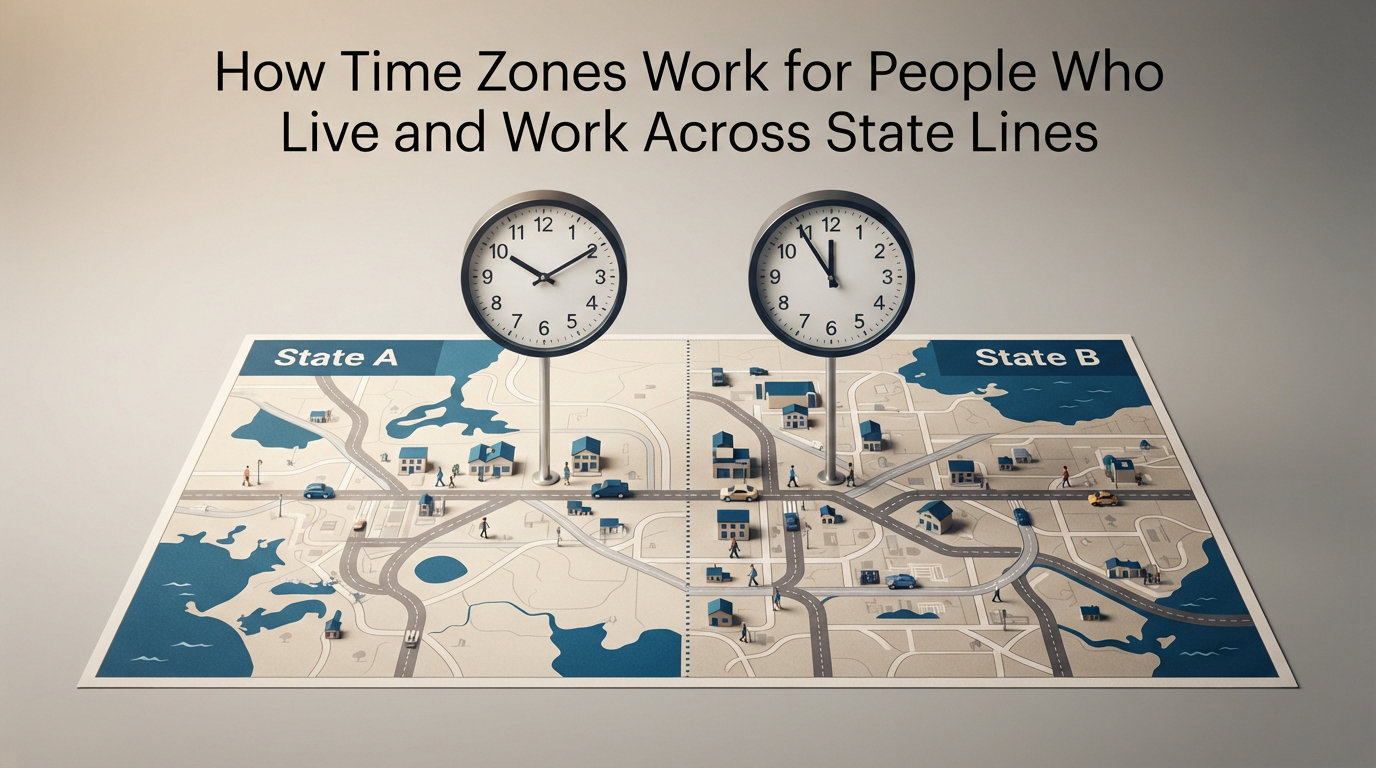
Imagine leaving your house at 7:30 AM for a 15-minute commute, but when you arrive at work your phone says 7:30 AM again. Or worse, it says 8:30 AM. For thousands of Americans who deal with time zones across state lines every single day, this is not a hypothetical scenario. It is their morning routine.
Living or working near a time zone boundary turns an ordinary day into a constant mental math problem. You schedule a doctor appointment for 2:00 PM, but is that 2:00 PM Eastern or 2:00 PM Central? The difference matters more than you might think when a missed hour means a missed appointment or a late start at work.
In this guide, I will break down exactly how time zones work for people who live and work across state lines. You will learn which states sit in two time zones, how daylight saving time complicates border living, and the real strategies that border town residents use to keep their schedules straight.
Whether you are moving to a border town, starting a remote job in a different time zone, or just curious about what life is like on the edge of a time line, this article covers the practical details that most guides skip. Our team pulled together forum discussions, real commuter experiences, and the technical mechanics behind time zone boundaries to give you a complete picture.
Table of Contents
What Are Time Zones and Why Do They Exist
Time zones exist because the Earth rotates, and different parts of the planet face the sun at different moments throughout the day. Without time zones, every town would set its clock based on local solar noon, creating chaos for travel, communication, and commerce.
The system we use today divides the world into 24 standard time zones. Each zone covers roughly 15 degrees of longitude, which corresponds to one hour of Earth’s rotation. Since the planet spins 360 degrees in 24 hours, it moves about 15 degrees every 60 minutes.
Here is where it gets interesting. Time zones were not always standardized. Before the late 1800s, cities and towns set their own clocks based on the sun. This worked fine when travel took days. But when railroads started crisscrossing the country, the patchwork of local times became a logistical nightmare.
In 1883, the United States and Canadian railroads adopted a system of four standard time zones to solve this problem. The following year, an international conference in Washington, D.C. established the global standard we still use today, anchored to the Prime Meridian in Greenwich, England.
That global reference point is called Coordinated Universal Time, or UTC. Every time zone in the world is defined by its offset from UTC. Eastern Standard Time, for example, is UTC-5, meaning it is five hours behind the time at the Prime Meridian.
The key thing to understand is that time zones are administrative boundaries, not physical ones. They follow lines of longitude loosely but bend around state borders, county lines, and political decisions. That bending is exactly what creates the messy reality for people who live and work on the edges.
Understanding the Six Main US Time Zones
The continental United States spans four standard time zones, and including Alaska and Hawaii, the country covers six total zones. Each one has an abbreviation you will see constantly on schedules, flight bookings, and meeting invites.
Eastern Standard Time (EST) covers the largest population in the country. It runs UTC-5 and includes the entire East Coast from Maine down through Georgia, plus states like Ohio, Michigan, and the eastern parts of Florida and Indiana. When someone says “Eastern time,” this is what they mean.
Central Standard Time (CST) sits one hour behind Eastern at UTC-6. It covers states like Texas, Illinois, Minnesota, and the western portions of Tennessee and Kentucky. If you cross from Eastern into Central, you gain an hour. Your watch suddenly jumps backward.
Mountain Standard Time (MST) is UTC-7 and covers states like Colorado, Montana, and Utah. It is one hour behind Central and two hours behind Eastern. The Mountain zone has the smallest population of the four continental zones.
Pacific Standard Time (PST) at UTC-8 includes Washington, Oregon, Nevada, and California. Crossing from Mountain into Pacific means gaining another hour. This four-zone cascade is what makes a cross-country phone call from New York to Los Angeles a three-hour difference.
Alaska Standard Time (AKST) runs UTC-9, and Hawaii-Aleutian Standard Time (HST) runs UTC-10. Most Americans rarely interact with these zones, but they matter enormously for businesses with operations in those states or for families spread across the Pacific.
During daylight saving time, each zone shifts forward one hour. EST becomes EDT (Eastern Daylight Time), CST becomes CDT, and so on. The abbreviations change but the relative differences stay the same, assuming both locations observe DST.
How Time Zones Work for People Who Live and Work Across State Lines
For people dealing with time zones across state lines, the clock change is not a once-a-year event. It is a twice-a-day reality. You wake up in one time zone, drive across the line, and suddenly everything shifts by an hour.
I have read dozens of accounts from border town residents on geography forums and community discussions, and the picture they paint is surprisingly consistent. Most people adapt, but the adjustment never fully disappears from their mental background process.
One Reddit user who lives about five miles from the Central and Eastern time zone boundary put it simply: “Day to day, it’s not so bad.” Their main headache was working 30 miles away on the other side of the line, which meant constantly recalculating arrival times and meeting schedules.
The core challenge is that your body clock and your work clock can disagree. If you live in Central time and work in Eastern time, you need to be at your desk an hour earlier than your body expects. That 8:00 AM Eastern start time feels like 7:00 AM to your internal rhythm.
Phone management is one of the biggest daily hurdles. Your smartphone automatically updates to the local time zone based on your GPS location. But what happens when you stand right on the boundary line and the signal bounces between cell towers on each side? Your phone can flip back and forth, showing different times within minutes.
Scheduling becomes an exercise in precision. People who live on borders learn to always specify the time zone when making plans. “Let’s meet at 3:00 PM Central” is the norm, not just “Let’s meet at 3:00.” Without that clarification, someone always shows up an hour early or an hour late.
Border towns sometimes solve this problem collectively. Rather than following the official time zone line, some communities adopt the time of their nearest major economic hub. If a town’s jobs, shopping, and healthcare are all in the next zone over, residents often just live on that zone’s time unofficially.
The confusion extends to entertainment, too. Television schedules, sports broadcasts, and even streaming service live events air at different clock times depending on which zone you are in. A border resident might see a show listed at 8:00 PM on one side and 7:00 PM on the other, for the exact same broadcast.
States That Span Multiple Time Zones
Thirteen states in the US are split across two or more time zones, and understanding which ones helps explain where border living is most common. These splits happen because time zone lines follow county boundaries and state edges rather than neat longitude lines.
Florida is one of the most well-known examples. The western portion of the Florida Panhandle, including Pensacola, operates on Central Time. The rest of the state follows Eastern Time. Residents who commute between Panama City and Tallahassee cross a time line on a regular route.
Indiana and Kentucky both sit on the Eastern and Central divide. For decades, Indiana was a patchwork where some counties observed daylight saving time and others did not. The state finally standardized in 2006, but the western edge still operates on Central while the rest follows Eastern.
Tennessee splits down the middle. The western third of the state, including Memphis, runs on Central Time. Nashville and everything east follows Eastern Time. Commuters between Nashville and Memphis regularly navigate the one-hour shift.
South Dakota, Nebraska, and Kansas all straddle the Central and Mountain divide. Texas has a small western sliver in Mountain Time near El Paso, though most of the state runs on Central. North Dakota splits between Central and Mountain along a jagged county line.
Idaho and Oregon both split between Mountain and Pacific zones. Alaska is particularly complex because it technically spans two time zones, with the Aleutian Islands running on Hawaii-Aleutian Time while the rest of the state follows Alaska Standard Time.
The states that do not split are equally important to know. California, New York, Colorado, and most others sit entirely within one zone. But the split states are where the daily reality of cross-time-zone living concentrates, and they are home to millions of people.
Daylight Saving Time and Border Complications
Daylight saving time adds another layer of complexity to border living. When most of the country springs forward in March and falls back in November, the transition is routine. But for people on time zone borders, DST can temporarily shift the gap between neighboring communities.
The core rule is simple. In spring, clocks move forward one hour. In fall, they move back one hour. Most US states observe this cycle, which means Eastern Time becomes EDT at UTC-4 during summer, and Central becomes CDT at UTC-5.
But two states do not observe daylight saving time at all: Arizona and Hawaii. Arizona stays on Mountain Standard Time year-round. This creates a peculiar situation on the Arizona and New Mexico border. For half the year, both states are on the same time. For the other half, there is a one-hour difference between them.
For border town residents between observing and non-observing areas, this means the time gap changes twice a year. A commute that normally has no time difference suddenly has a one-hour shift. People have to relearn their schedules every March and November.
Even between two states that both observe DST, the spring transition can cause problems. Not every organization updates its automated systems at the same moment. Some scheduling software defaults to the wrong offset for a few days, and meetings booked during the transition week often have errors.
The Navajo Nation in northeastern Arizona observes daylight saving time even though the rest of Arizona does not. If you drive through that region, your clock changes multiple times within a few hours. Forum users describe this as one of the most confusing time zone experiences in the country.
There has been ongoing discussion in Congress about making daylight saving time permanent, which would eliminate the twice-yearly clock changes. As of 2026, no permanent change has taken effect, so the biannual shift continues to complicate border living.
Managing Work and Schedules Across Time Zones
Working across state lines that fall in different time zones requires deliberate planning from both employees and employers. The one-hour difference between adjacent zones may seem small, but it compounds quickly when you factor in commute times, meeting schedules, and personal routines.
For remote workers, the challenge shifts. You might live in Central Time but work for a company headquartered on the East Coast. Your 9:00 AM Eastern standup meeting starts at 8:00 AM your local time. Every meeting invite requires a mental translation.
The most successful cross-time-zone workers adopt one simple habit. They set their primary calendar to the time zone where most of their colleagues work, not their own local time. This eliminates the mental math for meetings and prevents the classic mistake of joining an hour late.
Synchronous communication becomes harder across time zones. If your team spans Eastern and Pacific, you have a three-hour overlap window where everyone is awake and working. Outside that window, someone is always inconvenienced.
Asynchronous communication solves part of this problem. Tools like shared documents, recorded video updates, and project management boards let people contribute on their own schedule rather than requiring real-time overlap. Many remote-first companies structure their entire workflow around asynchronous communication specifically to handle time zone differences.
Employers with workers in multiple time zones need clear policies. Which time zone governs work hours? When are core collaboration hours? How are deadlines communicated to avoid ambiguity? Without written answers to these questions, confusion and resentment build quickly among cross-zone teams.
Hourly workers face a particularly thorny question that comes up repeatedly in forum discussions. If you live in Central Time but work in Eastern Time, does your eight-hour shift count as eight hours regardless of the zone? The answer depends entirely on your employer’s payroll policy. Some pay based on the time zone where the work happens. Others use the employee’s home time zone. Getting this clarified upfront saves a lot of frustration.
Practical Tips for Living on a Time Zone Border
People who have lived on time zone boundaries for years have developed reliable strategies for managing the daily confusion. Here is what experienced border residents recommend.
Set up dual clocks on your phone and computer. Most smartphones let you display a second time zone in your clock and calendar apps. Keep both your home zone and your work zone visible at all times. This eliminates the mental arithmetic that leads to errors.
Always specify the time zone when making plans. Write “2:00 PM Central” in every text message, calendar invite, and appointment reminder. Never assume the other person knows which zone you mean, even if you are both in the same town.
Build buffer time into cross-border commutes. If your drive takes 20 minutes but involves a time zone change, leave 30 minutes early. The extra cushion absorbs the mental shift and prevents you from rushing while your brain recalibrates.
Check your phone’s time zone setting manually when you arrive at work. GPS signal near borders can be unreliable, and your phone might flip to the wrong zone without warning. A quick glance at your lock screen saves you from walking into a meeting at the wrong time.
Talk to your employer about a standardized time reference. Agree on which time zone governs your schedule, your timesheets, and your deadlines. Get it in writing so there is no ambiguity if a dispute arises later.
Connect with other border town residents. Local Facebook groups, community forums, and neighborhood networks are goldmines of practical advice. The people who have navigated these waters for years know the shortcuts, the problem spots, and the unofficial conventions that keep things running smoothly.
Healthcare, Schools, and Services Across Time Zone Lines
Public services face unique challenges at time zone boundaries. Schools, healthcare systems, and government offices must decide which time zone governs their operations, and the answer is not always obvious.
School districts that straddle a time zone line face a real scheduling dilemma. If one side of the county starts school at 8:00 AM Eastern and the other starts at 8:00 AM Central, buses and families dealing with both zones must navigate a one-hour gap. Some split counties have negotiated shared start times that work across the boundary.
Healthcare appointments are another pain point that forum users mention frequently. A telehealth visit scheduled for 3:00 PM might mean different things to the patient and the provider if they are in different zones. Patients have reported missing appointments entirely because the confirmation used the provider’s time zone without specifying it.
The solution healthcare systems use is to always state the time zone in appointment confirmations, texts, and automated reminders. “Your appointment is Tuesday at 2:00 PM Eastern” removes all ambiguity. Patients who deal with cross-zone healthcare learn to confirm the zone every time.
Legal and insurance questions also arise when your home and workplace are in different time zones. Workers compensation claims, for example, must specify where the injury occurred and under which state’s laws it falls. The time zone difference is secondary to the state jurisdiction question, but it adds another layer of documentation that cross-border workers need to track.
Pharmacies near borders sometimes post both time zones on their hours signs. A 24-hour pharmacy might advertise “Open until 10 PM CST / 11 PM EST” to avoid confusing late-night customers who cross the line for medication.
FAQs
How do time zones work for people that live right next to one?
People living next to a time zone boundary deal with a one-hour shift every time they cross the line. Your phone updates automatically based on GPS location, but scheduling requires always specifying which time zone you mean. Most border residents adapt within a few months and develop habits like dual-clock displays and always writing the zone in meeting invites.
What happens if you live on the border of a timezone?
Living on a time zone border means constant awareness of which side you are on. You may wake up in Central Time and arrive at work in Eastern Time an hour later. Challenges include phone signal confusion near the line, scheduling ambiguity, mismatched business hours, and the need to always clarify time zones when making plans. Most people adjust, but it never fully leaves your mental radar.
How to work with people in different time zones?
Set your calendar to the time zone where most colleagues work. Use asynchronous communication like shared docs and recorded updates to reduce the need for real-time overlap. Always specify time zones in meeting invites. Identify core collaboration hours where everyone is available, and schedule important meetings within that window. Keep a dual-clock display on your devices.
How does traveling across time zones work?
When you travel east, you lose time because you move toward earlier sunrises. Traveling west, you gain time. Your devices update automatically via GPS and cell tower signals. Jet lag becomes more noticeable with larger jumps of three or more hours. For driving across one zone at a time, the adjustment is usually mild and takes a day or two.
What does EST, CST, MST, and PST mean?
EST is Eastern Standard Time at UTC-5, covering the East Coast. CST is Central Standard Time at UTC-6, one hour behind Eastern. MST is Mountain Standard Time at UTC-7, covering states like Colorado and Montana. PST is Pacific Standard Time at UTC-8, including California and Washington. During daylight saving time these become EDT, CDT, MDT, and PDT respectively.
What are the 7 time zones in order?
From east to west, the main US time zones are Atlantic Standard Time (US territories like Puerto Rico), Eastern, Central, Mountain, Pacific, Alaska, and Hawaii-Aleutian. The four continental zones most Americans interact with are Eastern, Central, Mountain, and Pacific, each one hour apart from the next.
Which time zone do most Americans live in?
The Eastern Time Zone has the largest population of any US time zone. It includes major cities like New York, Atlanta, Miami, Philadelphia, and Washington DC. Roughly half of the US population lives in the Eastern zone, which is why so many national broadcasts and business schedules default to Eastern Time.
How do locals cope with living on the border of a time zone?
Border residents use several coping strategies. They keep dual clocks visible, always specify time zones when making plans, and sometimes adopt the time of the nearest major city rather than their official zone. Many build buffer time into cross-border commutes. Local communities often develop informal conventions about which time zone governs daily life, even if the official line says otherwise.
What is the hardest time zone to adjust to?
For most people, the hardest adjustments involve crossing three or more time zones at once, such as coast-to-coast travel between Eastern and Pacific. The jet lag from a three-hour shift can take several days to resolve. For daily border living, the one-hour shift between adjacent zones is manageable but requires consistent attention to avoid scheduling errors.
Wrapping Up: Life on the Time Zone Edge
Understanding how time zones work for people who live and work across state lines comes down to one core principle. Time zones are administrative boundaries, and the people who navigate them daily have built practical systems to manage the confusion.
The mechanics are straightforward. The Earth rotates, we divide it into 24 hourly segments, and those segments roughly follow lines of longitude. But when the boundary cuts through your town, your commute, or your workplace, the simplicity gives way to daily negotiation.
Thirteen US states span multiple time zones. Millions of people wake up, drive across a line, and shift their clocks every single day. They use dual-clock displays, specify time zones in every message, and build buffer time into their schedules. Some communities even adopt the time of their nearest economic center, ignoring the official line entirely.
If you are moving to a border town or starting a cross-time-zone job, the best thing you can do is build good habits early. Set up dual clocks on your devices. Always specify the zone. Clarify your employer’s time zone policy before your first day. And connect with locals who have already figured out the conventions that keep daily life running.
The time zones across state lines will not change anytime soon. But the people who live with them have proven that the adjustment is entirely manageable with the right systems in place. Your phone does most of the work automatically. Your habits do the rest.
1 thought on “Time Zones Across State Lines: A Practical Guide (October 2026)”