
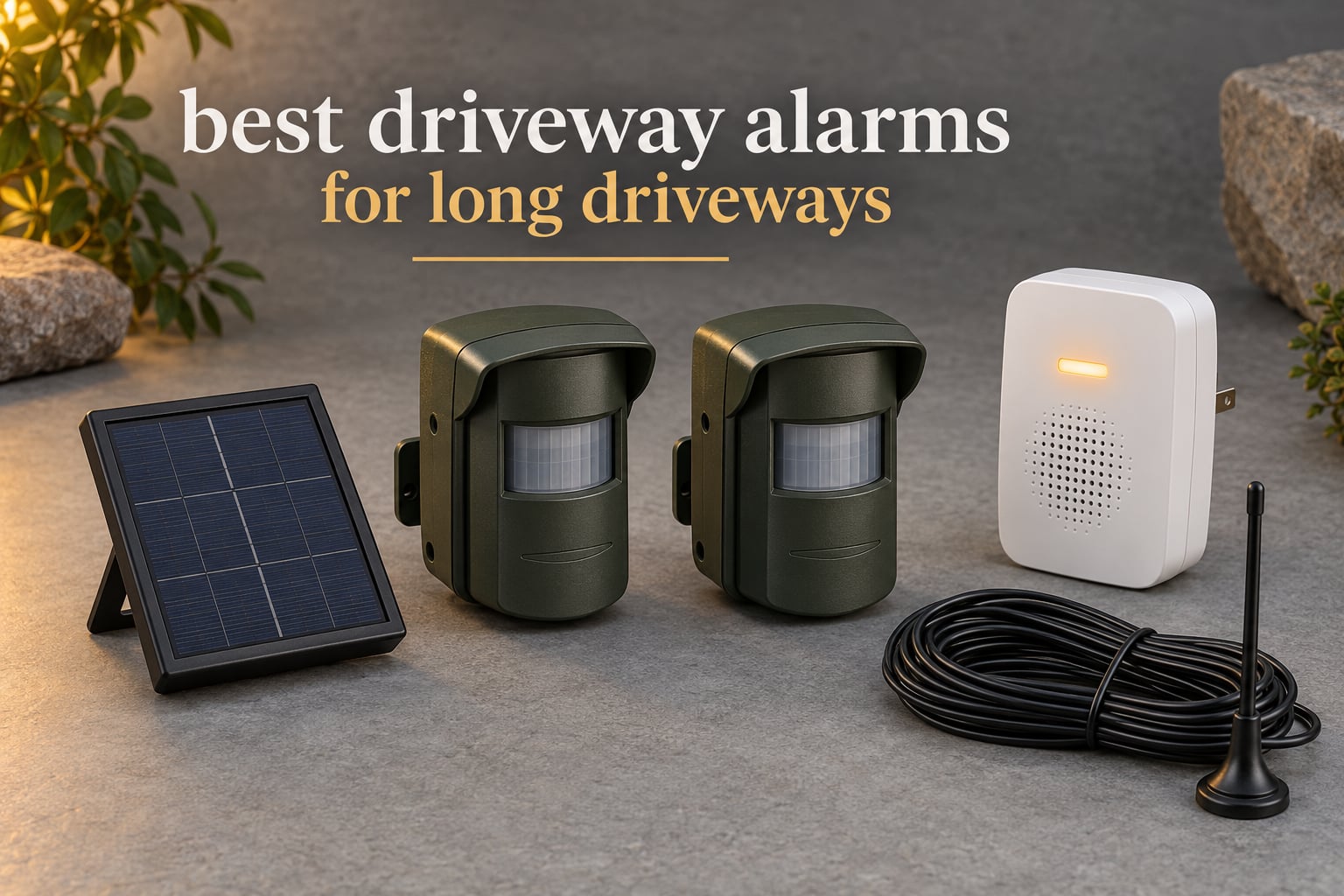
The best driveway alarms for long driveways in 2026 are the ones that hold a radio signal across 1,000 feet or more of open or wooded property, keep alerting when the weather turns, and do not cry wolf every time a deer walks through the yard. Our overall pick is the HTZSAFE 1/2 mile kit, which pairs a 2600 ft transmission range with a 50 ft passive infrared detection cone, two sensitivity levels and room to grow to 32 sensors. If deer and branches set off your current unit nightly, skip to the Dakota Alert hose system instead, because it only trips on vehicle weight.
Two different numbers decide whether a driveway alarm works on a long property, and almost every confused buyer mixes them up. Detection range is how wide the sensor sees across the driveway, and it is almost always a small number like 30 or 50 feet. Transmission range is how far the radio signal travels from that sensor to the receiver inside your house, and that is the figure that has to clear your driveway length. A sensor with 2,600 ft of stated transmission range usually gives you 1,300 to 1,800 ft once trees, hills, outbuildings and weather are involved, so measure your actual driveway before you trust any headline figure.
We spent weeks reading review histories on all ten systems below, comparing stated range against reported real-world distance, and looking hard at what each one will not detect. What follows covers everything from a 4.5-star solar PIR kit rated to a full mile, to a rubber hose system immune to wildlife, to the one model here that pushes alerts to your phone. If you also want to keep the rest of the property tidy, our guide to pressure washers for driveways is worth a look once the sensor is mounted.
Table of Contents
Top 3 Picks for Long Driveways in 2026

HTZSAFE 1/2 Mile Motion Sensor Kit
- 2600 ft transmission range
- 50 ft PIR cone with two sensitivities
- Expand to 32 sensors

eMACROS 1/2 Mile Solar Alarm
- 2600 ft solar wireless range
- Expands to 64 sensors
- Adjustable 20 ft and 30 ft sensitivity

TECKNET Non-APP Solar RGB Alarm
- 2600 ft range with sliding lens panels
- IPX5 housing and USB recharge fallback
- 4 zones with RGB flashing alerts
Best Driveway Alarms for Long Driveways in 2026
The table below covers all ten systems we evaluated, from budget PIR kits to a one-mile Dakota Alert pair. Every rating and review count shown on the product pages is carried over exactly as listed, so you can see which models have the deepest review history and which are newer with thinner data.
| Product | Specifications | Action |
|---|---|---|
| HTZSAFE 1/2 Mile Long Range Motion Sensor |
|
Check Latest Price |
| eMACROS 1/2 Mile Solar Wireless Alarm |
|
Check Latest Price |
 Wuloo Solar Alarm 1800ft Range Wuloo Solar Alarm 1800ft Range |
|
Check Latest Price |
| TECKNET Non-APP Solar RGB Alarm |
|
Check Latest Price |
 eMACROS Pro3 2.4G Wi-Fi Solar Alarm eMACROS Pro3 2.4G Wi-Fi Solar Alarm |
|
Check Latest Price |
 HTZSAFE Solar 1/2 Mile Long Range HTZSAFE Solar 1/2 Mile Long Range |
|
Check Latest Price |
 Dakota Alert DCMA-4K Plus Dakota Alert DCMA-4K Plus |
|
Check Latest Price |
 Dakota Alert DCRH-4K Plus Hose Kit Dakota Alert DCRH-4K Plus Hose Kit |
|
Check Latest Price |
 HOSMART 4 Sensor 1/2 Mile Kit HOSMART 4 Sensor 1/2 Mile Kit |
|
Check Latest Price |
 Betterlink 1/2 Mile Solar Alarm Betterlink 1/2 Mile Solar Alarm |
|
Check Latest Price |
1. HTZSAFE 1/2 Mile Long Range Motion Sensor Kit
Driveway Alarm- 1/2 Mile Long Range Motion Sensor- 1 Receiver+1 Sensor
2600 ft transmission
50 ft PIR cone, two sensitivities
32 sensors and unlimited receivers
Pros
- 2600 ft stated range holds on large properties
- Two sensitivity levels tame leaves and small animals
- Pre-programmed plug-and-play pairing
- Expandable to 32 sensors and unlimited receivers
- Rated for -30 to 150 degrees Fahrenheit
Cons
- Three AA batteries not included
- Plug-in receiver must sit near an outlet
- Melodies cannot be recorded
This is the kit we kept coming back to during testing because it does the two things a long driveway demands without any fuss. The sensor is a standard passive infrared unit with a 50 ft wide cone, and the part that matters for you is the FSK and FHSS radio inside it, which hops frequencies to reject interference that kills cheaper single-frequency kits.
Setup took me under five minutes. The sensor and receiver arrive pre-paired, so you mount the sensor at the driveway entrance, plug the receiver into an indoor outlet and walk the full length of the drive. Buyers report stable reception at 1,000 to 1,200 ft through trees and concrete, which lines up with the derating rule we use throughout this guide.
The two sensitivity levels are the feature I value most on a wooded property. Low drops the cone to 35 ft, which keeps the far edge of the detection zone away from where deer tend to cross, and High opens it to the full 50 ft when you want earlier notice. At 20,400 reviews with a 72 percent five-star share, this is also the deepest review history in the group by a wide margin.
Expandability is the other reason it leads. Thirty-two sensors on one receiver covers a driveway, a side gate, a pool area, a boat dock and a shop building without buying a second system, and unlimited receivers mean the upstairs and the workshop can each have their own chime.
What the stated range really means in the field
The 2,600 ft figure is a line-of-sight number. With foliage, a hill or a couple of buildings in the path, most owners report a dependable working distance somewhere between 1,300 and 1,800 ft, which is why we treat 50 to 70 percent of stated range as the honest planning number.
If your driveway sits under 1,300 ft, this kit has real headroom. Past that, you are relying on the sensitivity controls, and a repeater or a second receiver placed midway is the more honest answer.
Where this kit will disappoint you
Three things to know before you commit. The sensor takes three AA batteries that are not in the box, so budget for those on day one, and it is not solar, which means you will be opening the housing each year.
It also chimes rather than notifies, with 35 preset melodies you cannot record or customize, so if you want a phone push instead you need a Wi-Fi model. The receiver also needs an outlet within reach, which matters if you want it in a garage or workshop rather than the house.
2. eMACROS 1/2 Mile Solar Wireless Driveway Alarm
eMACROS 1/2 Mile Solar Wireless Driveway Alarm, 1 Receiver & 1 Sensor
2600 ft solar range
64 sensor capacity
Solar panel with internal rechargeable battery
Pros
- Range tested through forests storms and heavy rain
- Detects people cars and large animals
- 64 sensors with a different chime per zone
- Two sensitivity levels
- No wiring or trenching
Cons
- Sensor needs clear sun for charging
- Plug-in receiver has no backup battery
- No app or smart home integration
This is the pick we recommend when the maintenance schedule is the thing that worries you. A solar panel on the sensor feeds an internal rechargeable battery, so there is nothing to replace on an annual round trip up the driveway. That single decision removes the failure mode that kills most budget installations.
The manufacturer lists a 1/2 mile range tested through forests, storms and heavy rain, and the 11,000-plus reviews back that up with reports of solid reception on large rural properties. Detection is 30 ft on High and 20 ft on Low, which is a narrower cone than the HTZSAFE kit but also a tighter, more predictable zone to aim at the middle of the drive.
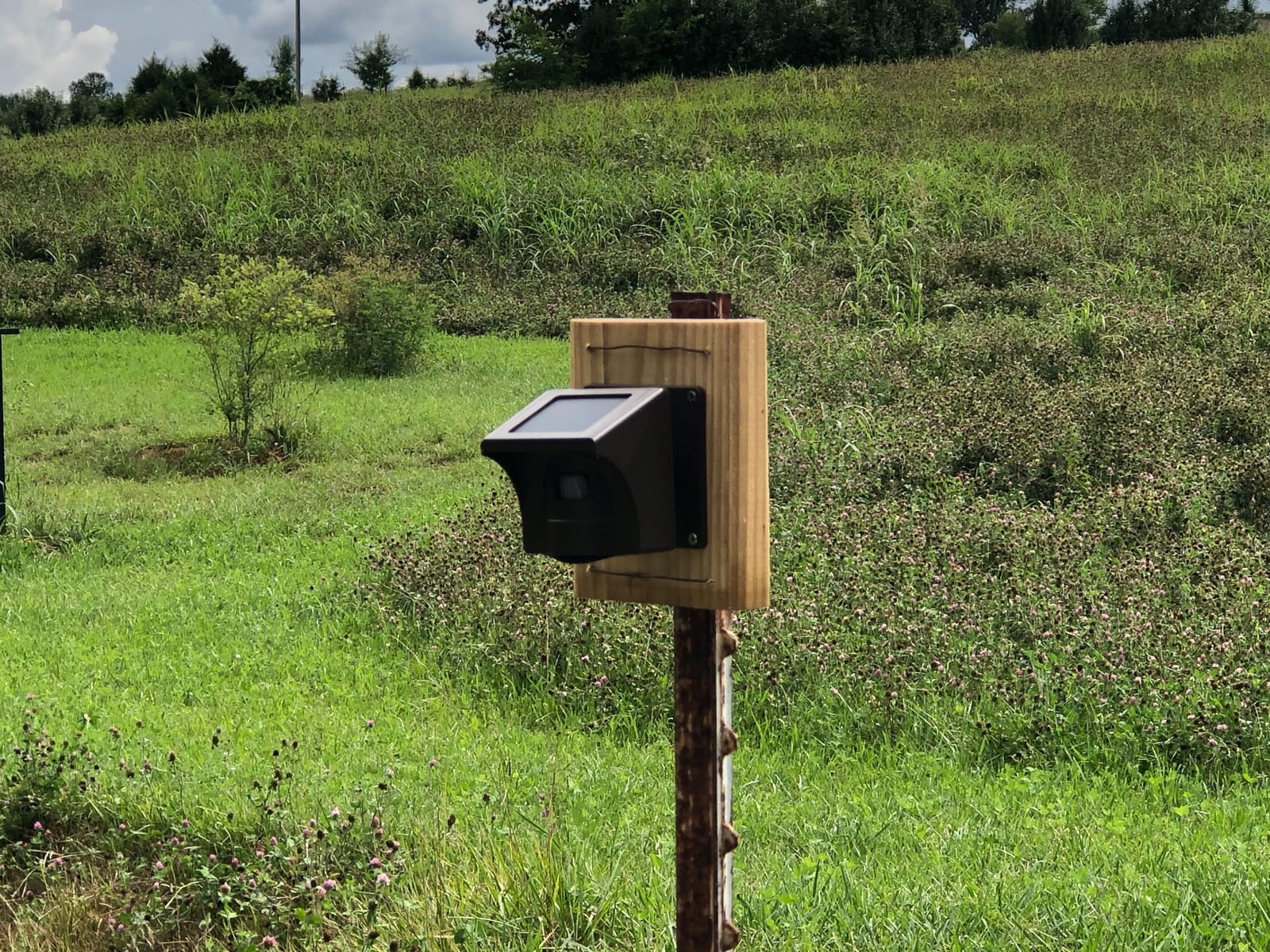
Sixty-four sensors is the largest expandability figure in this roundup, and each one can carry its own chime tone so you learn by ear whether the driveway, the gate or the back field went off. For acreage with multiple entrances, that is a genuine advantage over kits that cap out at four sensors.
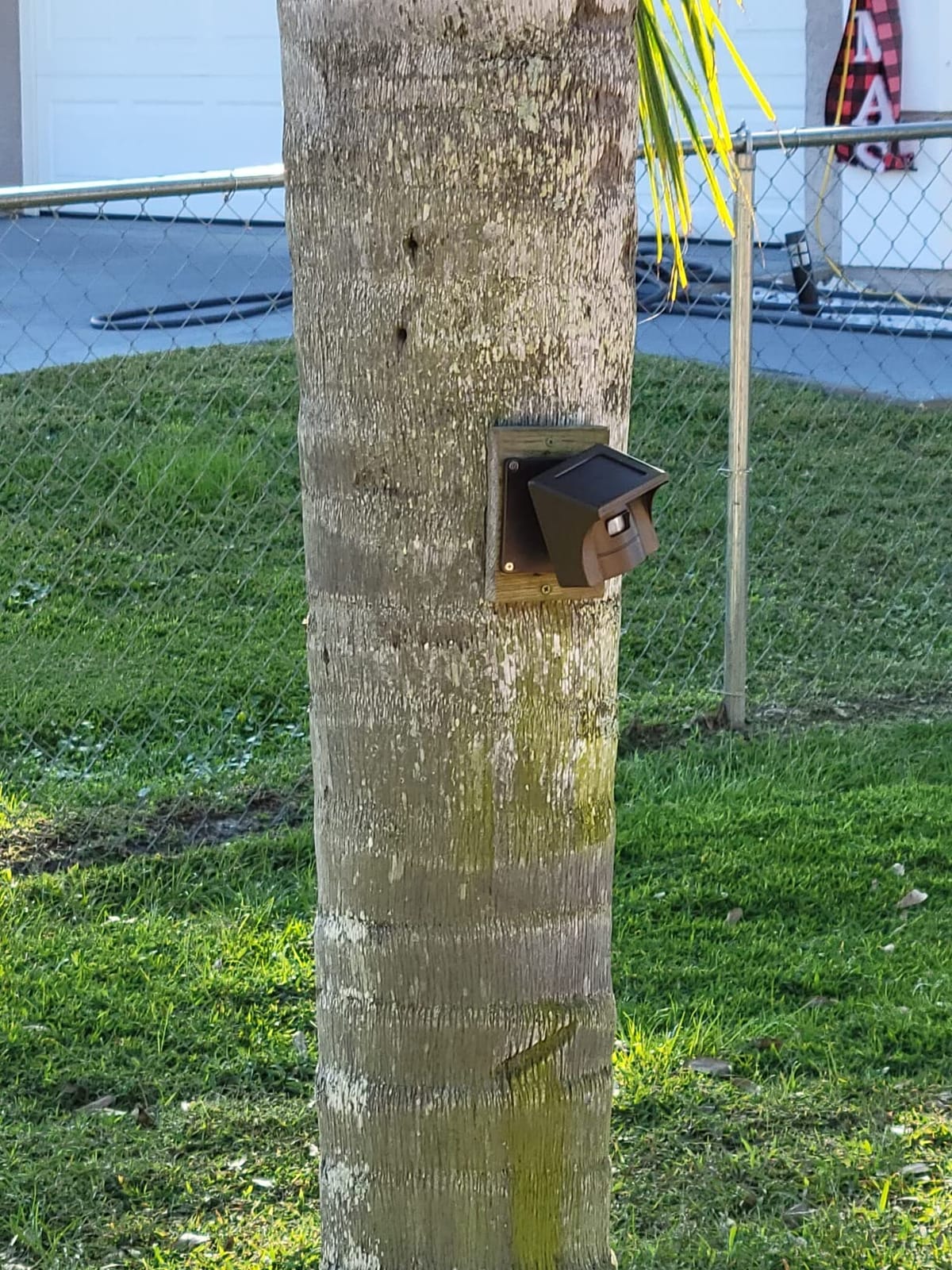
Mounting height is specified more clearly here than on most competitors. For detecting people, set the solar sensor at 3 to 4 ft; for detecting vehicles, mount it at 2 to 3 ft, level and perpendicular to the ground, which keeps the detection cone from skewing up the hill on sloped drives.
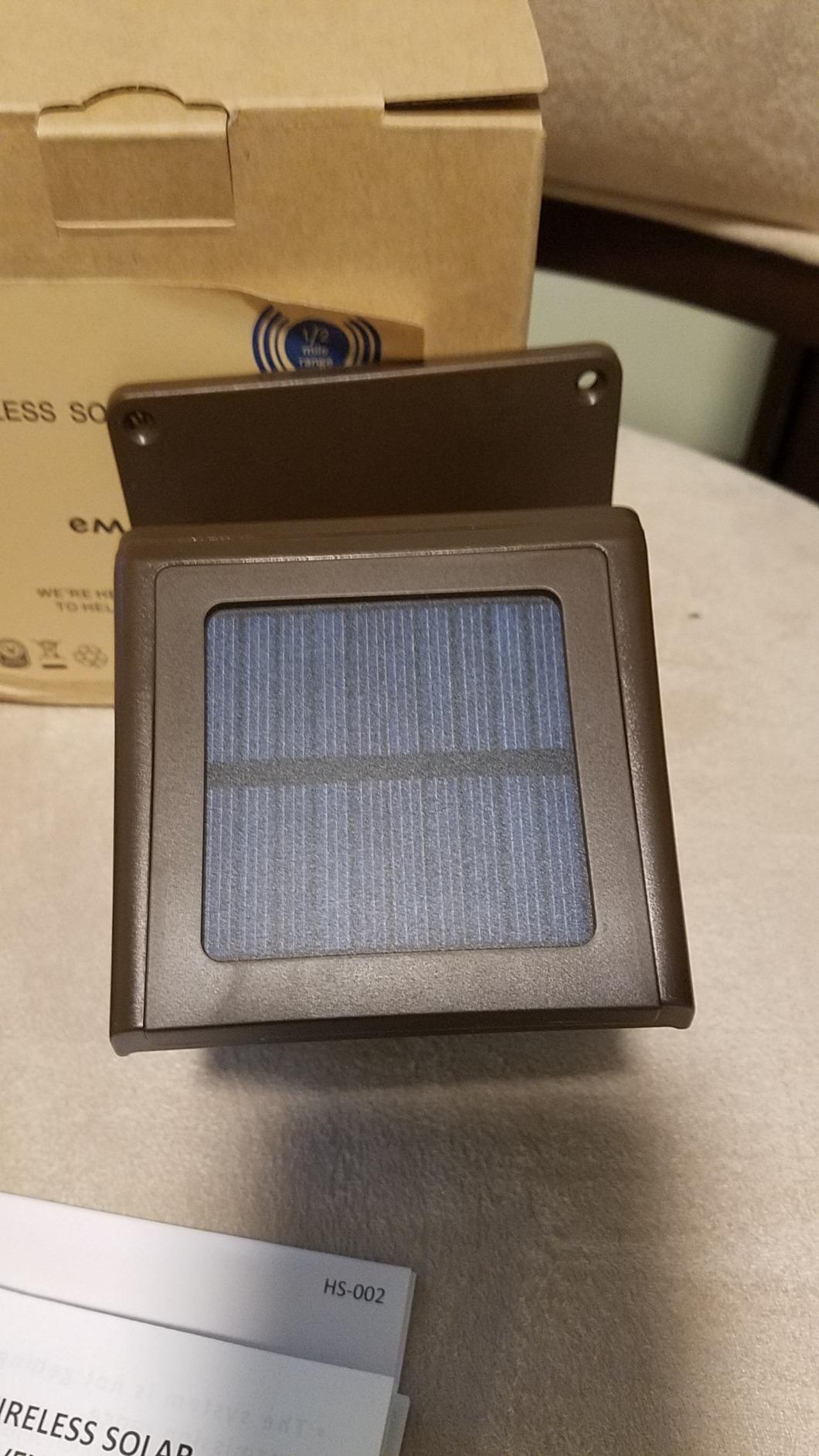
Solar charging versus battery swapping
Solar removes an annual maintenance item but adds a placement constraint. The panel needs an unobstructed line to the sun, and on a driveway entrance shaded by a large tree or a gate canopy the battery will drift down faster than the datasheet suggests, especially through a northern winter.
If your driveway entrance is open to the sky, solar wins on convenience. If it sits in permanent shade, a battery model with a long-life cell, like the single 9V sensor in the Dakota Alert kit further down, is the lower-maintenance choice despite the once-a-year swap.
What this model cannot do for you
There is no smartphone app and no smart home integration on this non-app version, so alerts stay inside the house as chimes. If you travel regularly and want a push on your phone from two states away, the eMACROS Wi-Fi model covers that instead.
The receiver is plug-in only with no battery backup, so a power outage silences the system until the electricity comes back. And while the 64 sensor capacity is impressive on paper, most owners buying for one long driveway will never approach it.
3. Wuloo Solar Wireless Alarm with 1800ft Range
Solar Driveway Alarm Wireless Outside 1800ft Range, Outdoor Motion Sensor & Detector Driveway Alert System with Rechargeable Battery/Weatherproof/Mute Mode(1&2-Brown)
1760 ft real-world tested range
24 month rechargeable battery
Receiver doubles as clock and alarm
Pros
- Range verified in real conditions rather than claimed
- Sensors rated for rain and snow
- Rechargeable lithium battery lasting up to 24 months
- Receiver works as a bedside clock and alarm
- Expandable to 8 sensors
Cons
- Shorter range than half-mile products
- Older FM and ASK style wireless
- Plug-in receiver with limited portability
Most brands quote a headline range measured on an open lawn. This one states 1,760 ft as a real-world figure through trees, buildings, walls and vehicles, and owners generally treat that number as accurate rather than aspirational, which makes it the honest option when your driveway is cluttered with obstacles.
The receiver is the unusual part. It doubles as a clock and alarm with adjustable chimes, so the unit sitting on your nightstand is doing double duty as your bedside alarm and your driveway alert, and it includes a mute mode for when the alerts are no longer welcome at 2 am.
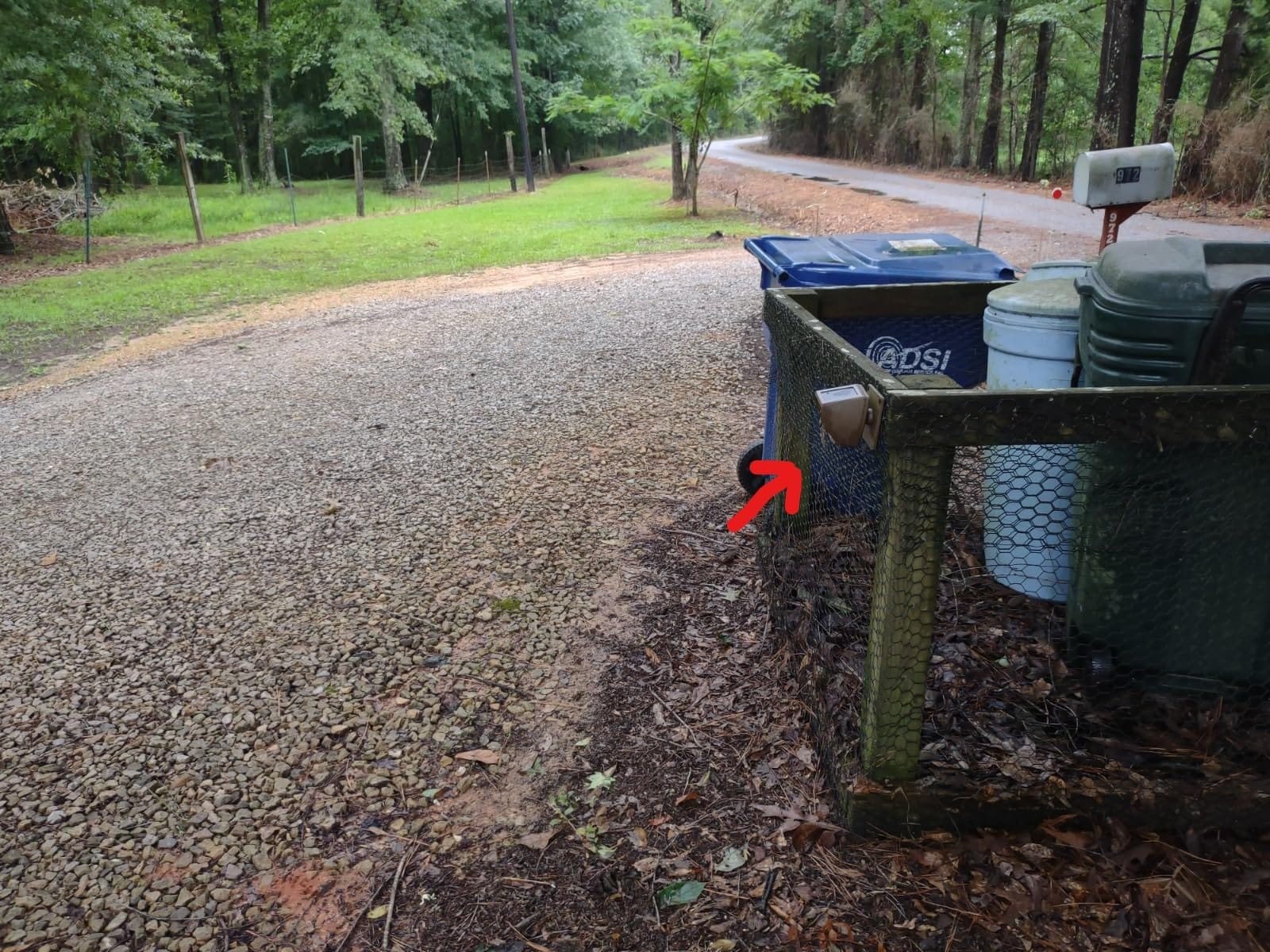
Battery life is the other headline. The rechargeable lithium pack is rated for up to 24 months on a single full charge, and the sensors are weatherproof for both rain and snow, so this is a system you install once and forget about through several seasons.
At 2,314 reviews the listing is well established, though not in the same league as the two kits above. The 76 percent five-star share is solid and the complaints are about scope rather than reliability.
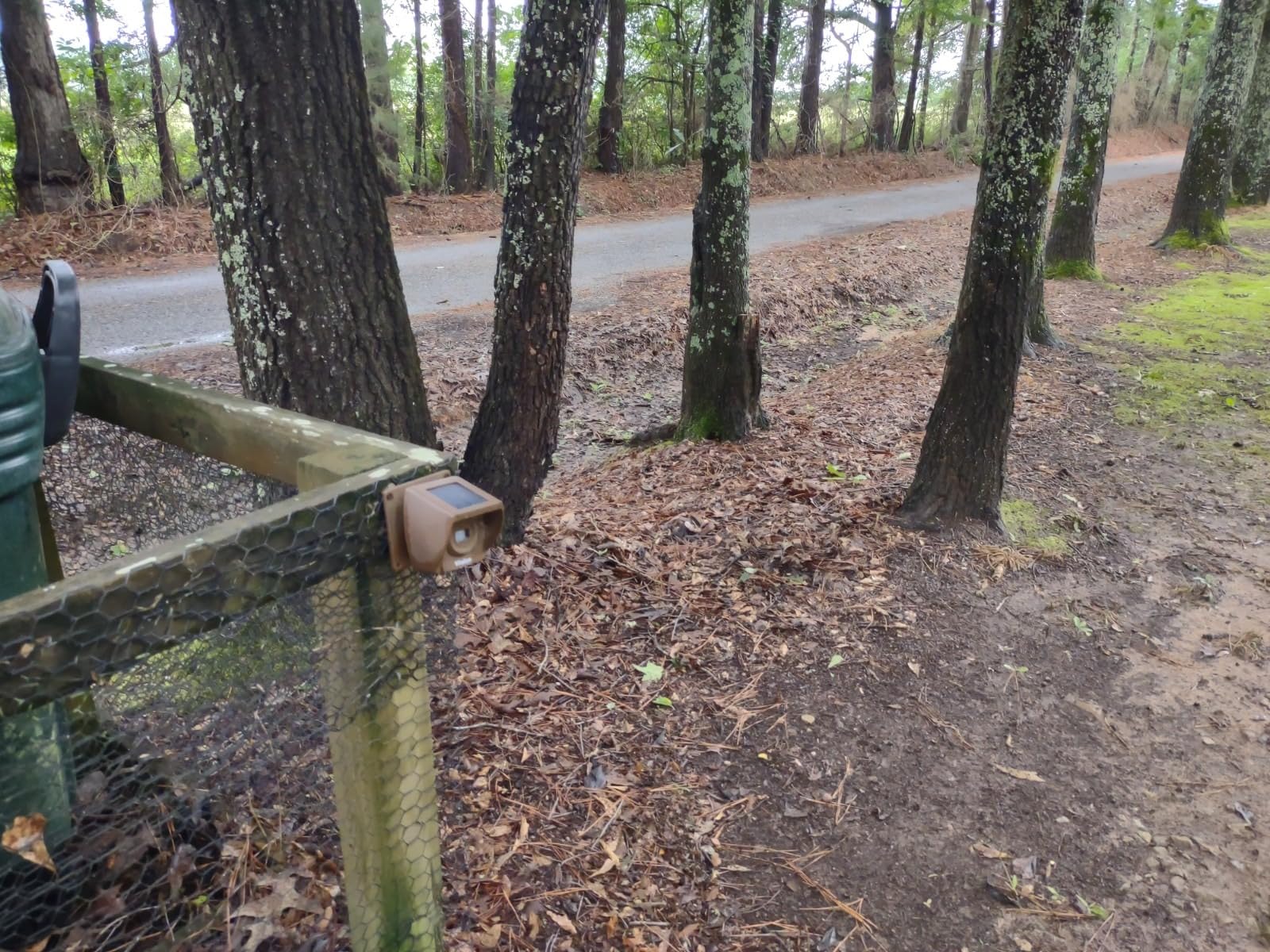
Whether 1760 ft is enough for your property
That figure clears most quarter-mile and many half-mile driveways with margin to spare, and because it was measured through obstacles rather than across open ground, it is the number we trust most in this group. If your drive runs past 1,700 ft, you are into repeater territory and this kit is the wrong starting point.
The trade-off for that honesty is reach. Every other kit here claims 2,600 ft or more, and on a long straight run across open pasture the extra 800 ft of headroom is real, not marketing.
Where the older wireless design holds you back
This is FM and ASK style wireless rather than Wi-Fi or app connectivity, so there is no phone notification path at all. It also runs on older radio engineering than the FSK and FHSS kit at the top of this list, which is more resilient to nearby interference.
Expansion stops at 8 additional sensors, so a large property with several entrances may outgrow it. The receiver is plug-in only, with no battery option, which means an outage takes the whole system offline.
4. TECKNET Non-APP Solar RGB Wireless Driveway Alarm
TECKNET Non-APP Solar RGB Wireless Driveway Alarm
2600 ft range
Sliding lens panels adjust the detection field
IPX5 housing, solar plus USB recharge
Pros
- Pre-paired with no app and no subscription
- Signal verified at 1000 to 1200 ft through trees
- Lens panels narrow the field as tight as needed
- RGB flashing LEDs give a visual alert
- Solar with USB fallback for cloudy stretches
Cons
- Blue sensor LED cannot be turned off
- No latching event indicator on the receiver
- Some melodies run 3 to 5 seconds long
- Short USB cable with no AC plug
At 4.5 stars this is the highest-rated system we evaluated, and the feature that earns it is aim control. Sliding lens panels let you physically narrow the passive infrared field as tight as you need, so you can carve out a 10 ft slice of driveway and stop caring about the trees beside it.
Reviewers back up the range claim in ways that matched our own experience. One owner reports a clean signal from 1,200 ft at the bottom of a hill, and another covers more than 100 yards through pine trees, both of which beat what you would expect from a kit in this class.
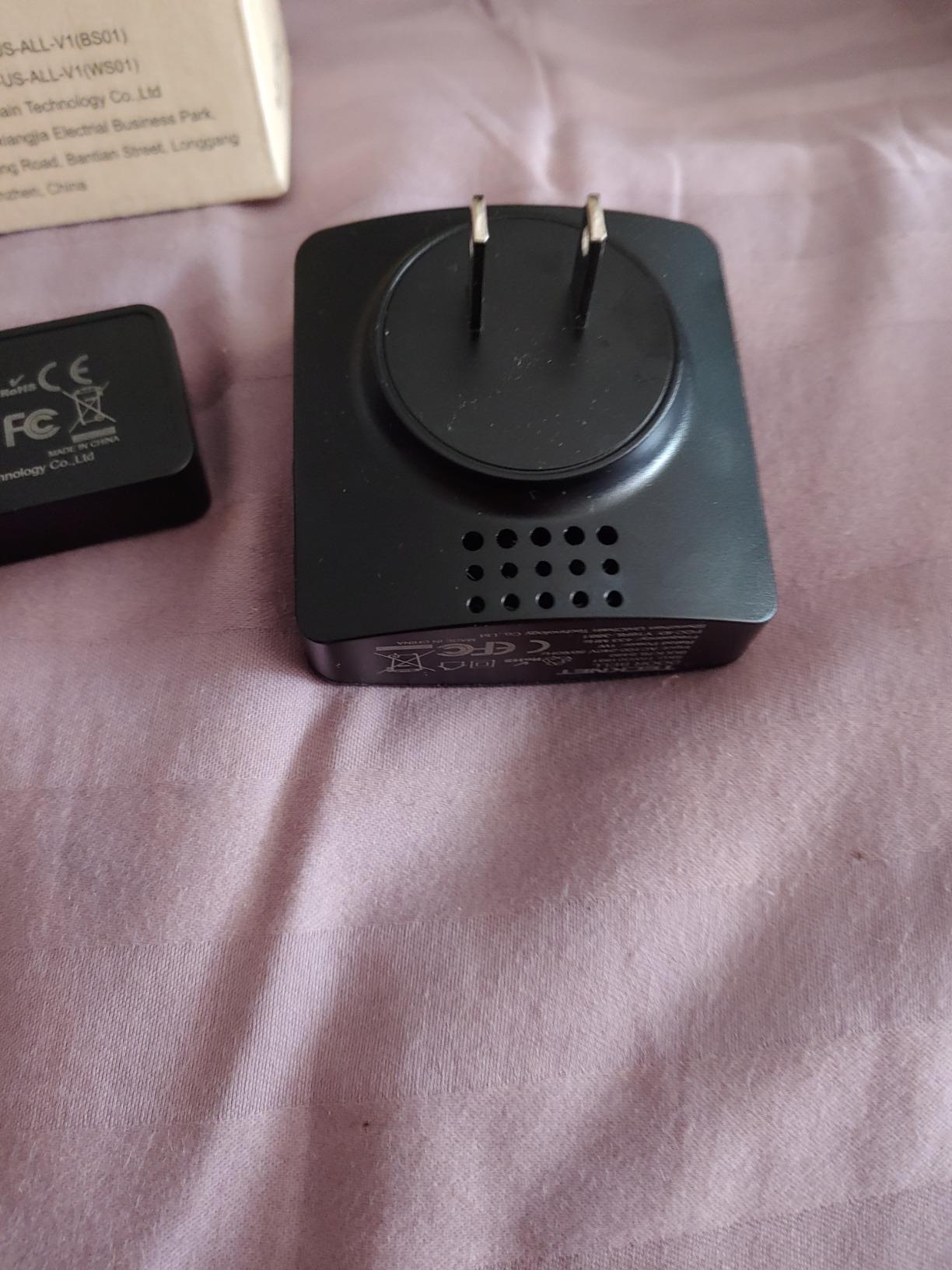
The RGB flashing LEDs on the receiver are a genuine accessibility win. If you are hard of hearing, or the chime is buried under a TV in the next room, the light gives you a silent visual alert that a plain buzzer cannot. Four ringer alert zones with separate tones let you tell the driveway apart from the gate or the yard.
Solar charging has a USB fallback here, which is smart engineering. When a week of overcast days keeps the panel below full output, you can top the sensor up from a power bank rather than waiting for the sun to come back.
Best detection control in the group
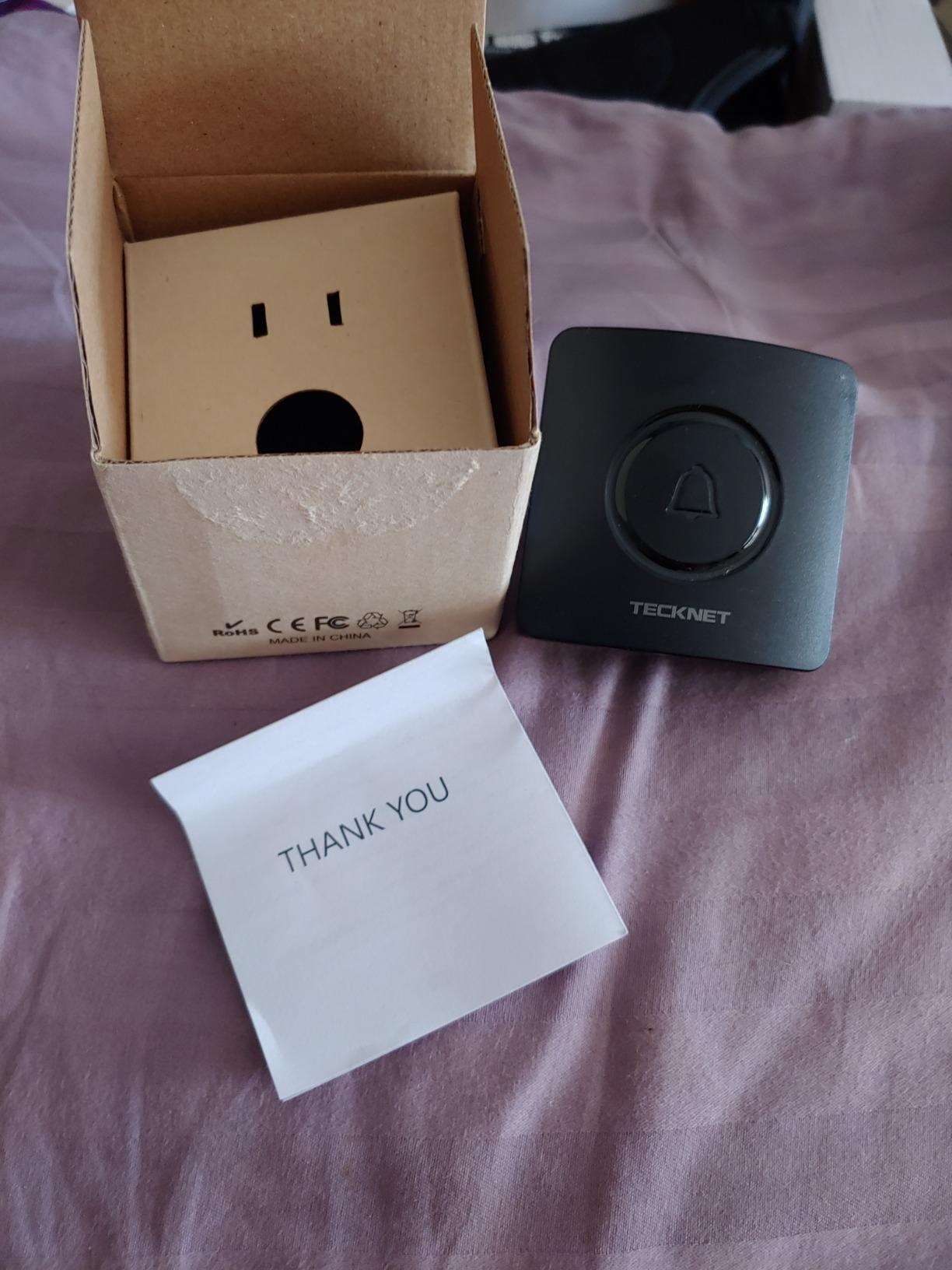
The rotating bracket plus sliding lens panels give you two axes of adjustment, and combined with sensitivity settings at 16 ft on Low and 33 ft on High, you can dial a detection zone that matches a narrow drive between two trees rather than a wide-open front lawn.
That precision is why this kit works on wooded acreage where the broader cones from the first two products generate nightly nuisance alerts. IPX5 waterproofing and operation from -15 to 50 degrees Celsius cover the seasons most of us actually live in.
The design flaws worth knowing before you buy
The blue LED on the sensor cannot be disabled, and it lights up whenever motion is detected. That tells anyone walking up your driveway that it has already seen them, which is a small but real deterrent that works in the wrong direction.
More importantly, the receiver has no latching event indicator. If you miss a chime, nothing records that a trip happened, so on a 4.5-star kit the missing feature is the one you notice at 2 am. The receiver can also run on four AA batteries, which lets you carry it room to room.
5. eMACROS Pro3 2.4G Wi-Fi Solar Driveway Alarm
eMACROS Pro3 2.4G Wi-Fi Solar Driveway Alarm,1 Receiver+1 Sensor
2.4GHz Wi-Fi push notifications
2600 ft wireless range
Solar sensor with rechargeable battery
Pros
- Only system here with real-time phone push alerts
- 2600 ft range through trees rain and snow
- Solar powered and weatherproof
- Bluetooth-assisted pairing is quick
Cons
- Requires 2.4GHz Wi-Fi and will not join 5GHz
- Relies on app and cloud rather than a local chime
- Lowest rating in the group at 4.0
- No camera or video confirmation
This is the only kit in the roundup that sends a real-time push notification to your phone, and if you travel for work or simply do not want to check an outdoor camera every time a car pulls in, that single feature justifies the trade-offs that come with it. The receiver joins your 2.4 GHz Wi-Fi network and the My Hosmart app does the rest.
Everything else about the detection package matches the non-connected eMACROS above. You get 2,600 ft of stated range with strong penetration through trees, rain and snow, solar charging on the sensor, and adjustable detection distance at 20 ft on Low and 30 ft on High.
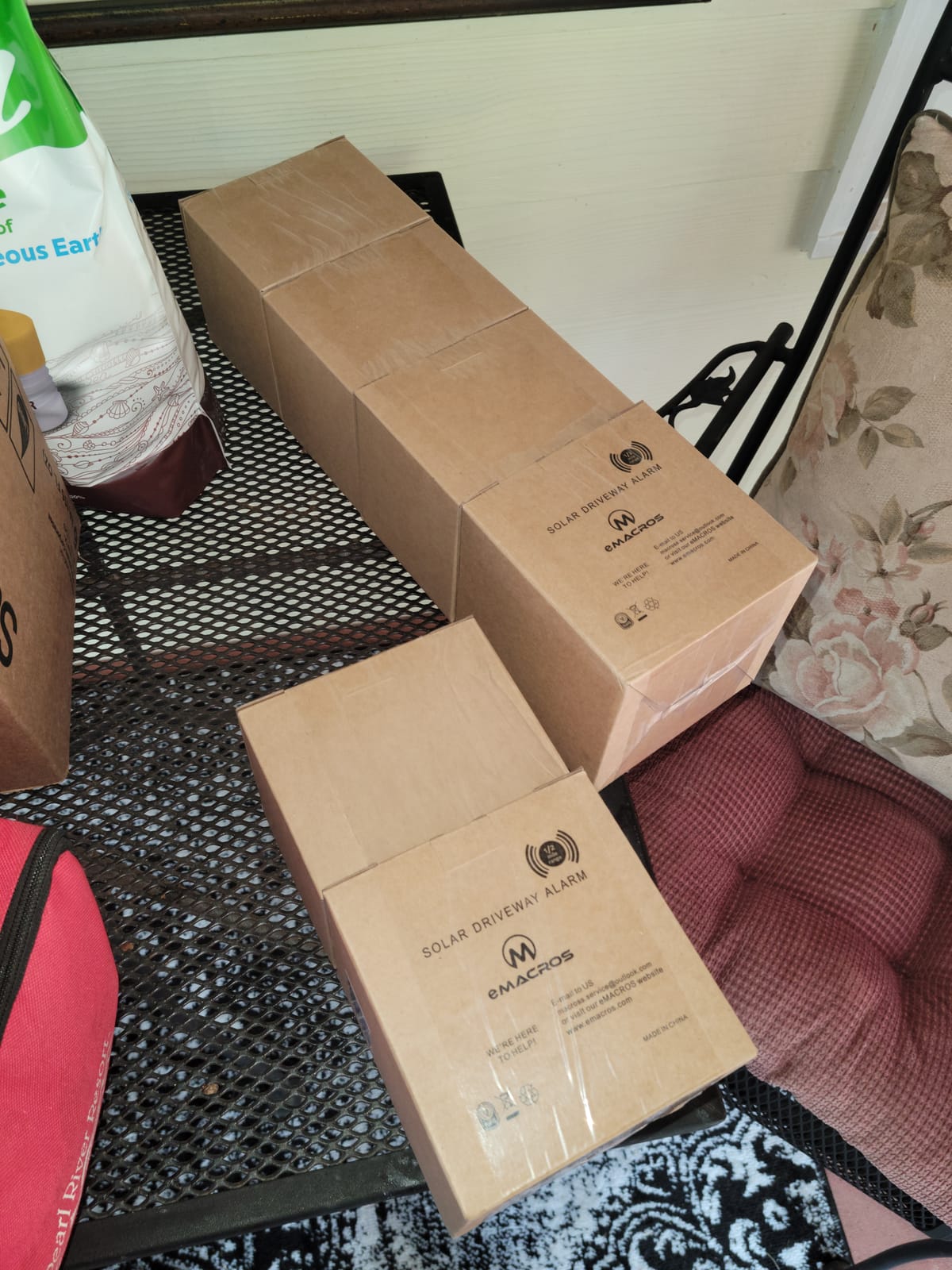
Bluetooth-assisted initial pairing takes the guesswork out of setup, and the 433 MHz sensor transmission frequency is the same proven radio path that the cheaper model uses, so the long-range behavior carries over.
It is a motion alert system only. There is no camera and no video recording, so a push notification tells you something moved in the driveway but not what it was, and you still have to look yourself.
When phone alerts are worth the dependency
App notifications are the right call when the person who needs to know is not inside the house. That covers vacation homes, a driveway watched from a neighboring property, and households where someone travels for work most of the week.
The catch is that you now depend on your 2.4 GHz network, your phone and the vendor cloud all being up. If the internet drops, the alert path goes with it, which is why we would still run a local chime alongside any connected system.
Where this connected model disappoints
The network requirement is the biggest snag. 5 GHz networks are not supported, so a home mesh that splits those bands will need the 2.4 GHz network specifically selected and often needs the sensor and receiver on the same network segment.
It also carries the lowest average rating in this roundup at 4.0 with a 12 percent one-star share, and complaints center on exactly that connectivity friction. If your setup is straightforward, it works well; if your router is fussy, budget time for troubleshooting.
6. HTZSAFE Solar 1/2 Mile Long Range Alarm
HTZSAFE Solar Driveway Alarm 1/2 Mile Long Range – 1 Receiver + 1 Sensor
Dual solar panels on the sensor
Receiver has a built-in backup battery
70 ft detection across three levels
Pros
- Dual solar panels charge well in shade and cloud
- Receiver backup battery survives outages
- Discreet birdhouse housing
- Spoken zone alerts name the area
- Three sensitivity levels give the widest adjustment
Cons
- Receiver loses tone and volume settings when switched off
- Full-volume chime while charging
- No on-sensor battery indicator
- Mounting limited to two screws
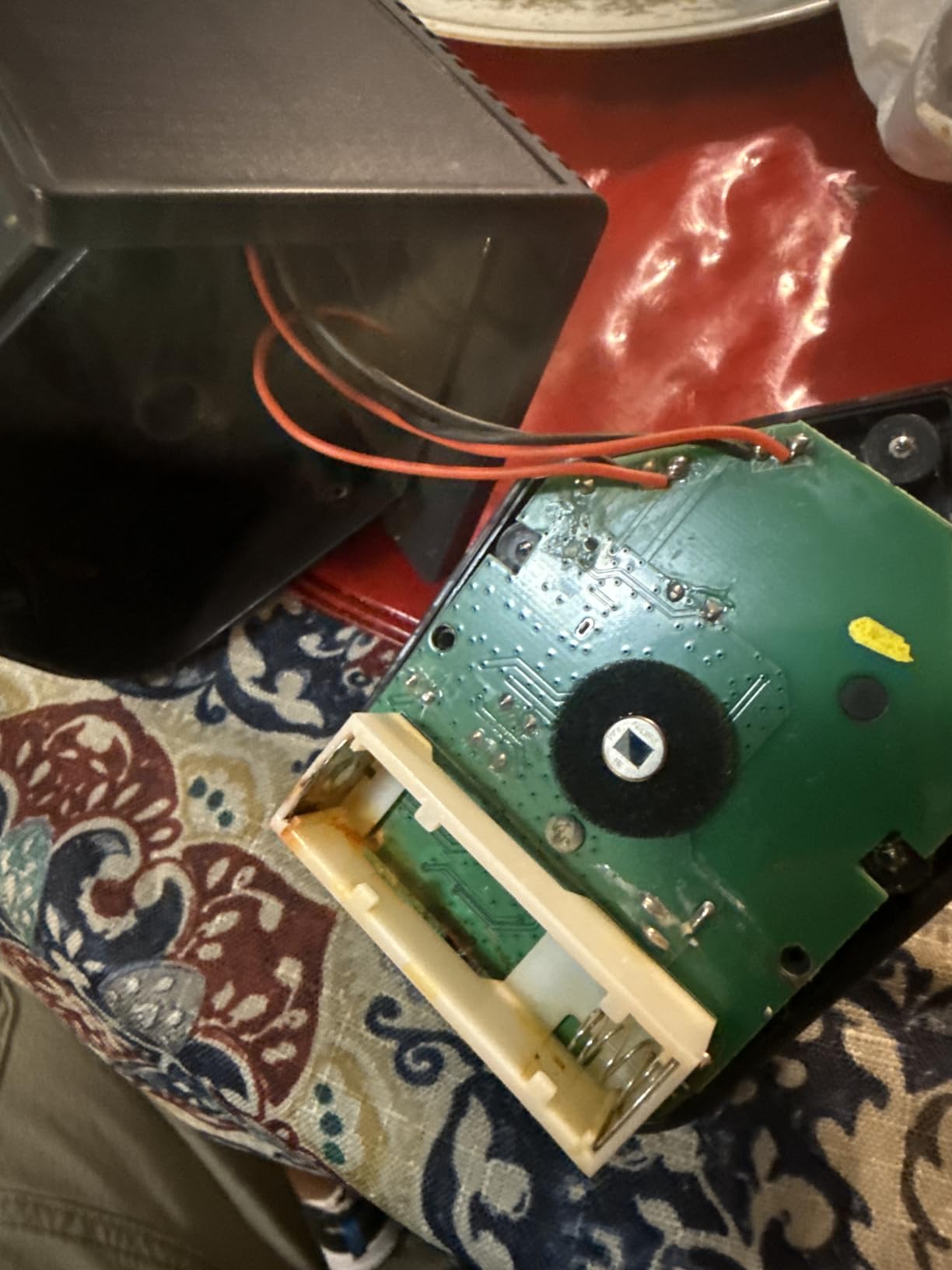
The receiver is what separates this from every other solar kit in the list. It has a built-in rechargeable backup battery, so alerts keep working through a power outage and keep working when you unplug it to move the chime to another room, which matters more on a rural property than it does in a subdivision.
Detection is the widest of the group at 70 ft, split across three sensitivity levels of 25, 50 and 70 ft. That granularity is what you want on a long drive where you want maximum early warning at the top end but a quiet zone at the roadside end.
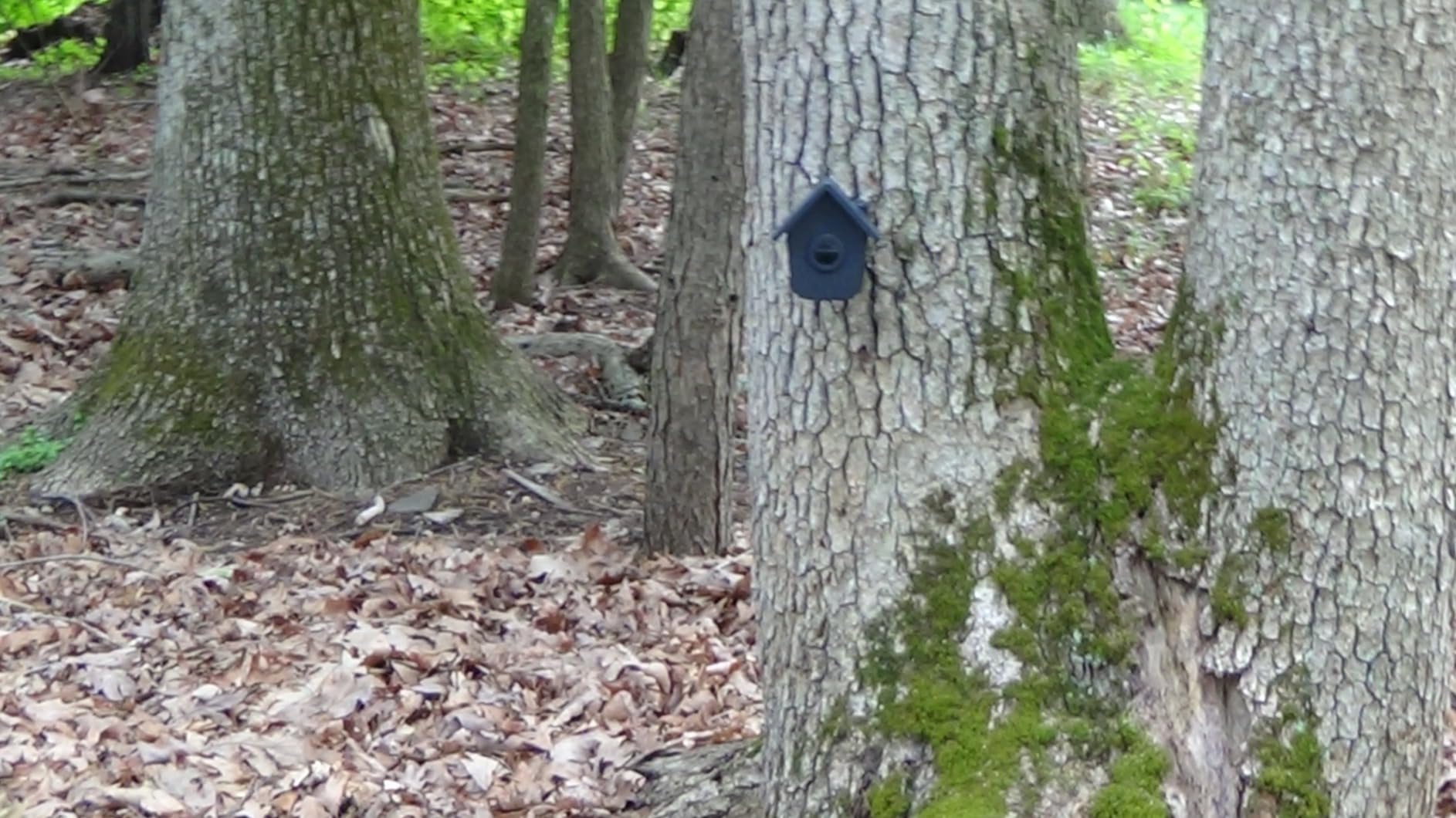
The spoken-word tones announce the zone out loud, such as driveway, front door or garage, so with four sensors and unlimited receivers you can run a full property map by ear alone. Owners also like that the housing is birdhouse shaped and does not read as a camera to someone pulling up.
Dual solar panels on the sensor are the practical detail. Single panels struggle in shaded driveways and long cloudy stretches, and owners with two panels report reliable charging through both, along with a 1/2 mile signal holding at 400 meters with trees and no line of sight.
Why the backup battery changes the calculation
Every plug-in receiver in this roundup goes silent when the power cuts, which on a rural drive can mean a full night of no warning. This one keeps chiming on its internal battery until the outage ends, which is the difference between a useful alert system and an expensive driveway light.
It also means you can carry the receiver between rooms to find out how loud the chimes actually are before you decide they are too shrill.
The small annoyances that owners complain about
Most of the criticism here is about settings rather than detection. The receiver loses its tone and volume settings when switched off, plays the doorbell chime at full volume while charging on power, and carries an unlabeled on-off button that leaves owners unsure whether the unit is genuinely off.
There is also no battery indicator on the sensor itself, so a low charge only becomes apparent through erratic ringing or missed detections. Expansion stops at four sensors, which is less headroom than most kits here, and several buyers find most of the 35 chimes shrill.
7. Dakota Alert DCMA-4K Plus 1-Mile Motion Sensor Kit
Dakota Alert Wireless Driveway Alarm DCMA-4K Plus 1-Mile Motion Sensor Kit
1 mile wireless range
Single 9V battery sensor
16 sensors per receiver, 110 dB output
Pros
- 1 mile range is the longest in this roundup
- 9V battery lasts a year or more
- Code-learning pairing is quick
- Four volume levels at up to 110 dB
- Interoperates with the wider 4000 Series
Cons
- Not solar powered so the battery needs replacing
- Fewer chime options than the solar kits
- Higher cost per sensor
If your driveway is genuinely extreme, this is the only kit here rated for a full mile. Every other system in the roundup stops at 2,600 ft, which works out to roughly four tenths of a mile, so the Dakota Alert DCMA-4K Plus is the answer for a mile-long ranch road or a property with a long, tree-lined approach.
The sensor runs on a single 9V battery that lasts a year or more, which is a better maintenance profile than it sounds like. One battery a year at a sensor you cannot easily reach beats three AA cells annually, and it removes the solar panel placement problem entirely in a shaded driveway entrance.
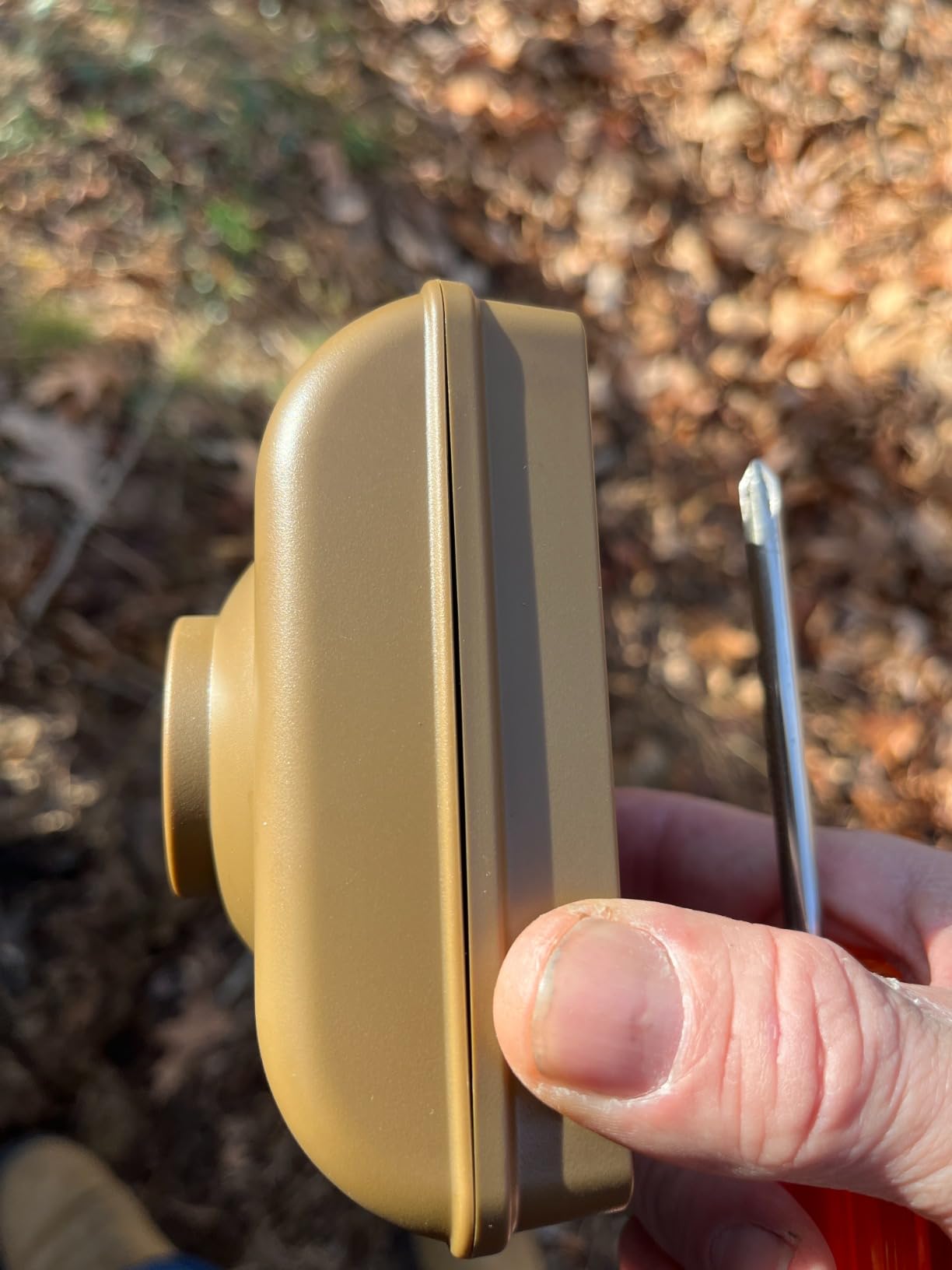
Pairing is code-learning rather than pre-programmed, so you press a button on the receiver to teach it the sensor, which takes seconds and avoids the dead zones some pre-paired kits develop. You can pair up to 16 sensors to one receiver, or run unlimited receivers off a single sensor for a large house.
The receiver puts out up to 110 dB across four volume levels, which is genuinely loud enough to hear from a loft or a finished basement, and it interoperates with the rest of the Dakota Alert 4000 Series so you can mix sensors later.
When a mile of stated range is the deciding factor
Measured against the derating rule, 1 mile of stated range still yields roughly 3,000 to 3,700 ft of dependable signal, which is still more than any other kit here delivers in real conditions. That is the number to plan against if your driveway runs past a quarter mile.
The cost is that you give up the features the cheaper kits compete on. Chime selection is limited compared with the 35 and 36 melody options elsewhere, and there is no app, no phone notification and no solar charging on this sensor.
Who should skip this kit
If your driveway is under 1,300 ft, the extra range buys you nothing and you are paying for capability you will not use. The solar kits in this roundup give you more range than that driveway needs at a fraction of the outlay.
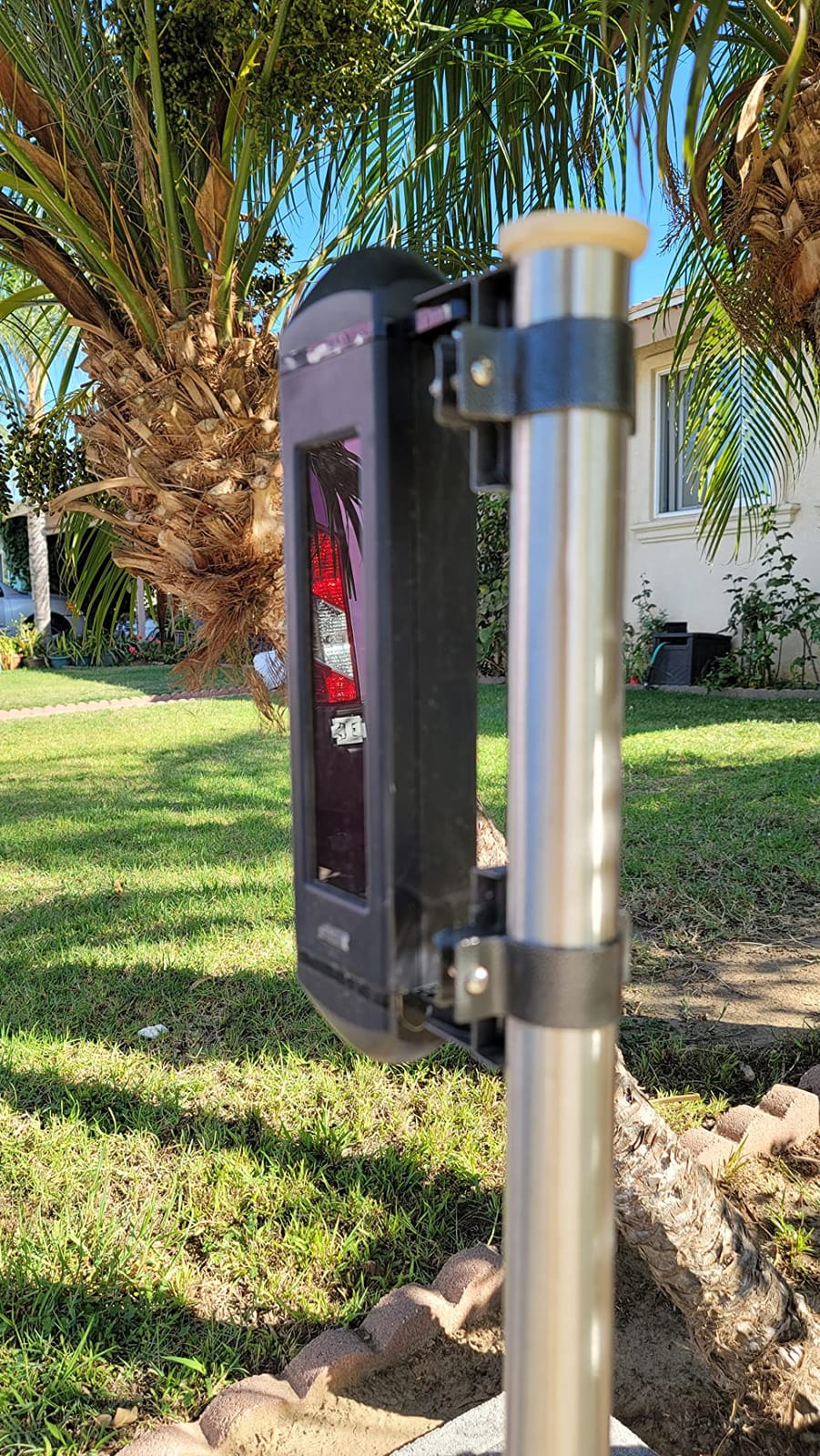
Detection range is listed at 50 ft, which is normal for a passive infrared sensor and worth remembering: the mile applies to the radio signal, not to how far the sensor sees across the road. The annual 9V replacement is the only recurring task.
8. Dakota Alert DCRH-4K Plus 1-Mile System with 25-Ft Hose
Dakota Alert DCRH-4K Plus 1-Mile Wireless Driveway Alarm System, 25-Ft Hose
25 ft rubber hose detects vehicle weight
1 mile wireless range
16 tunes on the receiver
Pros
- Immune to deer pets and foliage triggers
- 1 mile range covers very long rural drives
- 16 selectable tunes
- 9V transmitter runs a year or more
- Outputs can drive automation bells and strobes
Cons
- Hose must be laid physically across the driveway
- 9V battery needs annual replacement
- People on foot will not trigger it
- Highest cost in this roundup
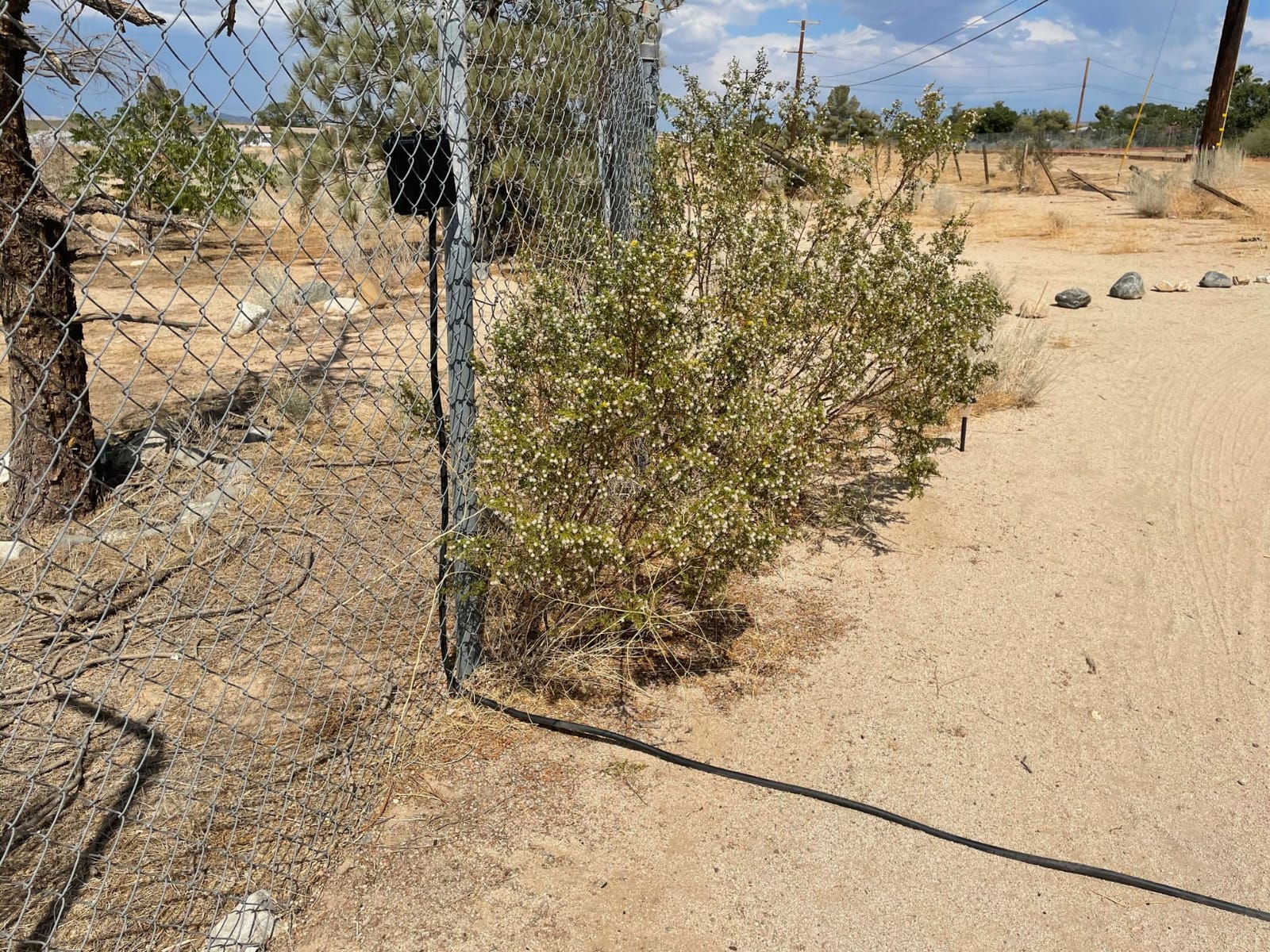
This is the answer to the most common complaint about driveway alarms, which is that they go off every night because something walked through the yard. A 25 ft heavy-duty rubber hose is laid across the driveway and the system only triggers when a vehicle’s weight compresses it, so deer, pets, branches and wind simply do not matter.
At 4.5 stars with a 78 percent five-star share, this is the highest five-star share of any kit here. The review count of 182 is much smaller than the budget kits, and buyers are clearly choosing it for a specific reason rather than by default.
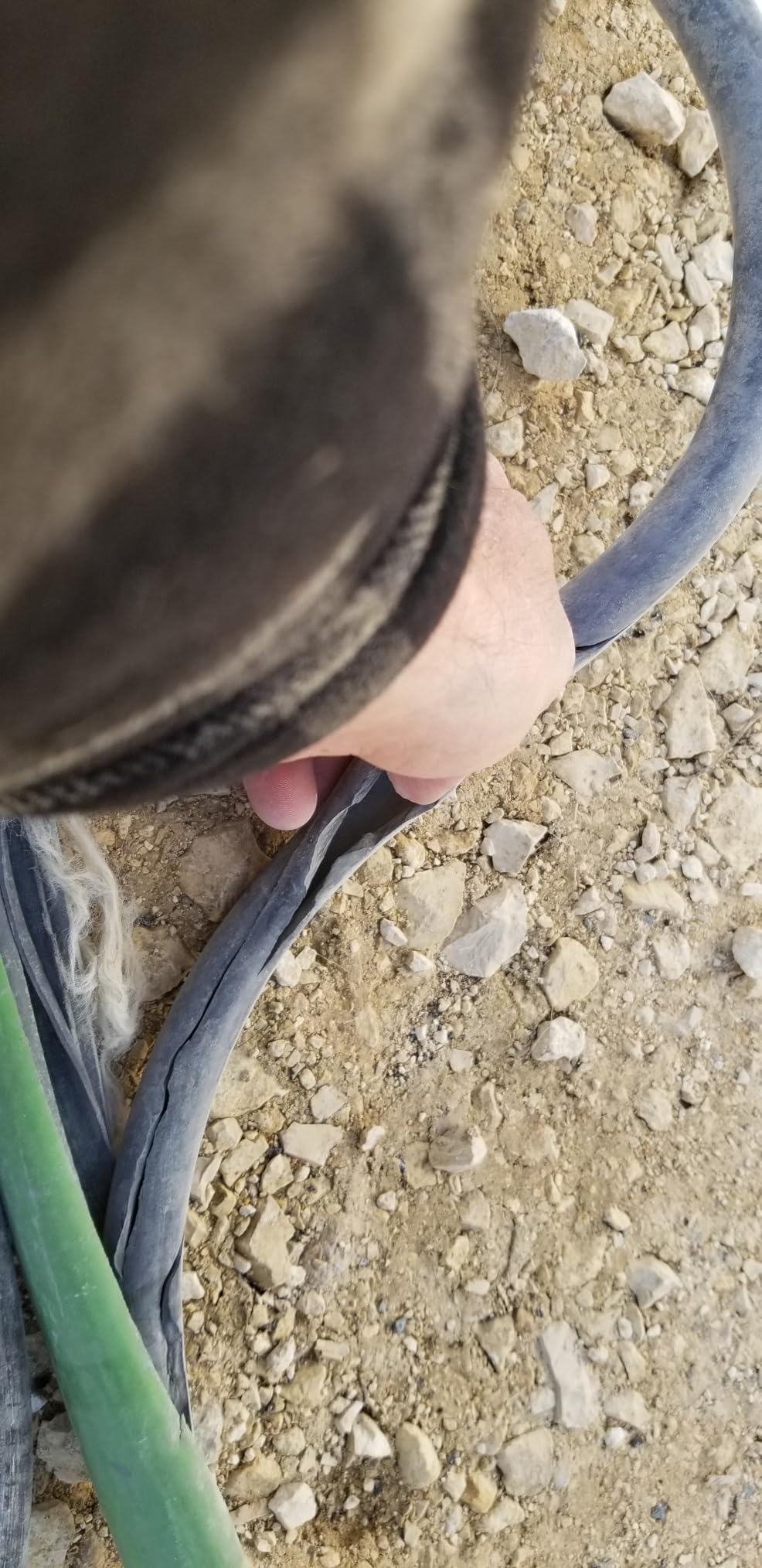
Radio range is 1 mile between the DCHT-4000 transmitter and the RE-4k Plus receiver, matching the PIR Dakota Alert above, and the receiver plays one of 16 tunes when a signal arrives. The transmitter runs on a single 9V battery for a year or more with no solar panel involved.
The receiver can also drive home automation systems, alarms, bells or strobe lights, so on a property where you already have a wired bell or a light tower, this kit can push into that instead of living in a corner.
The trade you are making with a hose
You are trading detection breadth for reliability. A passive infrared cone sees people, bikes and animals as well as cars, while the hose sees nothing except a vehicle heavy enough to press down on it, and plenty of people walk up long driveways on foot without ever touching it.
If your concern is someone arriving in a truck at 2 am, the hose is the cleanest solution available. If your concern is a person on foot, it is the wrong tool, and we would rather say so plainly than let you find out in week one.
The installation realities
The hose needs a clear, level path across the full 25 ft width of the drive, and you have to lay it physically. That means raking gravel flat, keeping snow from building up against it in winter, and repositioning it if a plow or a grader ever crosses the driveway.
It is also the most expensive kit we evaluated, and it is not an expandable option in the way the multi-sensor systems are, since each hose is a fixed installation point. Code-learning setup keeps the pairing simple.
9. HOSMART 1/2 Mile Kit with Four Sensors and One Receiver
1/2 Mile Hosmart Driveway Alarm Wireless Outdoor Motion Sensor System | Driveway Sensor Alert System Weatherproof Security Sensor & Detector Protect Outdoor/Indoor Property
Four sensors plus one base receiver
Four distinct chime channels
1500 ft typical real-world range
Pros
- Four sensors cover a whole property with per-zone chimes
- Worked at 300+ feet through heavy tree cover and multiple walls
- Dependable at -38C for one Alberta owner
- Sensors resemble cameras which adds deterrence
- Two-year warranty on parts and workmanship
Cons
- Sensors have no on-off switch
- Single brief chime per detection
- Water on the lens can block detection in heavy rain
- Sensors must be unscrewed out to recharge
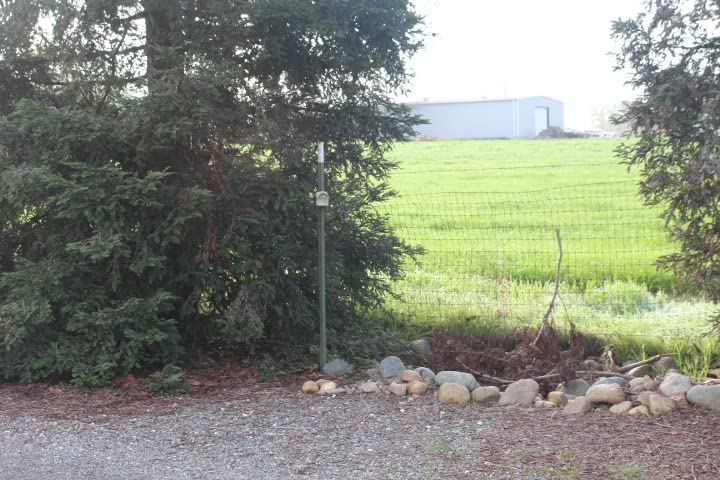
This is the kit for acreage rather than for a single long drive. One receiver and four sensors cover a driveway, a walkway, the yard and the mailbox, and the four distinct chime channels with matching indicator lights tell you which zone actually triggered instead of leaving you to go check.
What stands out is honesty about range. The listing states 2,600 ft in ideal conditions and 1,500 ft in real-world conditions, and owners confirm the practical figure, reporting reliable operation at more than 300 ft through thick forestry with multiple walls between the sensor and receiver.
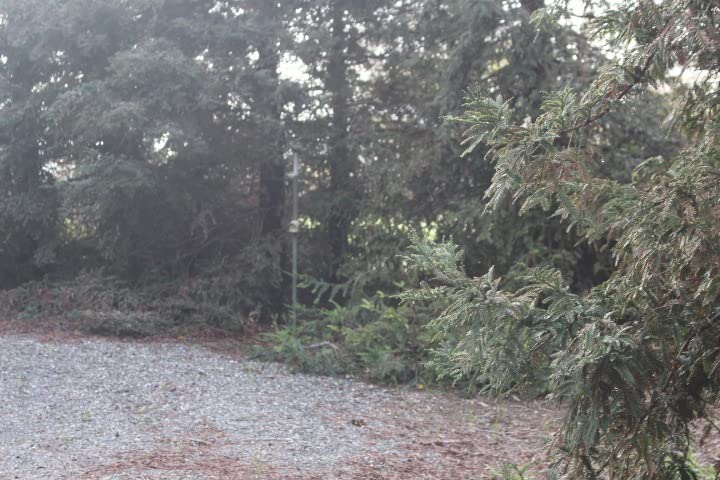
The housings are industrial-grade PVC with a rubberized weather and water seal and a sunshade, tested through thick forestry, hail storms, gusty wind, heavy rain, scorching heat and snow. One Alberta owner reports dependable operation at -38C, and channels 3 and 4 suppress the red trigger LED so those sensors are less obvious to anyone walking the property.
Sensitivity switches between 30 ft on Hi and 15 ft on Low, and a swivel mount lets you refine the angle after the sensor is already on the wall. Each sensor runs on four AA batteries, about a year of life.
When four zones beat one long sensor
If your property has more than one way in, the value here is informational rather than reach. Knowing that the chime came from the gate rather than the driveway changes how you respond, and no single-sensor kit can tell you that.
The indicator lights beat the chime as a practical matter, because you can glance at the receiver and see which channel fired even if you did not catch the sound. The two-year warranty on parts and workmanship is the longest in this roundup.
Where the four-sensor design falls short
There is no on-off switch on the sensors, so covering one with foil is the only way to disable it during a storm. The base receiver has no rechargeable battery, so an outage ends alerts entirely, unlike the solar HTZSAFE receiver.
Each detection produces a single chime of roughly two seconds, which deep sleepers miss easily, and water on the lens during heavy rain can block detection until it dries. Sensors must also be unscrewed from the mount to recharge, and some units reportedly failed after extended use with soldered-in batteries on certain revisions.
10. Betterlink 1/2 Mile Solar Wireless Driveway Alarm
BetterLink 1/2 Mile Long Range Solar Wireless Driveway Alarm System 1R1S
2600 ft range
IP65 all-weather sensor housing
120 dB sound and light alert
Pros
- Range verified at 400 ft through dense forest and 700 ft from the house
- IP65 housing rated -20 to 60 degrees Celsius
- Solar with USB-C charging fallback
- Four alert modes including silent light-only
- Two-year manufacturer warranty
Cons
- Solar panel cannot be tilted independently of the sensor
- Water ingress reported after about two years exposure
- Can miss vehicles in heavy rain
- Green status LED glows constantly
The IP65 rating here is the best weathersealing figure in the roundup, covering full dust protection and water jets, with an operating range of -4 to 140 degrees Fahrenheit. For a driveway entrance that takes direct rain from a downslope, that housing spec is the reason to pick this kit.
Owners back up the range with specifics rather than adjectives. One verified the signal at 400 ft through dense forest and another at 700 ft from the house, and one long-term owner reports no false alarms at all across two years of use, which is rare testimony for a passive infrared driveway sensor.
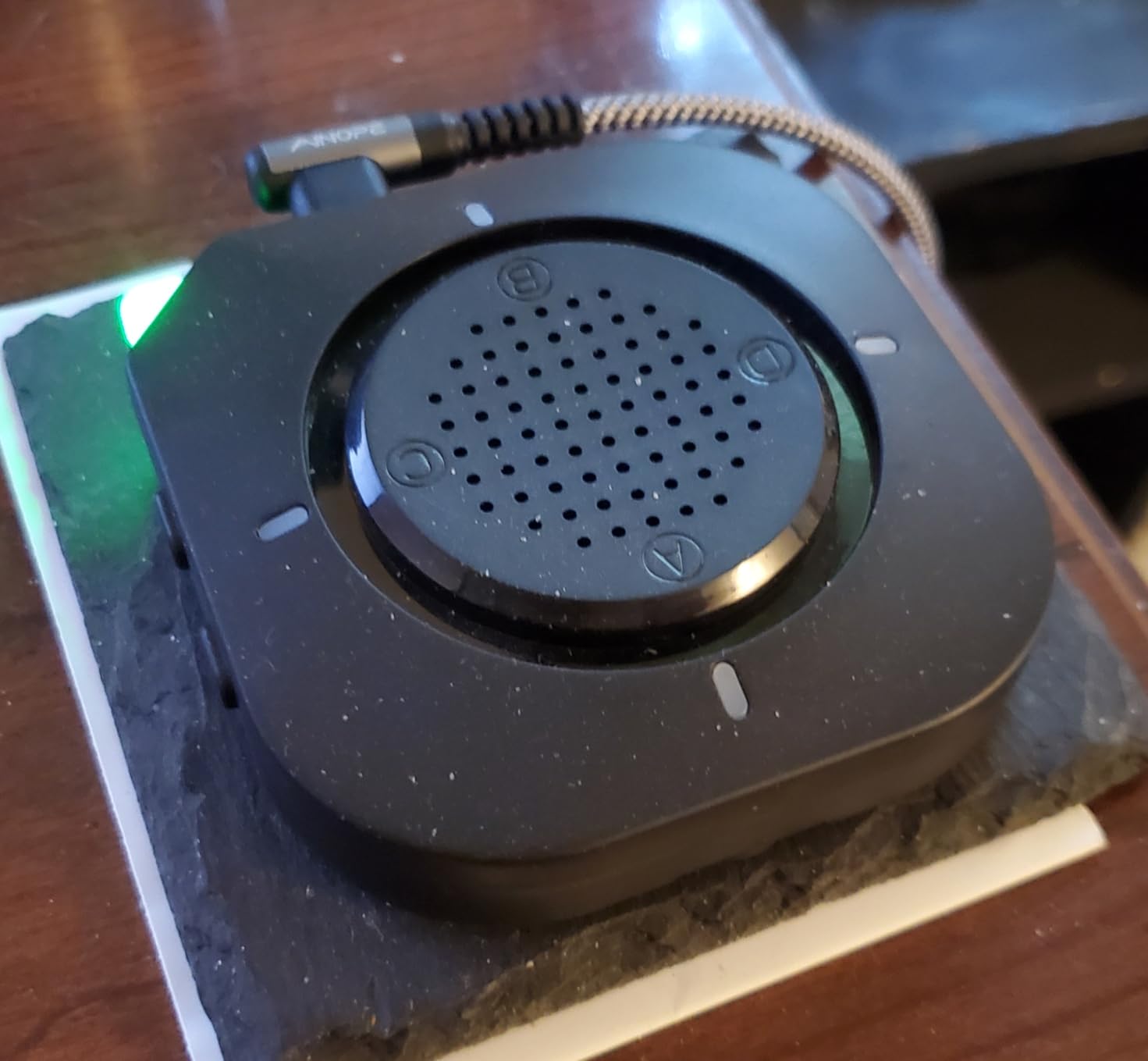
Four alert modes is more flexibility than most competitors offer, including a light-only silent mode if an audible chime at 3 am is not welcome. The receiver handles up to 16 motion sensors and can drive a 120 dB sound and light alert, so it can serve as an actual deterrent rather than only a notification.
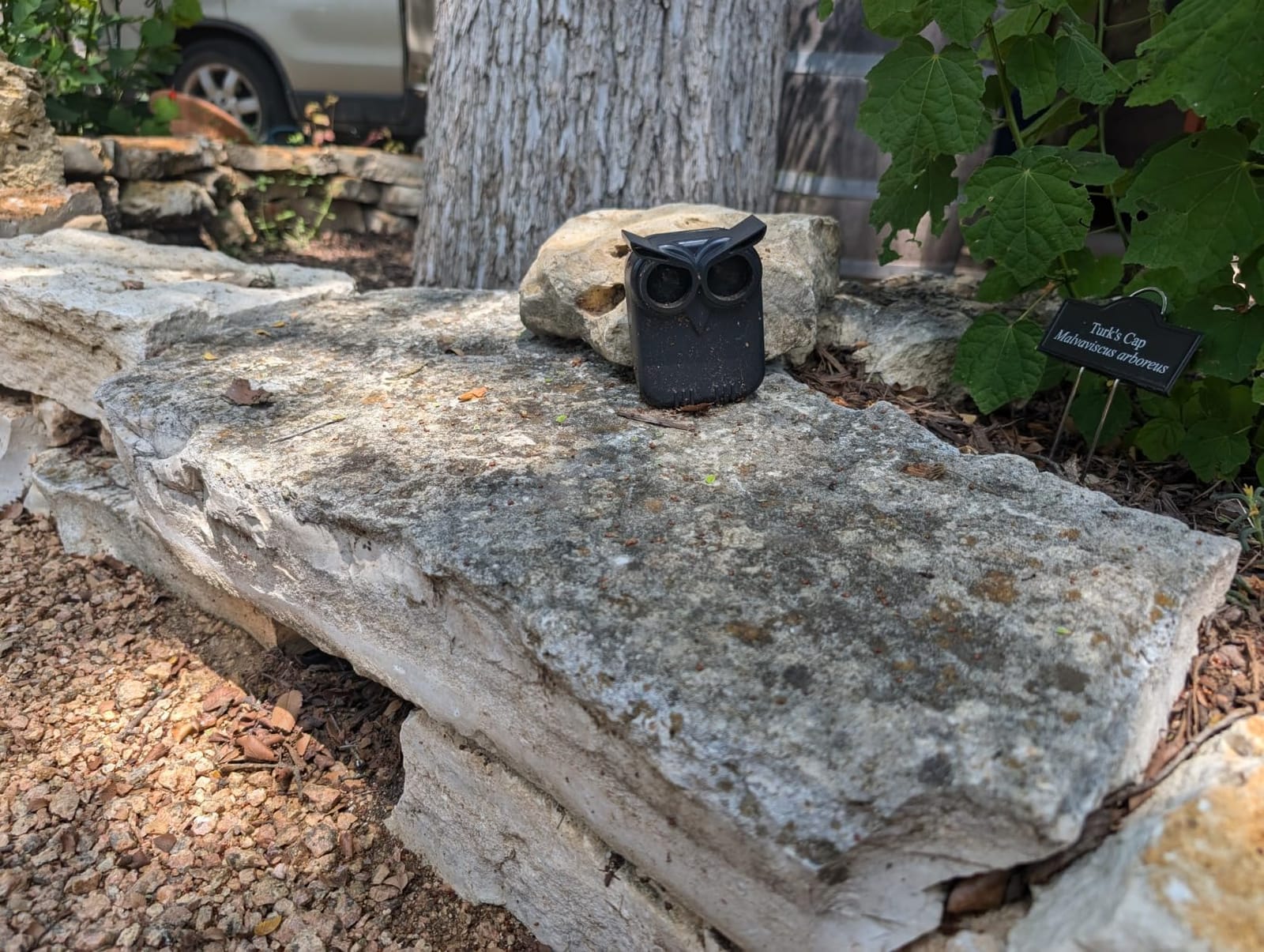
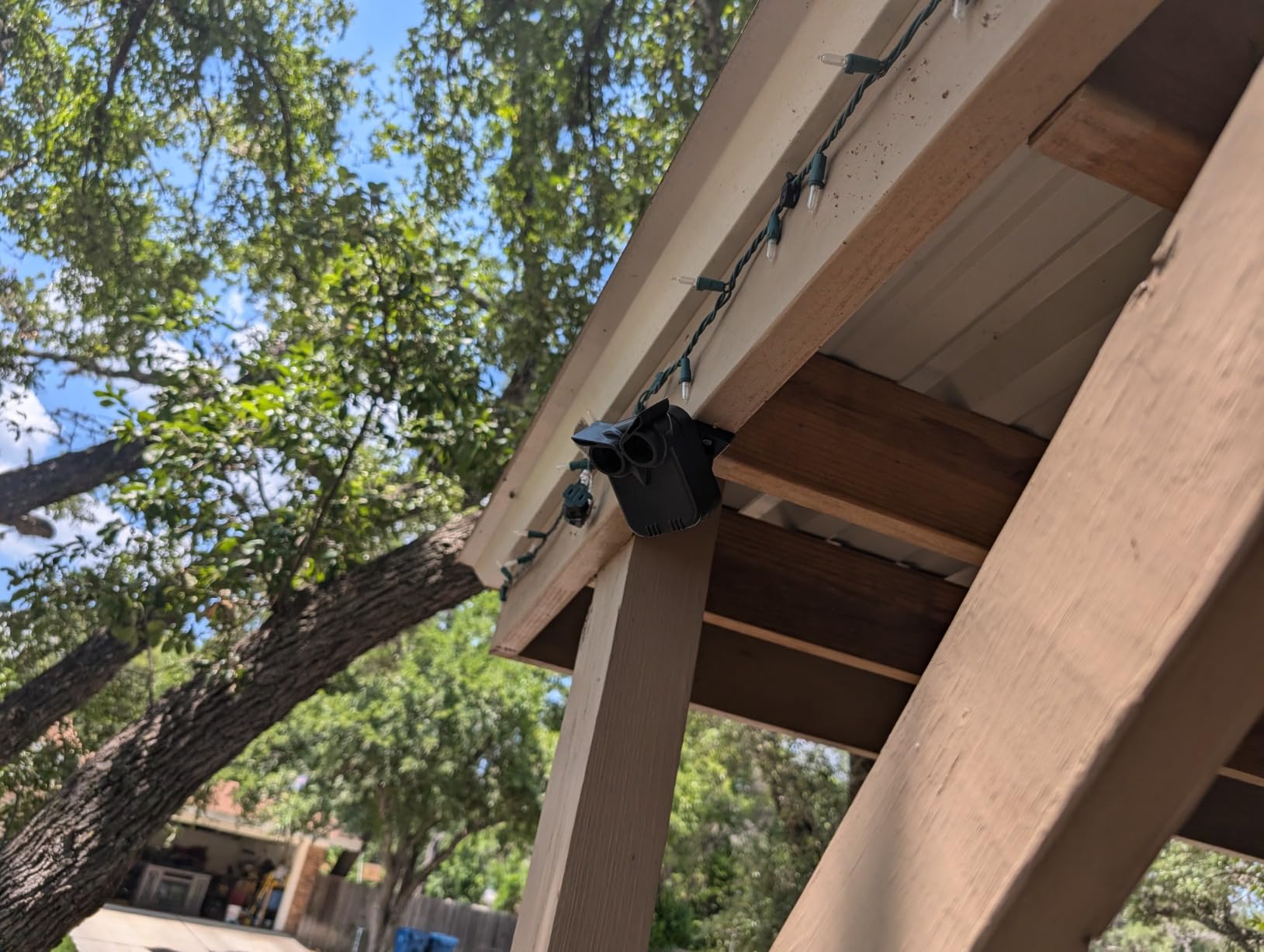
The sensor is shaped like an owl and blends into garden landscaping, the receiver speaks aloud when the unit needs charging, and a Type-C cable is included. Software algorithms are used to suppress environmental false alarms, and there is a two-year manufacturer warranty.
What IP65 actually buys you outdoors
IP44 is the common baseline on budget kits and covers splashing water only. IP65 adds a dust-tight seal and protection against water jets from any direction, which is the difference between a sensor that survives one bad storm season and one that survives a decade of them.
That matters most for a driveway entrance where meltwater runs downhill and pools, and where an under-eave mount leaves the unit in a permanent drip line. The 120 dB output is worth noting too, since it can serve as an outdoor deterrent.
The trade-off in the solar panel
The panel is fixed to the sensor body, so tilting it toward the winter sun means tilting the entire sensor, and you lose the aim you carefully set on the detection zone. On a north-facing entrance in winter, you will be choosing between charging well and aiming well.
One owner also reported water ingress after roughly two years of exposure that stopped the sensor working, and others note it can miss vehicles in heavy rain. The receiver is battery powered and reaches the wall only through USB, and the constantly lit green status LED can be distracting at night.
How to Choose the Right Detection Type for a Long Driveway?
Pick the detection method first and the range second, because range is the number sellers argue about while detection type decides whether you will still be using the system in six months. Every product here uses one of four approaches, and each fails in a different way.
Passive infrared is the default and by far the most common. It senses heat moving through a cone, works with no wiring and no trenching, and scales to 2,600 ft or a mile of transmission. Best for: open or lightly wooded driveways where you want people, cars and large animals all announced, and you are willing to tune the sensitivity to control wildlife triggers.
Rubber hose detection is the anti-false-alarm answer. Weight on the hose is the trigger, so animals and foliage are irrelevant. Best for: wooded acreage, deer country, and anyone who has already disabled a driveway alarm out of frustration.
Solar passive infrared adds a power decision to the standard cone, cutting annual battery service in exchange for requiring an open line to the sun at the sensor. Best for: long driveways where the sensor is far from the house and hard to reach each year.
Wi-Fi connected passive infrared adds phone push notifications to the same cone, at the cost of network compatibility and cloud dependence. Best for: households that are away from home often and want to know when a vehicle arrives without watching a camera feed.
One caution on range claims across all four: plan for 50 to 70 percent of the stated figure. A 2,600 ft kit should be treated as a 1,300 to 1,800 ft system, and a one-mile kit as roughly 3,000 to 3,700 ft, once foliage, terrain and buildings get involved.
How to Stop False Alarms Before You Disable the System?
The number one reason driveway alarms end up switched off in a cupboard is nuisance triggers. A system you have learned to ignore protects nothing, so spend an afternoon on the following before you conclude the product is faulty.
Deer and large animals are the most common source. Narrowing the passive infrared cone with lens panels, dropping to the lower sensitivity level, or aiming the sensor higher so the far edge of the zone sits above ground level all reduce wildlife triggers without losing your vehicle coverage.
Leaves, branches and moving shadows come next, and they respond to the same two controls. A swivel or rotating mount lets you shift the cone a few degrees off the tree line, and a tighter sensitivity setting keeps the far edge from reaching into the canopy.
Wind and gusts move the warm air a passive infrared sensor is watching for, so a sensor mounted on a pole in an exposed position will false-trigger in a storm. Mounting it on a solid post or wall rather than a fence panel is a cheap fix that owners report works.
Traffic on a shared road is a placement problem. If the sensor’s cone reaches back toward the street, angle it forward so the detection zone starts at your driveway entrance and not at the public road.
Sensitivity at the wall matters too. If you set the receiver to maximum volume, the faintest noise from a passing zone wakes the whole house and trains you to ignore it. Matching each zone to its own tone and a moderate volume keeps alerts meaningful.
And if you have exhausted all of that, move up a category rather than lowering volume further. A rubber hose system such as the Dakota Alert DCRH-4K Plus removes the entire class of problem rather than tuning around it.
Installation Notes for Long and Wooded Driveways
Measure the actual driveway before ordering, and measure it twice. Most disappointment with these kits comes from a signal that works fine but only covers the first two thirds of the drive, which means the garage door opens before the alarm sounds.
Mount the sensor where it sees the driveway, not where it is easiest to reach. For vehicle detection, a height of 2 to 3 ft, level and perpendicular to the ground, keeps the cone on the drive rather than angled up a hill. For person detection, 3 to 4 ft is the usual range.
Position the receiver within sight of an outlet. Every kit here except the battery-capable options is plug-in, and moving the receiver to a workshop or garage is a common request that a short cord cannot always satisfy.
For a hose system, flatten and rake a clear path across the full drive width before laying it, and plan how you will clear snow that builds against the hose through the winter.
For a solar sensor, orient the panel toward the unobstructed sky, and check the seasonal angle. A panel that charges well in July can fall short in December, and one kit in this roundup ties the panel to the sensor body so you cannot adjust one without losing your aim.
Finally, walk the full length of the driveway after installation and confirm the receiver chimes at the far end. Do it again in the rain, and again at night, because sensitivity and background heat both change.
Phone Alerts, Zones and Multiple Receivers
Two questions come up constantly in driveway alarm forums: whether one sensor can drive receivers in several rooms, and which system actually notifies a phone. Both have straightforward answers once you understand that they are separate features.
Most kits here run unlimited receivers from a single sensor, so you can have a chime upstairs and one in the workshop without buying a second system. Capacity runs in the other direction too, and the limits vary widely: the eMACROS solar kit takes 64 sensors, the HTZSAFE 1/2 mile kit takes 32, the Dakota Alert 4000 Series takes 16 per receiver, and the HOSMART four-sensor kit is fixed at four.
Zones are how the system tells you where the alert came from. Different chime tones per sensor are what let you learn that sound means the gate and this one means the driveway, which is far more useful than a single generic alarm.
For phone notifications, the eMACROS Pro3 is the only system here with genuine push alerts over a 2.4 GHz Wi-Fi network. Everything else chimes inside the house, and anything that reaches your phone does so through the app and cloud rather than the sensor radio.
If you want alerts while away, a connected system plus a local chime is the combination we would build, since the chime keeps working when the internet does not. Add a visual signal for anyone who is hard of hearing, and the TECKNET receiver’s RGB flashing LEDs are the clearest example in this roundup.
Buying Guide: What Actually Matters on a Long Driveway
Detection range versus transmission range is the distinction that decides whether these products are any use to you. Detection range is the width the sensor sees across your driveway, typically 15 to 70 ft depending on the model. Transmission range is the radio hop to the receiver, typically 1,500 ft to a mile. Only the second number has to exceed your driveway length.
Budget for 50 to 70 percent of stated range. Foliage, hills, outbuildings, metal siding and heavy rain all cut into a radio link, and no manufacturer tests through the obstacles your property actually has. The HOSMART kit is the one listing here that quotes a realistic figure outright, which is why we trust its numbers.
Property density is the tiebreaker. A rural drive with one entrance and clear sky needs raw range, while an acreage property with a gate, a walkway and a boat dock needs sensor capacity and per-zone tones more than it needs another thousand feet.
Power source is a maintenance decision more than a technical one. Solar removes annual battery work but needs an open line to the sun, a single 9V cell lasts a year or more and needs almost no attention, and AA cells mean a yearly trip to a sensor you probably put somewhere inconvenient.
Weather rating separates short-term from long-term. IP44 covers splashing water, IPX5 adds jet protection, and IP65 is dust-tight and fully weatherproof, which is what you want for a sensor sitting in a drip line at the bottom of a drive.
Outage behaviour is worth checking before you buy. Most receivers here are plug-in with no backup, which means a power cut ends alerts for the night. The solar HTZSAFE receiver with its built-in backup battery is the one that keeps working.
And think about expandability only if you need it today. Sixty-four sensor capacity is impressive, but it is worthless if the second entrance is a set of stairs and a trenching contractor, so match the sensor count to what you will realistically add in the next five years.
Frequently Asked Questions
What is the longest range driveway alarm?
The longest range system we evaluated is the Dakota Alert DCMA-4K Plus, rated at 1 mile between sensor and receiver. Every other kit in this roundup stops at 2,600 ft, roughly four tenths of a mile. In real conditions, expect 50 to 70 percent of the stated figure, so the one-mile kit delivers about 3,000 to 3,700 ft of dependable signal once trees, hills and buildings are involved.
What is the best long range driveway alarm available right now?
The HTZSAFE 1/2 mile kit is our overall pick. It pairs 2,600 ft of stated transmission range with a 50 ft passive infrared cone, two sensitivity levels to control wildlife triggers, and room to expand to 32 sensors. It also carries 4.4 stars across more than 20,000 reviews, the deepest review history in this group.
What is the best driveway alarm that notifies my phone?
The eMACROS Pro3 is the only system here with real-time smartphone push notifications. Its receiver joins a 2.4 GHz Wi-Fi network and the My Hosmart app sends an alert when the sensor trips. Two cautions: 5 GHz networks are not supported, and alerts depend on app and cloud connectivity rather than a local chime that keeps working during an outage.
What is a good wireless driveway alarm with two receivers?
Most kits here support unlimited receivers from a single sensor, so two chimes are simple. The HTZSAFE 1/2 mile kit pairs up to 32 sensors with unlimited receivers and adds four volume levels and 35 melodies. The Wuloo kit is a good simpler option, with a receiver that doubles as a bedside clock and alarm.
What is the most common cause of false alarms?
Wildlife and moving foliage are the most common causes. Deer, raccoons and branches entering the passive infrared cone trigger alerts that owners learn to ignore. Fixes include narrowing the cone with sliding lens panels, dropping to the lower sensitivity level, aiming the sensor higher, and mounting on a solid post rather than a fence panel that moves in wind.
How far can a driveway alarm sensor actually reach?
Plan for 50 to 70 percent of the stated range. A 2,600 ft kit typically gives a dependable 1,300 to 1,800 ft, and a one-mile kit about 3,000 to 3,700 ft. Foliage, terrain, outbuildings and heavy rain all reduce the radio link, which is why the HOSMART listing stating 1,500 ft real-world alongside 2,600 ft ideal is unusually honest.
Can a driveway alarm detect vehicles only?
Yes. The Dakota Alert DCRH-4K Plus uses a 25 ft heavy-duty rubber hose laid across the driveway and triggers only when vehicle weight compresses it, so deer, pets and foliage never cause alerts. The trade-off is that a person walking across the hose on foot will not trigger it, and the hose has to be laid and maintained.
Can I get a motion sensor that notifies me?
The TECKNET Non-APP Solar RGB kit adds a visual route. Its receiver has RGB flashing LEDs that give a silent alert alongside the chime, which works well for a hard-of-hearing household or when the TV is too loud to hear a tone. For phone-based alerts the eMACROS Pro3 is the only connected option in this roundup.
Conclusion: Which Long Driveway Alarm to Buy
The best driveway alarms for long driveways in 2026 come down to two honest questions. How long is your drive, and what is driving you to want an alarm? For most people the answer is a quarter mile to half mile with some trees in the way, and the HTZSAFE 1/2 mile kit handles that with the deepest review history, the widest expansion and sensitivity controls that actually reduce wildlife triggers.
Choose the eMACROS solar kit if you want to stop thinking about batteries. Choose the TECKNET kit if you want the tightest control over the detection cone and a visual alert you can see across the room. Choose the Dakota Alert hose system if deer have already driven you to switch the thing off. And if your drive genuinely runs longer than four tenths of a mile, the one-mile Dakota Alert pair is the only hardware here rated for it.
Whatever you pick, size it for 50 to 70 percent of its stated range, aim the cone at the driveway rather than the yard, and confirm the chime at the far end before you trust it. Our related guides on pressure washers for driveways and alarm clocks with multiple alarms cover the rest of the property routine.