
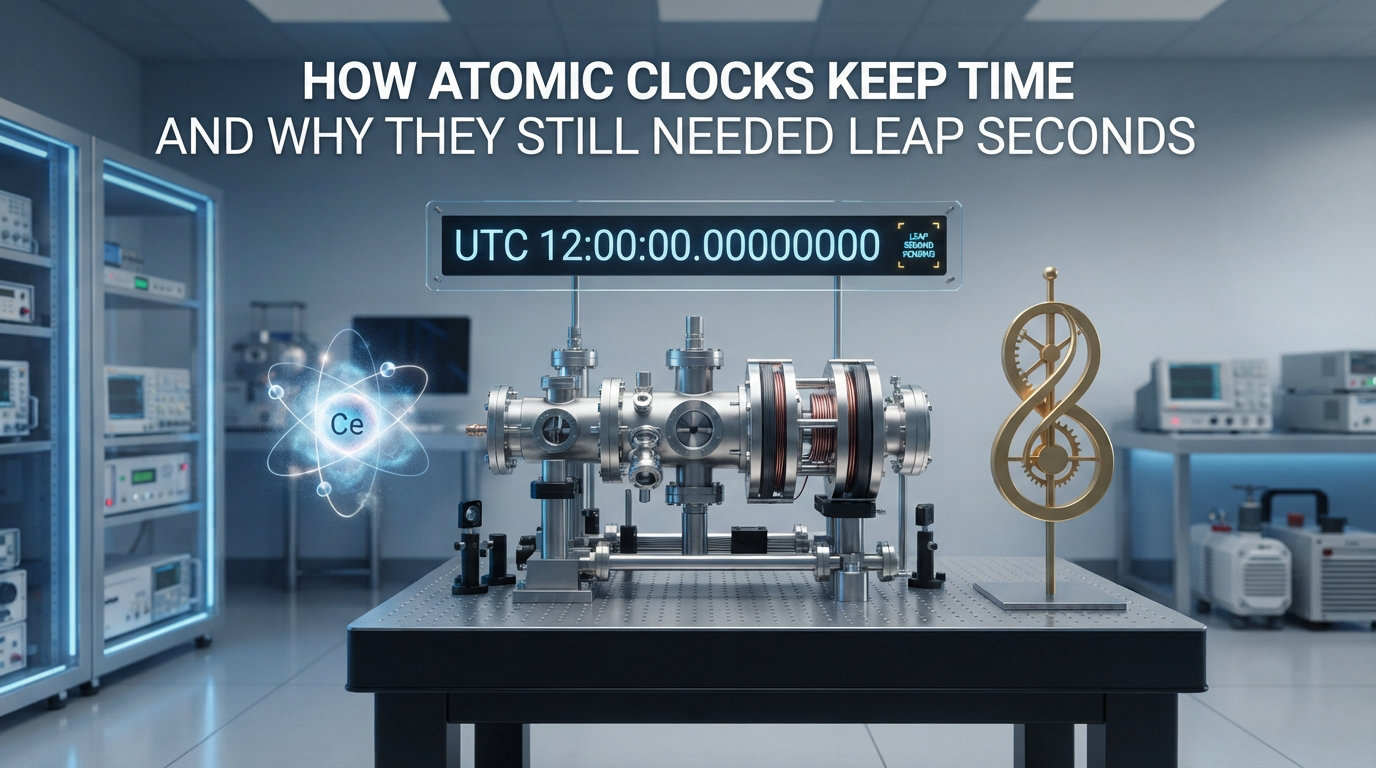
Atomic clocks keep time by counting the electromagnetic oscillations of cesium-133 atoms, ticking exactly 9,192,631,770 cycles per second by international definition. Yet despite this staggering precision, the global timekeeping community still inserts leap seconds to keep our clocks aligned with Earth’s slowing rotation. The story of atomic clocks leap seconds is really a story about two different kinds of time colliding: the flawless, uniform time of atoms and the messy, wobbly time of a spinning planet.
If you have ever wondered why your phone knows the exact time down to the nanosecond, or why a single extra second once crashed major websites in 2012, this guide will walk you through it all. We will cover how cesium atomic clocks actually work, why leap seconds exist, the difference between UT1 and UTC time scales, and what the future holds for leap seconds as we move toward 2026.
Whether you are a programmer who has been bitten by a leap second bug or simply curious about the invisible infrastructure that keeps our modern world synchronized, understanding atomic clocks leap seconds gives you a window into one of the most precise systems humanity has ever built.
Table of Contents
How Atomic Clocks Work: Counting the Unthinkably Small
Atomic clocks measure time by tracking the natural vibration frequency of atoms, making them the most accurate timekeeping devices ever created. Unlike mechanical clocks that rely on pendulums or quartz clocks that rely on electrical oscillations, atomic clocks tap into the quantum behavior of matter itself.
Every atom has electrons that occupy specific energy levels. When an atom absorbs or releases energy, its electrons jump between these levels at extremely predictable frequencies. This consistency is what makes atoms such reliable timekeepers. The atomic clock does not wear out, slow down with friction, or drift the way a mechanical watch does.
The Cesium Standard: 9,192,631,770 Cycles Per Second
The second is officially defined by the cesium-133 atom. Specifically, one second equals exactly 9,192,631,770 cycles of the radiation that corresponds to the transition between two hyperfine levels of the ground state of cesium-133. This definition was adopted in 1967 by the General Conference on Weights and Measures, and it remains the foundation of the International System of Units (SI) today.
That number is not arbitrary. Physicists spent years measuring the resonant frequency of cesium atoms against the best astronomical observations of Earth’s rotation available at the time. They chose 9,192,631,770 because it preserved continuity with the historical astronomical second, keeping the atomic second matched to what people already understood a second to be.
Cesium-133 was selected because it has a single stable isotope, its hyperfine transition frequency falls in a convenient microwave range, and the atoms are relatively easy to vaporize and manipulate. The result is a timekeeping standard so stable that the best cesium fountains would neither gain nor lose more than about one second in 100 million years.
Step by Step: What Happens Inside an Atomic Clock
Here is how a cesium atomic clock actually produces time, broken into its core steps:
Step 1: Vaporize the atoms. A small piece of cesium is heated inside an oven until it releases a beam of neutral atoms. These atoms are in one of two hyperfine energy states, and the clock needs to sort them.
Step 2: Select the energy state. The atoms pass through a magnetic field that filters out atoms in the higher energy state, allowing only those in the lower state to continue into the main chamber.
Step 3: Bombard with microwaves. The selected atoms enter a microwave cavity where they are exposed to electromagnetic radiation tuned to a frequency very close to 9,192,631,770 Hz. The goal is to find the exact frequency that causes the maximum number of atoms to undergo a quantum jump to the higher energy state.
Step 4: Measure the transition rate. A second magnetic separator sends only the atoms that made the quantum jump to a detector. The more atoms that reach the detector, the closer the microwave frequency is to the true cesium resonant frequency.
Step 5: Lock the frequency and count. A feedback loop continuously adjusts the microwave frequency to maximize the number of detected atoms. Once locked at the resonant peak, the clock simply counts 9,192,631,770 oscillations and declares that exactly one second has passed.
This feedback loop is what gives the atomic clock its extraordinary accuracy. The quartz oscillator provides the raw ticking, but the cesium atoms provide the correction that keeps those ticks honest.
Types of Atomic Clocks in Use Today
Cesium beam clocks were the first practical atomic clocks and remain the workhorse of national time standards. Institutions like NIST in the United States and the National Physical Laboratory in the United Kingdom operate cesium fountain clocks, which cool atoms with lasers and toss them upward through a microwave cavity, allowing longer interaction times and greater precision.
Rubidium atomic clocks are smaller, cheaper, and less accurate than cesium clocks, but they are compact enough to fit inside GPS satellites. Hydrogen maser clocks offer even better short-term stability and are used in radio astronomy and deep space navigation.
The newest generation includes optical lattice clocks and single-ion clocks, which use optical frequencies rather than microwaves. These clocks are so precise that they can detect the gravitational time dilation caused by a change in elevation of just a few centimeters. They represent the frontier of timekeeping precision and may eventually replace cesium as the definition of the second.
Why Leap Seconds Are Still Needed
Leap seconds are needed because atomic time and Earth rotation time do not stay perfectly in sync. Even though atomic clocks measure seconds with breathtaking accuracy, the Earth itself does not rotate at a perfectly constant rate. Over time, a gap opens between atomic time (UTC) and astronomical time (UT1), and leap seconds are inserted to close that gap.
Here is the core problem. The length of a day is defined by one full rotation of the Earth, but that rotation is gradually slowing down due to tidal friction from the Moon. Meanwhile, the SI second is fixed at 9,192,631,770 cesium cycles and never changes. If we used atomic time exclusively, our clocks would slowly drift away from the position of the Sun in the sky. Over centuries, noon could eventually arrive in the morning.
Leap seconds exist to prevent that drift. The International Earth Rotation and Reference Systems Service (IERS) monitors the difference between UT1 and UTC, and whenever the gap approaches 0.9 seconds, they schedule a leap second insertion to bring them back into alignment.
The UT1 vs UTC Problem
Understanding atomic clocks leap seconds requires understanding the difference between two critical time scales. UT1 is astronomical time, based on the actual rotation of the Earth relative to distant stars. It reflects the real, physical day that humans have always experienced. UTC, or Coordinated Universal Time, is the time scale derived from atomic clocks that the entire world uses for civil timekeeping.
UTC is kept within 0.9 seconds of UT1 through the insertion of leap seconds. Without these adjustments, UTC would drift away from UT1 by roughly one second every 500 to 700 days, since the atomic second is slightly shorter than the mean solar second. Over decades, the gap would grow large enough to cause real problems for navigation, astronomy, and any system that needs to know where the Earth is pointing.
There is also TAI, International Atomic Time, which is a pure atomic time scale with no leap second corrections. TAI runs continuously and uniformly, while UTC is TAI plus or minus an integer number of leap seconds. As of 2026, TAI is ahead of UTC by 37 seconds, which represents every leap second inserted since the system began in 1972.
What Actually Happens During a Leap Second
When a positive leap second is inserted, the last minute of the day gets 61 seconds instead of 60. The sequence goes 23:59:58, 23:59:59, 23:59:60, then 00:00:00. That extra second is slotted in on either June 30 or December 31, the two dates designated by international agreement for leap second adjustments.
From a human perspective, nothing dramatic happens. You do not feel time pause. But from a computing perspective, that 61st second is a nightmare. Most software assumes every minute has exactly 60 seconds, and the appearance of a 23:59:60 timestamp can confuse timekeeping libraries, crash servers, or cause systems to skip or repeat operations.
Leap seconds are announced at least six months in advance by the IERS, giving critical infrastructure teams time to prepare. But preparation does not always prevent problems, as the events of 2012 made painfully clear.
When Leap Seconds Go Wrong: The 2012 Outage
On June 30, 2012, a leap second insertion triggered widespread outages across the internet. Reddit experienced a massive system failure that took the site offline for several hours. LinkedIn, Yelp, StumbleUpon, and Foursquare all reported similar problems. Some Linux servers consumed 100 percent of their CPU as they struggled to reconcile the unexpected extra second.
The root cause was a common programming pattern where applications queried the system clock repeatedly and compared timestamps. When the clock jumped backward or introduced an unexpected value, infinite loops and resource spikes resulted. Some airlines’ reservation systems also experienced disruptions.
This incident crystallized the debate over whether leap seconds are worth the trouble. Programmers on forums have called leap seconds an abomination for computing, and many tech companies now use a technique called smear, which gradually spreads the extra second across a 24-hour period rather than inserting it all at once. Google and Amazon both use this approach for their internal systems.
The 2012 outage proved that even a single second can bring down global infrastructure when millions of interconnected systems all encounter an unexpected edge case at the same moment.
Earth Rotation vs Atomic Time: A Cosmic Tug of War
Earth’s rotation is not constant, and that variability is the entire reason leap seconds exist. Multiple forces act on the planet to speed it up or slow it down, creating fluctuations that atomic clocks can measure but not predict with perfect certainty.
Why the Earth Does Not Spin at a Constant Rate
The dominant long-term factor is tidal friction. The gravitational pull of the Moon creates bulges in Earth’s oceans, and as the planet rotates through these bulges, drag transfers angular momentum from Earth to the Moon. This process slows Earth’s rotation by roughly 1.7 milliseconds per century and causes the Moon to drift about 3.8 centimeters farther away each year.
Shorter-term variations come from atmospheric circulation, ocean currents, and changes in the distribution of mass within the planet. Seasonal winds can change the length of a day by about a millisecond. Large-scale climate phenomena like El Nino can add or subtract measurable amounts. Even the movement of molten material in Earth’s core introduces detectable fluctuations.
These effects mean that the length of a day can vary by several milliseconds from one year to the next. Since atomic time marches forward with perfect uniformity, these tiny irregularities accumulate until a leap second becomes necessary to realign the clocks.
The 2023 Temporal Anomaly: 1.3 Seconds That Changed Everything
In 2023, something unprecedented happened with Earth’s rotation. Scientists monitoring the planet’s spin noticed that the Earth was actually rotating faster than it had in decades. For the first time in the history of precision timekeeping, there was serious discussion about the possibility of a negative leap second, where one second would be removed from UTC rather than added.
The acceleration was subtle but measurable. Days in 2023 were running about 0.02 milliseconds shorter than the standard 86,400 seconds. This may sound trivial, but it represented a significant departure from the long-term slowing trend that has dominated for centuries.
The global timekeeping community began modeling whether the drift would continue to the point where a negative leap second would be needed within a few years. As of 2026, the situation has stabilized somewhat, but the anomaly highlighted how poorly we understand the short-term behavior of Earth’s rotation.
Interestingly, if a negative leap second were ever implemented, it could cause even more chaos than a positive one. Nearly all software is written to handle the addition of a second, not its removal. A day with only 86,399 seconds would break assumptions baked into countless systems worldwide.
A Brief History of Atomic Timekeeping
The quest for precise time measurement has driven scientific innovation for centuries, culminating in the atomic clock standards we rely on today.
From Pendulums to Atoms: The Race for Precision
The first atomic clock was built in 1949 by Harold Lyons at the National Bureau of Standards (now NIST) using ammonia molecules. It was more of a proof of concept than a practical timekeeper, but it demonstrated that atoms could be used to measure time far more accurately than any quartz or mechanical oscillator.
The breakthrough came in 1955 at the National Physical Laboratory in England, where Louis Essen and Jack Parry built the first cesium atomic clock. This device achieved an accuracy of one part in 10 billion, which was orders of magnitude better than any astronomical measurement of Earth’s rotation. It immediately became clear that atoms were better timekeepers than the planet itself.
In 1967, the SI second was redefined based on the cesium-133 transition frequency, severing the definition of time from astronomical observation for the first time in human history. The second was no longer a fraction of a day but a count of atomic oscillations. In 1972, the current system of leap seconds was introduced to keep atomic time (UTC) aligned with Earth rotation time (UT1), and 27 leap seconds have been inserted since that year.
Leap Seconds Since 1972: A Complete Timeline
Leap seconds have been inserted 27 times since 1972. The first was added on June 30, 1972, when 10 seconds were inserted all at once to correct accumulated drift. After that initial correction, individual leap seconds were added roughly every 12 to 18 months during the 1970s and 1980s.
The pace slowed significantly in the 2000s. Between 1999 and 2005, no leap seconds were needed at all, which surprised scientists who expected Earth’s rotation to continue slowing at the historical rate. The most recent leap second was inserted on December 31, 2016, and no leap seconds have been added since.
This gap has led to speculation about whether Earth’s rotation has temporarily stabilized or whether the long-term slowing trend is being offset by other factors. As of 2026, the gap between UTC and UT1 remains within acceptable bounds, but the situation is monitored continuously.
How Atomic Clocks Power Your Daily Life
Atomic clocks are not just laboratory curiosities. They are the invisible backbone of nearly every technology that depends on precise timing, from the GPS in your phone to the timestamps on financial trades.
GPS and Navigation
The Global Positioning System would not work without atomic clocks. Each GPS satellite carries multiple rubidium and cesium atomic clocks that broadcast precise time signals. Your phone receives signals from at least four satellites and calculates its position by measuring the tiny differences in how long each signal took to arrive.
Because GPS signals travel at the speed of light, an error of just one microsecond translates to a positioning error of about 300 meters. This is why satellites use atomic clocks that are accurate to within nanoseconds. GPS time itself is continuous and does not include leap seconds, which means GPS time currently differs from UTC by 18 seconds as of 2026. Your receiver handles the conversion automatically.
This same principle extends to aviation navigation, maritime positioning, and spacecraft guidance. When a probe flies past a distant planet, the timing of signals measured by atomic clocks determines whether it arrives at the right coordinates or misses entirely.
Internet, Telecommunications, and Finance
Every time you load a web page, send a message, or stream a video, atomic clocks are involved. Internet protocols like NTP (Network Time Protocol) and PTP (Precision Time Protocol) distribute atomic clock time from reference servers to devices worldwide. Data networks synchronize their transmissions using these timestamps to prevent collisions and keep packets arriving in the right order.
In finance, the stakes are even higher. Stock exchanges timestamp every trade to the microsecond, and regulations like MiFID II in Europe require timestamping to within 100 microseconds. At these speeds, even tiny clock disagreements between systems can cause order execution errors or regulatory violations. Atomic clocks maintained by national laboratories provide the reference that keeps the financial system honest.
Power grids also depend on atomic time. The phase synchronization of alternating current across transmission networks requires timing accuracy of better than a millisecond. Without atomic clocks coordinating grid frequency, large-scale blackouts would be far more common.
The Future of Leap Seconds: Abolition by 2035
The days of leap seconds are numbered. In November 2022, member states of the General Conference on Weights and Measures voted to abolish leap seconds by 2035, marking the most significant change to global timekeeping in half a century.
The 2022 Vote to End Leap Seconds
The decision to abolish leap seconds was driven by the growing recognition that the risks they pose to computing infrastructure outweigh their benefits. Every leap second insertion costs the tech industry millions of dollars in testing, preparation, and remediation. The 2012 and 2015 leap second events caused real outages, and the fear of a future negative leap second has only intensified concern.
Under the 2022 resolution, the maximum difference between UTC and UT1 will be allowed to grow beyond 0.9 seconds for the first time. The exact new tolerance has not yet been finalized, but proposals range from a few minutes to as much as an hour. The change would mean that civil time drifts slightly away from solar time over decades, a trade-off that most people would never notice.
As of 2026, working groups are finalizing the implementation details. The transition plan must address how existing systems that depend on leap seconds will be updated, what the new maximum tolerance will be, and how the change will be communicated to the public.
Will We Ever See a Negative Leap Second?
The 2023 Earth rotation acceleration raised the possibility of a negative leap second for the first time. If the trend had continued, the IERS might have needed to remove a second from UTC, creating a minute with only 59 seconds.
Most timekeeping experts consider a negative leap second to be the worst-case scenario for computing. Systems that handle the extra second of a positive leap second by pausing or smearing would need completely different logic to handle a missing second. The abolition of leap seconds by 2035 would eliminate this risk entirely.
Whether or not a negative leap second occurs before the abolition deadline, the 2023 anomaly underscored how much we still have to learn about the forces that shape Earth’s rotation. It also reinforced the argument that decoupling civil time from astronomical observation is the safest path forward for an increasingly digital world.
FAQs
How do atomic clocks keep time?
Atomic clocks keep time by counting the electromagnetic oscillations of cesium-133 atoms. One second is defined as exactly 9,192,631,770 cycles of the radiation that causes cesium atoms to transition between two hyperfine energy levels. A feedback loop continuously tunes the microwave frequency to maximize atomic transitions, then counts the cycles to produce a perfectly uniform second.
Why do we need leap seconds?
Leap seconds are needed because atomic time (UTC) and Earth rotation time (UT1) gradually drift apart. Earth’s rotation is slowing due to tidal friction, while atomic seconds remain perfectly fixed. Without leap seconds, our clocks would eventually fall out of sync with the position of the Sun, and noon could shift to morning over centuries.
What is the lifespan of an atomic clock?
Commercial cesium beam atomic clocks typically operate for 10 to 20 years before needing replacement, though their accuracy degrades slowly over time. National standard clocks like cesium fountains are continuously evaluated and replaced as newer, more accurate versions become available.
When was the last time we had a leap second?
The most recent leap second was inserted on December 31, 2016. No leap seconds have been added since then, which is the longest gap without a leap second since the system began in 1972.
Why are leap seconds being phased out?
Leap seconds are being phased out because they cause costly disruptions to computing infrastructure. The 2012 leap second crashed major websites including Reddit and LinkedIn, and each insertion costs the tech industry millions in preparation. In 2022, the General Conference on Weights and Measures voted to abolish leap seconds by 2035.
Did atomic clocks stop for 1.3 seconds in 2023?
No, atomic clocks did not stop. In 2023, scientists observed that Earth was rotating faster than expected, which raised the possibility of needing a negative leap second for the first time. The situation stabilized, but it highlighted how unpredictable Earth’s rotation can be and reinforced the case for abolishing leap seconds.
The Bottom Line
Atomic clocks leap seconds represent one of the most fascinating tensions in modern science. Our atomic clocks can count the vibrations of cesium atoms with such precision that they would neither gain nor lose a second over 100 million years, yet we still cannot predict the rotation of our own planet with the same confidence. Leap seconds bridge that gap, but at a growing cost to the digital systems that run our world.
As we move toward the abolition of leap seconds by 2035, we are entering a new era where time becomes purely atomic and the Sun’s position matters less than the reliability of our infrastructure. Whether that trade-off is worth it is a question that scientists, programmers, and policymakers will continue to debate for years to come.
1 thought on “How Atomic Clocks Keep Time and Why They Still Needed Leap Seconds (October 2026)”