
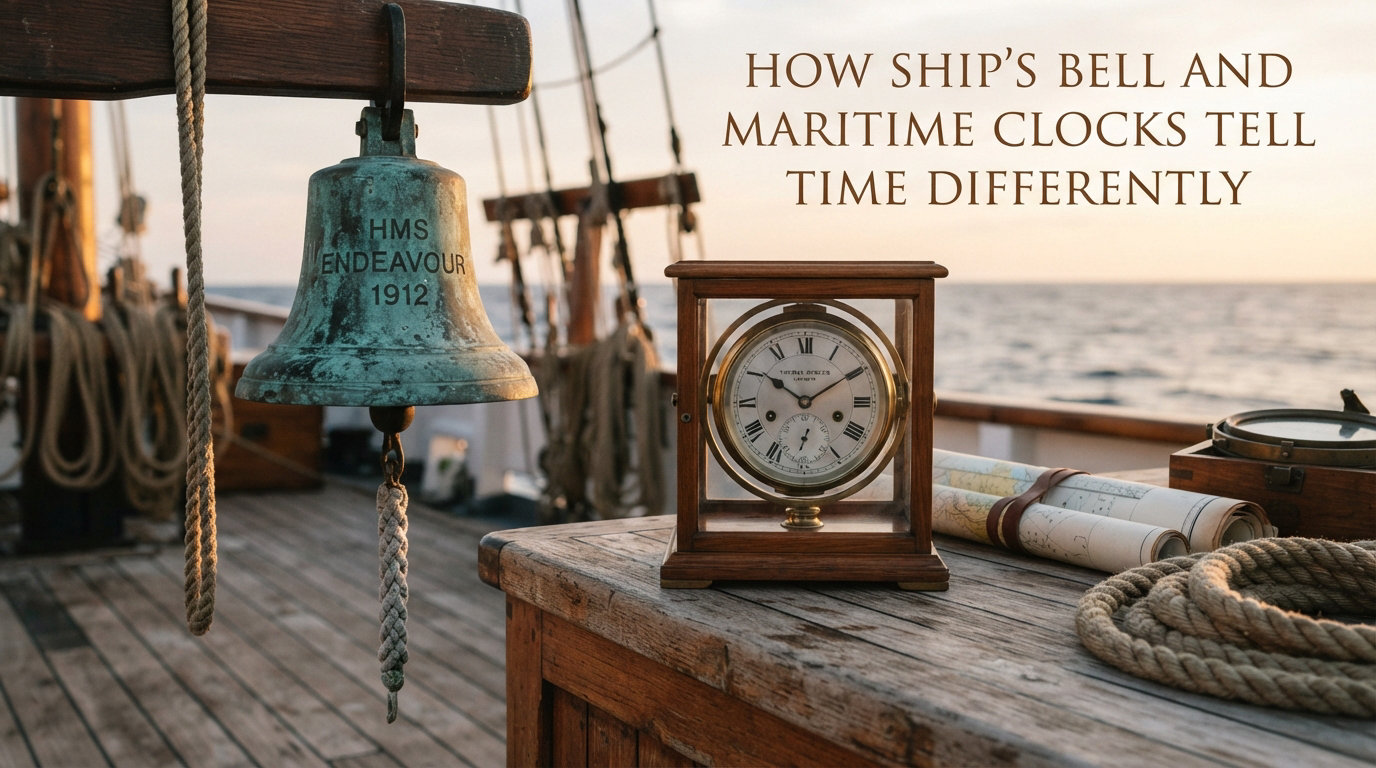
When I first heard a ship’s bell clock strike eight times at noon, I assumed someone had simply wound an old grandfather clock. I was wrong. The sound marked the end of a four-hour watch, and every sailor on deck knew exactly what it meant without looking at a dial. That moment sent me down a rabbit hole of maritime timekeeping traditions that go back hundreds of years, and I’m still fascinated by how different the system is from anything we use on land today.
Ship’s bell and maritime clocks tell time differently because they use a hybrid system that combines a traditional clock face with an audible bell code struck every half hour. Standard maritime clocks only show time on the dial. A ship’s bell clock does both, converting watch periods into a sequence of one to eight bells that the entire crew can hear and interpret instantly. This guide breaks down exactly how that system works, why it exists, and how to read one yourself.
Table of Contents
What Is a Ship’s Bell and How Does It Tell Time at Sea?
A ship’s bell is a traditional maritime timekeeping method that uses audible bell strikes to mark half-hour intervals over a four-hour watch period. Sailors developed this system centuries ago so that crew members could tell the time without seeing a clock face, which was essential in the days before reliable illumination below deck.
The system works on a simple rule. One bell marks the first half hour. An additional bell is added for every thirty minutes that pass. After four hours, the count resets to one bell and the cycle begins again with the next watch crew.
One bell = 30 minutes past the hour
Two bells = 1 hour past the start of the watch
Eight bells = end of the four-hour watch
This is why the phrase “eight bells” still means the end of a watch duty in navies around the world.
The History of Ship’s Bell Timekeeping
The ship’s bell system dates back to the Age of Sail in the 15th and 16th centuries. Before accurate mechanical clocks existed at sea, captains relied on a half-hour sandglass, also called an hourglass, to track time. A crew member turned the glass every thirty minutes and rang the ship’s bell to signal the change.
Half-hour intervals were practical because watches were originally divided into four-hour shifts. Eight half-hour sandglasses made up one full watch. I find it remarkable that such a simple device defined life at sea for hundreds of years.
The tradition continued even after accurate chronometers were developed in the 18th century. The bell code became standard naval practice because it kept working when clocks failed, when visibility was poor, and when the entire crew needed to know the time at once.
How the Four-Hour Watch System Works
Traditional maritime watchkeeping divides the 24-hour day into six four-hour watches. Three watches run in sequence through the day, and the cycle repeats every 24 hours. The naming convention follows the period of the day when the watch begins.
The six watches are:
First Watch – 8:00 PM to 12:00 AM (midnight)
Middle Watch – 12:00 AM to 4:00 AM
Morning Watch – 4:00 AM to 8:00 AM
Forenoon Watch – 8:00 AM to 12:00 PM (noon)
Afternoon Watch – 12:00 PM to 4:00 PM
Evening Watch – 4:00 PM to 8:00 PM
To make the rotation fair across port and starboard watch crews, the day is split into two short watches between 4:00 PM and 8:00 PM. These are called the first dog watch and the second dog watch.
What Are Dog Watches and Why Do They Exist?
Dog watches are two short two-hour watches that run from 4:00 PM to 6:00 PM and 6:00 PM to 8:00 PM. Sailors introduced them so that watch crews would alternate between day and night duties over time. Without dog watches, the same crew would always stand the same watch every day.
The origin of the term “dog” is debated. Some historians suggest it comes from the nautical term “dodge,” since sailors would dodge between duty shifts. Others link it to the fragmented sleep dogs often take during the day. Whatever the origin, the practical effect is fairer duty rotation across the entire crew.
The Bell Strike Sequence: 1 to 8 Bells Explained
The bell strike sequence counts up from one bell at the start of each watch to eight bells at the end. Each bell represents thirty minutes of watch time. This is the core of how ship’s bell and maritime clocks tell time differently from a standard clock.
Here’s the full bell strike to time conversion chart for a watch beginning at 8:00 AM:
| Bells | Time | Watch Position |
|---|---|---|
| 1 bell | 8:30 AM | First half hour |
| 2 bells | 9:00 AM | One hour in |
| 3 bells | 9:30 AM | 90 minutes in |
| 4 bells | 10:00 AM | Two hours in |
| 5 bells | 10:30 AM | Two and a half hours |
| 6 bells | 11:00 AM | Three hours in |
| 7 bells | 11:30 AM | Three and a half hours |
| 8 bells | 12:00 PM | End of watch |
When all eight bells have sounded, the watch ends and the next watch begins. The bell count immediately resets to one bell thirty minutes later. This is a continuous pattern that runs 24 hours a day, 7 days a week, for as long as the vessel is underway.
What Does 8 Bells Mean on a Ship?
Eight bells marks the end of a four-hour watch. It can also signal noon, 4:00 PM, 8:00 PM, or midnight, depending on which watch just ended. The phrase has become shorthand for the end of a duty period in both military and civilian maritime use.
How to Tell Time with Just the Bells
Without a dial, sailors identified the time by remembering which watch was in progress. For example, if you heard six bells during the forenoon watch, you would know it was 11:00 AM. If you heard six bells during the first watch, you would know it was 11:00 PM. The system required sailors to memorize the watch schedule, which became second nature after months at sea.
Ship’s Bell Clocks vs Standard Maritime Clocks: Key Differences
This is the core distinction that defines how ship’s bell and maritime clocks tell time differently. A standard maritime clock tells time exactly like any household clock, with hands on a 12-hour dial. A ship’s bell clock does that too, but it also strikes the bell code at every half hour, simultaneously.
The differences break down across four areas:
Audible output – Standard maritime clocks are silent. Ship’s bell clocks strike one to eight bells every half hour automatically.
Watch alignment – Ship’s bell clocks must be set so that eight bells always falls at the end of a four-hour watch, starting from midnight. Standard clocks can be set to any reference.
Strike pattern – Ship’s bell clocks distinguish between the half hour and the full hour by counting bells. Two bells at 1:00 PM is different from two bells at 5:00 PM only because of the watch context.
Use case – Standard maritime clocks are décor with practical timekeeping. Ship’s bell clocks are décor that also reproduces an authentic naval audio tradition.
Owners of ship’s bell clocks often report frustration when the chime sequence goes off after a power outage or time adjustment. The forum discussions I came across show that setting the clock correctly requires knowing that the four-hour watch cycle starts at midnight, not at noon. Getting this wrong is the most common cause of bell strikes that don’t match the dial.
How Modern Ship’s Bell Clocks Work Mechanically
Modern ship’s bell clocks use either a mechanical movement with an internal hammer mechanism or a quartz movement with electronic chimes. Chelsea Clock, founded in 1900, has built its reputation on mechanical 11-jewel movements and brass cases that weigh over 7 pounds. Schatz is another trusted name, especially for vintage collectors.
The mechanism works by tracking a four-hour cycle independently of the hour hand. A cam inside the movement counts strikes and resets every four hours. Mechanical versions need winding once a week or once a month, depending on the model. Quartz versions run on batteries and need only occasional adjustment after daylight saving time changes.
Collectors in the clock community consistently recommend keeping original documentation for higher resale value. Chelsea clocks in good working condition hold their value well, and even older pieces without maker’s marks can be worth significant sums to the right buyer.
Practical Guide: How to Read Time on a Ship’s Bell Clock
Reading a ship’s bell clock is simple once you understand the watch system. Follow these steps to interpret any bell strike.
Identify the current watch. Check the dial to see which watch period the ship is in. For example, if the time is between 8:00 AM and 12:00 PM, you are in the forenoon watch.
Count the bells. Listen for the number of strikes. Each bell equals thirty minutes into the watch.
Calculate the exact time. Multiply the number of bells by thirty minutes and add it to the start time of the watch.
Verify with the dial. Cross-reference your calculation with the clock face to confirm accuracy.
Reset at eight bells. When you hear eight bells, the watch has ended. The next bell will be one bell for the start of the following watch.
For example, if it is 10:00 AM and you hear five bells, you know it is 10:30 AM. Six bells at that same starting point means 11:00 AM
FAQs
How do ship bells tell time?
Ship bells tell time by striking one bell at the first half hour of a watch, with an additional bell added for each successive thirty minutes. After eight bells, the watch ends and the count resets to one bell for the next watch period.
What does 6 bells mean on a ship?
Six bells means three hours into the current four-hour watch. For example, six bells during the forenoon watch (8:00 AM to 12:00 PM) indicates 11:00 AM. Six bells during the morning watch (4:00 AM to 8:00 AM) indicates 7:00 AM.
What does 2 bells at sea mean?
Two bells at sea means one hour has passed since the start of the current watch. Two bells during the first watch (8:00 PM to midnight) means 9:00 PM. Two bells during the afternoon watch (12:00 PM to 4:00 PM) means 1:00 PM.
What time is 5 bells on a ship?
Five bells means two and a half hours into the current four-hour watch. For example, during the forenoon watch starting at 8:00 AM, five bells indicates 10:30 AM. During the evening watch starting at 4:00 PM, five bells indicates 6:30 PM.
What is the difference between a ship’s bell clock and a regular clock?
A ship’s bell clock combines a traditional clock face with an audible bell code that strikes one to eight bells every half hour. A regular clock shows time only on its dial and makes no sound. Ship’s bell clocks also follow a four-hour watch cycle that resets at midnight, while regular clocks run on a standard 12-hour cycle.
Final Thoughts on Maritime Timekeeping
Ship’s bell and maritime clocks tell time differently because they preserve a working naval tradition that goes back centuries. The dual system of dial plus bell strike gave sailors a way to coordinate watches, signal shift changes, and keep time accurately even in the worst conditions at sea.
If you own a ship’s bell clock, take a moment to listen to its chime and think about the thousands of sailors who depended on the same sound to know what time it was. The tradition still works as well today as it did in 1700, and that is a remarkable legacy for any timepiece to carry.