
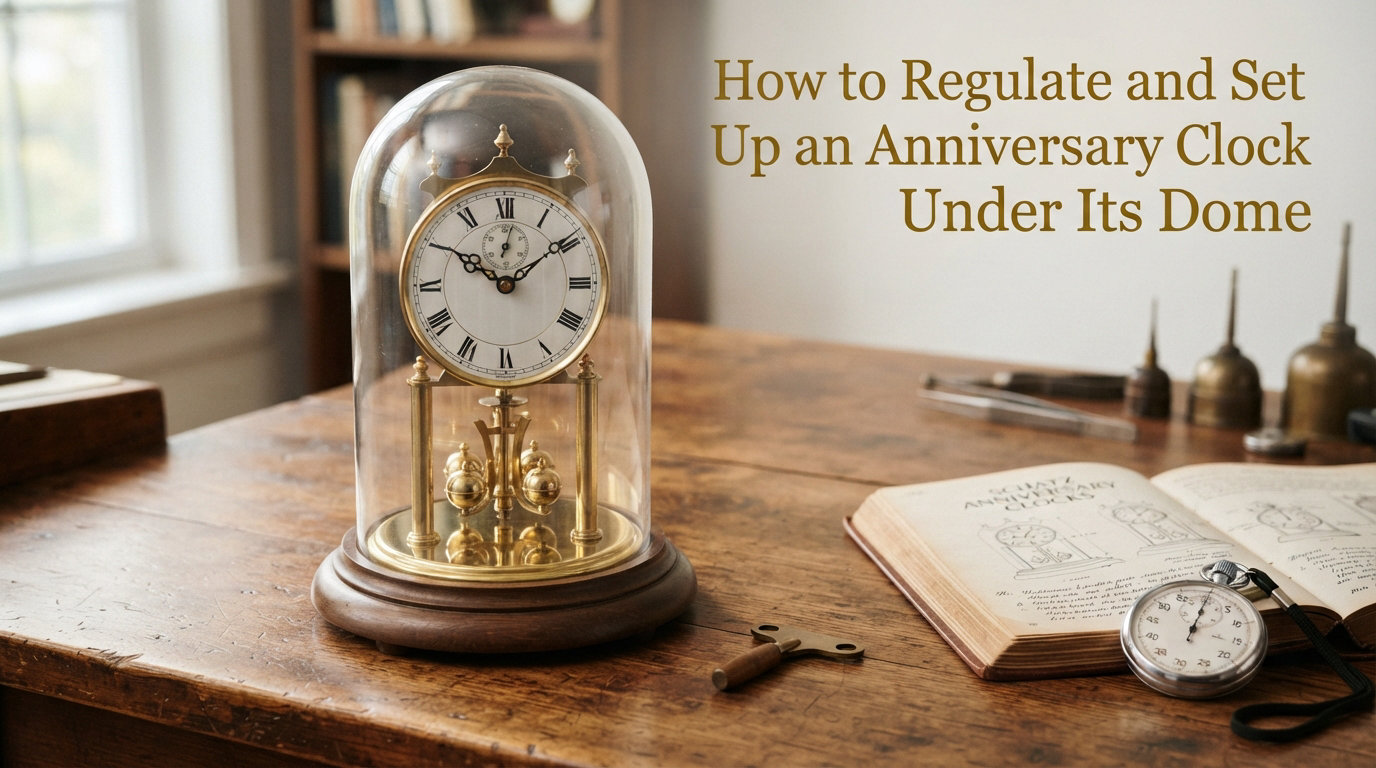
An anniversary clock is one of the most rewarding timepieces a collector can own. I remember unboxing my first 400-day clock years ago and watching the brass pendulum rotate slowly under its glass dome like a tiny brass ballet. Setting one up properly takes patience, but the result is a clock that can run for an entire year on a single wind.
In this guide, I will walk you through every step our team uses when we receive a new anniversary clock in our workshop. You will learn the right way to level the case, install the pendulum, wind the mainspring, set the time, and regulate the speed. We will also cover beat adjustment, dome placement, and the common problems that forum users run into most often.
Table of Contents
Tools Needed and Preparation Before You Start
Before you touch a single screw on your anniversary clock, gather what you need and clear your workspace. Anniversary clocks are far more delicate than a typical mantel clock, and the suspension spring inside can snap with one careless bump.
Here is what I keep on my workbench every time I set up a torsion pendulum clock:
A flat, stable surface away from doors, speakers, and foot traffic
A small bubble level (the kind used for picture frames works well)
The original winding key that came with the clock
Soft cotton gloves to avoid fingerprint smudges on the brass
A soft microfiber cloth for the glass dome
The manufacturer’s instruction sheet if you have it
Place the clock where you intend to keep it. Moving a 400-day clock after you start it running is risky, because the suspension spring can tangle or break if the pendulum is not locked. Read through the instruction sheet for your specific maker, since Schatz, Kundo, and Kern clocks each have small differences in how they are regulated.
Leveling the Anniversary Clock Properly
Leveling is the foundation of every other adjustment. If your anniversary clock sits even slightly off-level, the pendulum will swing unevenly, the beat will be out of sync, and the clock-will run fast or slow no matter how much you turn the regulating disc.
Most anniversary clock cases have three leveling screws on the bottom plate. Some have four. Turn each screw while watching your bubble level until the case is perfectly horizontal both front-to-back and side-to-side. The beat adjustment scale on the top of the movement should sit centered when level is correct.
I always test the level by placing the bubble level on top of the movement itself rather than on the case, because the case glass and brass can be slightly uneven. A movement that is plumb is what keeps the pendulum rotation symmetrical.
Once you have level, push gently on each corner of the case to confirm it does not rock. If the surface underneath is even slightly springy, place a piece of hardboard or marble underneath before proceeding.
Unlocking and Installing the Pendulum
Most anniversary clocks ship with the pendulum locked for transport. You will see a small wire or plastic clip holding the pendulum disc still. Remove that clip first, and keep it in a safe place. You will need it again if you ever move the clock.
Hold the pendulum by the brass disc, never by the suspension spring. The spring hangs from a thin post on top of the movement called the suspension post, and it threads through a tiny slot at the bottom of the post. Slide the suspension spring into that slot from front to back, and make sure the small brass guard plate pivots back over the spring to lock it in.
There is a small thumbscrew or set screw on the guard plate. Tighten it just enough to hold the spring in place. Overtightening can distort the spring and throw off your regulation from the very first rotation.
Starting the Pendulum Rotation
The pendulum on a 400-day clock does not swing side-to-side like a grandfather clock. It rotates slowly on a vertical axis, completing one full revolution in about 12 to 14 seconds when running at the correct speed.
To start the rotation, gently turn the pendulum disc about one full turn away from its resting position, then release it. The torsion spring will carry it the rest of the way. I usually give mine about three-quarters of a turn clockwise, release, and then watch to confirm it is moving freely in both directions without binding.
If the pendulum only rotates a quarter turn and stops, that is a sign something is wrong. Most often it means the suspension spring is caught on the guard plate, the movement is not level, or the clock needs winding first.
Winding the Anniversary Clock Correctly
Your anniversary clock will not run until you wind the mainspring. The winding hole is on the rear of the movement, behind the case, and it accepts a small square or hex key. Insert the key and turn clockwise until you feel firm resistance.
For most Schatz, Kundo, and Kern anniversary clocks, a full wind takes about seven to eight half-turns of the key. Stop as soon as you feel the resistance increase sharply. Forcing past that point can damage the mainspring and lead to costly repairs down the road.
I keep a small notebook with each clock in our collection and log the date of every wind. That way I always know when a clock is approaching the end of its 400-day run, and I never let a clock stop completely between windings. Letting a 400-day clock run down completely and sit idle for months is one of the most common causes of suspension spring failure.
Setting the Time on an Anniversary Clock
Anniversary clocks run noticeably slower than ordinary clocks, and you cannot rush the hands forward. To set the time, turn only the minute hand, and turn it clockwise only. Moving the hands counterclockwise can damage the movement in some models.
Spin the minute hand forward until the clock shows the correct time. The hour hand moves with it, so there is no separate adjustment needed. Then reset the seconds by stopping the pendulum rotation briefly with your finger, releasing it at the correct tick.
Because anniversary clocks drift slightly, plan to reset the time every few weeks. This is normal and not a sign of a problem with the movement. Most owners find that a 30-second nudge every two to three weeks keeps the clock within a minute of true time.
Regulating Speed with the Adjustment Disc
Speed regulation on an anniversary clock happens at the small disc on top of the pendulum. This disc slides up or down the suspension spring and acts like a fine-tuning dial for the rotation speed.
To speed up a slow clock, turn the regulating disc clockwise. To slow down a fast clock, turn the regulating disc counterclockwise. Each small click of the disc changes the rate by about one minute per day, so make tiny adjustments and wait at least 24 hours before judging the result.
Here is the exact sequence I use when regulating a new anniversary clock:
Wind the clock fully and let it run for 24 hours.
Compare the clock time to a reliable reference like your phone.
If the clock is fast, turn the disc counterclockwise one click.
If the clock is slow, turn the disc clockwise one click.
Wait another full day before making another change.
Repeat until the clock is within one minute per day of true time.
If you reach the end of the regulating disc travel and the clock is still running fast or slow, the suspension spring may be the wrong thickness for your climate. That is a more advanced repair and usually requires a clockmaker.
Putting the Clock in Beat
An anniversary clock is in beat when the tick-tock sound is evenly spaced. If the tick and tock are uneven, the escapement is being tripped too early or too late on one side of the swing. Most movements have a beat adjustment scale on top with an indicator arrow.
To adjust the beat, gently tilt the entire clock case in the direction of the slower tick. A quarter-inch tilt can be enough to bring the clock into perfect beat. Hold the clock steady in that tilted position for a moment, then set it back down and listen again.
Out-of-beat clocks will often stop after a few hours, even if they are perfectly level and fully wound. If your anniversary clock keeps stopping within a day or two of winding, beat adjustment is almost always the fix.
Placing the Glass Dome Over the Clock
Once the clock is level, wound, and running smoothly, slide the glass dome over the top. Hold the dome by its brass base ring, never by the glass itself, and lift it straight up rather than sliding it across the case. Sliding can scratch the lacquer and stress the seams where the glass meets the brass.
Lower the dome down over the pendulum carefully. Make sure the pendulum disc has clearance and the suspension spring guard is not touching the glass. If the dome includes a felt or cork liner at the base, make sure it sits flush against the case top to keep dust out.
Some domes lock to the case with small thumbscrews. Tighten those only finger-snug. Over-tightening can crack the glass or stress the brass ring.
Common Problems and Troubleshooting
Across the clock forums I follow, these are the issues that come up again and again.
Pendulum will not rotate or only rotates a quarter turn. Check that the suspension spring is properly seated in the post slot. Confirm the clock is level. Wind the mainspring fully before testing.
Clock runs very fast or very slow no matter how I turn the disc. The suspension spring may be too thick or too thin for your local barometric pressure and altitude. Replacement springs are available in different thicknesses from clock parts suppliers.
Clock keeps stopping within hours of winding. This is almost always a beat issue. Tilt the case slightly toward the slower tick and listen for an even tick-tock rhythm.
Suspension spring broke during a move. Always lock the pendulum with the original locking clip before transporting any anniversary clock. A new suspension spring is a common repair, and our team replaces a dozen of them every year on clocks that were moved without being locked.
Handling and Transport Tips
If you ever need to move your anniversary clock, lock the pendulum first. Slide the locking clip back into place, and make sure the pendulum disc cannot rotate freely. Then wrap the dome separately in soft cloth and pack the case so it cannot shift inside the box.
Never carry a running anniversary clock across a room. Even small tilts and bumps can tangle the suspension spring inside the movement, and you will spend hours regulating the clock back to time afterward.
Brand-Specific Notes for Schatz, Kundo, and Kern Clocks
Schatz anniversary clocks typically have a regulating disc on top of the pendulum and a small thumbscrew to lock the suspension spring. Kundo clocks often have a small brass disc with a pointer that turns left or right for regulation. Kern anniversary clocks use a similar disc system to Schatz, but the winding key and beat adjustment scale locations can differ between models.
Whichever brand you own, the principles in this guide apply the same way. Level the case, install the pendulum carefully, wind to firm resistance, regulate in tiny clicks, and lock the pendulum before any move.
FAQs
How do I regulate an anniversary clock?
Turn the small regulating disc on top of the pendulum clockwise to speed up the clock and counterclockwise to slow it down. Each click changes the rate by about one minute per day, so adjust in small steps and wait 24 hours between changes.
What are the common problems with anniversary clocks?
The most common problems are shallow pendulum rotation, clocks running fast or slow that will not respond to regulation, and clocks stopping within hours of winding. Each is usually fixed by reseating the suspension spring, replacing the spring with a different thickness, or adjusting the beat.
How many turns to wind an anniversary clock?
Most anniversary clocks take about seven to eight half-turns of the winding key on the rear arbor. Turn clockwise until you feel firm resistance, then stop. Forcing past that point can damage the mainspring.
Do you raise or lower the pendulum on an anniversary clock?
On an anniversary clock the pendulum rotates rather than swings, so you do not raise or lower it. You regulate the speed by turning the small disc on top of the pendulum clockwise to speed up or counterclockwise to slow down.
How to set chimes on an anniversary clock?
Not all anniversary clocks have chimes. On models that do, the chime rod is usually activated by a lever on the side of the movement. Move the lever to the on position and adjust the chime sequence the same way you would set the time, by turning the minute hand clockwise.
How to regulate a chiming clock?
Regulate the timekeeping first using the disc on the pendulum. Then adjust the chime speed separately using the small regulator near the chime hammer, turning it clockwise to slow the chimes and counterclockwise to speed them up.
Why won’t my anniversary clock spin?
The pendulum will not rotate if the suspension spring is not properly seated, the case is not level, or the clock has not been wound. Check all three before assuming the movement is damaged.
How accurate are anniversary clocks?
A well-regulated anniversary clock typically stays within one to two minutes per week. Because of changes in temperature and barometric pressure, you should expect to reset the time every few weeks for best accuracy.
Final Thoughts on Regulating and Setting Up Your Anniversary Clock
Setting up an anniversary clock under its dome is part patience and part craft. Take your time leveling the case, install the pendulum carefully, wind to firm resistance, and adjust the regulating disc in tiny clicks. With a little practice, your anniversary clock will reward you with a full year of quiet, hypnotic rotation under its glass dome.