
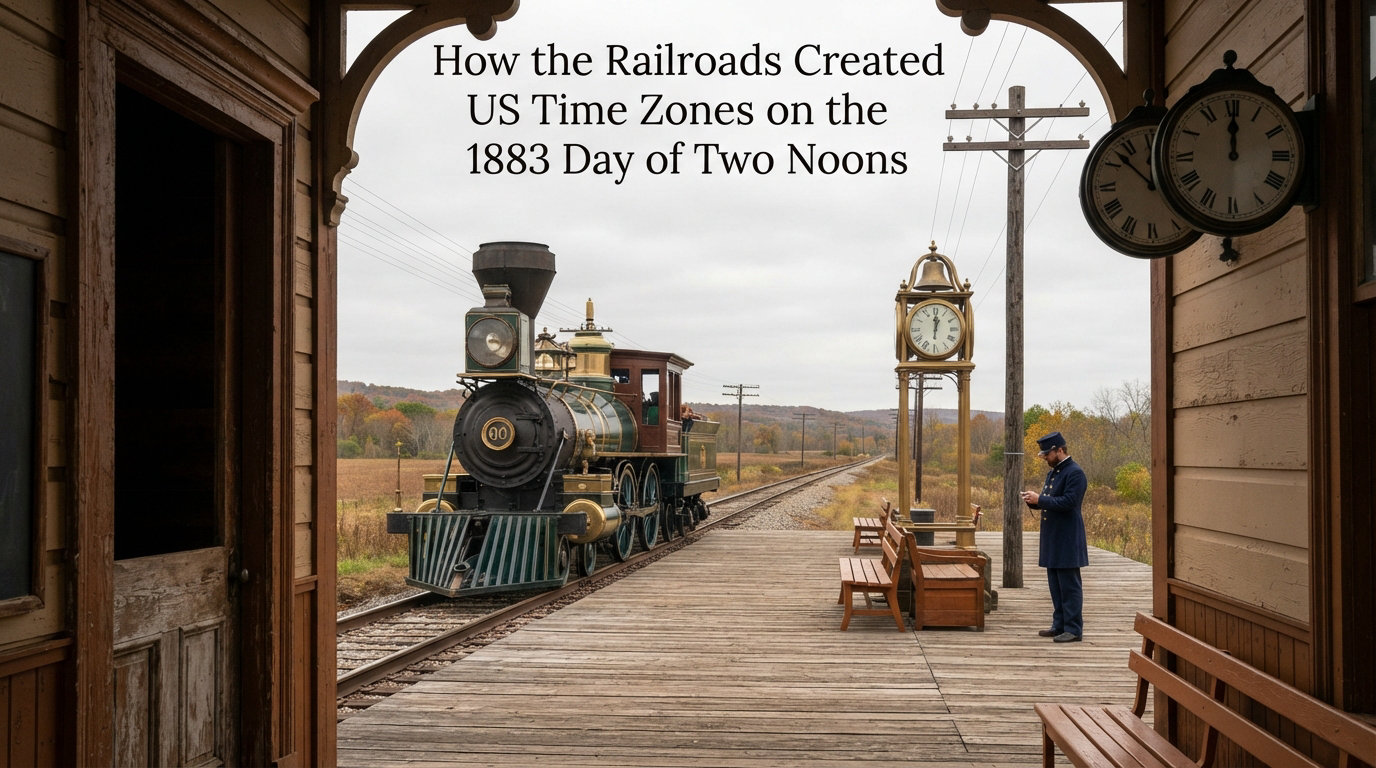
On November 18, 1883, something extraordinary happened across the United States. In dozens of cities and towns, the clock struck noon twice in the same day. Some clocks jumped forward, others jumped back, and people stood in train stations watching time itself bend to a new system. This was the Day of Two Noons, and it marked the moment how the railroads created US time zones changed the way an entire nation kept time.
Before that November day, every American city set its clocks by the sun. Noon was whenever the sun reached its highest point in the sky, and that meant every town along a railroad line had a slightly different version of what time it actually was. The chaos this created nearly broke the American railroad system, and fixing it required an audacious move by private industry that the federal government would not formally legalize for another 35 years.
I have spent years researching horological history and the stories behind how we measure time. The Day of Two Noons stands out as one of the most fascinating turning points in that history. It is a story of brilliant ideas, stubborn resistance, and a handful of railroad executives who simply decided to rewrite time itself because the old system was literally getting people killed.
Table of Contents
The Chaos Before Standardization: Local Solar Time
For most of human history, local solar time was the only system anyone knew. When the sun reached its highest point in the sky, you called it noon. That worked fine when the fastest way to travel was by horse. But as railroads spread across the continent in the mid-1800s, the cracks in this system became catastrophic.
Here is why it was a problem. The Earth rotates 15 degrees of longitude every hour, which means every degree of longitude equals roughly four minutes of time difference. New York City and Boston are about 360 miles apart, and their solar times differed by around 12 minutes. Buffalo was several minutes behind Albany. Pittsburgh ran on its own time. Multiply that across thousands of cities and you get a nightmare.
By the early 1880s, the United States had somewhere around 144 different local times in active use. Each railroad had to publish its own schedules using the local time of whatever city served as its reference point. A single rail journey from the East Coast to the West could pass through dozens of time changes, and passengers had to manually adjust their watches at nearly every stop.
The result was not just inconvenience. It was deadly. Train collisions became increasingly common because two trains operating on different local times could be scheduled on the same track at what each crew believed were safe intervals. In some of the worst accidents, dispatchers had no reliable way to know exactly when a train would arrive because every station clock told a different story.
How the Railroads Created US Time Zones
The railroads created US time zones because no one else could or would. The federal government showed no interest in standardizing time, and individual cities certainly could not agree on whose time should win. So the railroad industry, which had the most to lose from continued chaos, took matters into its own hands.
The railroads were uniquely positioned to solve this problem. They already owned telegraph lines running along their tracks. They operated on strict schedules that crossed state and municipal boundaries. And they had the organizational infrastructure to coordinate a national change in a way no government agency of the 1880s could match.
Their solution was elegant. Instead of hundreds of local times, they would divide the continent into just four broad time zones. Every clock within each zone would read identically, regardless of where the sun actually was. This meant that at the eastern edge of a zone the sun might reach noon 30 minutes before clocks said noon, and at the western edge it might reach noon 30 minutes after. That tradeoff was considered acceptable compared to the alternative of 144 competing times.
The decision was made at the General Time Convention, a meeting of railroad managers held in Chicago in October 1883. The railroads voted to adopt Standard Railway Time and set the implementation date for Sunday, November 18, 1883, a day chosen specifically because Sunday had the lightest train traffic.
The Day of Two Noons: November 18, 1883
November 18, 1883 dawned like any other Sunday, but by midday, time across North America would never be the same. At precisely the moment standard-time noon arrived in each zone, railroad station agents reset their clocks according to telegraph signals sent from the United States Naval Observatory in Washington, DC.
In cities where the local solar time was ahead of the new standard time, clocks were turned back. That meant noon had already passed by the old reckoning, and then it was noon again under the new system. This is how the day earned its famous name. People literally experienced two noons in a single afternoon.
In other cities where local solar time lagged behind the new standard, clocks jumped forward. Noon simply arrived earlier than the sun suggested, and people lost a chunk of their morning. Some towns saw their clocks shift by as much as 28 minutes in a single instant.
The change did not happen all at once across the country. Each time zone reached its standard noon at a different moment, staggered by exactly one hour from east to west. Eastern Time hit noon first, then Central, then Mountain, then Pacific, rolling across the continent like a wave over the course of about three hours.
Most railroad companies adopted the new system immediately and universally. The Pennsylvania Railroad, the New York Central, the Baltimore and Ohio, and dozens of other lines all switched their clocks simultaneously. By the end of that single day, the vast majority of North American railroads operated on four standard times instead of hundreds of local ones.
The Four Time Zones Established
The 1883 system divided North America into four standard time zones, each spanning 15 degrees of longitude and separated by exactly one hour:
Eastern Time was based on the mean solar time of the 75th meridian west, roughly matching the time in New York City.
Central Time was based on the 90th meridian west, roughly matching the time in Chicago.
Mountain Time was based on the 105th meridian west, roughly matching the time in Denver.
Pacific Time was based on the 120th meridian west, roughly matching the time in San Francisco.
Each zone was exactly one hour apart from its neighbor, making time conversions between zones simple for the first time in history. A train departing New York at noon Eastern would arrive in Chicago on Central Time without anyone needing to calculate an odd number of minutes difference.
The boundaries between zones were drawn to follow railroad lines wherever possible, rather than strict lines of longitude. This was a practical decision. Railroad managers wanted to minimize the number of times a single rail route crossed from one zone into another, reducing confusion for crews and dispatchers.
Key Figures Behind the Change
The creation of standard time was not the work of one person. Three men in particular shaped the system we still use today, each contributing a different piece of the puzzle.
Charles F. Dowd: The First Proposal
Charles Ferdinand Dowd, a school principal from Saratoga Springs, New York, was the first person to propose a systematic time zone plan for North America. In 1870, he presented a scheme dividing the continent into four zones based on the Washington meridian. He later revised his proposal to use the Greenwich meridian as the reference point, which aligned with international scientific standards.
Dowd spent years lobbying railroad companies and even secured a meeting with railroad officials in 1872 to present his plan. The railroads acknowledged the merit of his ideas but were not yet ready to act. His contribution was foundational, though. He established the four-zone framework that would eventually be adopted with modifications more than a decade later.
William F. Allen: The Man Who Made It Happen
William Frederick Allen was the secretary of the General Time Convention, the body that represented railroad interests in scheduling matters. If Dowd was the visionary, Allen was the operator who turned vision into reality. As editor of the Official Guide of the Railways, Allen had enormous practical influence over how schedules were published and distributed.
Allen took Dowd’s concept, refined it, and built the political consensus among competing railroad companies to adopt it. He personally wrote the resolution that the General Time Convention passed in October 1883. His advocacy was relentless, and he understood that the change would only work if all major railroads adopted it simultaneously, preventing competitive disadvantage.
Sir Sandford Fleming: The Global Visionary
Sir Sandford Fleming, a Scottish-Canadian engineer, took the concept even further than anyone else. Fleming reportedly conceived his idea for worldwide standard time after missing a train in Ireland in 1876 because the schedule used a different local time than he expected. That frustration sparked a lifelong mission to standardize time globally.
In 1879, Fleming proposed a system of 24 hourly time zones covering the entire planet, each 15 degrees of longitude wide, all referenced to a single prime meridian. His vision directly influenced the International Prime Meridian Conference held in Washington in 1884, which established Greenwich as the global zero-degree meridian. While the American railroad system adopted only four of Fleming’s zones, his global framework underpins every time zone system in use around the world in 2026.
The Telegraph: How Clocks Were Synchronized
None of this would have worked without the telegraph. In an era before radio, before telephone, and certainly before atomic clocks, the telegraph was the only technology capable of transmitting a time signal instantaneously across vast distances.
The United States Naval Observatory in Washington, DC served as the master timekeeper. Each day, the observatory calculated precise mean solar time using astronomical observations. On November 18, 1883, the observatory sent telegraph signals along railroad telegraph lines to stations across the continent.
When the signal arrived at each station, the local agent adjusted the station clock to match. In the Eastern zone, the signal came first. One hour later, Central zone stations received their signal and adjusted accordingly. The same process repeated for Mountain and Pacific zones, each one hour behind the previous.
This was not the first time telegraph time signals had been used. The observatory had been sending daily noon signals for years to help cities and railroads set their clocks. But November 18 was different because the signals were used to implement an entirely new system of time, not just fine-tune the old one.
Community Reactions and Resistance
The public reaction to the Day of Two Noons was mixed and often colorful. Many people embraced the change immediately, recognizing that standardized time made daily life simpler and travel safer. Newspapers across the country ran front-page stories explaining the new system, and most city governments followed the railroads’ lead within days or weeks.
But not everyone was happy. Some communities saw the change as an assault on local identity. If your town had always set its clocks by its own sun, switching to a time dictated by distant railroad executives felt like a loss of autonomy. Religious leaders in some cities argued that standard time was an artificial human invention that disrupted the natural order God had established.
Detroit became the most famous holdout. The city refused to adopt standard time and continued using local solar time until 1905, more than two decades after the rest of the country. Detroiters stubbornly kept their clocks running on what they considered proper local time, creating confusion for anyone traveling to or from the city.
Interestingly, the legal system was also slow to adapt. Many courts and municipal governments continued operating on local time for years, meaning that a trial might start at a different time than the courthouse clock displayed. This legal limbo persisted in pockets well into the 1890s.
Why the Government Waited Until 1918
One of the most common questions people ask about this story is why the federal government waited 35 years to officially legalize time zones. The Standard Time Act of 1918 finally put the government’s stamp of approval on a system that had been running the country since 1883.
The answer is partly philosophical and partly practical. In the 1880s, the federal government was much smaller and less inclined to regulate daily life. Standardizing time was not seen as a federal responsibility. The railroads had already solved the problem voluntarily, so there was little political pressure for Congress to act.
There was also a constitutional question. Some legal scholars argued that time was a local matter reserved to the states, not something Congress could regulate under its existing powers. It was not until the federal government needed to coordinate railroads and other industries during World War I that Congress found both the will and the justification to pass the Standard Time Act.
The 1918 act did more than just legalize the four zones. It also established Daylight Saving Time in the United States for the first time, as a wartime energy conservation measure. Daylight Saving Time was repealed after the war but returned during World War II and eventually became permanent with the Uniform Time Act of 1966, which is the framework still governing time zone observance in 2026.
The Bigger Picture: International Context
The American railroad time reform did not happen in a vacuum. Great Britain had faced the same problem decades earlier and arrived at a similar solution. In 1847, British railway companies adopted Railway Time, a single standard time based on the Greenwich Observatory, to replace the chaotic patchwork of local times across England.
The British experience directly influenced American reformers. Railway Time proved that voluntary industry adoption could work, and that communities would gradually fall in line even without a government mandate. The American railroads essentially scaled the British model up to a continental level, adding the multi-zone approach that a country spanning from ocean to ocean required.
The International Prime Meridian Conference, held in Washington in 1884, sealed the global framework. Delegates from 25 nations agreed to adopt Greenwich as the universal prime meridian and established the system of global standard time based on 24 hourly zones. This conference formalized what the railroads had already put into practice.
Today, every time zone on Earth traces its lineage back to that November day in 1883. When you check the time in 2026, whether on your phone, your computer, or a wall clock, you are using a system born from the practical needs of 19th-century railroad schedulers who were tired of trains crashing into each other.
FAQs
How did railroads lead to time zones?
Railroads led to time zones because the old system of local solar time created scheduling chaos and caused deadly train collisions. Each city kept its own time based on the sun, resulting in roughly 144 different local times across the country. Railroads solved this by dividing North America into four standard time zones in 1883.
What were the time zones for trains in 1883?
The four time zones created in 1883 were Eastern, Central, Mountain, and Pacific, each based on a meridian 15 degrees apart. Every clock within a zone read identically, and each zone was exactly one hour apart from the next, making train scheduling consistent for the first time.
Who created the new system of US time zones in 1883?
William F. Allen, secretary of the General Time Convention, designed and implemented the system. Charles F. Dowd first proposed the four-zone concept in 1870, and Sir Sandford Fleming contributed the broader global framework. The railroad industry voted to adopt the plan on October 11, 1883.
What were the standardized time zones created by the railroads in 1883?
The railroads created Eastern Time (75th meridian), Central Time (90th meridian), Mountain Time (105th meridian), and Pacific Time (120th meridian). These four zones, each one hour apart, replaced approximately 144 different local solar times previously in use.
Why did the US government wait 35 years to legalize time zones?
The federal government waited until 1918 because standardizing time was not seen as a federal responsibility in the 1880s, and some scholars questioned whether Congress had constitutional authority to regulate time. World War I created the urgency needed to pass the Standard Time Act of 1918.
What industry created standardized time zones that we still use today?
The railroad industry created standardized time zones. Railroad companies voluntarily adopted the four-zone system on November 18, 1883, because local solar time was causing scheduling chaos and deadly collisions. This same system, with modifications, is still used across North America today.
Conclusion
The story of how the railroads created US time zones on the 1883 Day of Two Noons is a reminder that some of the most fundamental systems in our daily lives were not handed down by governments or scientists in laboratories. They were built by practical people solving urgent problems. When local solar time became too dangerous to sustain, the railroad industry simply decided to fix it, and the rest of the country followed.
Charles Dowd imagined the zones, William Allen organized the vote, Sandford Fleming placed it in a global context, and thousands of telegraph operators reset their clocks on a single Sunday in November. The system they created has survived wars, technological revolutions, and the transition from mechanical clocks to atomic ones. If you want to explore more stories about the history of timekeeping and how humanity learned to measure its days, we invite you to keep reading at Exquisite Clock.