
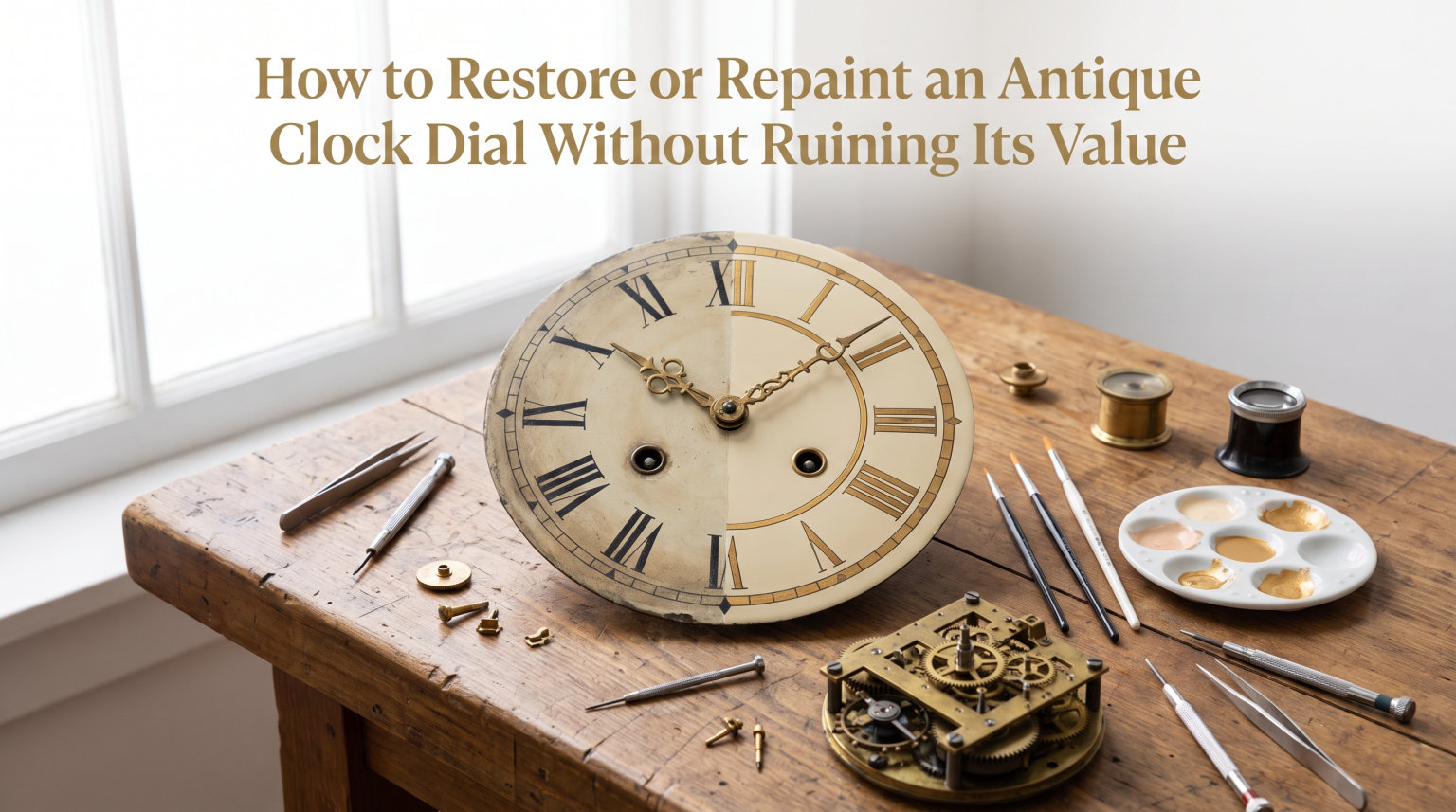
Antique clock dial restoration sits at a tricky crossroads between preserving history and making a clock readable again. A dial is original only once, and the wrong cleaning method or a sloppy repaint can erase decades of patina and permanently cut the value of your clock. I have spent years around collectors, hobbyists, and professional dial specialists, and the same question comes up every time: should I fix this dial myself, send it out, or just leave it alone?
This guide walks you through every option so you can make that call with confidence. You will learn how to tell inpainting from a full repaint, when restoration actually helps or hurts value, what a careful DIY inpainting process looks like step by step, and how to find a professional who will treat your dial right. Whether you inherited a tall case clock with a faded moon dial or picked up a Seth Thomas with chipped paint, the principles here apply.
One thing I want to be upfront about: there is no single correct answer that fits every clock. A rare 18th-century brass dial demands a completely different approach than a common 20th-century kitchen clock. By the end of this article, you will have a clear decision framework, a realistic sense of costs, and the knowledge to avoid the mistakes that ruin value.
Table of Contents
What Makes Clock Dial Restoration So Different
Antique clock dial restoration is unlike refinishing furniture or polishing silver because the dial is the single most important factor in a clock’s collectibility. The dial carries the maker’s signature, the hand-painted decoration, and the original numeral work that collectors use to authenticate and date a piece. Touch any of those elements incorrectly and you have altered the clock’s identity.
The core distinction you need to understand is inpainting versus a full repaint. Inpainting means carefully touching up only the damaged areas, matching the original paint as closely as possible while leaving the surrounding original surface untouched. A full repaint strips the entire dial and reproduces the artwork from scratch. Both have their place, but they carry very different consequences for value.
Collectors prize originality above almost everything else. Honest wear, a softened patina, and even a few age cracks tell the story of a clock’s life. A dial that looks too fresh or too perfect is an immediate red flag to anyone who knows antique clocks. That is why the first rule of dial work is to do as little as necessary to stabilize and make the dial readable.
The other concern is irreversibility. Many restoration techniques involve solvents, abrasives, or new paint layers that cannot be undone once applied. If you re-lacquer a brass dial or strip a painted dial, there is no going back. This permanence is exactly why so many collectors and museum professionals advocate for a conservative approach.
Types of Antique Clock Dials and Their Restoration Requirements
Not all dials are created equal, and the type of dial on your clock determines what restoration is even possible. The four main categories you will encounter are brass, silvered, white painted, and paper dials. Each has its own vulnerabilities and its own best-practice approach.
Brass Dials
Brass dials, common on English and early American clocks from the 17th and 18th centuries, develop a warm patina that collectors value highly. The engraved numerals and chapter ring were originally filled with black wax or lacquer, and the surface was protected with a clear lacquer coating. Over time that lacquer breaks down and the brass beneath tarnishes.
Restoration of a brass dial typically involves re-lacquering to halt further tarnish, but this must be done with extreme care. Aggressive polishing removes the engraving fill and softens fine detail. Re-lacquering a previously unlacquered dial also changes its appearance, which can alarm purist collectors. For valuable brass dials, stabilization and light cleaning by a specialist is almost always preferable to a full re-lacquer.
Silvered Dials
Silvered dials, often found on marine chronometers and high-grade clocks, have a thin layer of silver applied over a base metal. The silvering gives a soft, silvery-white background that darkens with age. These dials are notoriously fragile because ordinary cleaning can strip the silvering right off the surface.
Re-silvering is a specialized process that involves applying a fresh silver chloride compound and burnishing it into the dial. It is genuinely difficult to do well and should never be attempted as a first DIY project. If your silvered dial is simply tarnished, a specialist can often stabilize it without re-silvering. If the silvering has worn through, professional re-silvering is the only route that maintains value.
White Painted Dials
White painted dials are the most common type on tall case clocks, shelf clocks, and many American clocks from the late 18th through 19th centuries. These are typically painted on a metal pan with a white ground layer, decorated with painted spandrels in the corners, a chapter ring with numerals, and sometimes a moon phase dial or calendar aperture.
White dials are also the most common candidates for DIY inpainting because the paint is accessible and the damage is usually localized. Flaking paint, faded numerals, and chipped spandrel artwork can all be addressed with careful touch-up work. This is the dial type covered in the step-by-step inpainting section later in this guide.
Paper Dials
Paper dials, found on many 20th-century American kitchen and shelf clocks, are printed paper applied to a metal or wooden back. They are prone to staining, tearing, and foxing as the paper ages. Restoration options are limited because the paper itself is the artwork.
For damaged paper dials, the most practical solution is often a high-quality reproduction replacement. Several suppliers now produce accurate paper dial reproductions that match original dimensions and artwork. If you want to preserve the original paper, a paper conservator can stabilize tears and reduce staining, but this is specialized museum-style work rather than typical clock repair.
When to Restore vs Leave Original: A Decision Framework
The decision to restore a clock dial comes down to three factors: the rarity and value of the clock, the current condition of the dial, and your reason for wanting the work done. I use a simple framework that helps collectors and owners make this call without regretting it later.
First, assess the rarity and value of your clock. If the clock is rare, historically significant, or worth several thousand dollars, the dial should almost always be left original. Even professional restoration on a rare clock can reduce collector value because originality is the primary driver of price in that tier. Stabilization to prevent further flaking is acceptable, but refinishing is not.
Second, evaluate the dial condition objectively. A dial with minor crazing, light fading, or a few small paint chips is a candidate for stabilization and inpainting only. A dial that is barely readable, with large areas of missing paint and illegible numerals, may justify a full repaint because the practical value of being able to read the clock outweighs the loss of original surface.
Third, be honest about your goal. If you want the clock for personal enjoyment and have no intention of selling, a careful repaint or inpainting that makes the clock beautiful again is a reasonable choice. If resale or preserving heirloom value matters, restraint is the better path.
Here is the decision checklist I recommend working through before touching any dial:
1. Is the clock rare or worth more than a few thousand dollars? If yes, stabilize only and consult a specialist before doing anything else.
2. Can you still read the time and numerals clearly? If yes, leave the dial alone or pursue minimal inpainting of specific damage.
3. Is the damage localized or spread across the entire dial? Localized damage favors inpainting, while widespread damage may require a full repaint.
4. Do you plan to sell the clock in the foreseeable future? If yes, original condition almost always commands a higher price than even excellent restoration.
5. Are you comfortable with the work being irreversible? If the answer is no, choose stabilization over refinishing every time.
How to Restore or Repaint an Antique Clock Dial Without Ruining Its Value
If you have worked through the decision framework and decided that inpainting is the right approach for your white painted dial, this section walks you through the process. The goal of inpainting is to make damaged areas blend with the original surface so seamlessly that the eye does not catch the repair. Done well, it improves readability without announcing that restoration has occurred.
Before you begin, gather your materials. You will need water-based acrylic paint in white and a selection of colors for matching, fine detail brushes in sizes 0 through 3, a black fine-point pen such as a Sharpie for numeral detailing, a small math compass for scribing arcs, clear microcrystalline wax for the protective finish, cotton swabs, distilled water, and mild soap for initial cleaning. Avoid oil-based paints, which yellow over time and are difficult to reverse.
Always photograph the dial from multiple angles before starting. These images serve as your reference during the work and as documentation of the original condition for future owners.
Step 1: Clean and Stabilize the Surface
Begin by gently cleaning the dial with a soft cloth dampened with distilled water and a tiny amount of mild soap. Work in small sections and never scrub. The goal is to remove surface dirt without disturbing the original paint underneath. Any loose or flaking paint should be stabilized rather than removed.
If you encounter actively flaking paint, you can carefully consolidate it using a tiny amount of reversible conservation adhesive applied with a fine brush. This holds the original paint in place and prevents further loss. Let the cleaned dial dry completely before moving to the next step.
Step 2: Paint Large and Small Damaged Sections
Mix your white acrylic paint to match the aged tone of the original dial. Fresh white straight from the tube is almost always too bright, so add a trace of yellow or gray to approximate the mellowed ground color. Test your match on a piece of scrap paper and hold it beside the dial in natural light.
Apply paint only to the areas where the original ground is missing. Use a fine brush and build up thin layers rather than applying one thick coat. Feather the edges of your repair into the surrounding original paint so there is no visible ridge. Let each layer dry before adding the next.
Step 3: Touch Up the Numerals
Once the ground paint has dried, address any faded or missing numerals. This is the most delicate part of inpainting because the numerals define the dial’s character. Use reference photos to match the original style, whether Roman or Arabic, and pay close attention to the stroke weight and proportions.
For black numerals, a fine-point pen often produces cleaner lines than a brush. Work slowly and correct mistakes immediately with a damp cotton swab before the ink sets. The numerals must match the original size and spacing exactly, because incorrect proportions are one of the easiest ways for a knowledgeable buyer to spot restoration.
Step 4: Restore the Chapter Ring and Fine Line Details
The chapter ring is the ring of numerals and minute marks that circles the dial, and it often requires the most precision. Use a small math compass to scribe any missing arc lines, keeping the radius consistent with the original. Minute marks and radial lines can be re-drawn with a fine pen or a single-hair brush.
Take your time with decorative elements like spandrel corner artwork. These painted decorations are unique to each dial style, and a clumsy reproduction stands out immediately. If you are not confident in your ability to reproduce the artwork faithfully, this is where a professional restorer earns their fee.
Step 5: Apply an Aged Effect and Protective Finish
Freshly applied paint will look too bright against the aged original surface. To blend your repairs, apply a very thin wash of tinted paint or diluted brown acrylic over the restored areas. This simulates the aged effect and helps new paint recede into the background. Wipe off the excess immediately so the wash settles only into recesses and edges.
Finally, protect your work with a thin layer of clear microcrystalline wax. Apply it with a soft cloth, let it haze, and buff gently. Wax is reversible, which means a future owner or conservator can remove it without damaging the paint beneath. Avoid spray lacquers and clear coats, which are far more permanent and difficult to undo.
A critical warning: never use this inpainting approach on brass, silvered, or rare painted dials without professional guidance. The techniques described here are appropriate for common white painted dials where the decision framework has already confirmed that restoration is acceptable.
Professional Restoration: What to Expect and How to Find a Specialist
For valuable dials, complex damage, or any work beyond your comfort level, a professional dial restorer is the right call. The key is finding someone who specializes in dials specifically rather than a general clock repair shop. Most clock repair shops handle movements and cases but outsource dial work because it requires a distinct skill set.
A qualified dial specialist will begin with an assessment of your dial’s condition, originality, and value. They will discuss whether inpainting, partial restoration, or a full repaint is appropriate and explain how each option affects collectibility. A good specialist will sometimes tell you that the best restoration is no restoration at all.
The professional process typically involves cleaning, stabilizing flaking paint, inpainting damaged areas with precisely matched paints, re-silvering or re-lacquering where appropriate, and applying a protective finish. Museum-quality specialists use reversible materials and document every step so the work can be identified and, if necessary, undone by future conservators.
To find a reputable specialist, start with the National Association of Watch and Clock Collectors, whose member directory includes dial specialists with established reputations. Ask for references from other collectors, request to see before and after photos of previous work, and verify that the restorer has experience with your specific dial type. A specialist who mostly works on watch dials may not be the best choice for a large tall case clock dial, and vice versa.
Expect to wait several months for quality work. Dial restoration is detail-intensive and reputable specialists often have backlogs. Rushed work is a hallmark of amateur restoration, so patience is part of getting a result that protects value.
How Restoration Affects Value: Common vs Rare Clocks
The impact of dial restoration on value depends almost entirely on where your clock sits on the rarity spectrum. Understanding this relationship is essential for making a decision you will not regret.
For rare and high-value clocks, any refinishing tends to reduce collector value. A collector who pays a premium for an 18th-century clock wants an original dial, even one with honest wear and age. A refinished dial on a rare clock can cut the value significantly because it removes the very originality that justifies the price. In this tier, stabilization and conservation are the only acceptable interventions.
For common clocks worth a few hundred dollars, the value equation shifts. A barely readable dial makes the clock less enjoyable and harder to sell, so a well-executed inpainting or even a careful repaint can actually improve the clock’s appeal. The key is that the work must be done to a high standard, because a poor restoration is worse than honest wear.
Honesty about restoration matters regardless of the clock’s value. A well-documented, professionally executed restoration is far more acceptable to buyers than a disguised refinish discovered later. If you restore a dial, record what was done, photograph the before and after states, and be transparent when selling.
Insurance and appraisal considerations also come into play. If your clock is insured or appraised, any restoration work should be reported to your insurer and documented for the appraisal record. A professional appraisal before and after restoration provides an objective measure of how the work affected value, which protects you in any future sale.
Cost Considerations: When Professional Work Is Worth It
Cost is one of the most common questions I hear, and the answer depends on dial type, extent of damage, and the specialist’s expertise. Professional dial repainting for a tall case clock typically ranges from moderate to significant investment, reflecting the hours of detail work involved. Watch dial restoration tends to cost somewhat less due to the smaller surface area but still requires specialized skill.
For comparison, DIY inpainting of a white painted dial costs only the price of materials, which runs quite low for acrylic paints, brushes, and wax. This makes inpainting an attractive option for common clocks where the value does not justify professional fees. However, the cost savings must be weighed against the risk of amateur work reducing value if the results are poor.
The break-even analysis is straightforward. If your clock is worth more than the cost of professional restoration by a comfortable margin, and the dial damage is significant enough to affect enjoyment or saleability, professional work is worth it. If the clock is inexpensive and the damage is minor, DIY inpainting or simply leaving the dial alone is the better financial choice.
Always get quotes from at least two specialists before committing. Prices vary based on the restorer’s experience, your location, and the specific challenges of your dial. A quote that seems unusually low may indicate inexperience, while an unusually high quote should come with a clear explanation of what justifies the cost.
Warning Signs of Bad Previous Restoration Work
If you are buying a clock or assessing one you already own, recognizing poor restoration is a valuable skill. The most reliable indicator is proportion. Numerals, chapter ring spacing, and decorative elements that do not match the correct proportions for the clock’s style and period suggest a refinished dial rather than an original.
Inconsistent wear is another red flag. If the dial looks fresh and perfect but the case shows significant age and wear, the dial has likely been refinished. Honest wear develops uniformly across a clock over decades, so a mismatched dial-to-case condition is a strong warning sign.
Overly bright or flat paint also signals amateur work. Original painted dials have a soft, slightly textured surface with subtle variations. A dial that looks like it was sprayed with uniform flat white paint has been refinished, and probably not by a specialist.
Finally, check the maker’s signature and any lettering for spelling errors or unusual letter forms. Inexperienced restorers sometimes introduce errors when reproducing signatures, and these mistakes are dead giveaways that the dial has been repainted.
Documenting Your Restoration for Future Collectors
No competitor I reviewed covers documentation, and it is one of the most overlooked aspects of responsible dial work. Good documentation protects the long-term value of your clock and builds trust with any future owner.
Take clear, well-lit photographs of the dial before any work begins, during each stage of restoration, and after completion. Store these images with written notes describing what was done, what materials were used, and who performed the work. Keep receipts from any professional restorer.
If you sell the clock, include this documentation with the sale. A buyer who can see exactly what was restored and how will pay more and trust the transaction more than one facing an unknown restoration history. Honesty about restoration is not just ethical, it is the smartest financial strategy for preserving value over time.
FAQs
How much does it cost to restore a clock?
Professional clock dial restoration cost varies widely based on dial type, damage extent, and the specialist’s experience. A full repaint of a tall case clock dial represents a moderate to significant investment due to the many hours of detailed hand painting involved. DIY inpainting of a white painted dial costs only the price of materials, making it a cost-effective option for common clocks.
How much does it cost to restore a watch dial?
Watch dial restoration typically costs somewhat less than large clock dial work due to the smaller surface area, but it still requires specialized skill. Re-silvering and refinishing watch dials are best left to professionals with experience in horological restoration. Costs vary by the complexity of the dial and the reputation of the specialist.
What are some common problems with antique clocks?
Common antique clock problems include cracked or flaking dial paint, faded or illegible numerals, tarnished or worn silvering on silvered dials, degraded lacquer on brass dials, stained or torn paper dials, damaged chapter rings, and previous poor-quality touch-ups. Movement issues like worn pivots and dried lubricants are also frequent, but dial condition is the primary factor affecting collector value.
Does clock dial restoration decrease value?
Clock dial restoration can decrease value, especially on rare or high-value clocks where originality is the primary driver of collector price. Any refinishing on a rare dial tends to reduce what knowledgeable buyers will pay. On common clocks, well-executed restoration that improves readability can maintain or even modestly increase appeal. The key factors are the clock’s rarity, the quality of the work, and full documentation of what was done.
Conclusion
Learning how to restore or repaint an antique clock dial without ruining its value comes down to respecting the principle that a dial is original only once. The decision framework in this guide helps you weigh rarity, condition, and intent so you can choose between stabilization, inpainting, professional restoration, or leaving the dial untouched.
When in doubt, choose the least invasive option. Stabilizing flaking paint and cleaning gently preserves far more value than an ambitious repaint, and reversible materials like wax finishes keep your options open for the future. Document everything you do, work with specialists for valuable dials, and be honest about any restoration when passing a clock along.
Your antique clock has already survived decades or centuries. With the careful approach outlined here, it can remain readable, beautiful, and valuable for generations to come.