
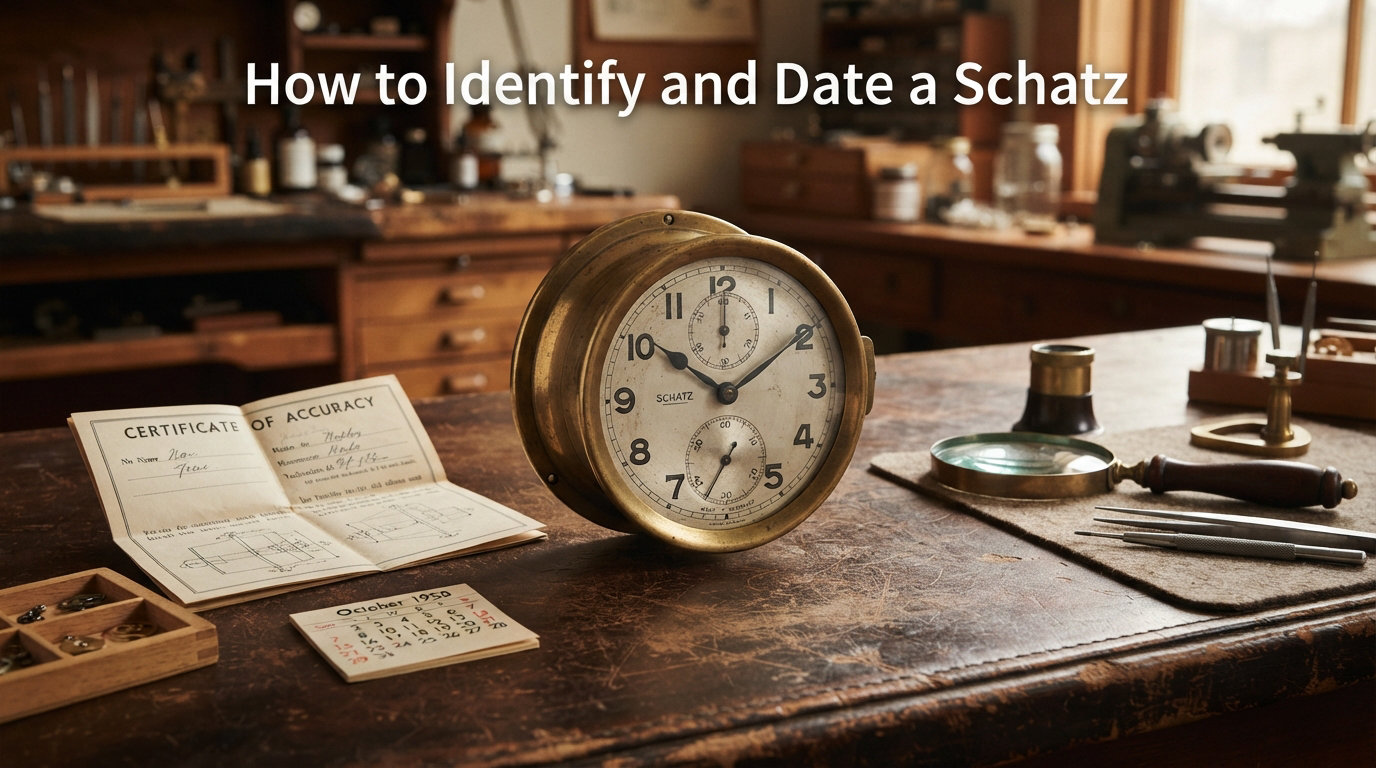
Schatz anniversary clocks are among the most collected torsion pendulum timepieces in the world. You found one in your grandmother’s attic, inherited it from a family member, or picked one up at an estate sale, and now you need to know what you have. Our team has spent years researching 400-day clocks, and I’m going to walk you through exactly how to identify and date a Schatz clock using nothing more than a careful look at the movement and backplate.
Schatz was the original manufacturer of the 400-day anniversary clock, starting production in 1881 in the Black Forest region of Germany. These clocks run for roughly a year on a single winding, which is why they became popular wedding and anniversary gifts. Millions were produced through the 1970s, which means there are still thousands sitting in homes, attics, and antique shops waiting to be properly identified. By the end of this guide, you’ll know how to spot an authentic Schatz, determine its age, and distinguish it from similar clocks made by Kundo and Kern.
The information in this guide comes from multiple expert sources, including the National Association of Watch and Clock Collectors (NAWCC) forums, Bill’s Clockworks repair documentation, and the Anniversary Clock Identification reference book by Mervyn Passmore. These are the gold standard resources for 400-day clock authentication. I’ve synthesized the key identification and dating techniques from these sources so you can apply them to your own clock without needing to wade through hundreds of forum threads.
Table of Contents
The History of the August Schatz Company
August Schatz founded his clock company in 1881 in Triberg, a small town in Germany’s Black Forest region. The company name was Jahresuhrenfabrik, which translates to “Anniversary Clock Factory.” Schatz wasn’t the inventor of the 400-day torsion clock, but he was the first to manufacture them on a commercial scale, making them affordable to middle-class families across Europe and eventually America.
The Black Forest region had a centuries-old tradition of clockmaking, and Schatz was at the center of this specialized industry. By the early 1900s, the company had become one of the largest producers of 400-day anniversary clocks in the world. The original Schatz factory focused almost exclusively on producing these clocks with brass movements and four-ball rotating pendulums, perfecting the mass-production techniques that made them accessible to ordinary households.
Schatz also produced other specialty clocks during this period, including 1000-day clocks, 8-day clocks, and maritime clocks designed for use on ships. The company survived both World Wars, though production was halted during the war years as German factories were repurposed for the war effort. After World War II, Schatz resumed manufacturing and continued producing clocks through the 1970s, adapting to changing consumer tastes and introducing new designs along the way.
The peak production years for Schatz clocks were the 1950s and 1960s, when the company produced thousands of clocks per year. During this period, Schatz became the dominant manufacturer of 400-day clocks in the American market, with major distributors like Remington Rand importing the clocks and selling them through department stores and jewelry shops across the United States.
Today, Schatz clocks are highly collectible. Their value depends on age, condition, model, and whether the original components are intact. The company’s long production history means that identifying and dating these clocks requires careful attention to specific markings and design features that changed over the decades. A well-preserved 1950s Schatz in working condition can be worth considerably more than a later model, making proper identification essential for collectors and owners.
How 400-Day Torsion Clocks Work
Before diving into identification, it helps to understand how a 400-day clock actually functions. Unlike traditional pendulum clocks that swing back and forth in a wide arc, a 400-day anniversary clock uses a torsion pendulum that rotates in one direction, then the other, in a much smaller motion. This is why these clocks are sometimes called torsion pendulum clocks or rotary pendulum clocks.
The pendulum is suspended from a thin metal strip called a suspension spring, which acts like a very weak torsion bar. As the pendulum rotates, the spring twists and untwists, providing the restoring force that keeps the pendulum oscillating. The four-ball pendulum design, with brass balls mounted on a rotating disc, gives the pendulum enough rotational inertia to keep moving for an extended period.
The mainspring provides the energy. When wound, it stores enough power to drive the clock for approximately 400 days. The escapement mechanism, which consists of the escape wheel and pallet fork, regulates the release of energy and keeps the pendulum swinging at the correct rate. This is the same basic principle used in traditional pendulum clocks, but the geometry and timing are different.
Because the torsion pendulum rotates rather than swings, it experiences less air resistance and loses energy more slowly than a traditional pendulum. This is why a single winding can keep the clock running for over a year. The suspension spring is the critical component, and if it stretches, breaks, or loses its temper, the clock will stop keeping accurate time or stop running entirely.
Identifying Schatz Markings on the Backplate
The fastest way to identify a Schatz clock is to look at the backplate of the movement. To access this, you’ll need to remove the back cover of the clock case. Most Schatz clocks have a rear door that opens or a back panel that slides off, giving you access to the brass movement where all the critical markings are stamped. Take your time with this step and work in a well-lit area so you can read the often-small stamped text.
Once you can see the movement, look for the Schatz logo. There are two main versions of the logo that you’ll encounter, and identifying which one you have is the first step in authenticating and dating your clock. The logo location varies depending on the model and year, but it is almost always either on the dial face or stamped directly into the movement backplate.
The early Schatz logo was a horizontal design with the word “SCHATZ” stamped in black lettering, typically located on the front dial of the clock. This logo was used from the 1950s through the early 1960s. The lettering was usually printed in a straight horizontal line across the lower portion of the dial or on the backplate itself. The black color and horizontal orientation are the two key identifying features of this early logo style.
The late Schatz logo features the word “SCHATZ” in red lettering, often at an angle or slanted position. This logo appeared in the mid-1960s and continued through the late 1970s. The red color is a distinctive marker that separates later production from earlier models. The angled positioning of the late logo is also a useful indicator when dating your clock.
Beyond the logo, look for the full company name stamped on the backplate. Many Schatz movements have “Jahresuhrenfabrik” or “Jahresuhren-Fabrik” stamped directly into the brass. This German word for “anniversary clock factory” is a strong indicator of authenticity. The text might also include “Triberg” or “Germany” depending on the production year. Early clocks often have “Made in Germany” while later production pieces may simply state “Germany” or “West Germany” reflecting the post-war political division.
You may also see importer markings stamped on the backplate. The most common is “RR” which stands for Remington Rand, a major American distributor of Schatz clocks in the 1950s and 1960s. Other importers included “HAC” and various company names. These markings help confirm the clock was sold through official channels and can help narrow down the production period. If you find an importer marking, research the company to determine when they were active in the clock business, which gives you a date range for your clock.
Dating Methods for Schatz Clocks
Dating a Schatz clock is straightforward if your clock has a date code stamp. Starting around 1952, Schatz began stamping date codes on the back of the movement plate. The format is MM YY, meaning two digits for the month followed by a space and two digits for the year. For example, “10 54” means October 1954. This two-digit MM YY system makes dating relatively simple and reliable for clocks made after 1952.
To find the date code, look at the back of the movement plate, the flat brass surface that forms the rear of the movement. You’ll typically see the date code stamped in one of the lower corners or near the center. Sometimes the date code is partially hidden by the mounting bracket that holds the movement in the case. If you can’t see the full date, you may need to carefully loosen the bracket to read it completely. Be gentle when adjusting the bracket, as forcing it can damage the delicate brass components.
If your clock has a date code, that’s your answer. A clock stamped “03 62” was made in March 1962. This system makes dating relatively simple, and most Schatz clocks from the 1950s through the 1970s have these stamps. The date code is the most reliable dating method available for Schatz clocks and should always be your first reference point.
Pre-1952 Schatz clocks don’t have date codes. If your clock lacks a date stamp, you’ll need to use other methods to estimate its age. The logo style is one indicator. Early logos in black horizontal lettering suggest pre-1965 production, while red angled logos indicate post-1965 production. Case style and pendulum design can also help narrow the era. Early cases tended to be simpler in design, while later cases featured more elaborate glass domes and decorative elements.
Serial numbers are another clue, though they’re less reliable than date codes. Schatz serial numbers don’t follow a standardized chronological sequence that collectors can easily decode. Some collectors have compiled partial records, but there’s no comprehensive public database. Use serial numbers as a secondary dating tool, not a primary one. If you can find a clock with a similar serial number that has a known date, you can use that as a reference point, but the gaps between known serial numbers can be quite large.
The suspension spring can also provide dating clues. The suspension spring is the thin metal strip that holds the pendulum in place. Early Schatz clocks used specific spring designs, and replacements over the decades have varied. If your clock has its original suspension spring, the design might help narrow the production era. However, many clocks have had their suspension springs replaced over the years, so this method only works for clocks with original components.
Another dating method involves the pendulum style and disc design. Early Schatz pendulums had smooth rotating discs, while later models featured decorative patterns or different ball configurations. The four-ball pendulum remained standard throughout production, but the weight and finish of the brass balls changed over time. Examining the pendulum alongside the logo and date code can give you a more complete picture of when your clock was made.
Distinguishing Schatz from Kundo and Kern
Many antique 400-day clocks are confused with one another because Schatz, Kundo, and Kern all produced similar torsion pendulum clocks during the same era. Knowing the differences helps when you encounter an unmarked movement or a clock with a worn logo.
Kundo clocks were made by Kieninger and Obergfell, also based in the Black Forest region. Kundo movements typically have a different escapement design than Schatz, with a distinctive suspension bridge. The Kundo logo is usually stamped on the backplate with the maker’s name and location. Kundo clocks were produced from the 1930s through the 1970s and had their own production evolution that parallels the Schatz timeline.
Kern clocks were made by Gebrüder Kern, another Black Forest manufacturer. Kern movements are identifiable by their distinctive backplate shapes and mounting styles. The company was smaller than Schatz and Kundo, and their clocks are less common today. Kern clocks often have a particular bridge design that experienced collectors can identify on sight.
The most reliable way to distinguish these manufacturers is by examining the backplate markings, escapement design, and suspension bracket. Each company had its own design conventions, and comparing your clock to reference images can quickly reveal the manufacturer. The NAWCC forums and Mervyn Passmore’s reference book are excellent resources for visual comparison.
Common Schatz Models and Their Characteristics
Schatz produced several distinct models throughout their production history. The most common is the standard 400-day rotation clock with a four-ball pendulum. These have a brass movement, a rotating pendulum that turns 180 degrees per cycle, and typically run for 400 days on a single winding when properly maintained. The standard model is the clock most people think of when they hear “anniversary clock,” and it represents the majority of Schatz production.
Miniature models were also produced, featuring smaller movements and slightly shorter running times. These compact clocks were popular as gifts and often had simpler cases. The miniature models are easy to identify by their smaller movement plates and reduced case dimensions. They typically stood about 6 inches tall compared to the standard 8 to 10 inches, and the four-ball pendulum was proportionally smaller as well.
Schatz also made 1000-day clocks, which are longer-running versions of the standard design. These use a different escapement mechanism that allows the clock to run for nearly three years on a single winding. They’re less common than the standard 400-day models and are prized by collectors. The 1000-day movement is larger and more complex than the standard 400-day, and the clocks typically came in larger, more elaborate cases to accommodate the bigger movement.
Maritime clocks were another specialty product. These were designed for use on ships and featured brass cases with gimbaled suspensions to keep the pendulum vertical even when the ship rocked. Maritime models are highly sought after by collectors and are considerably rarer than standard anniversary clocks. The gimbals and brass construction reflect their nautical heritage.
Pendulum styles varied by era. Early Schatz clocks typically had four-ball pendulums with brass balls on a rotating disc. Later models introduced different pendulum designs, including variations with decorative weights and different mounting styles. The pendulum style can help confirm the production era when combined with logo and date code information. Some pendulums have serial numbers or model stamps that can be cross-referenced with documentation.
Dial variations are another distinguishing feature. Many Schatz clocks have diamond-shaped or square dials with Roman or Arabic numerals. The dial style changed over the decades, and collectors often use dial design as a secondary dating tool. Some dials have the company name printed on them, while others have it stamped on the movement only. The typeface, font size, and numeral style all changed subtly over the years, giving experienced collectors additional clues for dating.
Authentication Tips and Red Flags
Not every clock with a Schatz logo is an authentic Schatz. Reproductions and Frankenclocks (clocks with mixed parts from different manufacturers) do exist, and even well-meaning repairs over the decades can lead to clocks with mismatched components. Here are the key things to watch for when authenticating your clock.
Check for mismatched components. If the movement says Schatz but the pendulum or dial has a different maker’s mark, you likely have a parts clock. Authentic Schatz clocks should have consistent markings across all major components. A movement stamped “Schatz” paired with a Kundo pendulum is a red flag, even if the clock looks complete and functional.
Look at the quality of the markings. Authentic Schatz stamps are clean, precise, and deeply impressed into the brass. Reproductions often have fuzzy, shallow, or poorly aligned stamps. Compare your clock’s markings to verified examples online through the NAWCC forums or reference books. The depth and clarity of the stamping is a reliable indicator of authenticity, because original German factory stamps were made with high-quality tooling.
Be cautious of clocks with no identifying marks. Some torsion pendulum clocks were produced by smaller German manufacturers who didn’t stamp their movements. If your clock has no maker’s mark, it might be a Schatz with worn markings, or it might be from a different company entirely. Researching the case style and movement design can help identify these unmarked clocks. The NAWCC forums have experts who can often identify unmarked movements from photographs.
Painted logos are a red flag. Authentic Schatz logos from the 1950s and 1960s were typically printed or stamped, not painted on. If the logo looks like it was applied with a brush or has thick, uneven paint, the clock may be a reproduction or have been refinished. However, some original late-model Schatz clocks did have red printed logos, so consider the paint quality alongside other authentication factors.
Examine the suspension spring for originality. Replacement suspension springs are common because the original springs often break or stretch over decades of use. An obviously modern-looking spring in a clock that otherwise appears original may indicate repairs. This doesn’t necessarily mean the clock is inauthentic, but it’s a sign that the clock has been serviced at some point.
When in doubt, consult an expert. The National Association of Watch and Clock Collectors (NAWCC) has members who specialize in 400-day clocks and can authenticate your piece. Local antique clock dealers with experience in German clocks can also provide valuable insights. Many NAWCC members will look at photographs and provide identification opinions for free, making it easy to get a second opinion before assuming your clock is authentic or not.
Frequently Asked Questions
How can I tell how old my Schatz clock is?
Check the back of the movement plate for a date code in MM YY format. For example, 10 54 means October 1954. Schatz started stamping date codes around 1952. For pre-1952 clocks, use the logo style, case design, and pendulum characteristics to estimate the age.
Where is the serial number on a Schatz clock?
Serial numbers are typically stamped on the backplate of the movement, often near the date code or along the edges. However, Schatz serial numbers don’t follow a clear chronological pattern, so they’re less reliable for dating than the MM YY date stamps.
What year is my Schatz clock if it has no date stamp?
Clocks made before 1952 typically lack date stamps. Use the logo style to estimate: black horizontal lettering suggests pre-1965, red angled lettering suggests late 1960s to 1970s. Case style, pendulum design, and importer markings can provide additional clues.
How do I identify an unmarked 400-day clock?
Research the movement design, case style, and any partial markings. Compare your clock to reference images in books like Mervyn Passmore’s Anniversary Clock Identification. The NAWCC forums are also excellent resources for identifying unmarked torsion pendulum clocks.
Where are Schatz clocks made?
Schatz clocks were manufactured in Triberg, located in Germany’s Black Forest region. The company was founded there in 1881 by August Schatz and continued production in the same region until the 1970s.
How long does a Schatz 400-day clock run?
A properly maintained Schatz 400-day clock runs for approximately 400 days, or just over a year, on a single winding. The 1000-day models can run for nearly three years. Actual running time depends on the condition of the movement, suspension spring, and mainspring.
Conclusion
Knowing how to identify and date a Schatz clock comes down to examining the backplate for the MM YY date code, recognizing the logo style, and understanding the company’s production history. Start by removing the back cover, look for the date stamp, and note the logo color and orientation. With these three pieces of information, you can accurately determine when your Schatz clock was made and confirm its authenticity. For unmarked or unusual clocks, the NAWCC community and reference books remain your best resources.