
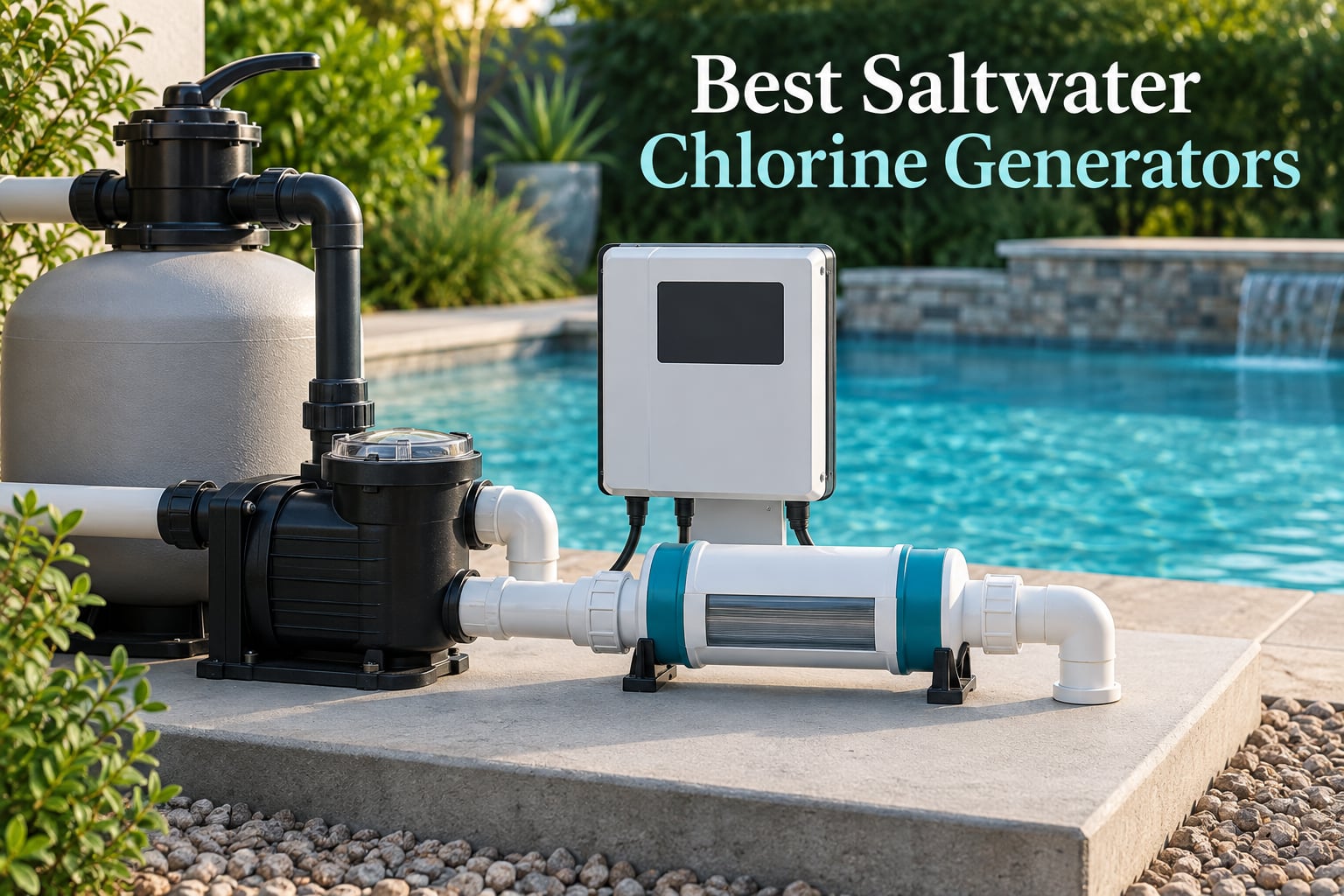
A saltwater chlorine generator turns the salt already dissolved in your pool water into free chlorine, so you stop hauling jugs of liquid chlorine and buckets of tablets to the deck. It is the single biggest upgrade a residential pool owner can make after the pump and filter, and also the most misunderstood: the cell is a wear item, the salinity target matters more than the brand badge, and half of the “my generator is broken” posts online are actually flow faults, cold water, or phosphate problems.
We built this list of the best saltwater chlorine generator options in 2026 by reading manufacturer specification sheets, warranty terms and certification marks, then cross-checking every one of them against long-term owner reports and service-industry data. We did not bench-test these units, and we think a list pretending otherwise is worse than useless to you. What we did do is compare chlorine output, rated gallons, salinity behaviour, flow handling, warranty length, cold-weather protection and how easy the thing is to install and plumb into the plumbing you already have.
Two rules solve most of the decision before any product name comes up. Size the cell at one-and-a-half to two times your pool’s actual volume, because chlorine demand rises with heat, sun exposure, swimmer load and stabilizer level. And match the brand to whatever pump and automation you already own, because a Pentair IntelliChlor or Hayward TurboCell cell drops straight into the same plumbing footprint as the unit it replaces. Get those two right and the rest is refinement.
Table of Contents
Our Top 3 Saltwater Chlorine Generators in 2026

Hayward AquaRite 40,000 Gallon
- Up to 40000 gallons
- LED service alerts
- Same plumbing as older Hayward units

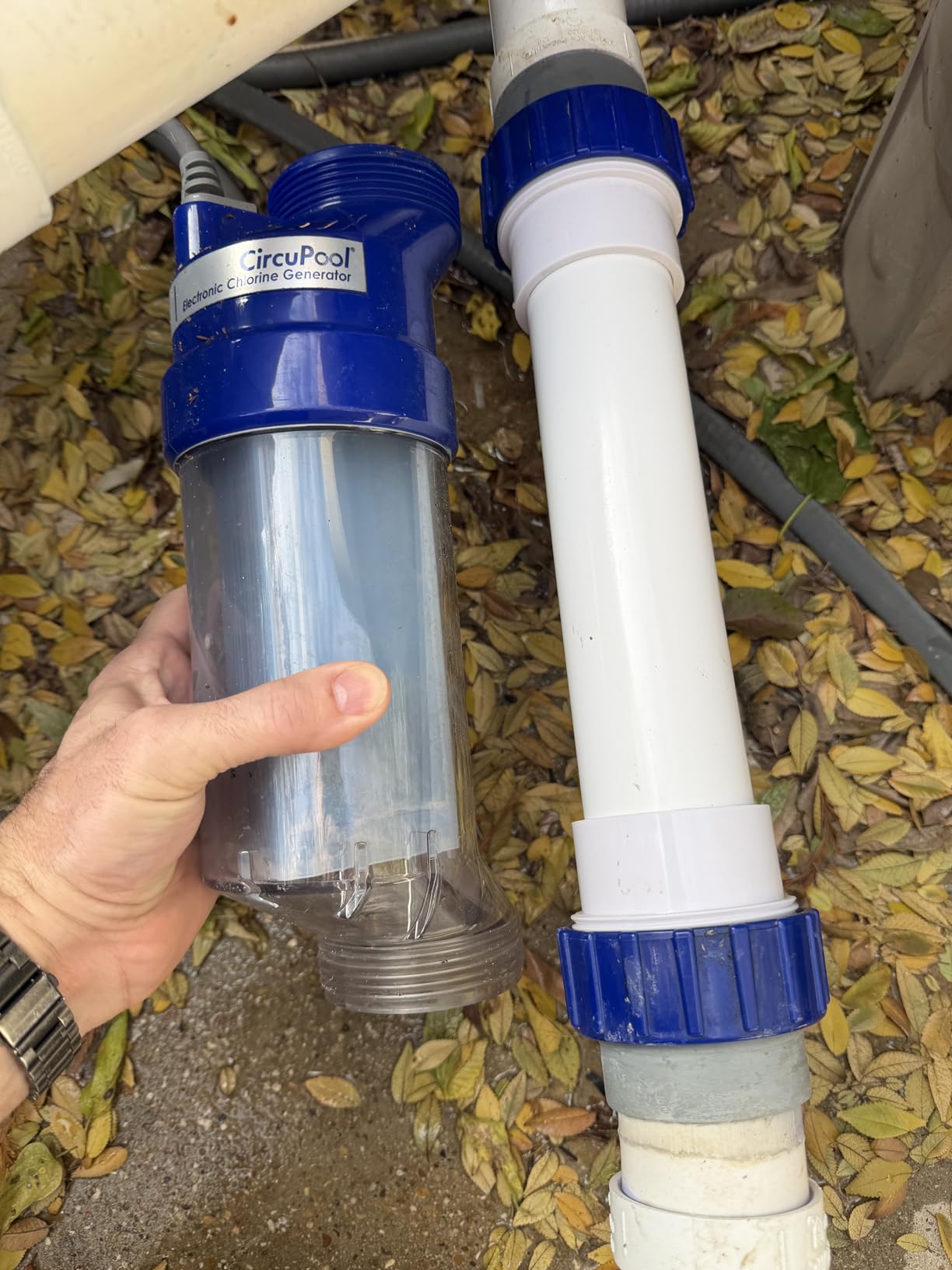
CircuPool RJ45+ 45,000 Gallon
- Up to 1.9 lb chlorine per day
- Clear cell housing
- 120V or 240V with PVC fittings

E-CHLOR APX 32,000 Gallon
- Up to 32000 gallons
- Variable-speed pump compatible
- Clear cell with cleaning plug
Best Saltwater Chlorine Generators at a Glance in 2026
| Product | Specifications | Action |
|---|---|---|
| Hayward AquaRite 40000 Gallon Salt System |
|
Check Latest Price |
| E-CHLOR Plug-in APX Performance 32000 gal |
|
Check Latest Price |
 CircuPool CORE35 35000 Gallon Max CircuPool CORE35 35000 Gallon Max |
|
Check Latest Price |
| CircuPool RJ45+ 45000 Gallon Pool Max |
|
Check Latest Price |
 EverCrystal Above-Ground System up to 15000 Gallons EverCrystal Above-Ground System up to 15000 Gallons |
|
Check Latest Price |
 EverCrystal In-Ground System up to 40000 Gallons EverCrystal In-Ground System up to 40000 Gallons |
|
Check Latest Price |
 Troxlly TP30 up to 40000 Gallons Troxlly TP30 up to 40000 Gallons |
|
Check Latest Price |
 WESTAHO Pool Salt System up to 40000 Gallons WESTAHO Pool Salt System up to 40000 Gallons |
|
Check Latest Price |
 Bonvoisin LC-300A up to 40000 Gallons Bonvoisin LC-300A up to 40000 Gallons |
|
Check Latest Price |
 briidea WiFi Chlorine Generator for Spas to 2000 Gallons briidea WiFi Chlorine Generator for Spas to 2000 Gallons |
|
Check Latest Price |
Two quick buying rules sit behind every pick below. Oversize the cell to one-and-a-half to two times your pool volume, and match the generator to the brand of pump and automation you already own so the plumbing lines up. Everything after that is a judgement call about warranty length and how the system reports problems.
1. Hayward AquaRite 40,000 Gallon Salt System – Best Overall
Hayward Aquarite Salt Chlorine Generator for Swimming Pools 40,000 Gallons
Rated to 40,000 gallons
LED monitor with service alerts
Same plumbing as older Hayward units
Pros
- Largest owner base in this group with 993 reviews
- Retrofit-friendly with the same plumbing footprint as earlier Hayward units
- LED monitor flags service needs so you test less often
- Chlorine from salt is gentler on skin and does not fade swimwear
Cons
- Owner's manual is dense and written near textbook level
- Warranty service can be hard to obtain without authorized-dealer installation
- Some reports of a failed cell or board within 6 to 10 months
The Hayward AquaRite is the safest pick in this category for most in-ground owners, and the reason is the review count rather than any single specification. At 993 ratings it has roughly six times the owner history of anything else we evaluated, which means the failure modes below are documented rather than hypothetical, and the fix for almost all of them is known. Owners describe steady automatic sanitization with far less chemical handling, and several report that a previous Hayward salt chlorinator of theirs ran for well over a decade.
That longevity reputation matters because the cell is the wear part, not the control box. Hayward’s LED monitor does not just show output percentage; it flags service conditions so you check salt and scale on a schedule instead of guessing. The unit also produces chlorine from salt rather than stabilized tablets, which is why owners mention less skin dryness and swimwear that keeps its color.
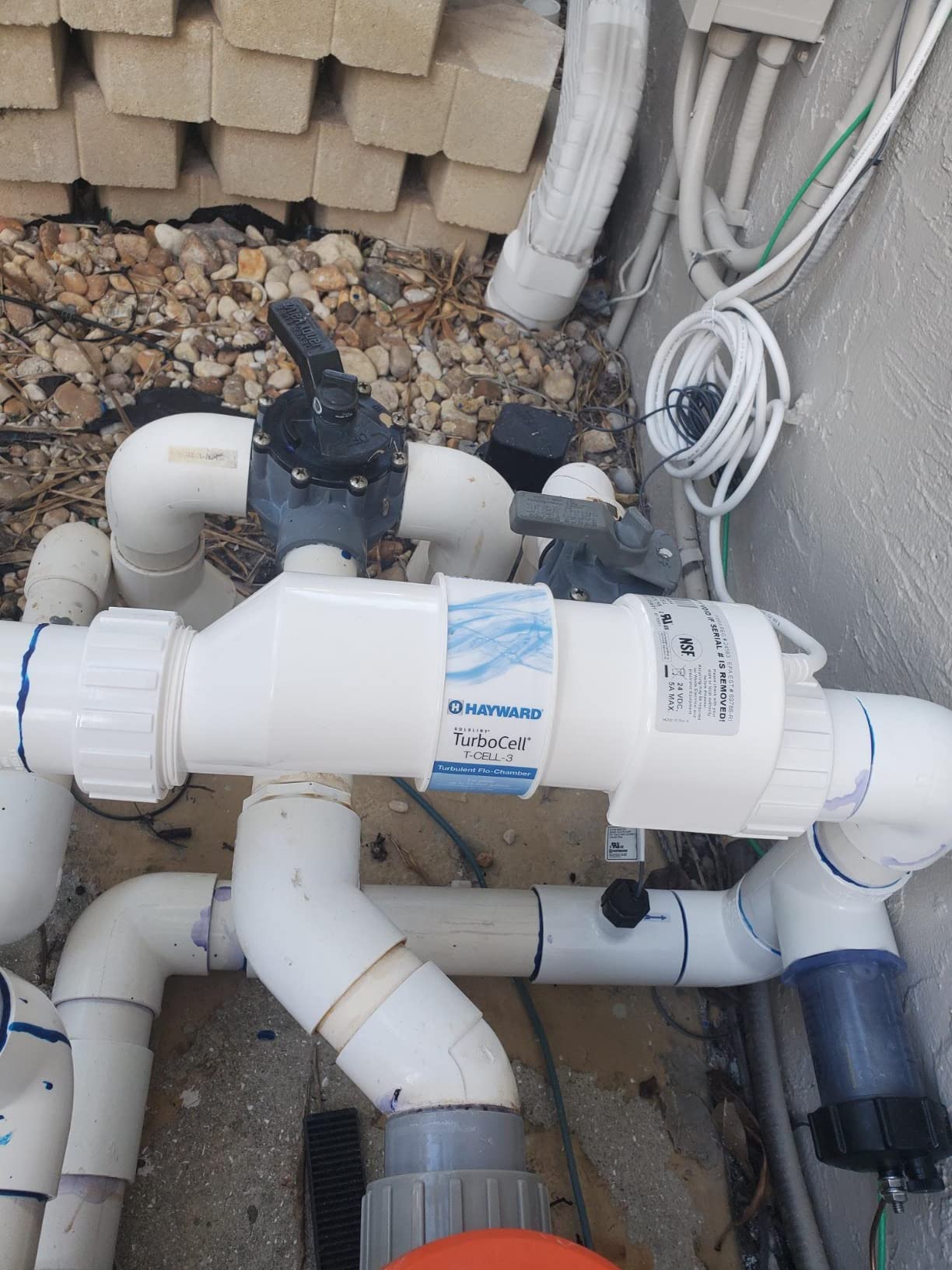
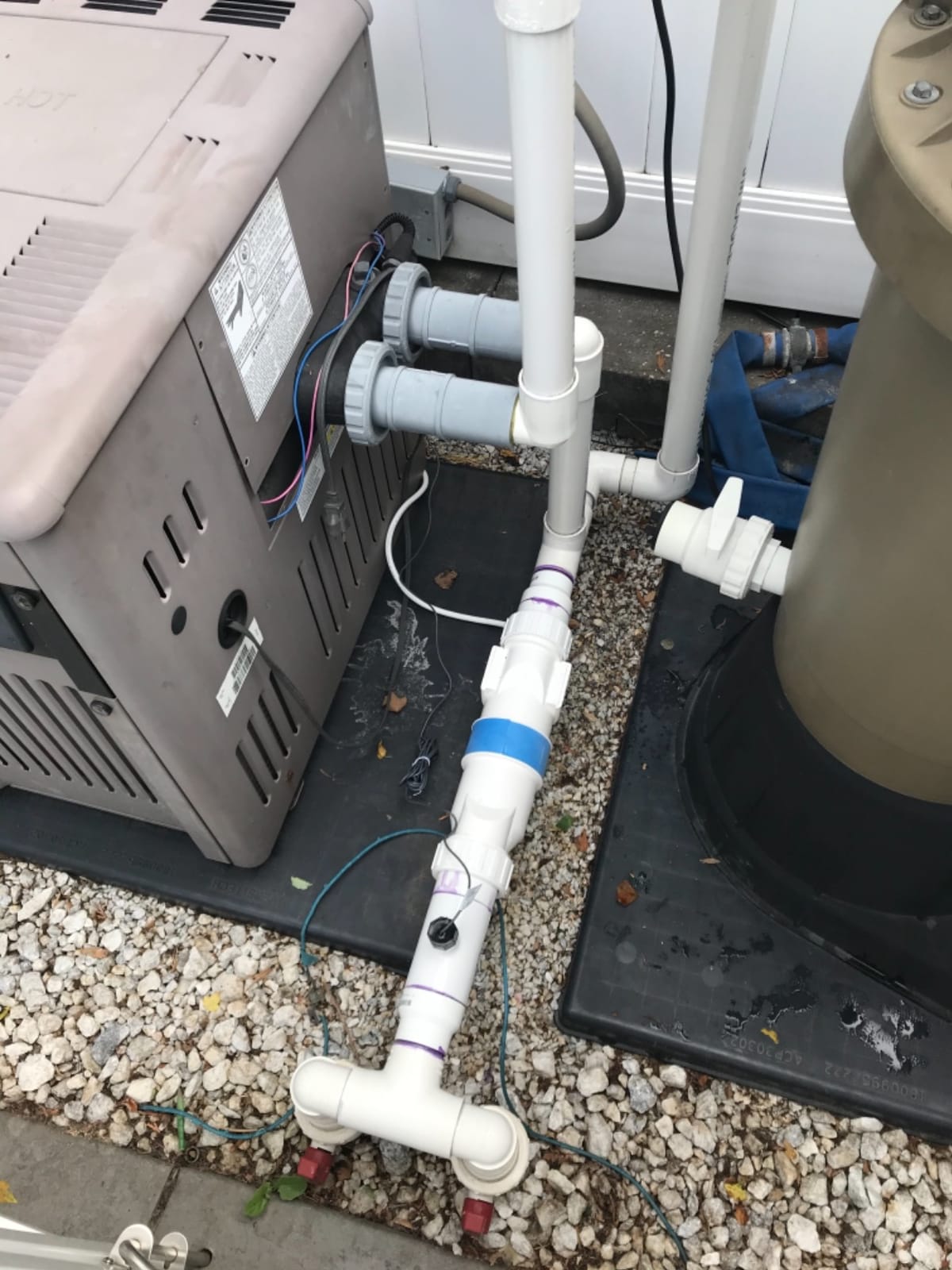
The retrofit story is the practical reason to pick Hayward over anything else. This system fits the same plumbing footprint as earlier Hayward units, so swapping a dead system is a plumbing job rather than a remodel. There is no separate power center to re-site, no new pad to pour, and no reason to move the cell. For a pool that already has Hayward plumbing, the labor saving alone can outweigh a specification difference between two competitors.
Now the honest part. The owner’s manual is dense enough that people routinely return it, and warranty service can be difficult to obtain if you did not have the system installed through an authorized dealer. Some owners report a failed cell or control board within six to ten months, and replacement power cord and mounting hardware are not always in the box. The rating distribution shows a meaningful one-star group tied almost entirely to support experience, so this is a product to buy from a dealer who will put their name on the install.
Who the Hayward AquaRite suits
It suits an in-ground owner up to 40,000 gallons who already has Hayward plumbing or is replacing an older Hayward unit, and who wants the deepest parts support network in the category. Techs work on Hayward power centers constantly, which is the single biggest practical advantage when something faults at the end of a season. It also suits anyone who plans to sell the house, because a widely recognised serviceable system is easier for a buyer to trust than a sealed box from an unfamiliar brand.
It is less attractive if you want app control, a compact all-in-one body, or a DIY install without dealer involvement. The system gives you a display and alerts rather than a phone app, and the control box is a wall-mounted unit rather than a sealed inline module. If you want to see chlorine production through a window, this is not the design for it.
Who should skip the Hayward AquaRite
Skip it if warranty service from a dealer matters more than installed price, because the one-star complaints cluster around exactly that. Also skip it if your pool has a Pentair IntelliChlor plumbing layout and you would rather not re-plumb, and skip it for a hot tub or above-ground pool, since the whole system is built around in-ground return and plumbing runs. The manual alone will turn off anyone who does not want to read 60 pages before a glue-up.
Budget for the cell as a consumable rather than a lifetime component. Owners with 15-plus year stories exist, but they are stories about one system, not a promise. Treat the first replacement cell as part of the purchase and the long life becomes a bonus instead of an assumption.
2. E-CHLOR Plug-in APX Performance 32,000 gal – Best Value
E-CHLOR Plug-in Salt Chlorine Generator | 32,000 gal Max | APX Performance
Rated to 32,000 gallons
Variable-speed pump compatible
Rated for winter operation
Pros
- Two-glue install with cut-to-fit template and unions
- Variable-speed pump compatible and rated for winter use
- Clear cell with a cleaning plug makes scale removal straightforward
- Owners report paying for themselves in avoided chlorine purchases
Cons
- Power cord is short and barely reaches a panel outlet
- Output can run high out of the box and needs dialling down
- No pump interlock mentioned so an outlet timer may be needed
The E-CHLOR APX is the one in this group that most cleanly answers the question of whether a salt system is worth the trouble. Owners replacing a failed Pentair unit describe an install that is a template cut, two unions, one 110V outlet, and then clear water maintained with almost no added chemicals. The manufacturer rates it to 32,000 gallons and claims output up to 15 percent above other compact chlorinators, and owners running it on hot-climate pools in the 9,000 to 11,500 gallon range report plenty of chlorine at about half output.
Variable-speed pump compatibility is the underrated spec here. A lot of compact salt systems assume a single-speed pump running flat out, and owners discover that at 300 RPM the flow switch never sees enough water. This one is rated for variable-speed pumps and for winter operation, which removes two of the most common reasons a small system ends up blamed for failing in a real installation.
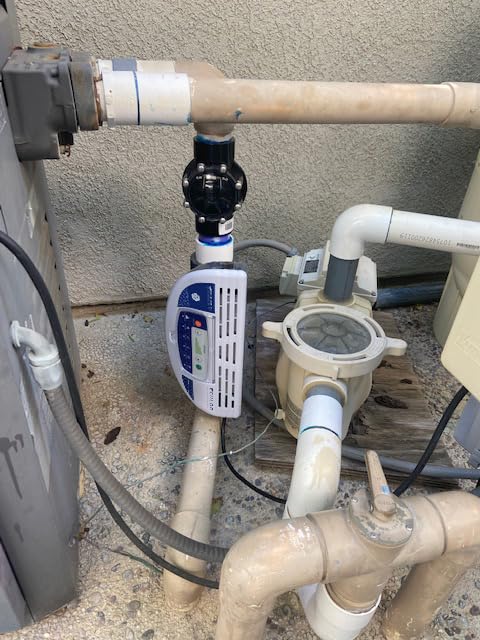
The sensors are unusually specific for a unit in this class. Salt level, temperature, cell scaling and remaining cell life are tracked independently, and the system raises notifications with an actionable cause rather than a bare error code. That matters more than it sounds: most complaints in this category are somebody staring at a fault light and not knowing whether to add salt, clean the cell, or call a plumber. A clear cell with a cleaning plug also means scale removal is a ten-minute job with a muriatic soak rather than a teardown.
Three drawbacks are worth weighing. The power cord is short, and owners regularly describe it barely reaching a panel-mounted outlet, so plan a reachable receptacle. Output can run high straight out of the box, so expect to dial it down in the first week. And the listing does not mention a flow-switch-based pump interlock, which means some installations use a timer on the outlet to control when generation happens.
What the E-CHLOR APX is good at
It is good at the mid-size in-ground pool that people forget exists: 10,000 to 20,000 gallons, single or variable-speed pump, standard 1.5 inch or 2 inch plumbing, no existing Pentair or Hayward ecosystem to match. The rated ceiling of 32,000 gallons gives headroom for a hot climate without the bulk of a 40,000 gallon body, and the three-year manufacturer warranty is described by owners as roughly the breakeven point where the system has offset the chlorine you no longer buy.
It is also good for a replacement project. Because the install is two unions and a plug, a competent homeowner can do it, and a dealer can do it in an afternoon. Nobody has to re-route plumbing, move a control box, or pour a pad, which is where most of the cost in a salt system install actually lives.
Where the E-CHLOR APX falls short
It falls short on branding confidence and on the warranty length you can expect from Hayward or CircuPool. A three-year term is a third of what the two leaders offer, and if the cell dies in year four the economics change quickly. It also falls short for anyone who wants a recognized service network, and for pools needing a certified-technician install for a longer warranty on a larger body.
It is the wrong product for a hot tub, an above-ground pool, or a very large pool in full sun. The 32,000 gallon rating assumes normal chlorine demand, and a shaded-versus-sun-exposed difference in summer demand is exactly why oversizing to one-and-a-half times volume is the safer bet.
3. CircuPool CORE35 35,000 Gallon Max – Best for DIY Installation
CircuPool CORE35 Salt Chlorine Generator System | 35,000 Gallon Pool Max
Rated to 35,000 gallons
Up to 1.4 lb chlorine per day
All-in-one cell and control box
Pros
- All-in-one body with no complex wiring and a 10 to 15 minute install
- Cut-to-fit template and unions remove measuring and install errors
- Built-in flow switch stops generation when the pump is off
- Smart sensors track flow salinity temperature scaling and cell life
Cons
- The 8 year warranty is prorated and drops sharply after year two
- Some cell units have shown short life against that warranty
- Input side compression clamp has failed on some units causing flow errors
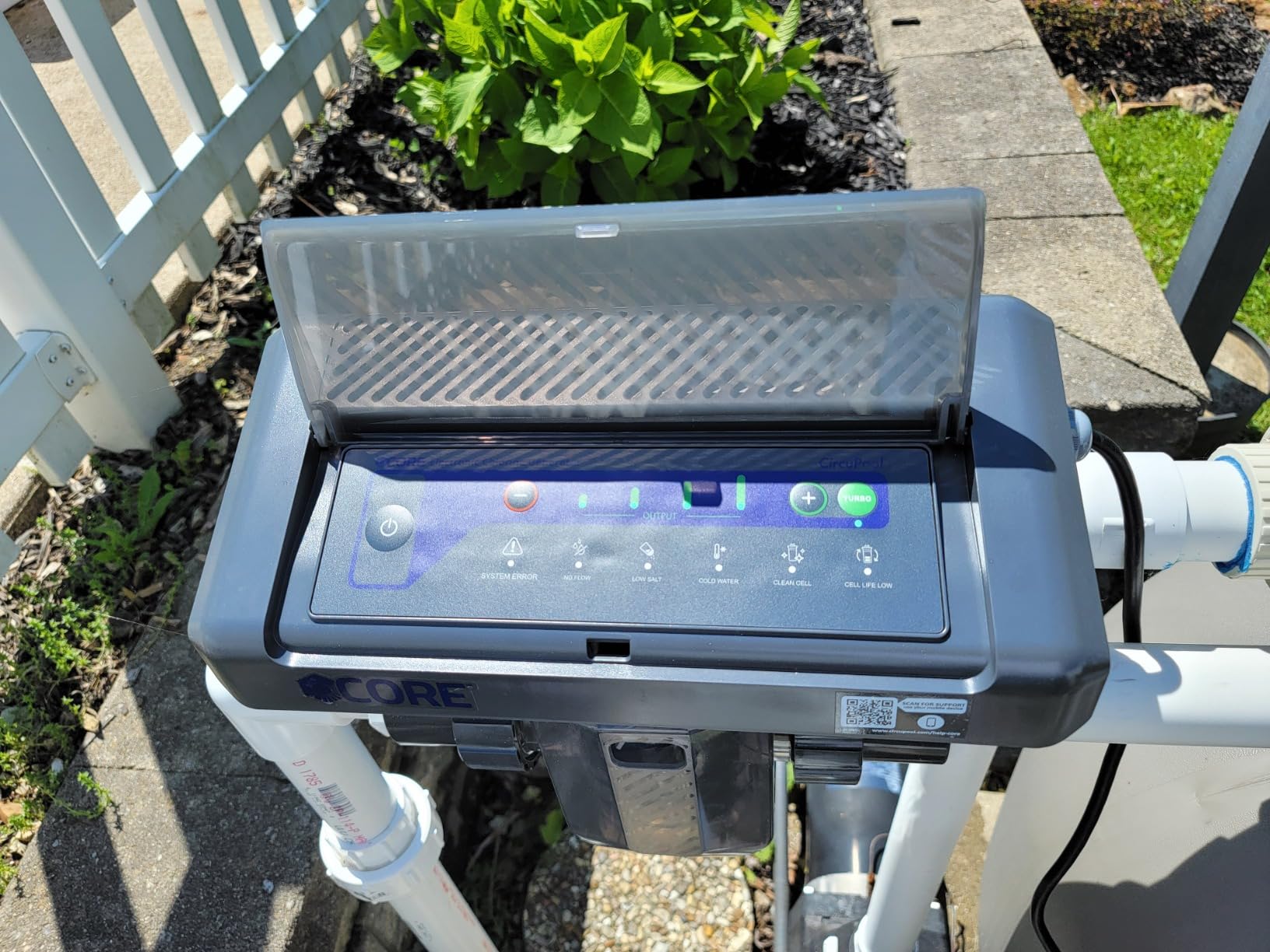
The CircuPool CORE35 exists for one reason: to make installation so simple that nobody can get it wrong. The cell and the control box are one sealed body, so there is no wiring diagram, no wall panel to mount, and no cable run between two boxes. Owners put the install at roughly 10 to 15 minutes. A cut-to-fit template and supplied unions mean you are not measuring pipe in the sun, and the two most common installation mistakes, a mis-cut and a leaking union, are designed out of the job.
The cell is a long-lifespan titanium unit rated to produce up to 1.4 lb of chlorine per day for a pool up to 35,000 gallons, and the body is IP66-rated for outdoor exposure. Smart sensors monitor flow, salinity, temperature, scaling and remaining cell life, which means the system can tell you it is scaling before the chlorine reading falls and you go looking for the wrong fault. The clear housing also lets you watch production directly rather than trusting a number on a display.
CircuPool supports DIY installation without sacrificing warranty coverage, and that is a genuine differentiator in a category where most manufacturers quietly void coverage on a self-install. Owners also report CircuPool repeatedly warrantying and replacing cells at no or minimal cost, which does more for satisfaction than a longer printed warranty would. On Trouble Free Pool, a long-running owner recommends the CircuPool RJ series specifically because the company stood behind the product and would buy it again after five years.
The warranty headline needs a caveat. The advertised 8-year term is prorated and drops sharply after the first couple of years, and several detailed reviews call that out directly, which is why the 4.1 average sits below the group leaders despite mostly positive experience. Some cell units also fall short of the stated life, and the input-side compression clamp has failed on a number of systems, producing flow errors and leaks. The good news is those failures land in the exact area the sensors watch, so the diagnostic is at least honest.
What the CircuPool CORE35 is good at
It is good at a 20,000 to 30,000 gallon in-ground pool where the owner wants a sealed, low-maintenance unit and refuses to call a contractor for a two-plumbing-job install. The all-in-one form factor also suits a pool equipment pad that is already full, since it needs no wall space for a separate control box. IP66 weatherproofing suits a pad exposed to weather year-round.
It suits anyone who values support responsiveness over paperwork. The pattern of free and low-cost replacement cells reported by owners is worth more in practice than a nominal warranty length, because the cell is the part that actually wears out and the part nobody wants to pay for unexpectedly.
Who should skip the CircuPool CORE35
Skip it if you read the 8-year warranty as a promise of 8 years of coverage, because the proration is the single most common complaint in the reviews and it drags the average down. Also skip it if you want the highest output available, since the 1.4 lb per day cell sits below the biggest units here and means less headroom for a hot climate or a heavily used pool.
Skip it if you need a model that can be vertically plumbed with downward flow, or if your existing automation expects to take over the cell through a proprietary connection. This is a standalone system, and the value of adding it to an existing control platform is not something it is trying to do.
4. CircuPool RJ45+ 45,000 Gallon Max – Top Rated
CircuPool RJ45+ Salt Chlorine Generator System | 45,000 Gallon Pool Max
Rated to 45,000 gallons
Up to 1.9 lb chlorine per day
7 year limited warranty
Pros
- Third generation platform with a long production history
- Highest chlorine output here at 1.9 lb per day
- Clear cell housing makes production easy to see
- OLED display and digital controls give a clear status readout
- Works on 120V or 240V with 1.5 and 2 inch fittings included
Cons
- Die-cast aluminum body is noticeably heavier than compact all-in-one models
- Clear housing only stays useful for inspection if you keep the cell clean
The RJ45+ carries a 4.5 average from 163 ratings with almost no tail, and 80 percent of those ratings sit at five stars. Owners point to proven long-term reliability, easy visual inspection through the clear cell, straightforward compatibility with existing plumbing, and responsive support from CircuPool. This is the third-generation RJ platform, and generation count is the point: it is a design that has been revised and rebuilt for decades rather than a first release.
It is also the highest-output unit here, with a long-life titanium cell rated at up to 1.9 lb of chlorine per day for a pool up to 45,000 gallons. That headroom is the reason to oversize, and this is a system you can oversize with, because even a 25,000 gallon pool in a hot climate has margin. The heavy-duty die-cast aluminum construction is backed by a 7-year limited warranty, which is the longest solid term in this group rather than a prorated headline.
Installation is refreshingly uneventful. It is compatible with virtually any existing pump and filter, runs on either 120V or 240V, and includes both 1.5 inch and 2 inch PVC fittings, so you are not hunting for adapters. The OLED display and digital controls give a clear system status readout, which matters when the alternative is blinking lights that decode into a manual you will not read.
The two reservations are physical rather than electrical. The die-cast aluminum housing makes the unit noticeably heavier than the compact all-in-one designs, and it is a larger object to lift onto a pad. And the clear housing, which is the reason people love it, is only useful for inspection if you actually keep the cell clean, so it asks a little more of you visually than an opaque box would.
Who the CircuPool RJ45+ is right for
It is right for an in-ground pool between 25,000 and 40,000 gallons in a hot climate, or for a cold-climate owner who wants a system with real output headroom rather than a unit that sits at 100 percent all summer. The clear cell is a genuine advantage if you like knowing the system is working without opening a panel, and the 7-year warranty is the one to hold a dealer to.
It is also right for anyone who wants one brand of serviceable part for the long haul and does not mind a heavier box. Buyers replacing a failed legacy salt system get the broadest compatibility of anything in this roundup, and the supplied fittings cover both common pipe sizes.
Who should skip the CircuPool RJ45+
Skip it for a compact pad, a small pool where a 1.9 lb cell is far more than you need, or anyone who wants a sealed all-in-one unit with no separate control box to mount. A 20,000 gallon pool that is shaded most of the day does not need this much output, and the smaller CORE35 or a value-tier system serves it better.
Skip it if your decision priority is the lowest ongoing expense rather than warranty length. A premium die-cast body with a premium titanium cell is a more expensive wear item to replace later, and the owners who complain about ownership costs in this category complain about cells, not about controllers.
5. EverCrystal Above-Ground System for Pools up to 15,000 Gallons – Best for Above-Ground Pools
Salt Chlorine Generator – for Above Ground Pools up to 15,000 Gallons, Intelligent Saltwater Pool System with Auto Chlorine Calculation, Salt Level Detection & Smart Salt Addition Guidance
Rated to 15,000 gallons
Fits 1.25 and 1.5 inch hose lines
Polarity reversal every 8 hours
Pros
- AI mode adjusts output from pool size salinity and temperature
- Digital panel tells you how many pounds of salt to add
- Automatic polarity reversal every 8 hours reduces scale
- Thick housing fits standard hose lines without leaking
- Test strips included and chlorine odor drops noticeably
Cons
- Some units stopped responding to button inputs and raised a flow fault within days
- On screen salt readings can disagree with independent testing
- Cell cleaning process is unproven for owners who close the pool for winter
Above-ground pools are the awkward case in this category. There is no return plumbing to cut into, no pad to mount a control box on, and most drop-in spa units are built for hot tubs rather than a 15,000 gallon family pool. This EverCrystal system is built specifically for that gap, fitting the inner and outer hose diameters of 1.25 inch and 1.5 inch above-ground hose lines so it can sit in the filtration loop without cutting anything.
What makes it interesting is the operating logic. Auto mode lets you set chlorine production time directly, while AI mode reads the pool size you entered plus detected salinity and temperature and adjusts output itself. The digital panel does more than show a number: when salt is low it tells you how many pounds to add, which removes the most common above-ground salt mistake, which is guessing.
Automatic polarity reversal every eight hours is the feature that matters most for longevity, because scale on the plates is what kills cells early. The thick plastic housing is reported as solidly built and fitting standard hose lines without leaks, and the included test strips mean you can start with something better than clear water. Owners consistently report improved clarity and a sharp drop in that sharp chlorine smell, which on an above-ground pool with a thin liner is often the first sign the system is working.
The honest read on the reviews is that the value proposition dominates. Buyers call it the best investment of the season, with 74 percent of ratings at five stars. The minority report early electronics failure with a misleading flow warning, and a few note that the reported salt level does not always match a test strip, so verify with your own test before adding salt. Note also that some reviews on this listing describe an off-season dummy cell accessory rather than the generator, which makes the review pool a little mixed in focus.
What the EverCrystal Above-Ground system is good at
It is good at seasonal above-ground pools of roughly 8,000 to 15,000 gallons where the owner wants automation without any plumbing work. If your filter uses 1.25 or 1.5 inch hose, the fit is direct. It is also good for a first salt system, because the panel does the explaining and the salt guidance is the part that would otherwise be guesswork.
It suits owners who want fewer decisions, since AI mode handles the daily adjustment and the eight-hour polarity reversal handles scale prevention without any thought from you. Kids and pets are another fit, since the reduced chlorine odor and the softer feel of salt-generated chlorine are the reasons people buy these systems in the first place.
Who should skip it
Skip it for an in-ground pool, where a purpose-built in-ground unit with more sensors and a longer warranty is a better buy. Skip it if you close the pool for the winter, because owners report uncertainty about the cleaning routine for a cell that sits in cold water for months. And skip it if you want app-based monitoring; this one is a panel system.
Skip it if you are the type who verifies everything twice, because a salt reading that disagrees with your test strips will cost you an unnecessary trip to buy salt. The fix is simple, test independently, but you have to be willing to do it.
6. EverCrystal In-Ground System for Pools up to 40,000 Gallons – Best for In-Ground Monitoring
EverCrystal Salt Water Pool Chlorinator System – Up to 40,000 Gallons
Rated to 40,000 gallons
Panel tracks salinity and current
Clear housing and self-cleaning cell
Pros
- Clear housing lets you watch chlorine production directly
- Self cleaning cell cuts scale buildup and maintenance
- Panel reports salinity voltage current temperature and cell operation
- Metal control box is sturdier than typical plastic housings
- Plug and play setup with union fittings and wall mount capability
Cons
- Operating manual was hard to find and support contacts were unclear for one buyer
- Only 1 year of after-sales support which is short for this category
This is the in-ground counterpart to the above-ground system, rated to 40,000 gallons, and on paper it is the richest diagnostic display in the group. The digital panel tracks salinity, voltage, current, temperature and cell operation simultaneously, with built-in salt calibration within plus or minus 800 ppm. That calibration figure is the one that earns the badge here, because a salt cell that reads low when the water is actually fine sends owners chasing a fault that does not exist.
Physically it is a competent design rather than a clever one. The clear housing lets you watch chlorine production directly, the self-cleaning cell reduces scale buildup, and the control box is metal rather than the plastic housings common in this price tier. Setup is plug-and-play with union fittings supplied, and the unit can be wall-mounted if the pad space is tight.
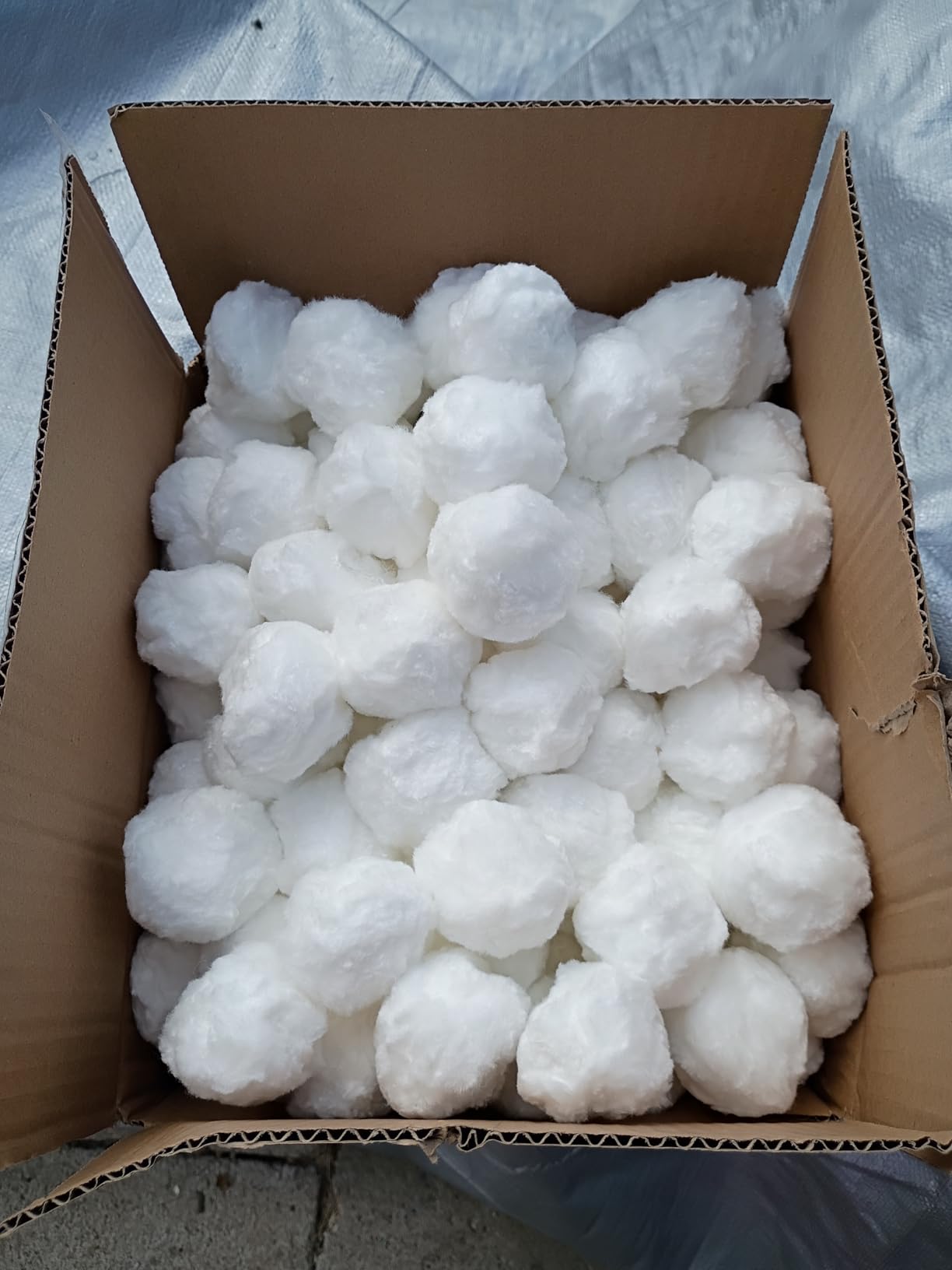
Owners of the in-ground variant report that it performs like the unit that came with their pool, which is a useful benchmark, because pool builders do specify this class of unit when they build a salt-ready pool. The 4.8 average is the highest in this roundup, but it comes from only 18 ratings, and most of the written reviews on the listing actually describe the same brand’s filter media balls rather than the generator. Treat that score as promising and lightly evidenced, not as a proven track record.
The support picture is the real weak point, and it is not minor. After-sales support runs one year, which is far shorter than anything else evaluated here, and at least one buyer could not locate the operating manual or a working support contact. On a device whose selling point is self-diagnosis, weak documentation and a one-year support window undercut the value proposition. If you buy this, expect to rely on your own troubleshooting.

What this EverCrystal In-Ground system is good at
It is good at an owner who wants a full diagnostic readout rather than a simple output percentage, and who plans to keep the system themselves. Watching actual current and voltage alongside salinity is genuinely useful when a cell is aging, because those numbers move before your chlorine test does. The clear housing and self-cleaning cell pair well with that, since you can see production and reduce scaling at the same time.
It is also a reasonable choice for a pool builder’s standard salt-ready installation, where matching what came with the pool keeps documentation and service simple. The metal control box is a quiet upgrade over plastic in a location that gets wet and hot all summer.
Who should skip it
Skip it if warranty length matters to your ownership math, because one year of support is the shortest in this group and a salt cell is a multi-year purchase. That gap is not a rounding error; it is the difference between a system you can rely on for the life of the equipment and one you may be diagnosing alone in year two.
Skip it if you want strong written documentation or an easy support call, and skip it if you need a brand name a pool tech already knows. There is no established service network here, and the review evidence on this listing is thin enough that you are buying on specification rather than on owner history.
7. Troxlly TP30 for Pools up to 40,000 Gallons – Best for IntelliChlor Retrofits
TP30 Salt Chlorine Generator for Pools up to 40,000 Gallons, Smart Salt Chlorinator with App Monitoring, ETL Listed, Auto Reverse Polarity Cell, Standard Plumbing Fit
Rated to 40,000 gallons
Fits IntelliChlor IC20/40/60 layouts
ETL Listed system
Pros
- Retrofit-ready fit for compatible Pentair IntelliChlor plumbing layouts
- App and panel show output salinity flow temperature and alerts
- Automatic reverse polarity and a clear cell reduce scale and ease inspection
- Included disc caps one end of the cell to replace acid cleaning
Cons
- Cannot be installed vertically with downward flow which is common on existing IntelliChlor plumbings
- Only 2 inch unions are included so 1.5 inch adapters must be sourced separately
- Power cord is a bit short and the app is basic
The Troxlly TP30 is a specific tool for a specific job: replacing a failed Pentair IntelliChlor without re-plumbing. It is designed with a matching installed length and threaded unions for compatible IntelliChlor IC20, IC40 and IC60 plumbing layouts, and it ships with a power adapter, so the swap is a matter of unbolting the old cell and bolting in the new one. It is not affiliated with or endorsed by Pentair, which matters for anyone who expects the warranty and the support of the original brand.
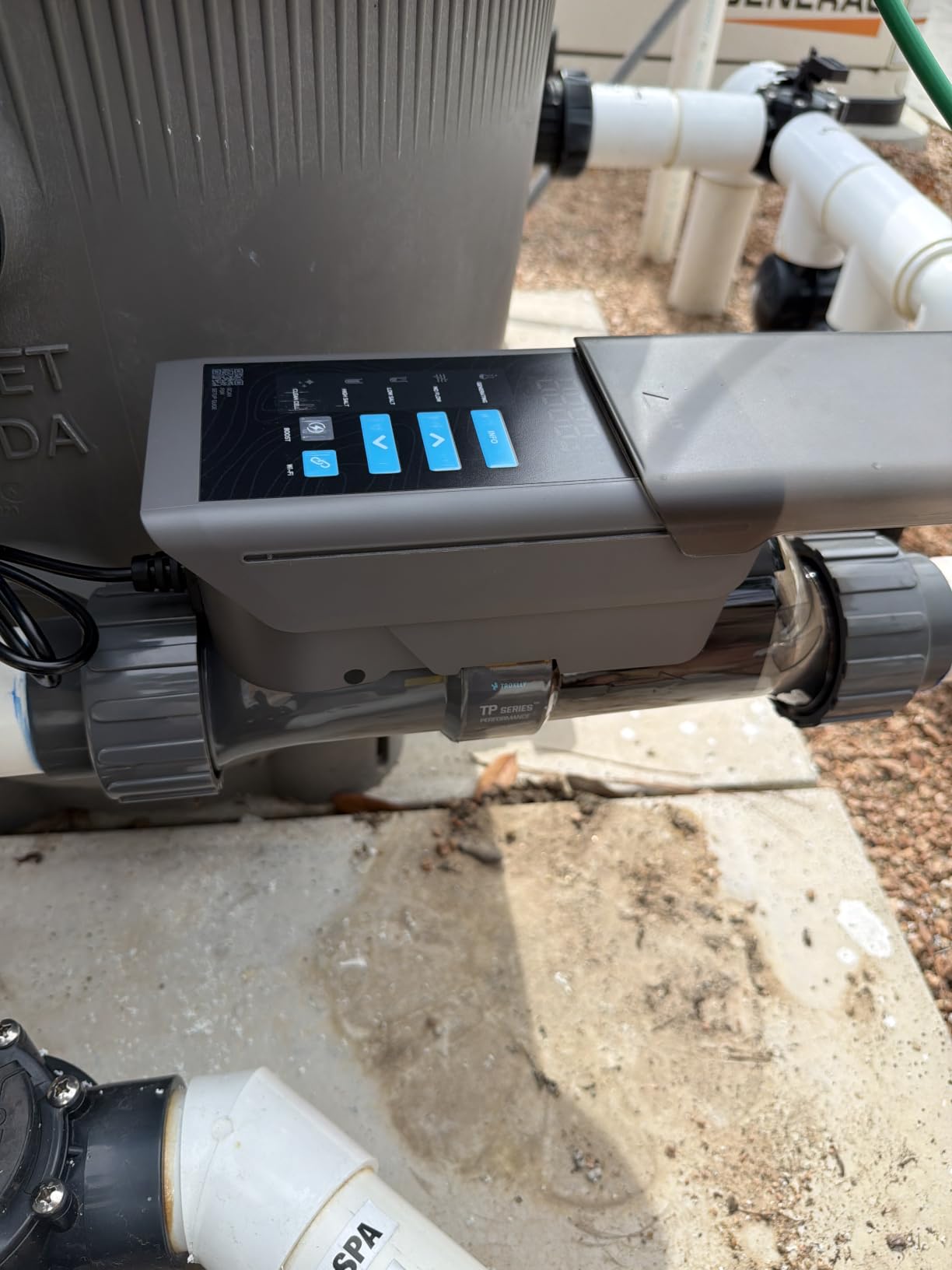
The monitoring is more complete than the compact price usually allows. The app and the panel both show output, salinity, flow, water temperature and system alerts, and the cell housing is clear with automatic reverse polarity to limit scale. The included disc that caps one end of the cell replaces the acid-cleaning routine, which is the single habit most damaging to cell life in this category.
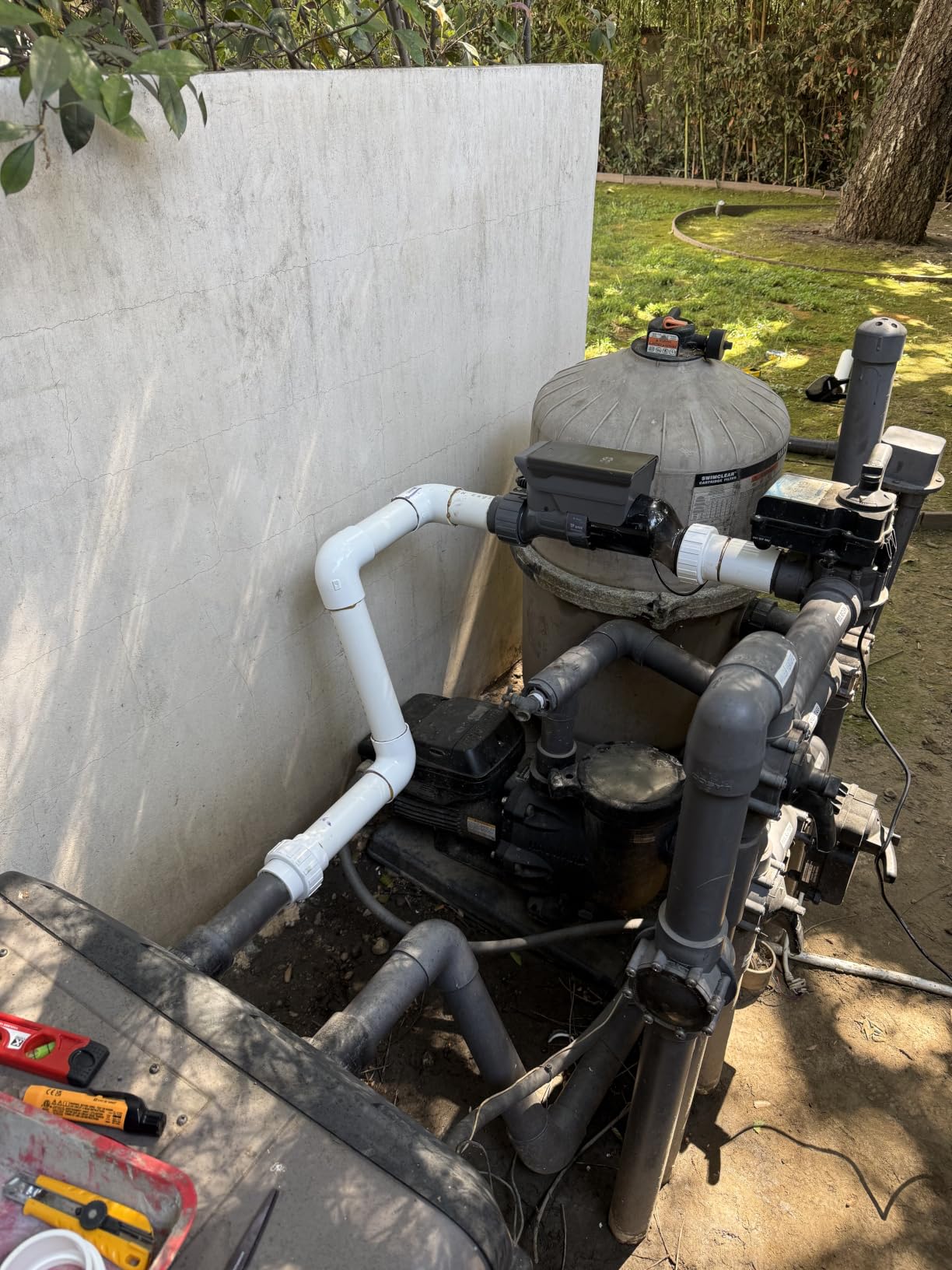
The most consequential caveat in the reviews is a plumbing limit, and it is not stated on the listing. This unit cannot be installed vertically with downward flow, and that is exactly how a great many existing Pentair IntelliChlor units are plumbed. Some buyers found that out at install and had to return the unit. Check your plumbing orientation before anything else, because it is the one flaw that can end the project.
Other notes: only 2 inch unions are included, so 1.5 inch plumbing means sourcing adapters separately. One owner judged output insufficient on a small pool and ended up needing long pump runtimes, the power cord is a bit short, and the app is basic. The system is ETL Listed for applicable safety standards, which is a meaningful mark on a product category where certification is often unmentioned.
Who the Troxlly TP30 is good for
It is good for an owner with a dead IntelliChlor cell who does not want to re-plumb and does not mind stepping outside the original brand ecosystem. Owners replacing an older in-ground unit describe it as well built, easy to install, working out of the box, with useful temperature and salt readouts, and several call the value unbeatable against premium pricing. The turbo boost function is genuinely useful after a heavy rain or a party weekend.
It is also a fit for a pool owner who wants app monitoring at a cost far below the premium systems, and who will confirm plumbing orientation before ordering. ETL listing gives a technician something to check during service.
Who should skip it
Skip it if your IntelliChlor is plumbed vertically with downward flow, because that install is not supported. Skip it if you want Pentair’s warranty and support network, since this is an independent product that borrows a compatible footprint rather than an official replacement. And skip it if your plumbing is 1.5 inch and you would rather not source fittings separately.
Skip it if your pool is small, since one owner found the output short for a small pool and had to extend pump runtime, which costs you money on your electricity bill every week of the season. For a 12,000 gallon pool, size up rather than down.
8. WESTAHO Pool Salt System for Inground Pools up to 40,000 Gallons – Best for Cold Climate Pools
Salt Chlorine Generator, Westaho Pool Salt System for Inground Pools Up to 40,000 Gallons, 1.4 lb Chlorine Output, USA Titanium Cell with 10,000-Hour Lifespan, Built-in Power Supply
Rated to 40,000 gallons
1.4 lb chlorine output per day
Automatic shutoff below 52F
Pros
- Built-in power supply so it plugs in instead of being wired
- Panel reports salt level temperature cell usage voltage and current
- Automatic shutoff below 52F protects the cell in cold weather
- Magnetic flow switch is more sensitive and durable than a mechanical switch
- 2 inch to 1.5 inch adapter included and IP66 rated
Cons
- Lowest average rating in this group at 4.0 with a 21 percent one-star group
- Single listed capacity variant so sizing is fixed at 40000 gallons
- Even with an IP66 enclosure and integrated supply you still need an outdoor-rated location
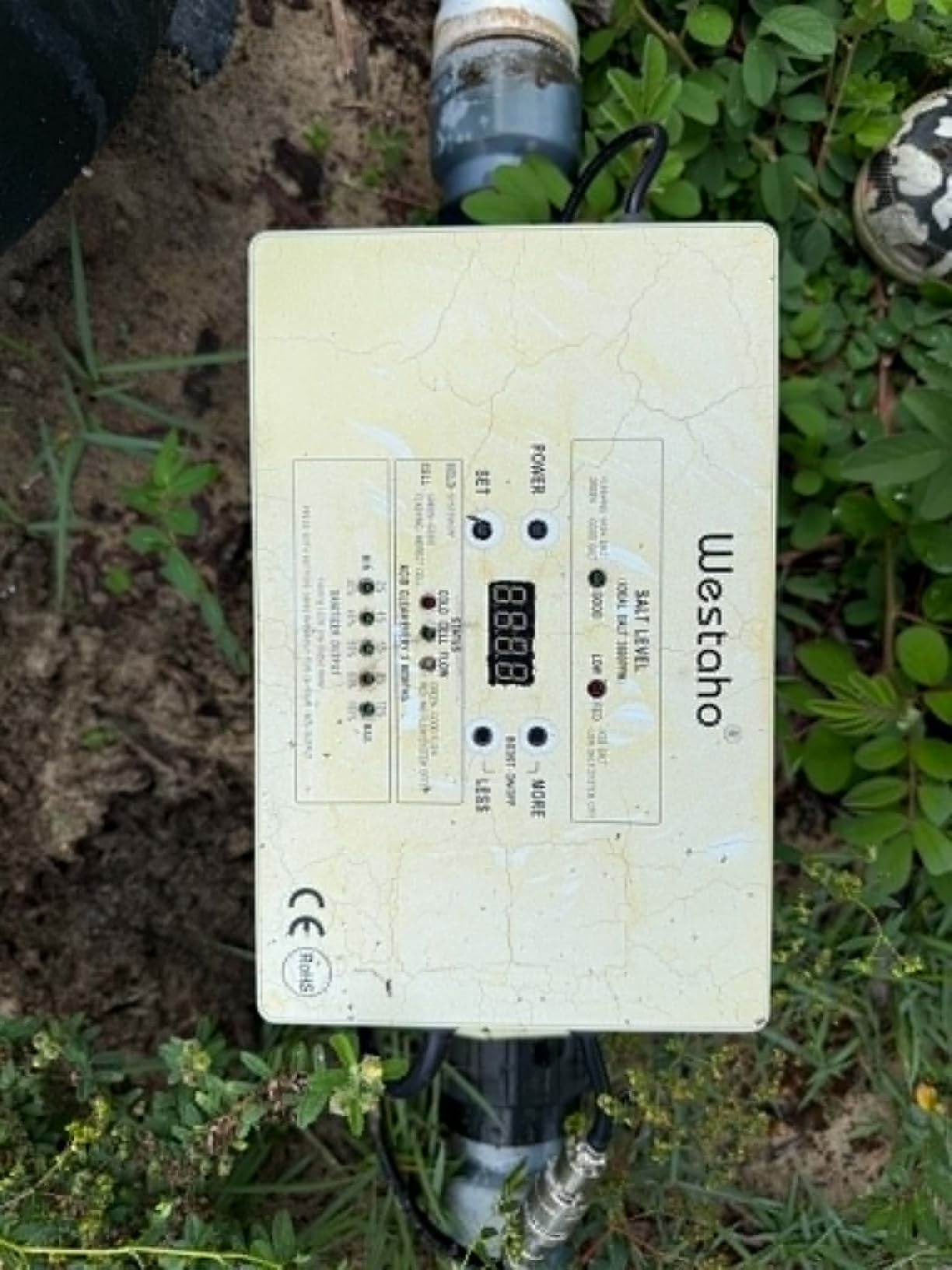
The defining feature of the WESTAHO system is cold-weather behaviour. It shuts down automatically below 52F, and the cell array is stated at up to 10,000 hours, roughly seven years, from USA-made titanium. Automatic low-temperature protection is the thing cold-climate owners ask about first, because a system that keeps grinding chlorine out of cold water is a system that is destroying its own plates all winter.
Integration is the other theme. The power supply is built into the unit, so there is no separate power box to mount and no wiring to run, which cuts the install down to plumbing and a receptacle. The display panel reports salt level, water temperature, cell usage, voltage and current, and the flow detection uses a magnetic flow switch that owners describe as more sensitive and more durable than a mechanical switch, which matters because marginal flow detection is the top cause of false faults.
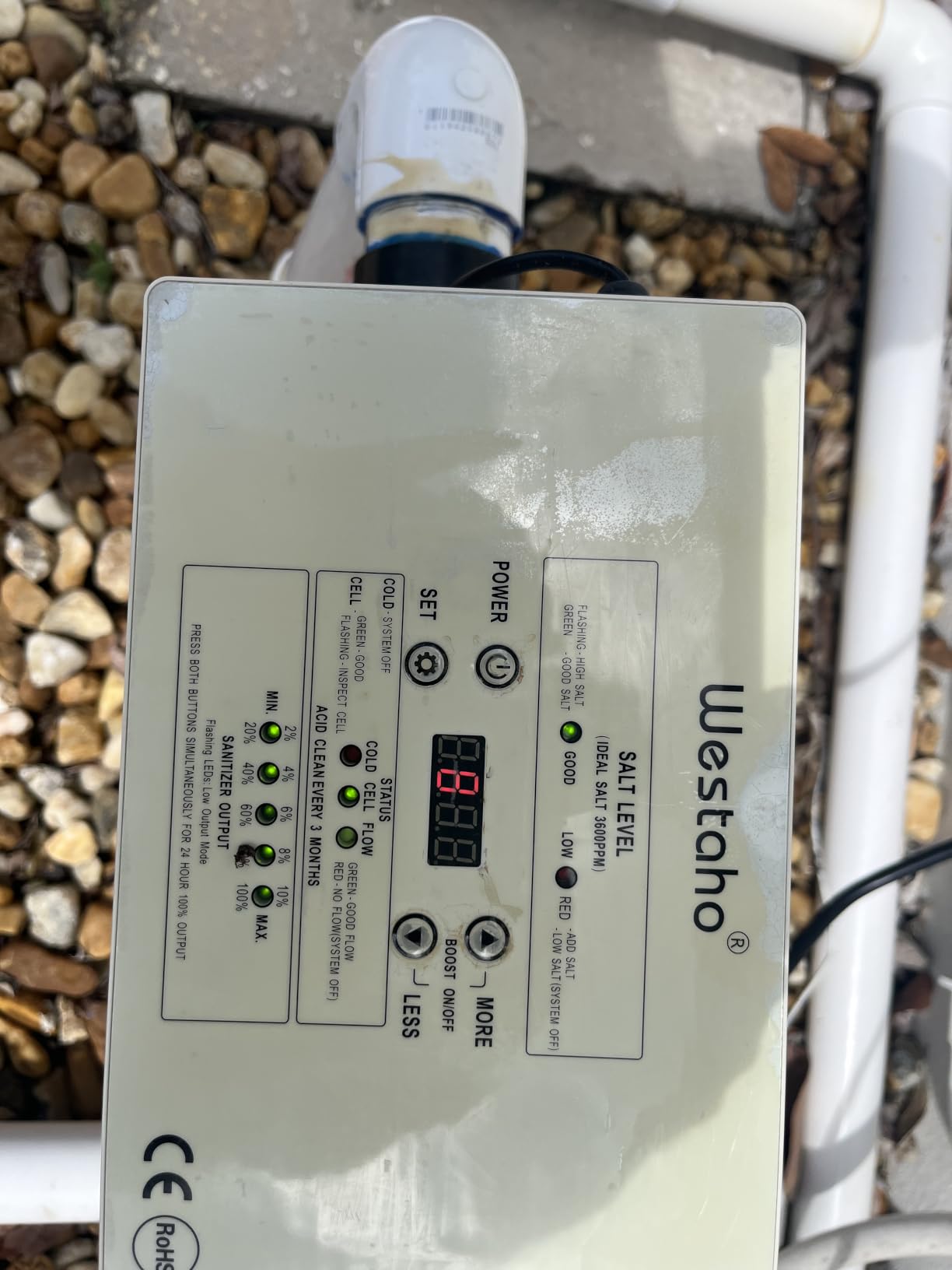
Chlorine output is 1.4 lb per day for pools up to 40,000 gallons, and the unit fits standard 2 inch pipe with a 2 inch to 1.5 inch adapter included. The IP66 waterproof rating covers outdoor exposure. On paper this is one of the most complete packages in the roundup, and the feature appeal for someone who wants a self-contained, low-temperature-protected system is obvious.
But the rating distribution is the most polarized in this group, with 67 percent five-star and 21 percent one-star, and no three-star reviews at all. That pattern usually means a split between people whose system worked and people whose system did not, rather than a gradual spread of moderate disappointment. It is also the lowest average here at 4.0, and the written customer reviews returned with the listing were minimal relative to the 30-rating count, so more of the case rests on engineering claims than on owner commentary.
What the WESTAHO system is good at
It is good at an in-ground pool in a cold climate where the owner wants protection built in rather than a manual winter shutdown routine, and where a 40,000 gallon ceiling suits the pool without oversizing. The integrated power supply means there is no control box to site, which simplifies installs in tight equipment areas and removes one of the most common sources of install errors.
It is also good for owners who value a magnetic flow switch and a long stated cell lifespan, and who want visible cell-life hours on the display rather than a percentage guess. The included adapter means 1.5 inch plumbing is not a parts problem.
Who should skip it
Skip it if you are risk-averse, because a one-star group of 21 percent on only 30 ratings is the weakest evidence base in this roundup, and there is not enough written owner feedback to offset that. Skip it if your pool is well under 40,000 gallons and you would rather have a properly sized unit, since there is only one listed capacity variant.
Skip it if you want an established support network or long warranty terms, since neither is a selling point here. And note that an IP66 rating and a built-in supply do not remove the need for a properly rated outdoor installation location, so plan the electrical before you plumb.
9. Bonvoisin LC-300A Salt Water Pool Chlorinator up to 40,000 Gallons – Best for App-Controlled Setups
Bonvoisin Salt Water Pool Chlorinator System Salt Chlorine Generator for Inground Pools Saltwater Pool System with Titanium Cell, LED/APP Control, Up to 40,000 Gallons Pool
Rated to 40,000 gallons
Output adjustable 5 to 100 percent
Installs horizontal or vertical
Pros
- Integrated controller and cell in one compact unit
- Very small footprint at 4.7 x 13 inches and 3.5 pounds
- Plumbs in either horizontal or vertical orientation
- Five percent output granularity and scheduled run times through the app
Cons
- Cleaning reminder is based on accumulated run hours so it can appear without real scaling
- App connection is limited to 2.4GHz networks
- Owner-reported support and documentation are thin against the feature claims
The Bonvoisin LC-300A is the most app-forward unit here, and the one that fits the least space. At 4.7 by 13 inches and 3.5 pounds you can install it with one hand, and the controller and cell are one sealed unit with no wall-mounted box anywhere. For an in-ground retrofit on a full equipment pad, that footprint is the whole argument.
Control granularity is unusually fine. Chlorine output adjusts from 5 to 100 percent in 5 percent increments, which is a wider and finer range than most compact systems offer, and scheduled run times are set through the app alongside water temperature and salinity detection. The self-cleaning titanium plates reverse electrode polarity every 4, 8 or 12 hours, and the interval is your choice, so you can match reversal frequency to your water’s scaling tendency rather than accepting a fixed schedule.
Flexibility extends to plumbing. The unit installs horizontally or vertically, and both 1.5 inch and 2 inch adapters ship in the box, with the 1.5 inch adapter fitting 1.875 inch outer diameter pipe and the 2 inch fitting 2.375 inch outer diameter. That combination of orientation freedom and included fittings is what makes it work in a retrofit you have not measured properly yet.
Three caveats. The cleaning reminder icon appears after 500 accumulated hours, which means it can light up regardless of whether the cell is actually scaled, so treat it as a prompt to look rather than a diagnosis. The app needs a 2.4GHz network, which excludes modern dual-band or mesh-only setups without a 2.4GHz component. And the support and documentation behind the feature set are thin, with owners reporting limited help when something needs explaining.
What the Bonvoisin LC-300A is good at
It is good at an owner who wants app control and scheduling without giving up installation flexibility. If your pool is plumbed vertically, or if you are still deciding between 1.5 inch and 2 inch pipe, this unit installs either way with the fittings in the box. The 5 percent output steps also suit anyone whose chlorine demand swings hard, such as a pool that goes from lightly used in May to heavily used in July.
It is good for a small equipment area and a single-hand install, and for anyone who prefers one sealed device to a cell plus a control box plus a cable run. The 4.2 average across 27 ratings also gives it a healthier distribution than several units in this roundup, with fewer extreme one-star ratings.
Who should skip it
Skip it if your home network is 2.4GHz-only, which is increasingly common on modern mesh systems, because the app is a core part of the value here. Skip it if you want deep written documentation and a responsive support line, since owners report both are limited relative to what the feature list implies.
Skip it if you want a temperature reading you can trust to the degree, and do not treat the 500-hour cleaning icon as a real scale reading. For a pool that needs serious output, check the chlorine production figure against your volume and chlorine demand, because this is a compact class of unit rather than a maximum-output one.
10. briidea WiFi Chlorine Generator for Swim Spas up to 2,000 Gallons – Best for Hot Tubs and Spas
WiFi Salt Chlorine Generator, Briidea Chlorine Generator with USA Titanium Salt Cell, APP Monitoring & Real-Time Salt Alerts, for Swim Spas Up to 2,000 Gallons
Rated to 2,000 gallons
No plumbing or tools needed
USA titanium electrodes to 3,000 hours
Pros
- Turnkey install with no plumbing or tools of any kind
- USA made titanium electrodes rated to about 3000 hours
- Real-time salt alerts on the controller and the app plus live temperature readout
- Noticeably reduces chlorine odor and leaves skin feeling soft at 7 to 10 hour run times
- App control lets you check and adjust settings remotely
Cons
- Only reports salinity and not chlorine level so output must be dialled in with test strips
- App temperature reading is off by a few degrees and the app data is basic
- Some units produced no measurable chlorine even at high run times
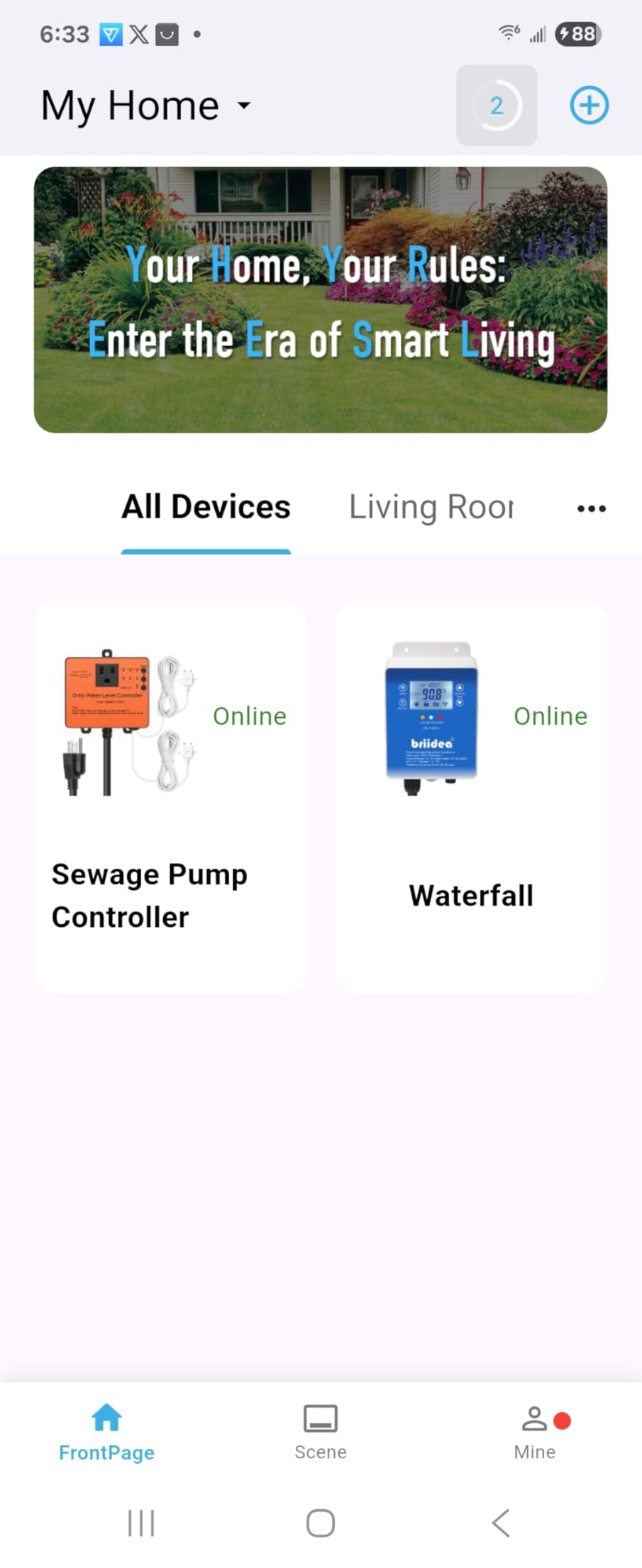
The briidea unit is the only product here designed for a hot tub rather than a pool, and the fit is genuinely convenient. There is no plumbing and no tools at all: you place the chlorinator in the tub and mount the controller. For a swim spa up to 2,000 gallons that sits behind a house on a patio, where cutting into return plumbing is a contractor job, that is the difference between a weekend project and a quote.
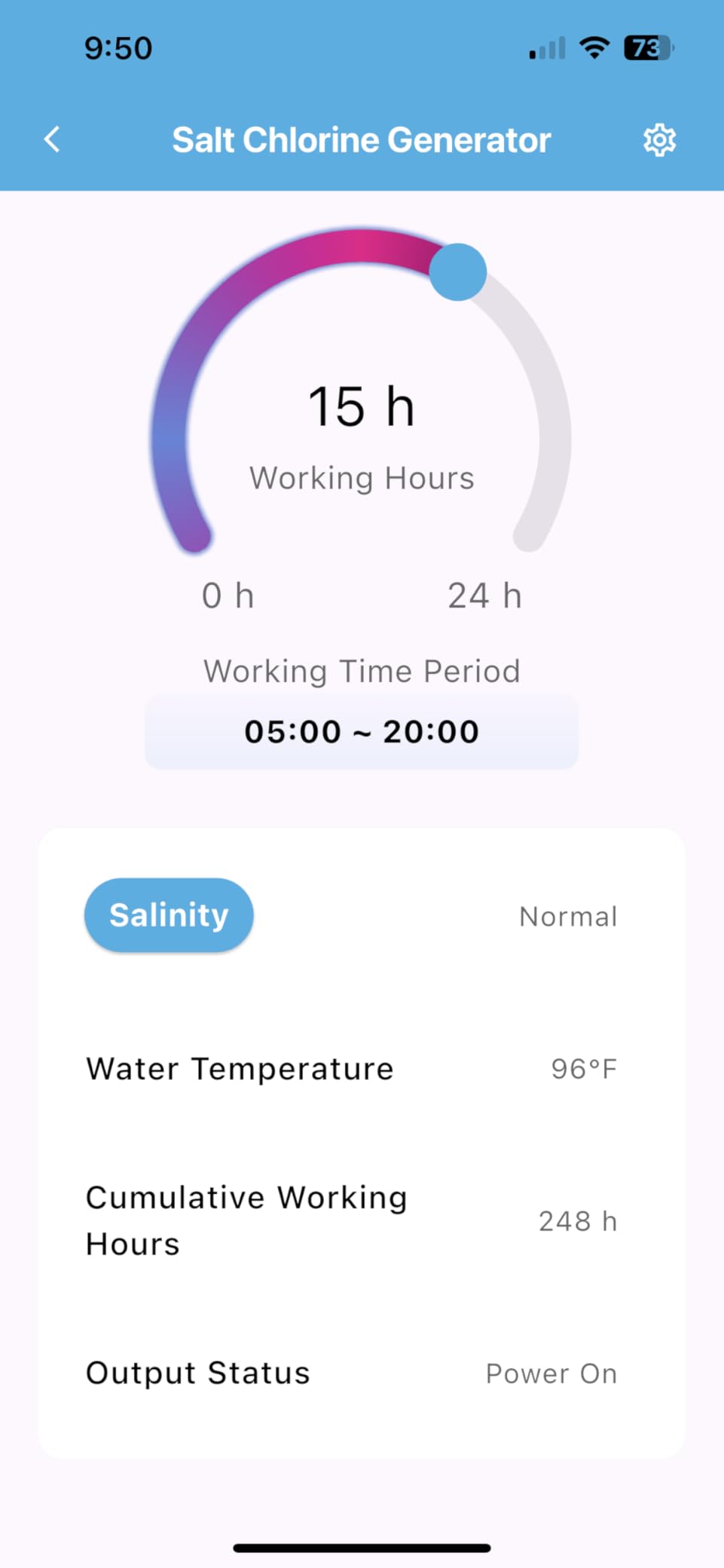
The electrodes are USA-made titanium rated to about 3,000 hours of use, and the controller tracks salt level and water temperature from 50F to 104F, with real-time salt alerts on both the controller and the app. Owners of small spas report clearly better water and much less chlorine odor, and a noticeable difference in how their skin feels after typical 7 to 10 hour run times, which is a hot-tub-specific benefit since that is where people soak for hours.
There is one serious complaint, and it deserves to be stated plainly. The most critical group of owners report that the cell never generated a measurable chlorine reading in their tub, even on replacements. That is a small share of the reviews but it is the failure that matters, and the honest conclusion is that hot tub chemistry, with its higher temperature and lower volume, is a harder environment than the listing implies.
The smaller gripes are predictable. There is no chlorine reading, only salinity, so output has to be dialled in with test strips and some trial and error. The app temperature reading runs a few degrees off, and the app itself is basic. WiFi is 2.4GHz only, and some units failed to pair on the first attempt. The power and cell cords are short for many patio setups, so plan your mounting positions before you mount.
What the briidea spa generator is good at
It is good at a hot tub or swim spa up to 2,000 gallons where the owner wants automation and cannot or will not cut plumbing. It is also good at anyone renting, or owning a pool or spa they will sell, since there is no fixed installation to remove. The reduction in chlorine odor and the feel of the water after a long soak are the benefits owners actually report noticing first.
It is good for a secondary use, such as keeping a small spa or a kiddie pool area sanitized without adding a second control system to your life. App monitoring is genuinely useful here, since a spa is often two rooms away from where you would otherwise have to look.
Who should skip it
Skip it if you need a chlorine-level reading, because this unit reports salinity only and you will be tuning output with test strips. Skip it if your WiFi is 2.4GHz-only, and skip it if you have a large patio layout where short cords are a problem.
Skip it if you need guaranteed measurable output without verification, given that a minority of owners could not get a chlorine reading even from replacement cells. Test the water independently in the first week and be prepared to fall back on a spa sanitizer. For a full-size residential pool this unit is not remotely big enough, and for a cold-climate spa the 50F tracking floor is the limit of what it monitors.
How to Choose a Saltwater Chlorine Generator in 2026
First, understand what the device does. Salt water flows through a titanium-plated electrolytic cell, and a low-voltage current splits the salt and water into hydrogen gas, which bubbles away, and hypochlorous acid, which does the disinfecting. The salt is not consumed, so you only top it up as it is lost through splash-out, backwashing and leaks. Everything the unit makes is free available chlorine, which is why salt systems produce water that is gentler on skin and hair and does not fade swimwear the way stabilized tablets do.
Sizing is the decision that most people get wrong. Multiply your pool’s actual volume by one-and-a-half to two and size to that result. Chlorine demand is not constant: heat, direct sun, swimmer load, contaminants and a high cyanuric acid level all raise it, and an undersized cell spends the summer at 100 percent output and still loses the fight. Work out the salt the same way, from your tested ppm up to the target the manufacturer specifies for that cell.
Flow is the other silent killer. Every one of these systems uses a flow switch or flow sensor to know water is moving, and a variable-speed pump running at 300 RPM may never satisfy it. Some systems rated for variable-speed pumps are flagged as such, and several compact units are not. If your generator reports a flow fault, check the pump speed and the switch before you blame the cell. A very common diagnostic on forums is simply that the system cannot see flow when the pump is idling.
Mind the salt threshold. Cells generally will not produce below roughly 2,300 ppm, and most manufacturers specify a working range with a floor somewhere near 3,000 ppm. Owners who add salt at the wrong time and then complain the cell is dead are usually looking at a unit that never reached its threshold. Add salt in stages, circulate, and re-test before adding more.
Then think about ownership cost, which is the cell, not the box. Manufacturers quote generous cell lives, and real-world data is less generous: a Florida pool service operator on r/swimmingpools reports cells failing at around 3.5 years while doing acid baths every 90 to 100 days. A second problem compounds it, since over-aggressive acid cleaning strips the electrode coating and shortens the very life you are trying to protect. Automatic polarity reversal, which eight of the ten systems here offer, and a gentle soak rather than a scrub, are the practical protections. Budget for at least one replacement cell, and prefer units with a long non-prorated warranty over a big prorated headline.
One buying trap deserves its own warning, because it is the top complaint in owner threads: know whether you are buying a complete system, a cell only, or a control box only. A cell-only listing does not include the controller, and a power-center-only listing does not include the cell, the cable, or the cell plug. Homebuyers routinely inherit a salt cell and panel far older than the house itself, which is how the category’s wear items end up as the most expensive surprise in a pool handover.
Finally, know when not to buy one. Skip it for a rental or a pool you will sell within a year, because the cell never pays back. Skip it for pools with corroding metal fittings that a salt environment will accelerate, unless you are replacing those fittings anyway. And skip it for a very short swimming season if you do not want to manage a winter shutdown, because a cell left in cold water needs a specific storage routine.
Why a Salt Cell Stops Making Chlorine
Work through these in order of likelihood before you buy anything, because most complaints resolve without a part.
Flow first. If the system reports a flow fault or check-cell, verify the pump is actually running at a speed that fills the pipe, and check whether the flow switch is being seen at all. Installation orientation is another hidden cause: a cell plumbed backwards or fitted where flow direction is wrong will never produce properly, and plumbers get this wrong on new builds more often than anyone admits.
Salt second. Below the specified minimum, roughly 2,300 ppm, a cell simply will not produce. Test independently rather than trusting the display, since on-screen readings are a known weak point on some of the budget units here.
Cold water third. Production drops and stops well above freezing on most systems, which is why the WESTAHO’s automatic shutoff below 52F is a genuine feature in a cold climate. If your chlorine reads fine in September and terrible in April, seasonality is the explanation.
Phosphates and stabilizer fourth, and this one is genuinely counterintuitive. On r/pools the standard answer to “the generator says 100 percent but my pool tests low” is that phosphates are masking the output. A working generator can be producing exactly as designed while the water will not hold a reading, and replacing equipment fixes nothing. Stabilizer level matters for the same reason, since a high cyanuric acid level ties up available chlorine.
Scale and a worn cell last. Calcium scale on the plates reduces output and eventually strips the coating, and by then the cell is a consumable, not a repair. That is also why owners with a balanced calcium hardness and reverse polarity on the cell tend to get the long lives manufacturers advertise, and owners doing weekly acid baths tend not to.
Frequently Asked Questions
What is the best salt water chlorinator?
For most in-ground owners the Hayward AquaRite is the safest overall pick, with the deepest parts support and a retrofit-friendly plumbing footprint. The CircuPool RJ45+ is stronger on warranty length and output, at up to 1.9 lb of chlorine per day. Cheap is not the goal here: match the cell to 1.5 to 2 times your pool volume, and match the brand to your existing pump and automation before choosing a model.
Is a salt chlorine generator worth it?
For a pool used more than a few weeks a year, yes, mainly because you stop handling liquid chlorine and tablets and stop fighting chlorine odor and faded swimwear. The tradeoff is a cell you replace every few years and water you still have to test and balance yourself. It is not worth it for a rental, a pool you will sell soon, or a pool with corroding metal fittings.
How much does a saltwater chlorine generator cost?
Spa and above-ground drop-in units sit at the low end, compact in-ground systems in the middle, and premium systems with long warranties and high-output cells at the top. The larger swing is the cell: budget for at least one replacement over the life of the system, and prefer a long non-prorated warranty because prorated terms transfer most of that cost back to you.
What is a good saltwater chlorine generator for hot tubs?
A drop-in unit rated for spas and swim spas is the right category, because there is no plumbing to cut and the cell is sized for a low-volume body. Look for salt and temperature monitoring with app alerts, and accept that you will verify chlorine with test strips since these systems usually report salinity rather than a chlorine reading. Cold-weather operation matters if the spa runs in winter.
What is the lifespan of a salt chlorinator cell?
Manufacturers quote generous lives, but real-world reports run shorter. A Florida pool service operator on r/swimmingpools reports cells failing at about 3.5 years while doing acid baths every 90 to 100 days. Over-aggressive acid cleaning strips the electrode coating, so balanced calcium hardness, automatic polarity reversal and a gentle soak rather than a scrub are what actually extend life.
How do you know if my pool salt cell is bad?
Check in this order: confirm real flow at the cell, confirm the salt is above the manufacturer minimum of roughly 2,300 ppm, confirm the water is not cold, and rule out phosphates and high stabilizer masking a working cell. If the display shows a check-cell or salt-cell error and the water is in spec, the cell is likely at end of life and is a consumable replacement rather than a repair.
Bottom Line: Which Saltwater Chlorine Generator to Buy
For most in-ground pools, the Hayward AquaRite is the saltwater chlorine generator we would put on a pad, because 993 owner ratings mean its strengths and its support complaints are both well documented, and because it drops into existing Hayward plumbing without a remodel. If you want the longest solid warranty and the most output headroom, the CircuPool RJ45+ takes it, with 1.9 lb per day of output and a clear cell you can watch. If you want the shortest honest install, the CircuPool CORE35 is a 10 to 15 minute job with a built-in flow switch and DIY-inclusive warranty coverage.
Match the rest to your situation. Above-ground pools get the hose-compatible EverCrystal system, hot tubs get the no-plumbing briidea spa unit, a Pentair IntelliChlor plumbing layout gets the Troxlly TP30 if you have checked the vertical-downward-flow limitation, and a compact all-in-one with app control in a 2.4GHz network gets the Bonvoisin. In every case, size the cell at one-and-a-half to two times your pool volume, keep the salt above the specified minimum, and treat the cell as the consumable it is. That is how a saltwater chlorine generator stays a convenience instead of becoming a second pool to manage.